The Electric Reliability Council of Texas (ERCOT) aims to finish Governor Greg Abbott’s comprehensive verification and audit of data center and large-load projects by December 2026. The review, ordered on August 3, pauses advancement of new data center interconnections until projects demonstrate compliance with state law, Public Utility Commission of Texas (PUCT) rules, and ERCOT standards. Officials provided an update at the August 20 PUCT meeting, confirming the timeline and scope.
ERCOT is tracking more than 1,800 large-load interconnection requests totaling approximately 474 GW—more than five times the grid’s recent peak demand records near 91 GW. Roughly 90% of these requests (about 427 GW) are tied to data centers. The audit prioritizes “Batch Zero,” the first group of mature projects under ERCOT’s new batched interconnection process for loads of 75 MW or greater. This involves verifying information from about 250–300 large energy consumers. ERCOT will also gather community-impact and related data from medium-sized loads (25–75 MW); as of April 2026, there were 157 such projects (including data centers and crypto facilities) totaling roughly 8.8 GW. Overall, the agency expects to collect details from more than 400 large and medium consumers.
Audit Scope and Timeline
The review examines projected annual and peak electricity use, reliance on the ERCOT grid versus on-site generation, water consumption (annual and peak) and sources, cooling technology, state or local tax incentives/grants/abatements, ownership and controlling interests, and community impacts (noise, lighting, traffic, emergency response). Projects that fail to respond or comply can be denied grid connection. Data centers already under construction with prior approval, fully off-grid facilities, and those outside the ERCOT footprint are generally excluded from the pause.
Key milestones from ERCOT’s August 20 presentation include Requests for Information (RFIs) in August–September, information gathering and cure opportunities through October–November, filing of the Batch Zero Eligibility Verification Report and Community Impact Review Report by December 10, and discussion at the December 17 PUCT open meeting. Energization approvals for large data centers and crypto facilities remain paused until verification is complete. The broader Batch Zero interconnection study results target remains April 2027.
Current ERCOT Nameplate Capacity Mix
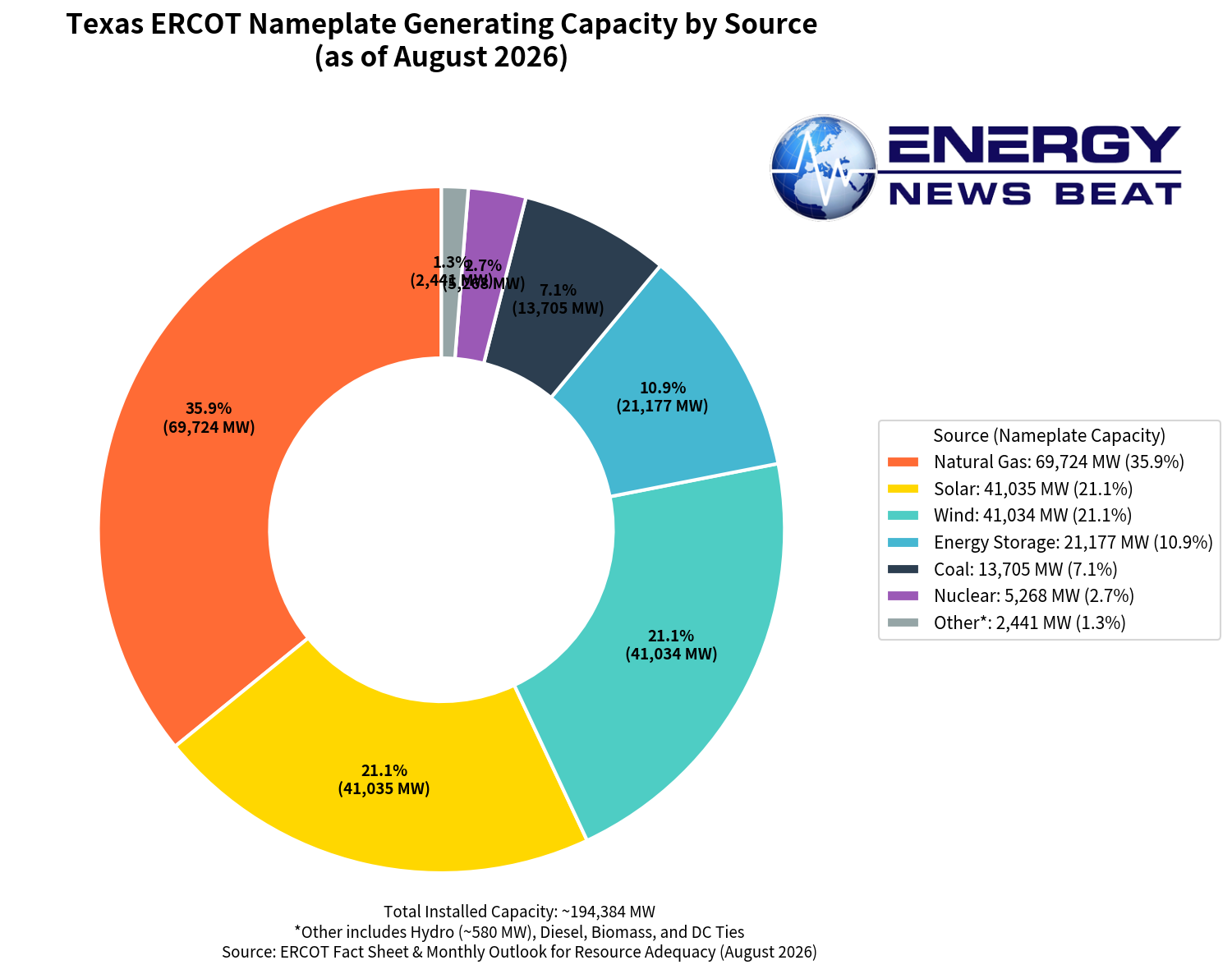
ERCOT’s operational installed generating capacity for summer 2026 stood at roughly 193 GW (based on the Monthly Outlook for Resource Adequacy). Approximate nameplate shares include natural gas around 37–45%, wind near 22–24%, solar about 20% (recently edging past wind at ~41 GW each), storage ~9%, coal ~8%, nuclear ~3%, and smaller shares for hydro and other. The grid has set multiple demand records in 2026, with peaks exceeding 90 GW amid summer heat, while renewables (especially solar) have driven high penetration rates during daylight hours.
The highest peak demand on the ERCOT grid is 91,089 MW, set on July 22, 2026.
This is the current all-time record according to ERCOT’s official Peak Demand Records page (last updated August 21, 2026). It is marked as preliminary/unofficial until final settlements are completed, which is standard for recent records.
Context
- Previous all-time record: 85,508 MW (August 10, 2023).
- Highest August 2026 reading so far: 90,353 MW (August 20, 2026) — still below the July record.
- For demand records, ERCOT uses the integrated system load for the full hour (not instantaneous peaks). Some real-time monitors briefly showed slightly higher instantaneous values (around 91,300 MW), but the official hourly figure stands at 91,089 MW.
- So ERCOT and Texas have overpaid for capacity because wind and solar are intermittent. They have done a good job improving grid resiliency even with the intermittent wind and solar.
- This overpayment for grids lacking resiliency, charged to wind, solar, and storage, has created an imbalanced network and pricing model.
Off-Grid Applications and Power Sources
The estimated 1,800 applications in the ERCOT queue are specifically for grid interconnection; fully off-grid or islanded projects fall outside this process (though they may face other PUCT registration). A parallel boom in behind-the-meter (BTM) and off-grid power for data centers has accelerated to bypass queue delays, with more than 20 GW of BTM capacity announced in Texas in 2024–2025 and additional multi-gigawatt projects (often natural-gas-fired, sometimes paired with batteries, solar, or future nuclear) announced in early 2026. Many of these aim for dedicated private generation rather than primary grid draw.
For the grid-tied applications themselves, most seek substantial power from the ERCOT system. The audit requires disclosure of any on-site generation plans or measures to reduce grid dependence. Co-location with renewables (wind or solar) and net-metering arrangements are emerging, but natural gas remains a common firm-power solution for reliability, both for on-site and broader grid support. The underlying ERCOT mix is diversified but still relies heavily on gas for dispatchable capacity when renewables are low.
A Necessary Reality Check on Build-Out
This audit is a constructive step. Speculative queue inflation has been widely acknowledged: many of the 1,800 projects lack firm financing, end-use customers (leases or offtake), site control, or equipment commitments. ERCOT and industry representatives have stated that a large share is unlikely to materialize. Analysts’ realistic estimates for data-center load that will actually be built are far below the headline 474 GW. BloombergNEF projects only about 1.2 GW of ERCOT data-center additions in the near term (2Q 2026–1Q 2027) and roughly 8 GW of cumulative additions through 2030. Other forecasts range from 10–15 GW (Vistra) to around 30 GW by 2030, with peak system demand projections nearer 120 GW by 2030 in some independent analyses—still substantial growth but manageable with proper sequencing.
By front-loading verification, ERCOT can focus transmission planning and reliability studies on credible projects, reduce the risk of stranded infrastructure investment, and maintain the Batch Zero framework’s goal of orderly, reliability-first interconnection.
Impact on Consumers
The audit prioritizes Texas ratepayers’ reliability and cost protection. Unfiltered interconnection of hundreds of gigawatts of large loads could strain reserves, drive expensive new transmission, and shift costs onto residential and small-business customers. By confirming projects will not unduly burden the grid or local water supplies, requiring transparency on subsidies, and enabling curtailment authority where needed, the process helps keep everyday electricity affordable and available during extreme weather. Short-term delays for some developers are the trade-off for long-term grid stability and avoided rate spikes. ERCOT continues to advance generation and transmission expansions (including gas, solar, storage, and high-voltage lines) to support sustainable growth.
Overall, completing the audit by December positions Texas to capture genuine economic benefits from data centers and AI infrastructure while safeguarding the 27-plus million customers who depend on ERCOT every day.
We need to re-examine how the Levelized Cost of Electricity is calculated to use the Levelized Cost of Energy. We will be putting out more articles on how this will be impactful to consumers.
Appendix: Sources and Links
- Houston Public Media: “ERCOT says it plans to complete governor’s data center audit by December” (Aug. 20, 2026) – https://www.houstonpublicmedia.org/articles/news/energy-environment/2026/08/20/559959/ercot-says-it-plans-to-complete-governors-data-center-audit-by-december/
- ERCOT Batch Zero Verification and Audit PUCT Presentation (Aug. 20, 2026) – https://www.ercot.com/files/docs/2026/08/20/Batch-Zero-Verification-and-Audit-PUCT-Presentation.pdf
- Texas Tribune: “Data center approvals in Texas halted until audits completed” (Aug. 3, 2026) and follow-up “Texas will audit up to 300 projects…” (Aug. 14, 2026)
- POWER Magazine / BloombergNEF coverage of audit impacts and forecasts
- ERCOT Fact Sheet (updated Aug. 2026) and Monthly Outlook for Resource Adequacy (August 2026) – https://www.ercot.com/files/docs/2022/02/08/ERCOT_Fact_Sheet.pdf and related MORA reports
- Reuters: “Texas off-grid power build soars as data centers bridge grid delays” (May 2026)
- Utility Dive, Converge Digest, and Gibson Dunn analyses of queue size, Batch Zero, and realistic build-out estimates
- Additional analyst commentary from Ascend Analytics, Aurora Energy Research, and industry statements cited in contemporaneous reporting
(Note: Queue totals, capacity mixes, and forecasts evolve; figures reflect publicly reported data as of mid-to-late August 2026.)