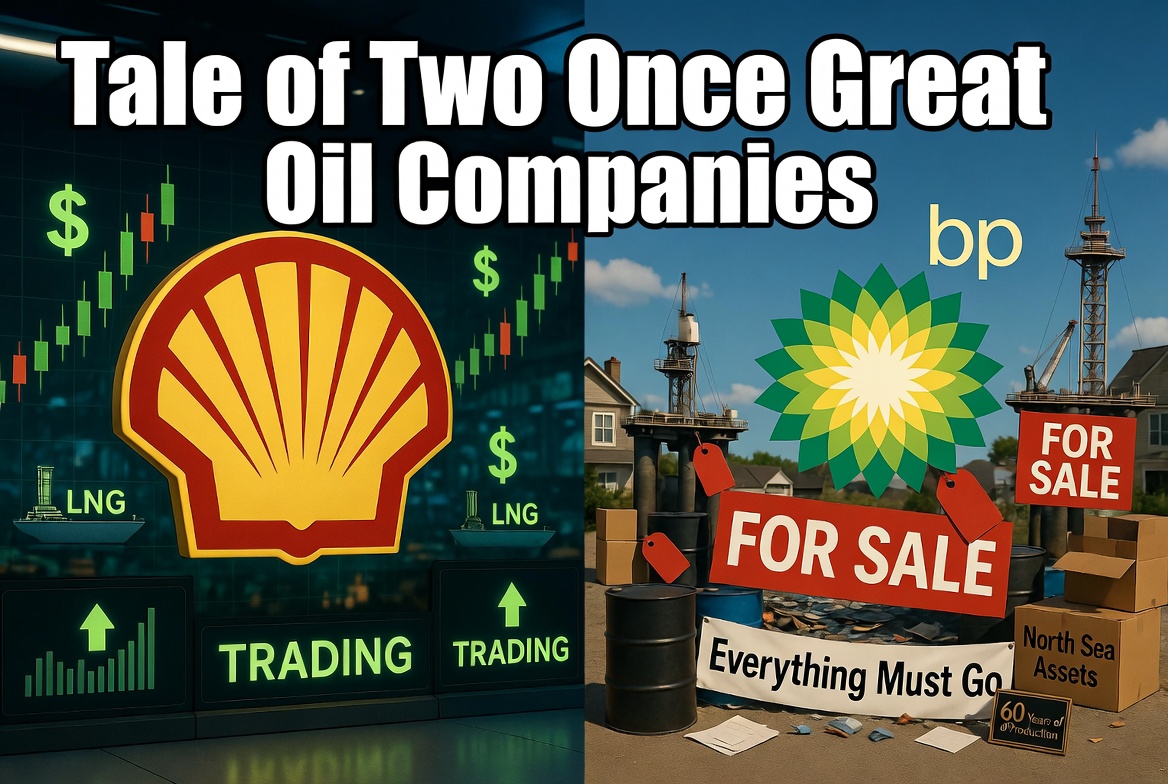
“The Tale of Two UK Oil Companies” could be the title of an old book, movie, or play. But sadly, it is a real-life story of how a once great country is imposing a self-imposed death spiral of deindustrialization and financial collapse. The very same death spiral the Blue / Net Zero crowd in the US is trying to impose on their citizens. Take notes.
Shell and BP, two of Britain’s historic energy giants, are charting sharply divergent paths in 2026. One is aggressively pruning its portfolio and exiting long-held upstream positions under intense fiscal and regulatory pressure. The other is doubling down on trading, optimization and integrated value chains—particularly LNG—while recycling capital away from lower-priority operating assets. Their choices illuminate the harsh realities facing North Sea producers and raise pointed questions about the United Kingdom’s future energy security.
BP’s Exit from the North Sea: Downsizing to Survive
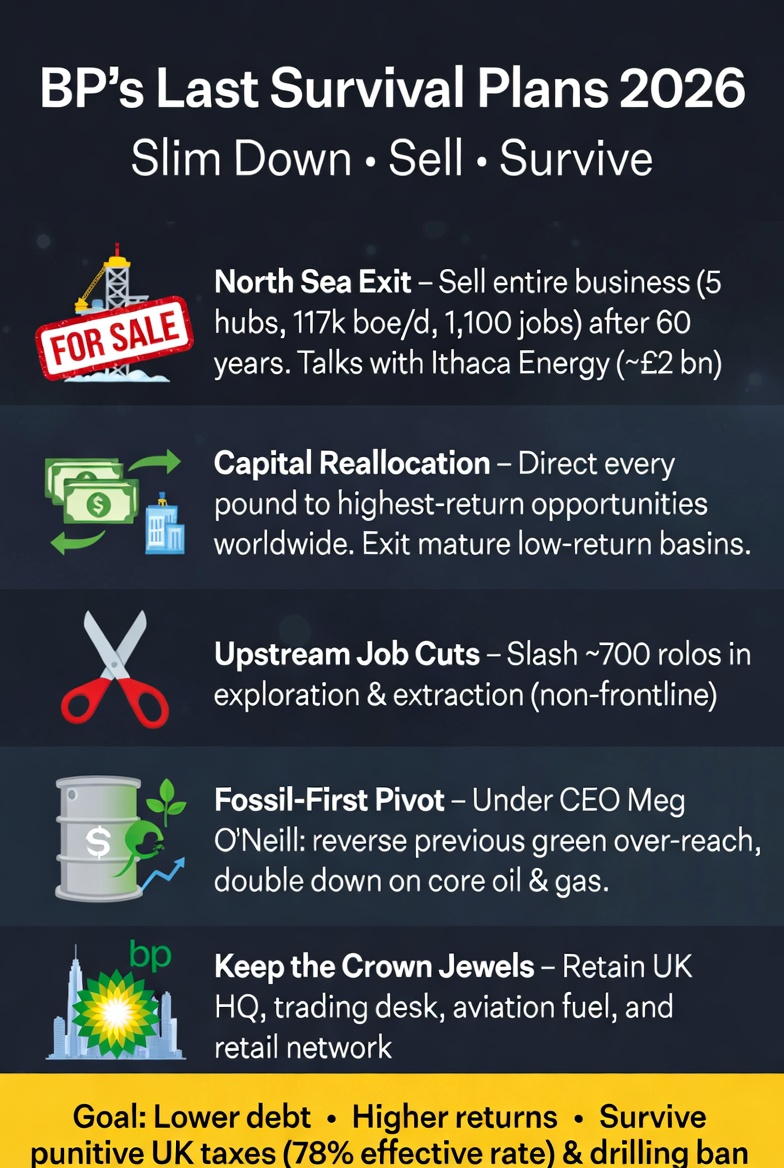
On 31 July 2026, BP confirmed it is putting its entire North Sea business up for sale, ending roughly 60 years of production in the basin. The portfolio includes five production hubs (two in the central North Sea and three west of Shetland). In 2025 it produced about 117,000 barrels of oil equivalent per day and employed around 1,100 people.
Chief Executive Meg O’Neill, who took the helm in April 2025 (or early 2026 depending on reporting), framed the decision clearly: “The North Sea remains integral to the UK’s energy system. However, as we focus our portfolio and direct capital to our highest-value opportunities, we believe our North Sea business will be better positioned as part of another company.” BP will retain its UK headquarters, trading desk, aviation fuel distribution and retail sites. The move forms part of a broader slim-down that also includes cutting hundreds of upstream jobs.
The drivers are well known to the industry. Combined taxation—corporation tax plus the Energy Profits Levy (raised and extended)—reaches an effective rate of around 78%. A ban on new exploration licenses, rooted in Labor’s net-zero commitments and championed by figures such as Ed Miliband, has further chilled investment. Earlier talks with Ithaca Energy over a potential deal worth nearly £2 billion did not conclude, but the formal sale process is now under way. Potential buyers are likely to be independents, private-equity-backed operators or specialist North Sea players comfortable with mature assets and high fiscal takes—precisely the type of companies that have been absorbing assets as the majors retreat.
Who would actually commit significant new capital to the North Sea under the current UK policy mix?
The answer is limited. High taxes, licensing restrictions, policy uncertainty and the long-term trajectory of net-zero rules make greenfield or even major brownfield investment unattractive for most international majors. Smaller operators with lower cost of capital, tax-loss positions or a pure focus on maximizing economic recovery from existing fields remain the most plausible acquirers. The result is a transfer of ownership rather than a surge in investment or production.
Shell’s Pivot: Trading and Integrated LNG over Capital-Intensive Operations
Shell is taking a different route. Rather than a wholesale geographic exit, it is becoming more selective about where it deploys operating capital. A clear recent example is the agreement to sell its BG Cyprus unit (35% stake in the Aphrodite gas field block) to MOL Group for up to $720 million, with completion expected in 2027. Shell’s stated rationale is disciplined capital allocation and strengthening its integrated LNG value chain.
The signal is consistent across Shell’s communications and results: the company wants gas assets that feed its global LNG machine—liquefaction, shipping, trading and optimization—rather than every non-operated upstream position. Integrated Gas continues to deliver strong results; Q2 2026 trading and optimization captured significant additional value, helping offset volume disruptions elsewhere. Shell’s broader strategy emphasizes “more value with less emissions,” growing where it has competitive strengths, and recycling capital from non-core holdings into higher-return opportunities. Trading is not a side activity; it is a core profit engine that allows Shell to extract value from molecules it does not necessarily produce itself.
This approach reduces capital intensity in mature or non-strategic basins while preserving exposure to the global energy system through trading books, long-term contracts and infrastructure that generates flexible margins.
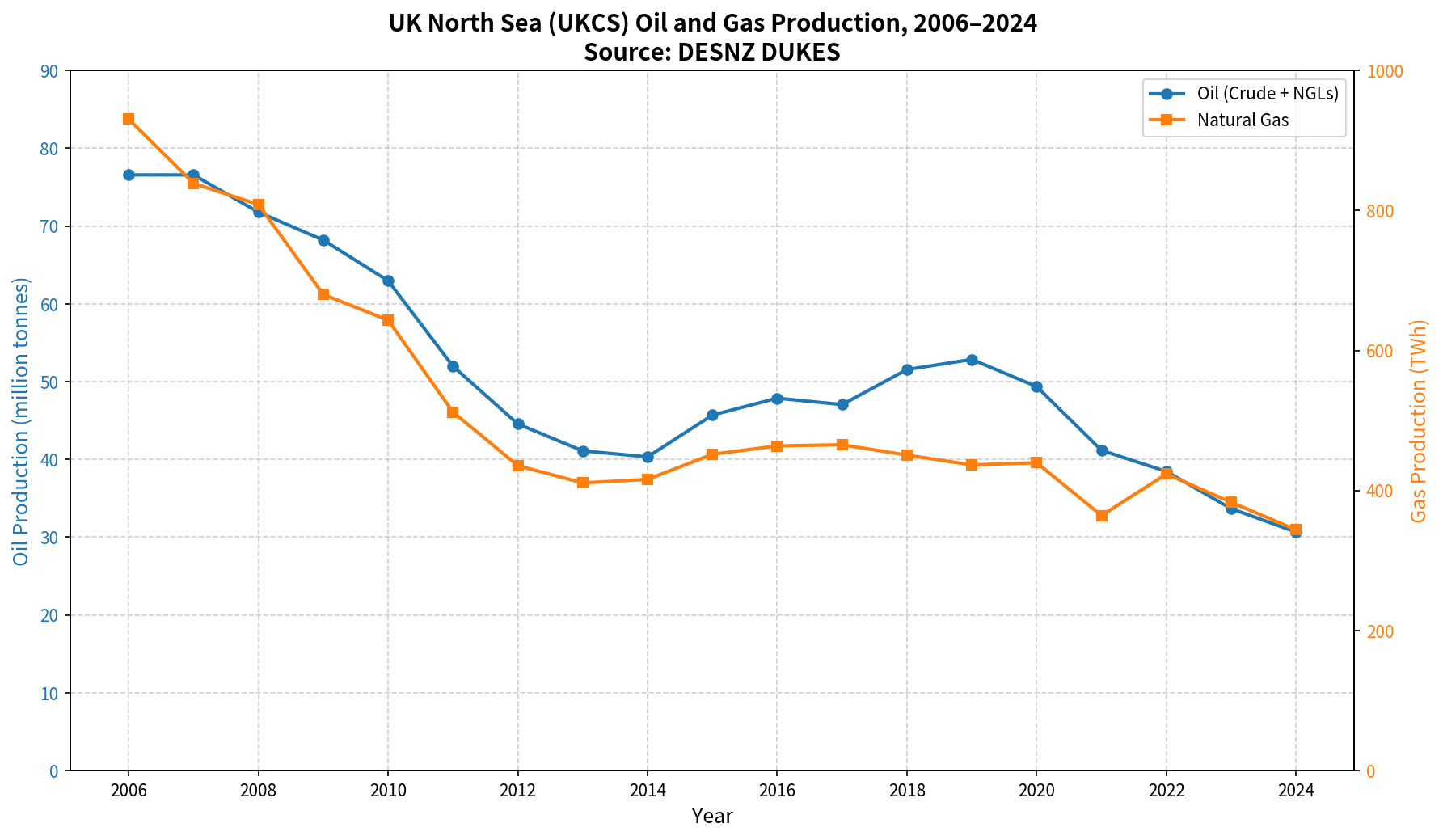
Oil volumes due to the Windfall Profits Taxes and Regulatory Burdens
Raising taxes does not increase tax revenue; it actually decreases the income to the Crown, but they don’t see it that way. Blue States in the US have the same problem. Increasing tax rates actually lowers spendable government money.
What Investors Should Watch
For BP, key indicators include the speed and valuation of the North Sea sale, the success of debt reduction and portfolio simplification under O’Neill, and the quality of the “higher-value” opportunities that receive the redirected capital. Progress on returns, share buy-backs and dividend sustainability will matter more than absolute production volumes.
For Shell, investors should monitor the continued strength of trading and optimization results (especially in Integrated Gas and oil products), growth in LNG sales volumes and the returns generated from capital recycled out of non-core upstream stakes. Portfolio metrics that show rising returns on average capital employed and disciplined free-cash-flow conversion are central. Both companies’ ability to navigate commodity-price volatility—recently amplified by Middle East disruptions—will test the resilience of their respective models.
Implications for UK Energy Security
The contrasting strategies do not paint a reassuring picture for UK energy security. Domestic North Sea production has been in long-term decline; remaining reserves and contingent resources still exist, but policy and fiscal settings have deterred the investment needed to slow that decline. As majors such as BP exit and others become more selective, the UK’s reliance on imports is projected to rise sharply—gas import dependence was already expected to climb significantly through the 2030s.
Greater import dependence exposes the country to geopolitical shocks, shipping disruptions and price spikes, exactly the risks highlighted by recent Middle East tensions. While new ownership of existing fields may keep some production flowing, it is unlikely to reverse the broader trend without a material improvement in the investment climate—lower effective tax rates, clarity on licensing and a more pragmatic recognition that oil and gas will remain part of the energy mix for years. Recent comments from Prime Minister Andy Burnham about a “pragmatic approach” and Energy Secretary Miatta Fahnbulleh’s emphasis on the North Sea as a “vital national asset” hint at possible shifts, but capital markets move faster than Whitehall.
BP’s departure after six decades and Shell’s preference for trading over heavy operating capital in less-favored assets are rational corporate responses.
For the UK, they are a warning: without competitive conditions, the country’s indigenous energy base will continue to shrink, and energy security will increasingly be outsourced.
Blue States should take note of the horrific energy policies, companies leaving or failing in the UK, EU and Germany. The once great poster children of the Green Energy Movement are going bankrupt at an incredible speed. Just don’t have any assets in a Blue State when they go bankrupt. – Just saying.
Appendix: Sources and Links
All factual claims in the article are drawn from the above publicly reported sources as of 31 July 2026.