Hat tip to Claire Coutinho (then Energy Secretary, now Shadow Secretary of State for Energy) and the think tank Onward with modeling by Transira Energy. This article was first published on the Energy News Beat Substack.
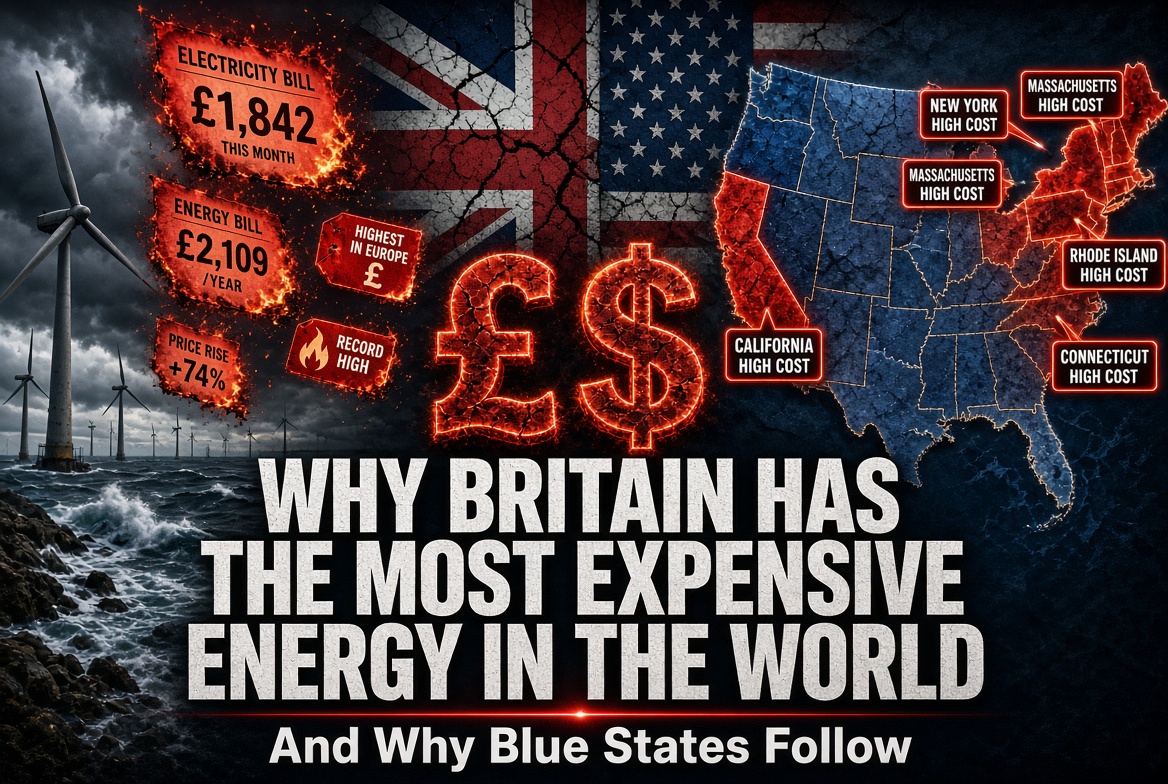
Britain’s electricity prices rank among the highest in the developed world—frequently the highest for industrial users among IEA countries and near the top for households. This is not primarily bad luck with global gas markets or geography alone. It stems from deliberate policy choices that prioritized rapid power-sector decarbonization through massive deployment of intermittent wind and solar, while understating the full system costs those technologies impose.
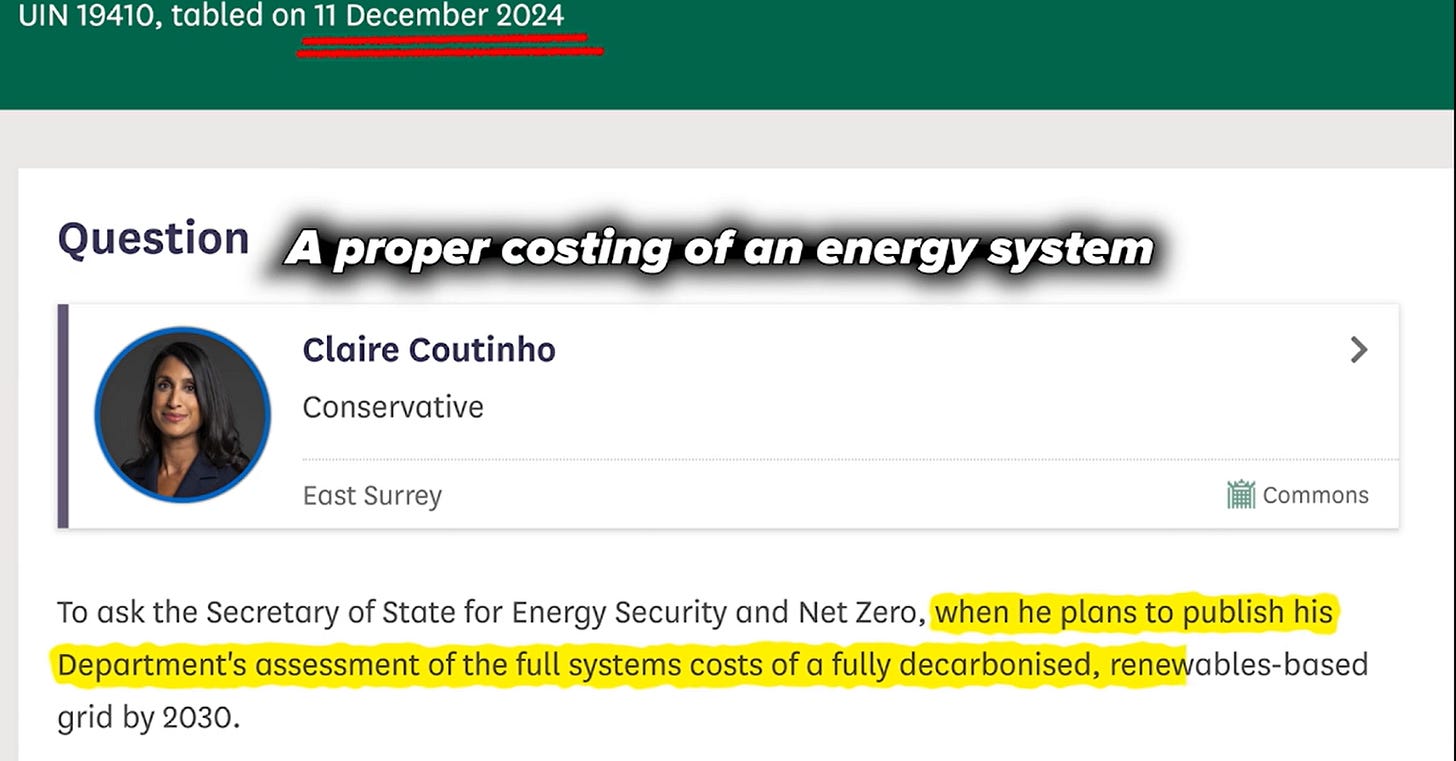
A detailed full-system analysis, originally commissioned by Claire Coutinho (then Energy Secretary, now Shadow Secretary of State for Energy) and completed by the think tank Onward with modeling by Transira Energy after the subsequent government canceled the work, quantifies the problem.
The results are stark: prioritizing firm power could save consumers over £320 billion in cumulative system costs between roughly 2030 and 2050—equivalent to around £540 per household per year—while still delivering a grid that is nearly 80% clean. Roughly half the savings come from needing far less network infrastructure (pylons, cables, and grid reinforcements). Other major savings arise from lower wholesale prices, reduced balancing and ancillary services costs, and lower subsidies. Electricity costs under the cheaper pathway would be about a fifth lower by 2035 and nearly a third lower by 2050 relative to the high-intermittency path.
How Too Much Wind and Solar Drives Catastrophic Price Increases
Wind and solar have near-zero marginal fuel costs and can appear cheap on a simple levelized cost of energy (LCOE) basis. But high penetrations create large “system costs” that are socialized onto consumer bills rather than fully internalized by the generators. These include:Overbuilding and low effective capacity: Intermittent sources require substantial overcapacity because of low and weather-dependent capacity factors. Modeling shows the need for large volumes of wind and solar (often well over 100 GW in high-renewables scenarios) to meet far lower average demand, while firm backup (gas plants running at very low capacity factors) must still be retained for calm, dark periods.
Grid and transmission expansion: Remote wind (especially offshore and Scottish) and solar require expensive new transmission. Network costs form a large share of the modeled savings when firm power is prioritized instead.
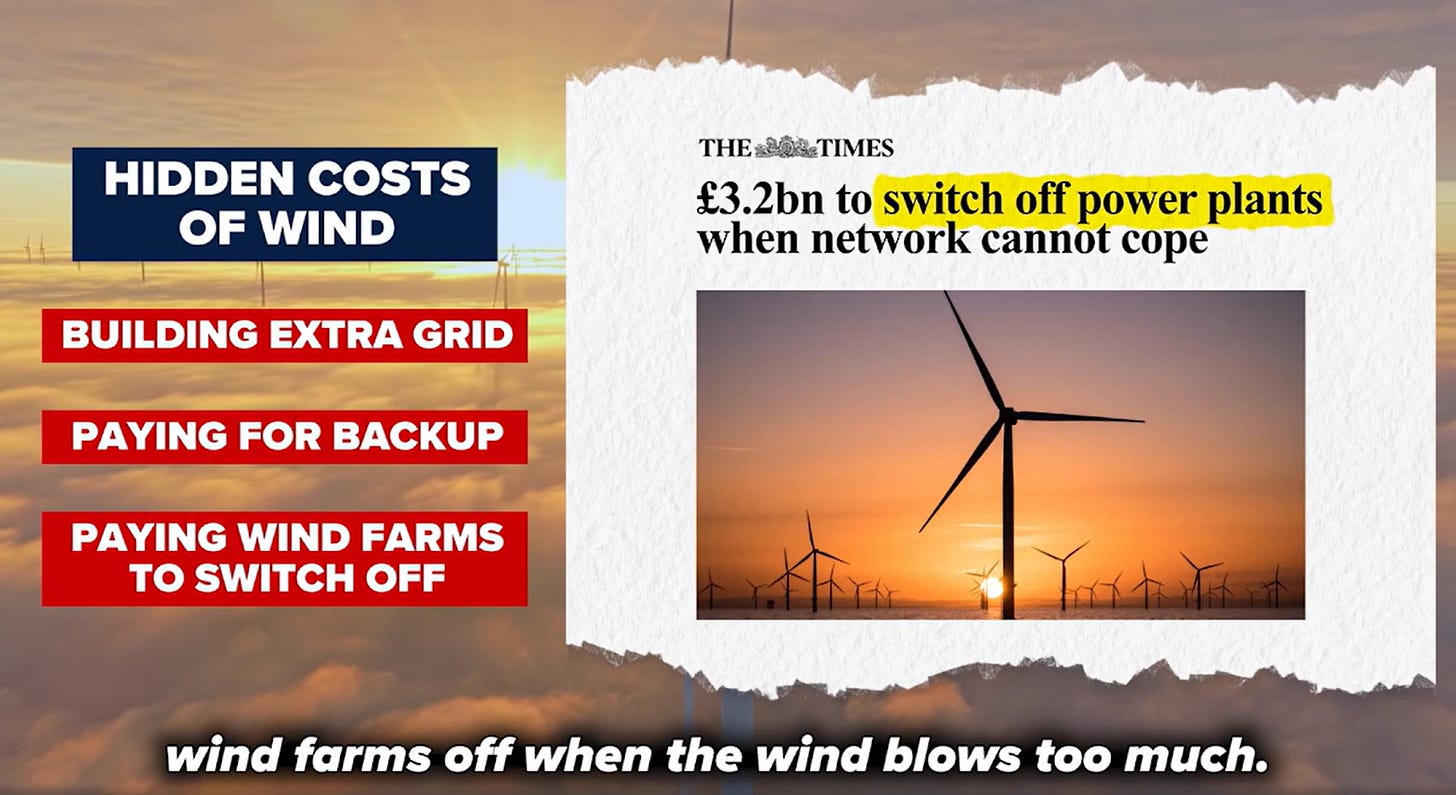
Curtailment and constraint payments: When wind or solar output exceeds demand or local grid capacity, operators are paid to switch generation off. These costs have already reached hundreds of millions to billions annually and are projected to rise sharply (examples cited in parliamentary debate include multi-billion figures by 2030).
Balancing, reserves, and backup: Volatility requires more real-time balancing services, frequency response, and underutilized firm capacity. Storage remains limited relative to multi-day or seasonal lulls. The full system cost of offshore wind, once these extras are added, has been argued to approach figures far higher than headline LCOE claims (one illustration placed it near £230/MWh in the context of prevailing wholesale prices around £97/MWh).
Policy levies and market design: Carbon pricing on electricity, legacy renewable obligation subsidies, Contracts for Difference strike prices that have risen after earlier declines, and recovery of network/balancing costs primarily from demand all inflate bills. Fixed costs rise even as overall electricity consumption has fallen in recent decades, creating a feedback loop of higher unit prices.
Power generation accounts for only about 10% of UK emissions (already down dramatically since 1990). The remaining 90% lie in heating, transport, and industry. Making electricity expensive undermines the very electrification (heat pumps, EVs) needed for deeper decarbonization and raises living costs and industrial competitiveness. The Onward/Transira work shows that an 80%-clean firm-power pathway still delivers large emissions reductions while avoiding the extreme costs of squeezing the last percentage points of carbon out of the power sector first.
Claire Coutinho has repeatedly highlighted that the previous full-system costing work was canceled, that strike prices in recent auctions have not delivered the promised continuous cost declines, and that overbuilding intermittency locks in higher bills for decades through long-term contracts. Official grid-operator and other analyses have also flagged higher system costs from rushing Net Zero power targets.
Gas price spikes after 2021 and the UK’s marginal pricing system (where gas often sets the wholesale price) matter, but they interact with and are amplified by the policy-driven system architecture. Countries with higher shares of nuclear or more flexible firm capacity have generally faced lower structural pressures.
Why Blue States Follow the Same Path
A parallel pattern appears in the United States. States with aggressive renewable portfolio standards, net-zero electricity mandates, rapid coal/nuclear retirements without adequate firm replacement, expansive net metering, and heavy policy-driven grid investments consistently post the highest retail electricity rates.
Recent EIA-based rankings of residential average rates (2025–2026 data) show the most expensive states are dominated by those with strong progressive energy policies:
- Hawaii (often 40–50+ ¢/kWh; isolated island grid plus oil dependence and renewable push)
- California (typically 30–35+ ¢/kWh)
- Massachusetts
- Rhode Island
- Connecticut (or close variants including New York or Maine depending on the exact month and all-sectors vs. residential focus)
These top positions are occupied overwhelmingly by reliably blue or Democrat-leaning states. Analyses from groups such as the Institute for Energy Research note that a large majority of states with electricity prices above the national average are blue, while the cheapest states are predominantly red and more reliant on domestic fossil fuels, nuclear, or hydro, with fewer intermittency mandates.
California’s combination of renewable mandates, wildfire-related grid hardening, nuclear closures, and carbon programs has driven rates well above the national average. Northeastern states face similar pressures from ISO-New England market dynamics, capacity costs, and offshore wind ambitions.
The common thread with Britain is the prioritization of intermittent generation shares and rapid decarbonization targets over system-cost realism and firm capacity. Both produce higher fixed costs (networks, balancing, underused backup), policy levies, and reduced industrial competitiveness—exactly the outcome the Onward modeling quantifies for the UK.
Making electricity cheap is the prerequisite for successful electrification, economic growth (including data centers and AI), and sustained emissions reductions. Prioritizing firm, reliable, lower-system-cost power—nuclear scaled up, gas as flexible bridge where needed, and renewables in roles that do not impose runaway integration costs—offers a more pragmatic route.
The British experience, documented in the Coutinho-linked analysis, is a cautionary tale that blue-state energy policies are already partially replaying.
Winning the Midterms will Require Two Things
Energy Policies matter, and we have the Single Best Energy Secretary in the history of the United States, but he can’t do this on his own. Just like Ed Milliband canceling a study he did not like, we cannot assume that Blue and Rino’s energy policies will do anything different.
Expect higher electricity prices and more blackouts as we go further down the Net Zero path. We all need to take voting seriously, and “Energy Security Starts at Home” will become increasingly important in the next few months.
When you have JPM and several other major Utilities warning that we are facing problems, don’t take my word for it; prepare for an unstable grid situation.
I am reaching out to Claire Coutinho, The Nemeth Report (Dr. Tammy Nemeth) and Kathryn Porter to see if we can schedule a podcast. This is a Cross Pond Issue that has all of the same problems, and we need to know how to articulate the real problems and costs of energy rather than letting elected officials put in systems that cost more money and provide unstable power.
How stable is your grid in your state today?
Do you have a backup generator?
How many days can you last without water?
How is your food Supply?
Please let me know how you are set up, as this could be important.
Thanks again to all of our patrons, sponsors, and paid subscribers. You mean the world to us!