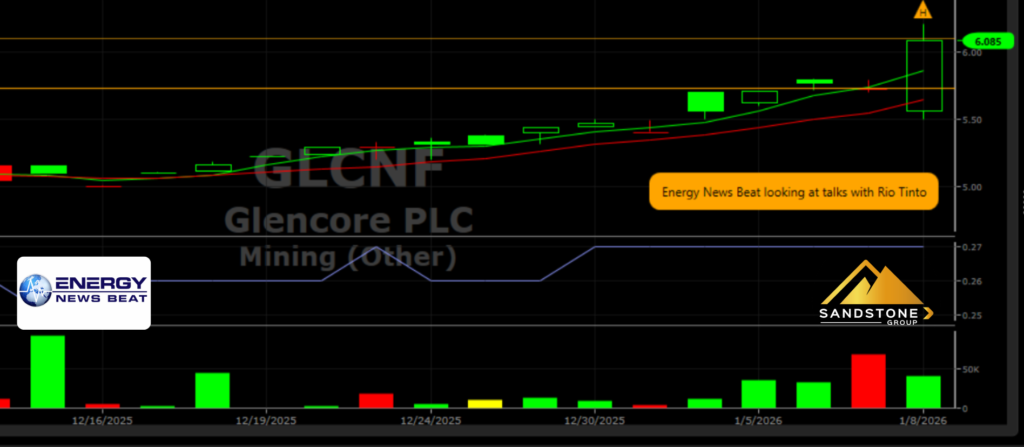
In a move that could reshape the global mining landscape, Rio Tinto and Glencore have reignited merger discussions, aiming to create a behemoth valued at over $200 billion, the world’s largest mining company.
The talks, which resumed at the end of 2025, come amid surging demand for critical minerals like copper, driven by the energy transition and electrification trends.
While still in preliminary stages, with Rio Tinto potentially acquiring Glencore through an all-share deal, the proposal has already sent shockwaves through markets—Glencore’s shares surged up to 10% on the news.
For the Energy News Beat audience, this potential union of two mining titans warrants a closer look at their recent financial performance, the synergies on offer, and what it means for investors and consumers alike.
Recent Earnings: A Tale of Resilience Amid Volatility
Both companies operate in a cyclical industry battered by fluctuating commodity prices, supply chain disruptions, and geopolitical tensions. Their latest 2025 half-year results provide a snapshot of their health heading into these talks. Rio Tinto, a leader in iron ore, aluminum, and copper, reported solid performance in the first half of 2025. Underlying EBITDA stood at $11.5 billion, supported by an operating cash flow of $6.9 billion.
Copper equivalent production rose 6% year-over-year, reflecting ramp-ups at key assets like Oyu Tolgoi in Mongolia. The company remains on track to meet its full-year 2025 production guidance, with upward revisions for bauxite output in the third quarter.
Rio Tinto’s focus on operational discipline and capital efficiency has paid off, with net earnings bolstered by stable iron ore shipments from its Pilbara operations (around 160 million tonnes in H1) and growing copper volumes. Dividends remained attractive, with an interim payout declared, underscoring its shareholder-friendly approach. Glencore, known for its diversified portfolio spanning metals, energy, and a robust trading arm, faced headwinds in H1 2025. Adjusted EBITDA fell 14% to $5.4 billion, primarily due to weaker coal prices and timing issues in copper volumes.
Revenue held steady at $117.4 billion, while funds from operations dropped 22% to $3.1 billion. The company posted a net loss of $655 million attributable to equity holders, though pre-significant items net income was $0.6 billion. Operationally, copper production in Q3 jumped 36% quarter-over-quarter to higher grades at assets like KCC in the Democratic Republic of Congo, setting up a stronger H2 with a 40/60 split in copper output.
Glencore identified $1 billion in recurring cost savings by end-2026 and announced $3.2 billion in shareholder returns, including buybacks, signaling confidence despite a net debt rise to $14.5 billion. These results highlight complementary strengths: Rio Tinto’s stable, high-margin iron ore business contrasts with Glencore’s volatile but high-potential trading and coal segments. In a merger scenario, this blend could provide ballast against market swings.
Potential Synergies: Unlocking Value in a Scarcity-Driven Market
A Rio Tinto-Glencore tie-up isn’t just about size—it’s about strategic fit in an era of mineral scarcity. Both companies are heavyweights in copper, a metal critical for EVs, renewables, and AI infrastructure, where supply struggles to keep pace with demand.
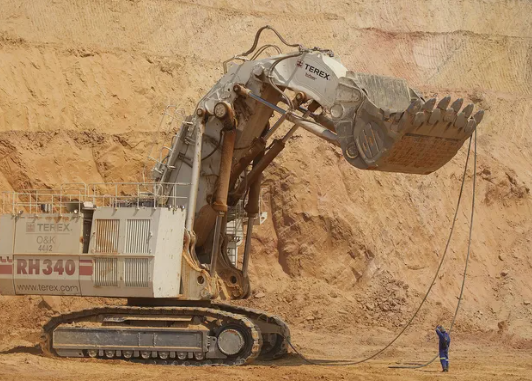
Combined, they would control significant copper production (Rio’s ~600kt annual output plus Glencore’s ~1Mt), creating a powerhouse capable of accelerating projects like Rio’s Oyu Tolgoi and Glencore’s African assets.
Synergies could be substantial, particularly in marketing and trading—Glencore’s world-class trading division could optimize Rio Tinto’s volumes, potentially adding billions in EBITDA through better pricing and logistics.
Cost savings from overlapping operations in zinc, nickel, and other metals might reach hundreds of millions annually via streamlined supply chains and shared technology. Rio Tinto has signaled openness to retaining Glencore’s coal assets, despite its own pivot away from fossil fuels, which could diversify energy exposure amid transitioning markets.
Overall, analysts point to this as a response to structural constraints: when organic growth is limited by permitting delays and declining grades, mergers offer a faster path to scale.
However, challenges loom. ESG risks are prominent—Glencore’s coal-heavy portfolio could clash with Rio Tinto’s decarbonization goals, potentially alienating investors focused on sustainability.
Antitrust scrutiny is a major hurdle; regulators in the EU, Australia, and China may balk at increased concentration in copper and iron ore, echoing the 2014 rejection of a similar approach due to competition concerns.
Implications for Investors: Opportunities and RisksFor investors, this merger represents a bet on commodity supercycles. A combined entity could deliver enhanced dividends and buybacks, backed by diversified cash flows—Glencore’s trading arm alone generates consistent earnings in volatile times. Market reactions suggest value creation: Glencore’s premium valuation in the deal could boost shareholder returns, while Rio Tinto gains exposure to high-growth areas like cobalt and zinc.
Key watchpoints include deal structure—an all-share merger minimizes cash outlay but dilutes existing holders. Investors should monitor regulatory timelines; under UK rules, Rio Tinto has until February 5, 2026, to formalize an offer.
Antitrust remedies, like asset divestitures, could erode synergies. Broader risks include commodity price drops (e.g., if China’s economy slows) or execution failures in integrating vast operations. On the upside, copper scarcity could drive long-term upside, with the merged firm positioned as a “must-own” for energy transition plays.
Implications for Consumers: Pricing Power vs. Supply Stability
Consumers—ranging from manufacturers to end-users of metals and energy—could feel ripple effects. Greater market concentration might lead to higher prices for copper and other commodities, squeezing industries like automotive and electronics amid already tight supplies. If the merger reduces competition, antitrust probes could force concessions, such as supply guarantees or price caps.
On the positive side, a stronger entity might invest more in new mines, stabilizing global supply chains and mitigating shortages that have plagued the sector. For energy consumers, retaining Glencore’s coal could ensure short-term affordability in regions reliant on it, even as the world shifts to greener alternatives.
What to watch: Regulatory outcomes will dictate price impacts—approvals with conditions could preserve competition, while a blocked deal might spur alternative consolidations.
Conclusion: A Defining Moment for Mining
The Rio Tinto-Glencore merger talks underscore the mining industry’s pivot toward consolidation in a resource-constrained world. While synergies in copper and trading promise efficiencies, investors and consumers must brace for regulatory battles and ESG trade-offs. As details emerge, keep an eye on production ramps, cost-saving deliveries, and commodity trends—these will determine if this mega-deal unlocks value or fizzles like past attempts. For now, it’s a high-stakes play in the energy transition game.
Sources: reuters.com, VectorVest.com Charting, discoveryalert.com.au, glencore.com