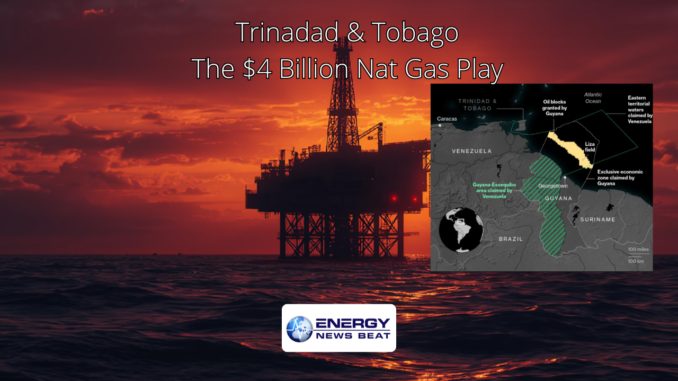
In the ever-evolving landscape of global energy, Trinidad & Tobago (T&T) is emerging as a pivotal player in the Caribbean natural gas sector. With declining domestic production threatening the viability of its Atlantic LNG facility—one of the world’s key export hubs—a potential $4 billion opportunity is on the horizon. This stems from cross-border gas fields shared with Venezuela, where major energy giants like BP and Shell are pushing for U.S. sanctions clearances to unlock trillions of cubic feet of reserves. Drawing from recent insights by commodity trader Jack Prandelli and ongoing developments, this article explores the play, the companies positioned to capitalize, and key considerations for investors eyeing this high-stakes arena.
The Geopolitical and Energy Backdrop
T&T’s natural gas production has been in a structural decline, dropping from peak levels and straining feedstock for Atlantic LNG, which supplies around 10% of global LNG to markets in Europe and Asia.
Without fresh supplies by 2026–2027, the facility risks further curtailments, potentially costing billions in export revenue.
Enter the cross-border fields with Venezuela: Loran-Manatee and Cocuina-Manakin, frozen by U.S. sanctions until recent shifts.In a significant move, BP and Shell are formally seeking U.S. Office of Foreign Assets Control (OFAC) licenses to develop these resources.
Shell targets the Loran-Manatee field, holding an estimated 10 trillion cubic feet (tcf) of gas—7.3 tcf on Venezuela’s side and 2.7 tcf in T&T waters.
BP focuses on the smaller but strategic Cocuina-Manakin project, with about 1 tcf across the border.
Additionally, Shell’s Dragon field in Venezuelan waters, licensed in October 2025, is eyed for a late 2027 startup, potentially delivering 185 million cubic feet per day (mmcfd) initially to T&T’s infrastructure.
The catalyst? Recent political changes in Venezuela, including the fall of Nicolás Maduro in late 2025, have opened doors for renewed energy cooperation.
U.S. policy shifts, including license grants and revocations (e.g., axed in April 2025 but reinstated for Dragon), reflect aligning geopolitics and energy needs.
If approved, these fields could supply 4–5 billion cubic feet per day (bcfd) of new feedgas, revitalizing Atlantic LNG and bolstering T&T’s economy through increased exports.
The $4 billion figure likely references the combined investment potential and revenue uplift from these developments, positioning the Caribbean as a renewed gas hub amid global demand for cleaner fuels.
Companies Poised to Capitalize on the Caribbean Nat Gas Play
Several firms stand to gain from this resurgence, ranging from majors with direct stakes to service providers and regional players. Here’s a breakdown:
Shell (SHEL): As the lead on Loran-Manatee and Dragon, Shell could see substantial production boosts. The company has lobbied intensely for sanctions relief and plans to pipe gas to T&T for processing.
With ownership in Atlantic LNG trains (up to 46% in some), Shell benefits from enhanced throughput and LNG exports.
BP (BP): Focused on Cocuina-Manakin, BP maintains interest despite license fluctuations, leveraging its strong T&T presence (34% stake in Atlantic LNG).
The firm’s experience in cross-border projects positions it for quick ramp-up post-approval.
National Gas Company of Trinidad and Tobago (NGC): As a state-owned entity and partner in Dragon (with Shell) and potentially others, NGC gains from feedstock security and revenue shares.
It also holds stakes in Atlantic LNG, amplifying domestic economic benefits.
Other Majors and Service Providers: Chevron (CVX) has lobbied on Venezuelan energy and could expand into gas, given its oil operations there.
BHP and Woodside Energy operate in T&T’s Calypso field, potentially tying into regional infrastructure.
Service firms like Halliburton (HAL) or Schlumberger (SLB) may secure contracts for drilling and development. Additionally, refiners like Phillips 66 (PSX) and PBF Energy (PBF) could benefit from increased gas flows impacting downstream markets.
Chinese Investment Corporation (CIC), with Atlantic LNG stakes, stands to gain from revived exports.
Overlooked Winners: Mid-cap industrials with infrastructure contracts could see recurring revenue. For instance, companies supplying pipelines or LNG tech in the region might capture 45% growth in production volumes through 2040, trading at discounts despite signed deals.
(Note: Specific names often emerge in specialized reports like Prandelli’s Substack.)
Neighboring Guyana’s oil boom (led by ExxonMobil) indirectly supports the Caribbean energy ecosystem, but T&T’s gas focus remains distinct.
With Guyana Right Next Door
🚨 GUYANA IS BECOMING A 1.5 MILLION BPD OIL STATE 🛢️🔥
This is one of the fastest oil supply expansions on Earth.
Production jumps from near zero to 1.5 mb/d by 2029#GUYANA rivals mid-sized #OPEC producers within a decade
Why this is a big deal?
• New low-cost, light sweet… pic.twitter.com/hKdxqNBh6o— Jack Prandelli (@jackprandelli) January 28, 2026
What Investors Should Look For
This play offers upside but carries risks—here’s a guide for due diligence:
|
Factor
|
Key Considerations
|
Why It Matters
|
|---|---|---|
|
Regulatory Approvals
|
Monitor U.S. OFAC licenses and Venezuelan agreements; recent grants (e.g., Dragon in 2025) signal progress, but revocations highlight volatility. |
Sanctions and politics drive access; post-Maduro stability could accelerate deals. naturalgasintel.com
|
|
Production Timelines & Reserves
|
Expect starts like Dragon in late 2027; verify reserve estimates (e.g., 10 tcf for Loran-Manatee) via company filings.
|
Delays erode value; confirmed volumes ensure long-term cash flows.
|
|
Global LNG Demand & Prices
|
Track European/Asian demand amid energy transitions; nat gas prices above $3/MMBtu support profitability.
|
High demand boosts export revenues; oversupply from U.S./Qatar could pressure margins.
|
|
Partnerships & Costs
|
Look for joint ventures (e.g., Shell-NGC) and capex estimates—$4B could cover development.
|
Strong partners mitigate risks; low costs enhance returns in a competitive basin.
|
|
Risks: Geopolitical & Environmental
|
Assess Venezuela’s post-Maduro governance; environmental regs in T&T could add hurdles.
|
Instability or policy shifts (e.g., U.S. elections) might halt projects; ESG scrutiny impacts funding.
|
|
Valuation Metrics
|
Favor stocks with low P/E ratios, strong balance sheets, and dividend yields; watch for 40% discounts in service plays.
|
Undervalued assets offer upside; diversify beyond majors for higher growth potential.
|
For investors, this isn’t a frontier gamble—it’s leveraging known reserves with policy tailwinds. However, patience is key, as timelines stretch to 2027+.
Sources: theenergynewsbeat.substack.com,
Get your CEO on the podcast: https://sandstoneassetmgmt.com/media/
Is oil and gas right for your portfolio? https://sandstoneassetmgmt.com/invest-in-oil-and-gas/