


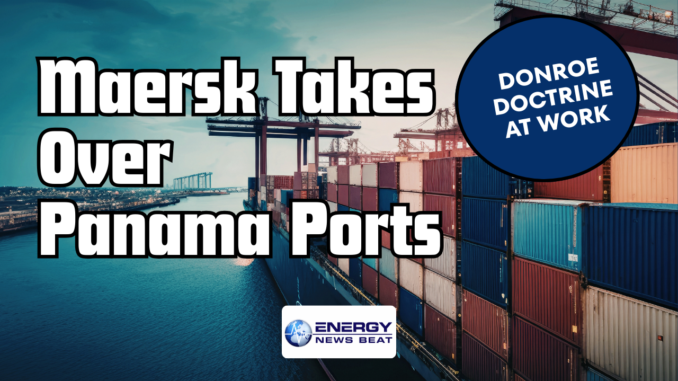
In a move that echoes the historical tenets of the Monroe Doctrine—asserting U.S. influence in the Western Hemisphere—the Danish shipping giant A.P. Møller-Maersk A/S has stepped in to temporarily operate two key ports at the entrances to the Panama Canal. This development follows a Panamanian Supreme Court ruling that annulled the long-standing concession held by Panama Ports Company (PPC), a subsidiary of Hong Kong-based CK Hutchison Holdings. The ports in question, Balboa on the Pacific side and Cristobal on the Atlantic, handle significant global trade volumes, and the shift raises questions about geopolitical maneuvering, including potential links to U.S. interests in Greenland and broader implications for global supply chains.
The announcement came on January 30, 2026, from the Panama Maritime Authority (AMP), which designated Maersk’s subsidiary, APM Terminals, as the temporary administrator to ensure operational continuity.
The court’s decision deemed the original 1997 concession and its 2021 renewal unconstitutional, citing failures by PPC to remit approximately $1.2 billion owed to the Panamanian state.
Panamanian President José Raúl Mulino emphasized that the transition would occur without disrupting canal operations, which facilitate about 5% of global trade and 40% of U.S. container traffic.
PPC, controlled by Hong Kong tycoon Li Ka-shing’s conglomerate, has contested the ruling as lacking legal basis and warned of potential job losses for thousands of Panamanians.
This takeover arrives amid heightened U.S. rhetoric under President Donald Trump, who has repeatedly expressed desires to reclaim influence over the Panama Canal, claiming it was under effective Chinese control through PPC.
The U.S. government welcomed the court’s decision, viewing it as a step toward reducing foreign influence in a strategically vital waterway.
In contrast, China’s foreign ministry vowed to safeguard the rights of its companies, highlighting escalating tensions in U.S.-China relations over Latin American infrastructure.
A Quid Pro Quo? Linking Panama to Greenland
Speculation has swirled around a possible quid pro quo between the U.S. and Denmark, Maersk’s home country. Just days before the Panama announcement, on January 22, 2026, President Trump revealed a “framework of a future deal” regarding Greenland, a Danish autonomous territory rich in rare earth minerals and strategically positioned for Arctic trade routes.
Trump has long advocated for the U.S. acquisition of Greenland, citing national security needs, and has employed tactics like tariff threats on Denmark and other European nations to push negotiations.
Although Trump initially refused to rule out military force, he later backed away from such rhetoric during the World Economic Forum in Davos, opting instead for diplomatic channels.
The emerging framework appears to focus on enhancing U.S. military access rather than full sovereignty transfer. It includes updating the 1951 Defense of Greenland Agreement to create sovereign U.S. enclaves for bases, restricting Russian and Chinese activities in the Arctic, and boosting investments in Greenland’s infrastructure.
Danish and Greenlandic officials have firmly rejected outright sale but are open to security and economic collaborations.
Unverified reports and social media commentary, including a widely shared post by journalist Ann Vandersteel, suggest incentives like $100,000 payments to Greenland’s roughly 56,000 residents could sweeten the deal, alongside U.S. gains in rare earth mining for AI, batteries, and renewable energy technologies.
While no official sources confirm a direct Panama-Greenland linkage, the timing is provocative. Maersk, a publicly traded but family-controlled Danish entity (via the Møller family), could benefit from U.S. goodwill in Panama as Denmark navigates Greenland concessions. This aligns with Monroe Doctrine principles, where the U.S. seeks to limit non-Western Hemisphere powers’ influence in the Americas, potentially in exchange for Arctic advantages.
Impacts on Key Stakeholders
China and the City of London Banking Interests
China faces a significant setback with the loss of PPC’s concessions, as CK Hutchison’s operations provided Beijing with indirect leverage over a critical chokepoint in global shipping. Analysts note that this could deter further Chinese investments in Latin American infrastructure, especially under U.S. pressure.
The move disrupts China’s Belt and Road Initiative ambitions in the region, potentially increasing shipping costs and delays for Chinese exports to the U.S. East Coast.
The “Bank of London” reference is likely alluding to the City of London’s financial cabal, as speculated in some circles, and may stem from broader conspiracy narratives tying global banking to colonial-era influences. CK Hutchison has ties to international finance, and a proposed 2025 deal to sell ports (including Panama’s) to a BlackRock-led consortium fell through amid geopolitical scrutiny.
If London-based investors were involved, this annulment could signal a loss for Anglo-American financial networks favoring Chinese partnerships, though evidence remains circumstantial.
Investors
For energy and shipping investors, this shift presents mixed opportunities. Maersk’s stock (MAERSK B on the Copenhagen Stock Exchange) could see short-term gains from expanded operations in a high-traffic zone, bolstering its global terminal portfolio. However, the temporary nature introduces uncertainty—Panama plans to rebid the concessions under terms favorable to the state.
CK Hutchison (0001.HK) shares may dip due to revenue loss, estimated at millions annually from the ports.On the Greenland side, a U.S.-backed deal could unlock rare earth investments, benefiting miners like Greenland Minerals (GGG.AX) or U.S. firms eyeing Arctic resources. Energy investors should watch for increased U.S. funding in Greenland’s hydropower and mineral extraction, potentially reducing reliance on Chinese-dominated supply chains. Overall, volatility in shipping ETFs (e.g., SEA) and commodity funds tied to rare earths (REMX) is likely as markets digest these geopolitical ripples.
Greenland
Greenland stands to gain economically from any deal, with potential U.S. investments in infrastructure, jobs, and resource development. However, sovereignty concerns loom large—polls show minimal support for U.S. annexation, with most favoring independence from Denmark.
Environmental risks from expanded mining could exacerbate climate vulnerabilities in the melting Arctic, while per-resident payouts (if materialized) might provide immediate relief but at the cost of long-term autonomy.
Panama
Panama benefits from reclaiming control, potentially negotiating better terms in future concessions, and addressing unpaid dues. Yet, the abrupt change risks short-term disruptions and legal battles with CK Hutchison.
Economically, the canal’s revenue (a major GDP contributor) remains secure, but foreign investor confidence may wane if perceived as U.S.-influenced.
United States National Security
This development strengthens U.S. security by diminishing Chinese presence near a vital trade artery, aligning with efforts to secure supply chains amid tensions over Taiwan and the South China Sea. Combined with Greenland progress, it enhances U.S. Arctic positioning against Russia and China, securing rare earths for defense tech and monitoring northern routes.
Risks include strained alliances if perceived as coercive, but overall, it bolsters hemispheric dominance per the Monroe Doctrine.
As these events unfold, the energy sector—intertwined with global shipping and resource extraction—must adapt to a landscape where geopolitics increasingly dictates trade flows. The Panama-Greenland nexus, whether coincidental or calculated, underscores a resurgent U.S. strategy to control strategic assets in an era of great-power competition.
Get your CEO on the podcast: https://sandstoneassetmgmt.com/media/
Is oil and gas right for your portfolio? https://sandstoneassetmgmt.com/invest-in-oil-and-gas/



Be the first to comment