


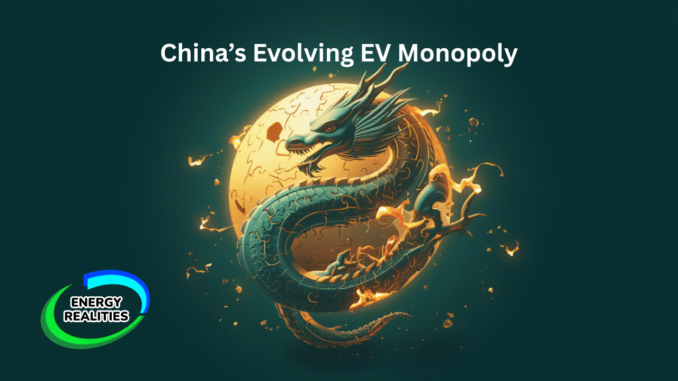
In the rapidly transforming landscape of global energy and transportation, China’s grip on the electric vehicle (EV) sector has become a dominant force. With control over critical supply chains, particularly batteries, China is reshaping the industry through aggressive strategies that blend state support with market tactics. This dominance, however, comes at a cost—raising alarms about fair competition and the survival of auto industries in regions like Canada, the UK, and the EU. Meanwhile, scandals within China’s own market expose vulnerabilities, contrasting sharply with Tesla’s pivot toward a tech-driven future. As we examine these dynamics in early 2026, the implications for energy security and automotive innovation are profound.
We will cover this and more on the Energy Realities Podcast with Tammy Nemeth, Irina Slav, David Blackmon, and Stu Turley. I will drop the video and updates here as well.
Cornering the Battery Market: Predatory Practices at Play
China’s ascent in the EV battery sector is no accident; it’s the result of deliberate, state-orchestrated efforts that have created a near-monopoly. Beijing has poured over $230 billion into EV and battery subsidies between 2009 and 2023, enabling companies to produce at scales and prices that undercut global competitors.
This has led to massive overcapacity—by 2025, China’s battery production was projected to exceed demand by four times, flooding markets and driving down prices through what experts describe as predatory pricing.
Key tactics include controlling upstream resources: China dominates 95% of global battery-grade graphite, 85% of lithium anodes, and 70% of cathodes.
This vertical integration, bolstered by low-interest loans, tax rebates, and manufacturing grants, allows firms like CATL and BYD to operate at a loss while building market share. The strategy echoes broader “Made in China 2025” ambitions, where inefficiencies at home are tolerated to achieve global dominance.
Smaller players worldwide struggle as Chinese producers oversupply lithium, slashing prices by over 80% in a single year to eliminate rivals.
This approach has consolidated power among a handful of Chinese firms, with 11 companies now controlling the domestic market.
The energy implications are stark: as batteries underpin renewable storage and electrification, China’s hold could dictate global transition paces, potentially using supply as leverage in geopolitical tensions.
Risks to Western Auto Industries: Canada, UK, and EU on the Brink
China’s EV exports, fueled by domestic overproduction, now pose an existential threat to auto manufacturers in Canada, the UK, and the EU. In 2025, Chinese brands captured nearly 70% growth in global market share, infiltrating markets with affordable, subsidized vehicles.
This influx has eroded foreign automakers’ positions, with Germany’s market share in China dropping from 20.4% in 2023 to 17.6% in 2024.
Canada faces acute risks after a 2025 trade deal lowered tariffs on Chinese EVs to 6.1%, allowing up to 49,000 units annually.
This could supplant U.S. and domestic production, as integrated North American supply chains—where parts cross borders multiple times—become unviable amid U.S. tariffs.
Unions like Unifor warn of destabilization, with cheap imports threatening jobs in a sector already hit by slowing EV demand.
In the EU, Chinese EVs claimed 10% of sales by late 2025, prompting tariffs up to 35% on battery EVs.
Yet exports to the bloc fell only 10% year-over-year, still totaling $13 billion.
Legacy players like Volkswagen and Stellantis face pressure in entry-level segments, where Chinese models cost half as much as U.S. counterparts.
The UK, post-Brexit, mirrors EU vulnerabilities, with Chinese dominance potentially dissolving industrial backbones tied to energy transitions.
Overall, these regions risk losing manufacturing sovereignty, with over 30 million Chinese vehicles produced annually—triple U.S. output—flooding markets and diminishing exports.
Energy-wise, reliance on Chinese batteries could hinder local green initiatives, exposing supply chains to disruptions.
The Domestic Scandal: Zero-Mileage “Used” Cars and Warranty Woes
Beneath China’s EV boom lies a scandal exposing market distortions: the proliferation of “zero-mileage used cars.” These vehicles—registered but undriven—are resold as used to inflate sales figures, secure subsidies, and clear inventory amid overcapacity.
In 2025, regulators investigated giants like BYD after such cars flooded lots, often with plastic-wrapped seats and negligible odometers.
The practice stems from cutthroat competition and a years-long price war, leading to chronic excess.
Dealers register new EVs to meet quotas or claim incentives, then offload them at discounts—sometimes exporting via grey markets.
Consumers face risks: warranties start at registration, reducing coverage by months, and vehicles may carry liens or unclear histories.
Government crackdowns ensued, with the Ministry of Industry and Information Technology banning resales within six months and condemning “irrational” competition.
Audits revealed $121 million in fraudulent subsidies, highlighting ethical lapses that undermine trust in China’s EV ecosystem.
This scandal, affecting profitability (only BYD and Li Auto turned profits in 2025), signals potential implosion if unchecked.
Tesla’s Tech Pivot: A Contrast in Strategy
In stark contrast, Tesla is evolving beyond EVs into a “physical AI company,” prioritizing autonomy and robotics over volume sales.
Despite a 46% profit drop to $3.8 billion in 2025—the lowest since the pandemic—and losing its top EV seller crown to BYD, Tesla’s valuation hinges on future tech bets.
EV sales fell 9% annually, but CEO Elon Musk emphasizes “growth waves” via Full Self-Driving (FSD), robotaxis (Cybercabs), and Optimus robots.
Projections suggest FSD and Cybercabs could generate 63% of $1.2 trillion revenue by 2029, with 86% of EBITDA from high-margin software.
Tesla ended Model S/X production to repurpose factories for robots, planning $20 billion+ in 2026 capex.
Unlike China’s subsidy-dependent model, Tesla’s profitability stems from vertical integration and software edges, though challenges like battery costs persist.
Musk envisions 100,000 monthly Optimus units in five years, potentially yielding $30 billion in revenue, alongside energy storage growth (46.7 GWh deployed in 2025).
This tech focus could yield a $100 trillion valuation, dwarfing EV profits
A Global Reckoning Ahead
China’s EV monopoly, built on predatory practices and exposed by internal scandals, threatens to upend Western auto sectors while straining its own market. Canada, the UK, and the EU must bolster protections to safeguard jobs and energy independence. Tesla’s shift to AI and autonomy offers a blueprint for innovation-led profitability, but success is uncertain amid competition. As the global balancing of new trading blocs accelerates, balancing competition with sustainability will define the next era—potentially reshaping global power dynamics in the process. Those new trading blocs following Net Zero and deindustrialization will lose their manufacturing and independence to determine their financial fortunes as countries.
Get your CEO on the podcast: https://sandstoneassetmgmt.com/media/
Is oil and gas right for your portfolio? https://sandstoneassetmgmt.com/invest-in-oil-and-gas/



Be the first to comment