


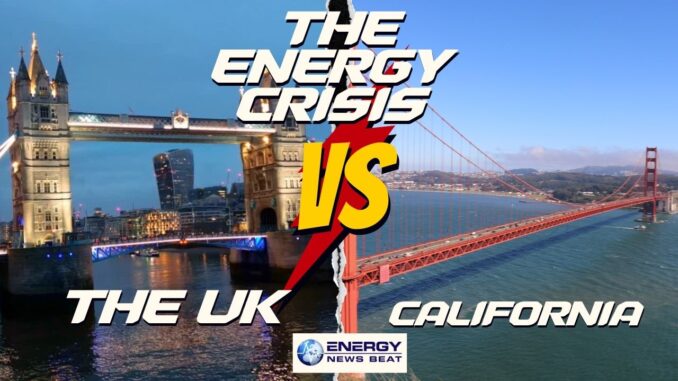
In an era where aggressive climate policies dominate headlines, two economic powerhouses—the United Kingdom and California—are charting strikingly similar courses toward energy transformation. Both are pursuing ambitious net-zero goals, but at what cost? A recent article on OilPrice.com highlights the UK’s precarious position, warning that its oil refineries are on the brink of extinction without urgent policy changes.
This mirrors California’s own trajectory, where refinery closures and stringent oil and gas restrictions are accelerating a shift away from fossil fuels. While proponents tout environmental benefits and long-term savings, the immediate threats include soaring energy prices, job losses, increased import dependence, and broader economic fallout. Let’s examine the parallels, the policies driving them, and the potential for economic turmoil.
This story comes out on the heels of Gavin Newsom cutting a deal with Ed Miliband. Stu Turley had to ask the question: how can the country with the highest energy costs expect to help lower costs in one of the highest-cost States? Two bad energy policies do not seem capable of lowering energy prices for consumers.
Newsom Cutting Clean Energy Deals with the U.K. Sparks Comments from President Trump
The UK’s Refinery Crisis and Net-Zero Ambitions
The UK, once a robust player in the global oil market, now faces severe challenges in its downstream oil sector. With only four operational refineries remaining after recent closures at Prax Lindsey in Lincolnshire and Grangemouth in Scotland, the country is more vulnerable than ever to global fuel supply disruptions.
Key threats include declining domestic demand, fierce competition from newer facilities in the Middle East, Asia, and Africa, ageing infrastructure, elevated energy costs, and escalating carbon emission expenses that are difficult to mitigate. Refineries currently shoulder up to £400 million ($540 million) annually in carbon costs, while international competitors often evade similar burdens, creating an uneven playing field without a Carbon Border Adjustment Mechanism (CBAM).
Make no mistake: the UK’s economic warfare against the oil and gas industry will be one of its key points of downfall. The Windfall profits taxes and CBAM participation are a wealth transfer that impacts every UK citizen.
At the heart of this is the UK’s commitment to net-zero emissions by 2050, enshrined in law since 2019 as the first major economy to do so.
The government’s Carbon Budget and Growth Delivery Plan 2025 outlines pathways to decarbonize sectors like electricity, transport, and industry, with initiatives such as the Clean Power by 2030 plan and the Great British Energy Act to boost renewables.
Investments in low-carbon technologies are projected to scale to £50 billion annually from 2030 to 2050, primarily from private sources.
Optimistic forecasts suggest the net-zero economy could be worth £1 trillion by 2030—about one-third of the UK’s current GDP—and create up to 725,000 new jobs in low-carbon sectors.
Yet, the UK’s heavy reliance on oil and refined products underscores the risks. Oil and gas meet over three-quarters of the nation’s primary energy needs, supplying 47% of final energy demand, 100% of aviation fuel, 97% of road fuel, and 61% of rail fuel.
The UK exports over 80% of its crude oil production, mostly to European refineries, while remaining a net exporter of petrol but a net importer of diesel and jet fuel.
Overall, 44% of petroleum products are imported, exposing the economy to price shocks and geopolitical instability.
Economic forecasts paint a mixed picture. The Climate Change Committee estimates net-zero costs at less than 1% of GDP annually through 2050.
However, in ambitious scenarios, investments could peak at £460 billion by 2029 before declining.
Real GDP growth is expected to average 1.5% annually through the decade, but the UK is off-track for its 2030 target of 68% emissions reduction from 1990 levels, with credible plans covering only 38% of needed savings.
Without reforms like a CBAM by 2028, industry experts warn of refinery extinction, job exports, higher emissions from imports, and deindustrialization.
California’s Parallel Path: Refinery Closures and Fossil Fuel Phase-Out
California, often a bellwether for U.S. environmental policy, is following a comparable route. The state is bracing for major refinery shutdowns, with Valero’s Benicia facility idling by April 2026 (145,000 barrels/day) and Phillips 66’s Carson complex already closed (139,000 barrels/day), slashing 17-18% of in-state refining capacity.
These moves, driven by zero-emission vehicle mandates and fossil fuel demand reduction, will likely spike gas prices by $1.21 per gallon by mid-2026, exacerbating California’s already high costs—43% above the national average.
Policies include a fracking ban by 2024, a 2045 oil production phase-out goal, and restrictions on new wells near communities.
Governor Gavin Newsom has delayed profit caps and expedited onshore drilling permits to avert shortages, but the state remains committed to carbon neutrality by 2045. He has signed legislation for an estimated 2,000 permits, but it is too little, too late.
Drilling permits have plummeted 95% since 2019, reducing output by 128,000 barrels/day despite vast reserves.
This has increased foreign imports from Brazil, Iraq, and Ecuador, raising emissions and security risks.
The oil and gas sector bolsters California’s economy, supporting 536,770 jobs, $23 billion in wages, and $338 billion in contributions.
However, regulations like reformulated gasoline and emissions standards add 18 cents/gallon in costs, creating a “fuel island” isolated from neighboring supplies.
Over half of Californians view gas and utility prices as major personal problems.
Second-order effects ripple outward. Neighboring Arizona and Nevada, reliant on California pipelines, face fuel shortages and higher prices.
With 40+ military installations, reduced refining threatens national security, potentially causing blackouts and volatility across the West Coast.
Gasoline demand is projected to drop 3.4-3.7 billion gallons/year by 2040 due to EVs, but without infrastructure, imports will fill gaps, undermining climate gains.
|
Aspect
|
UK
|
California
|
|---|---|---|
|
Key Policies
|
Net-zero by 2050; Carbon Budgets; No new CBAM yet
|
Zero-emission vehicles by 2035; Oil phase-out by 2045; Fracking ban
|
|
Refinery Status
|
4 remaining; 2 recent closures
|
17-18% capacity loss by 2026; 2 major shutdowns
|
|
Economic Dependence
|
75% primary energy from oil/gas; 47% final demand
|
$338bn contribution; 536k jobs; Imports 3x in-state production
|
|
Price Impacts
|
High carbon costs (£400M/year); Import vulnerability
|
$1.21/gallon hike by 2026; 43% above US avg
|
|
Second-Order Effects
|
Job exports; Deindustrialization; Higher emissions from imports
|
Impacts AZ/NV supplies; Military risks; Foreign dependence
|
|
Forecasts
|
Costs <1% GDP/year; £1tn net-zero economy by 2030
|
Demand destruction 4.7-4.9 bgy by 2050; Shortages without action
|
Both regions are decoupling from fossil fuels amid declining demand, but without adequate safeguards, this risks economic collapse.
Second-order effects amplify: California’s shortages threaten Western U.S. stability, while UK refinery losses could disrupt European supply chains.
The Grim Economic Outlook: How Bad Will It Get?
For the UK, missing 2030 targets could balloon costs beyond 1% of GDP, with peak investments at £460 billion eroding growth if not offset by savings from avoided climate damage.
Real GDP per person may stagnate at 1.1% annual growth, exacerbated by energy insecurity.
In California, refinery extinctions signal a manmade crisis: prices soaring, 400+ job losses per closure, and a $217 billion industry at risk.
By 2026, fuel shortages could become routine, with ripple effects costing billions in lost GDP and heightening foreign vulnerabilities.
Ultimately, both face potential collapse if policies prioritize ideology over pragmatism. Substantiated forecasts suggest manageable transitions with private investment and reforms, but current trajectories risk trillions in costs, mass unemployment, and energy instability. The question isn’t if refineries will go extinct—it’s whether economies can survive the fallout.
Stu Turley will be interviewing Katy Grimes, Editor-in-Chief of the California Globe, to discuss corruption and the energy crisis in California, and that podcast should roll out on Friday.
Get your CEO on the #1 Energy Podcast in the United States: https://sandstoneassetmgmt.com/media/
Is oil and gas right for your portfolio? https://sandstoneassetmgmt.com/invest-in-oil-and-gas/



Be the first to comment