


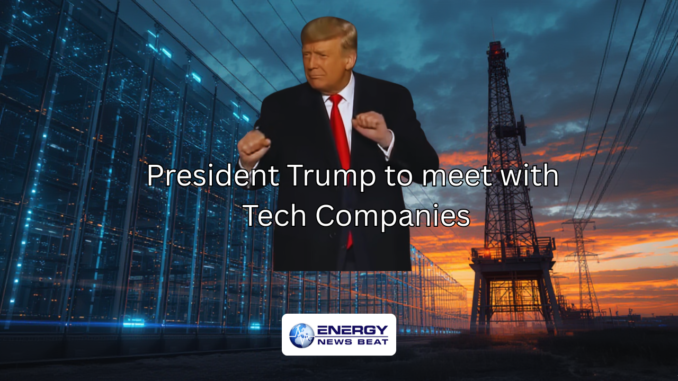
President Donald Trump is wasting no time turning his State of the Union promises into action. Just one day after highlighting the “Ratepayer Protection Pledge” in his February 24, 2026 address to Congress, the White House has confirmed a March 4 summit at the White House where executives from Amazon, Google (Alphabet), Meta, Microsoft, xAI, Oracle, and OpenAI will sign pledges committing their companies to cover the full electricity costs of new AI data centers.
According to Bloomberg and White House statements, the tech giants will formally agree to “build, bring, or buy” their own power supply for these energy-hungry facilities. The goal is crystal clear: keep everyday Americans’ electricity bills from rising as the AI boom drives explosive demand.
Will this meeting help stem Wall Street’s fears of an AI bubble?
Absolutely. One of the biggest drags on AI enthusiasm has been the looming power crunch. Hyperscale data centers can suck down hundreds of megawatts each—equivalent to powering entire cities—and grid constraints, permitting delays, and local opposition have raised red flags about whether the massive capex will actually deliver returns. By forcing Big Tech to internalize the power costs instead of leaning on ratepayers and strained utilities, Trump’s pledge removes a major political and logistical roadblock.
It signals that Washington is clearing the runway for AI dominance against China while protecting consumers. That kind of policy certainty is exactly what investors need to keep pouring capital into NVIDIA, AMD, the cloud giants, and the broader AI stack. Energy bottlenecks have been cited as a top risk to the AI supercycle; this meeting directly mitigates it.
Will it help consumers?
Yes—and that’s the whole point of the “Ratepayer Protection Pledge.” For years, utilities have warned that unchecked data-center growth would force rate hikes to pay for grid upgrades. Trump’s directive flips the script: tech companies pay their own way through behind-the-meter generation, dedicated plants, or long-term power purchase agreements. No more socializing the cost of AI onto families and small businesses.
Who benefits on the energy side?
The real winners are the American energy producers who are already positioned to supply reliable, dispatchable power—especially natural gas and the companies pivoting hard into data-center power generation.
Chevron has gone all-in. The supermajor is building a 2.5 GW (expandable to 5 GW) natural-gas-fired power project in the Permian Basin’s West Texas, co-located with data centers. Through its partnership with GE Vernova and Engine No. 1, Chevron aims to deliver up to 4 GW of dedicated power starting in 2027—exactly the “build or buy” model Trump is mandating. Chevron CEO Mike Wirth has been crystal clear: this is about leveraging America’s abundant natural gas to fuel AI without raising consumer bills.
ExxonMobil is right there with them, with over 2.7 GW in its data-center power pipeline, including a 1.2 GW project with NextEra Energy in the Southeast.
Liberty Energy (through subsidiary Liberty Power Innovations) just announced a strategic partnership with Vantage Data Centers to develop and operate up to 1 GW of onsite, high-efficiency gas-fired power solutions for hyperscale AI and cloud facilities across North America. This is the exact “hyperscaler component” business model that positions oilfield services leaders to capture recurring revenue from power generation, not just drilling.
These aren’t speculative bets—they’re shovel-ready projects already in flight. When Amazon, Microsoft, Google, Meta, and the rest start signing the March 4 pledges, they’ll need firm, reliable power partners who can deliver gigawatts on a timeline that matches their AI buildout.
Chevron, Exxon, Liberty, and the broader U.S. natural gas ecosystem are perfectly placed to fill that order.
Bottom line for Energy News Beat readers
Trump’s follow-through is classic America First energy policy: unleash AI leadership, protect ratepayers, and hand the power-generation upside to the domestic oil, gas, and services companies that actually know how to deliver reliable electrons at scale. March 4 won’t just be a photo-op—it will be the moment Big Tech formally commits to paying their own power bills, unlocking billions in new demand for American energy infrastructure. The hyperscalers get their power. Consumers stay protected. And the Chevrons, Exxons, Libertys, and the entire U.S. energy complex get a seat at the biggest growth table in the 21st century.
Stay tuned—Energy News Beat will be watching every gigawatt. Promises made, promises kept.
Get your CEO on the #1 Energy Podcast in the United States: https://sandstoneassetmgmt.com/media/
Is oil and gas right for your portfolio? https://sandstoneassetmgmt.com/invest-in-oil-and-gas/



Be the first to comment