California’s refining industry — once the backbone of the West Coast’s fuel supply — stands at a make-or-break moment. With just seven refineries still operating as of March 2026, the state is weeks away from the next wave of closures that will slash capacity by another 17–20%. Phillips 66’s Wilmington complex shut down late 2025; Valero’s Benicia facility is slated to idle in April 2026. The result? A self-inflicted gasoline deficit that experts warn could send pump prices to $8–$10 per gallon — or worse — while jeopardizing national security from Travis Air Force Base to the entire Pacific theater.
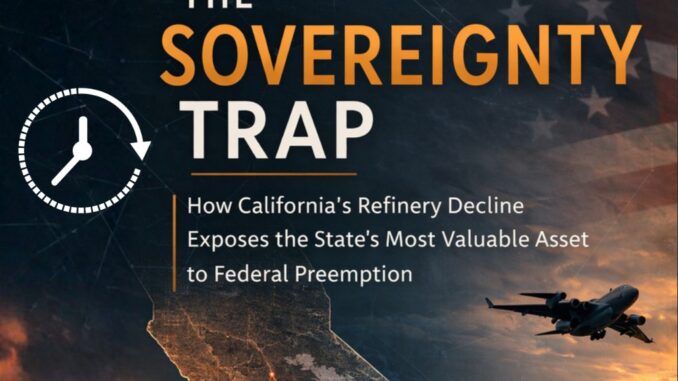
A new report from the Alliance for Innovation and Infrastructure, “The Sovereignty Trap: How California’s Refinery Decline Exposes the State’s Most Valuable Asset to Federal Preemption” (March 2026, by Mothusi Pahl), lays out the crisis in stark terms. California’s crude-processing capacity has collapsed from a 1980s peak of roughly 2.5 million barrels per day to about 1.27 million bpd across its remaining facilities. Northern California — a “fuel island” with no pipelines to the rest of the state — now faces a 36% gasoline shortfall. Statewide, the deficit sits at 13%. Zero days of strategic gasoline reserves. Aging plants prone to multi-month outages. And a regulatory thicket (CARB rules, New Source Review permitting, cap-and-invest expansions) that has made upgrades economically impossible.
Hat Tip to Mike Umbro for posting out the report link.
My homie’s article is a good read!https://t.co/58U7ffnWtW
Do you agree with my summary?
We need to stabilize California’s remaining refineries, streamline safety and maintenance permitting, build strategic fuel reserves, expand import and pipeline redundancy, protect military…
— Mike Umbro 🪃 (@MikeUmbro) March 20, 2026
The report’s central warning is what it calls the “Sovereignty Trap.” Decades of California-first environmental mandates created the very vulnerability that now invites federal intervention. When the next unplanned outage hits — and Chevron Richmond’s 123-year-old crude unit or PBF Martinez’s troubled track record make that a “when, not if” scenario — the military’s fuel lifeline snaps. Travis AFB, the Air Force’s primary Pacific power-projection hub, receives 100% of its JP-8 jet fuel via pipeline from Chevron Richmond. Coast Guard Island in Alameda depends on the same local diesel supply. A prolonged disruption doesn’t just spike California gas prices; it threatens KC-46 tanker missions to Japan and the Philippines, homeland defense, and deterrence against China.
That is exactly why the Trump administration must act decisively with federal power to keep all seven remaining refineries open and operating. The Defense Production Act (DPA), Stafford Act authorities, Jones Act waivers, and constitutional military exemptions give the Executive Branch tools that state regulators cannot touch. The federal government can:
Commandeer fuel contracts for military specification product
Override CARB fuel formulas for national-security needs
Fast-track permits and waive environmental reviews for upgrades
Provide direct purchase guarantees that create a market floor
President Trump has already shown the path forward by invoking the DPA to restart the Sable Offshore Santa Ynez pipeline — restoring California crude to these very refineries. The same authority, applied proactively to the downstream sector, is not optional; it is essential. Waiting for a full-blown crisis hands the precedent of federal preemption to future administrations and permanently erodes California’s regulatory sovereignty. Acting now protects American energy security, American jobs, and American military readiness.
Energy News Beat listeners have heard this warning for months. In the explosive “Point of No Return for the California Energy Crisis” episode, refinery veteran Mike Ariza joined host Stuart Turley and declared the situation “Venezuelan or Iranian in scale” — a national-security threat capable of destabilizing the entire Republic. Turley’s blunt assessment: “We need federal intervention today. Not tomorrow — today.” Guests Ronald Stein and Mike Umbro on other ENB episodes hammered the same points: skyrocketing reliance on imports from China, India, and South Korea; diesel and jet-fuel shortages; the real risk of $15-per-gallon extremes if another major outage hits; and the economic dominoes of food shortages and civil unrest. Chevron, Marathon, and PBF have all warned regulators in writing that the latest cap-and-invest amendments are a “death knell” for the remaining seven plants.
California Energy Commission officials themselves have admitted the trajectory: Vice Chair Siva Gunda warned prices could reach $8–$10 a gallon. Governor Newsom’s own planning committees have produced little more than talk while companies exit. The state has no strategic reserves, no bilateral supply pacts, and no realistic backup when the next fire or mechanical failure occurs.This is the critical junction. The Trump administration has both the legal authority and the political mandate to treat California’s remaining refineries as the strategic national assets they are. Federal contracts for military-grade fuels can stabilize cash flows. Emergency permitting relief and DPA-backed upgrades can keep the plants running through the energy transition — not against it. Failure to act now doesn’t just risk $8–$10 gasoline in the nation’s largest state; it risks a Pacific fuel emergency at the precise moment global tensions are highest.The sovereignty trap has been set by Sacramento’s own policies. The only question left is whether Washington will step in to secure the fuel supply — or wait for the crisis to force its hand. Energy News Beat will continue tracking every development. The seven refineries still standing cannot wait. America cannot afford to let them fall.
Sources: energynewsbeat.co/ , aii.org
Check out https://theenergynewsbeat.substack.com/