


While California’s leaders double down on aggressive decarbonization mandates and refinery-hostile regulations, Australia is delivering a live-action preview of exactly where those policies lead: shuttered refineries, chronic import dependence, and a full-blown fuel crisis that is now hammering farmers, truckers, and everyday consumers. The timing could not be more urgent. As of March 2026, Australia’s diesel, gasoline, and fertilizer shortages are no longer theoretical—they are a reality, triggered by global supply shocks but rooted in decades of domestic policy failure. California, already bleeding refining capacity and paying America’s highest fuel prices, is on the exact same trajectory. The Golden State still has an off-ramp—if it chooses to take it.
Australia’s Refinery Collapse: From Self-Sufficient to 80–90% Import Dependent
Not long ago, Australia was largely energy secure. In the early 2000s it operated eight refineries capable of meeting nearly all its fuel needs. Between 2012 and 2022, five of those facilities closed—victims of razor-thin margins, high operating costs, aging infrastructure, and relentless pressure from cheaper mega-refineries in Asia.
Today, only two remain: Ampol’s Lytton refinery near Brisbane (110,000 barrels per day) and Viva Energy’s Geelong refinery in Victoria (120,000 b/d). Their combined output covers roughly 20% of national demand. The rest—about 850,000 b/d of refined product—is imported, mostly from Asian suppliers in China, South Korea, Singapore, and Thailand.
Worse, Australia’s remaining refineries are mismatched to domestic needs. They are gasoline-heavy, yet the economy runs on diesel. Both plants are decades old, require imported crude (Australia’s own light, condensate-rich oil doesn’t fit their configurations), and survive only because the federal government extended the Fuel Security Services Payment subsidy through 2030.
Strategic stockpiles were already dangerously low—around 37 days total, far below International Energy Agency standards—before the current crisis hit.
The 2026 Crisis: Empty Pumps, Skyrocketing Diesel, and Fertilizer Panic
The trigger was the Iran conflict and the effective closure of the Strait of Hormuz, which choked Asian refinery output and export flows to Australia. South Korea capped exports. Multiple cargoes were turned back or deferred. Six vessels bound for Australia were cancelled or delayed in a single recent week.
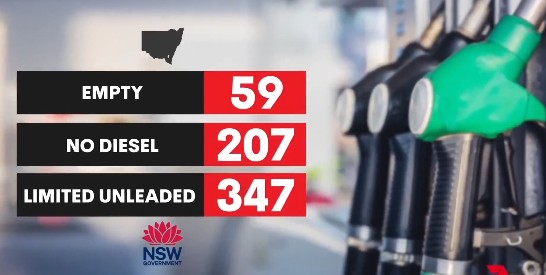
Result? More than 500 service stations across the country have run dry—187 in New South Wales alone are out of diesel. Diesel prices have surged more than 50%, with some reports showing jumps of 67%. Petrol is up nearly 40%. Rural areas are hit hardest.
Farmers are in full crisis mode. Winter planting season is underway, yet diesel supplies are rationed and urea fertilizer—also dependent on the same disrupted shipping lanes—is in short supply. Growers report three-week waiting lists for diesel. Some warn that without fuel and fertilizer, Australia’s winter crop could be halved, sending food prices soaring and threatening billions in agricultural output.
The government has released emergency reserves and scrambled to source cargoes from the U.S. Gulf Coast—a 55–60 day voyage with freight costs four times higher than normal Asia routes. It is a humiliating admission that Australia’s long-standing “export crude, import refined” model has failed under pressure.
California Is Already Walking the Same Path
California has already lost decades of refining muscle. In 1982 the state had 43 refineries. By the early 1990s that number was down to 25. Today it sits at roughly seven operating facilities—and the bleeding continues.
Phillips 66’s massive Los Angeles-area refinery (roughly 130,000–140,000 b/d) shut down at the end of 2025.
Valero’s Benicia refinery (145,000 b/d) is scheduled to idle in April 2026.
Those two closures alone wipe out nearly 18–20% of California’s remaining refining capacity. Six of the seven plants still running have signaled plans to exit or convert in coming years.
Like Australia, California’s refineries are uniquely configured to produce CARB-compliant gasoline and ultra-low-sulfur diesel. That makes importing replacement barrels expensive and logistically difficult. The state is an “energy island,” disconnected from the massive Gulf Coast refining hub and forced to rely on tankers—many from the very same Asian suppliers now throttling exports.
The numbers already tell the story: California motorists pay an average $5.82 per gallon for gasoline (versus the national average under $4), while diesel recently hit a record $7+ per gallon. Chevron’s head of refining publicly warned that the state is “careening toward an energy crisis” and that his company may walk away from California refining altogether unless taxes and regulations are rolled back.
Farmers, truckers, and the broader economy are feeling the pain—exactly as Australia’s rural sector is experiencing right now.
Australia used to have 8 refineries.
Now they have 2.They import diesel and gasoline from South Korea and Singapore.
With oil blocked in the Middle East, South Korea and Singapore are limiting exports of diesel and gasoline.
Australia gets crushedpic.twitter.com/qqp35dpssW
— Wall Street Mav (@WallStreetMav) March 27, 2026
The Off-Ramp: California Can Still Choose Differently
Australia’s lesson is brutally simple: once refineries are gone, they are almost impossible to replace quickly. Rebuilding even one world-scale facility costs billions, faces years of permitting hell, and competes against modern Asian mega-refineries. Australia is now stuck paying premium prices for imported fuel and praying global markets stay calm.
California still has choices:
Pause the regulatory pile-on. Proposed changes to Cap-and-Trade and new low-carbon fuel standards threaten to add billions in compliance costs. Lawmakers could delay or soften these rules to keep existing plants viable.
Offer real incentives. Australia subsidized its last two refineries to prevent total collapse. California could do the same—targeted relief on taxes, streamlined permitting, or direct support—rather than forcing premature shutdowns.
Recognize the transition reality. The 2035 gas-car ban and 2045 fossil-fuel phase-out sound ambitious on paper, but they ignore the fact that liquid fuels will power the economy, agriculture, aviation, and heavy transport for decades. A realistic plan must maintain domestic refining capacity during the transition.
Improve fuel security. California could explore strategic storage mandates, pipeline connections to other U.S. refining centers, or even limited new capacity investment—anything to avoid Australia’s 80–90% import trap.
Chevron’s recent warning was not alarmism—it was a last call. If California ignores Australia’s unfolding crisis and continues driving refineries out of business, it will wake up one day with empty pumps, $7+ diesel, stranded farmers, and no easy way back.
The warning lights are flashing. Australia is not a distant cautionary tale. It is the mirror California is about to stare into—unless leaders choose the off-ramp while they still can.
Appendix: Sources and References
The article draws on publicly available reporting, government statements, and industry data as of March 2026. Below is a compiled list of primary sources supporting the key facts on Australia’s refinery decline, the ongoing 2026 fuel crisis, and the parallel situation in California. All links were verified at the time of publication. Australia’s Refinery Decline & Import Dependence
- Australia now has only two operational oil refineries (Ampol Lytton, Brisbane 110,000 b/d; Viva Energy Geelong, Victoria ~120,000 b/d), supplying less than 20% of national fuel needs. The rest (850,000 b/d) is imported — 80–90% dependence.
Source: Australian Institute of Petroleum / Argus Media reports (March 2026) and industry summaries.
https://www.argusmedia.com/en/news-and-insights/latest-market-news/2803693-australia-extends-subsidy-plan-for-refiners-to-2030
https://oilprice.com/Energy/Energy-General/Australias-Fuels-Dependence-Turns-Into-a-Crisis.html - History of closures: From eight refineries in the early 2000s to just two today. Major shutdowns include Clyde (2012), Kurnell (2014), Bulwer Island (2015), Kwinana (2021), and Altona (2021).
Source: Crude Oil Peak analysis and Sydney Morning Herald (March 2026).
https://crudeoilpeak.info/foot-print-of-peak-oil-in-australia-fuel-import-vulnerability-update-september-2025-data
https://www.smh.com.au/national/nsw/coalition-s-refinery-closures-led-to-our-dependence-on-fuel-imports-20260319-p5pqxs.html - Fuel Security Services Payment (FSSP) subsidy extended to 2030 to keep the last two refineries open.
Source: Argus Media (March 19, 2026).
https://www.argusmedia.com/en/news-and-insights/latest-market-news/2803693-australia-extends-subsidy-plan-for-refiners-to-2030 - Strategic stockpiles pre-crisis: ~37 days total (well below IEA 90-day standard); MSO requires ~30–36 days of various fuels.
Source: Energy Minister statements and ABC News (March 2026).
https://www.abc.net.au/news/2026-03-23/fuel-shortage-warning-from-government-agency-before-iran-war/106471528
2026 Diesel, Gasoline & Fertilizer Crisis
- Strait of Hormuz closure and Asian export curbs (China, South Korea, Singapore) triggered cancellations of at least six cargoes to Australia; diesel prices up >50%, petrol up ~40%; >500 stations dry (187 in NSW alone).
Source: Bloomberg, ABC News, The Guardian, and Reuters (March 2026).
https://www.bloomberg.com/opinion/articles/2026-03-25/iran-war-a-country-fueled-by-subsidized-diesel-is-running-dry
https://www.abc.net.au/news/2026-03-22/iran-war-leaves-asias-oil-refiners-scrambling/106470932 - Farmers face rationing, three-week diesel waits, urea fertilizer shortages during winter planting; potential halving of crop output.
Source: ABC News, The Energy, and farmer reports (March 2026).
https://www.abc.net.au/news/2026-03-23/fuel-shortage-warning-from-government-agency-before-iran-war/106471528
https://theenergy.co/article/iran-crisis-fears-hit-australia-hard - Emergency measures: Government released ~5–6 days of reserves; scrambling for U.S. Gulf Coast cargoes (55–60 day voyages).
Source: Energy Minister Chris Bowen / Bernama and Reuters (March 2026).
https://www.bernama.com/en/news.php/business/politics/news.php?id=2534055
California’s Parallel Trajectory
- Phillips 66 Los Angeles-area refinery (Wilmington/Carson, ~139,000 b/d) closed end of 2025.
Source: Daily Breeze and Phillips 66 announcements (2025–2026).
https://www.dailybreeze.com/2026/03/02/as-oil-industry-in-california-wanes-what-will-become-of-shuttered-refineries/ - Valero Benicia refinery (145,000 b/d) idling/closing April 2026 — combined ~17–20% loss of state refining capacity.
Source: EIA, Valero filings, and Industrial Info (2025–2026).
https://www.eia.gov/todayinenergy/detail.php?id=65704
https://www.industrialinfo.com/news/article/valero-plans-gasoline-imports-as-california-refineries-close–351603 - California now down to ~7 operating refineries; historically 43 (1982) → 25 (1990s) → current levels. State is an “energy island” reliant on expensive imports.
Source: California Energy Commission data and USC analysis. - Current prices: Gasoline ~$5.82/gal (vs. U.S. average <$4); diesel recently >$7/gal. Chevron warnings of “energy crisis.”
Source: San Jose Inside, California Policy Center, and EIA (March 2026).
https://www.sanjoseinside.com/business/ca-refineries-limit-fuel-supplies-as-iran-war-pushes-gas-prices-in-ca-to-record-highs/
https://californiapolicycenter.org/what-will-california-gas-prices-do-in-2026/ - Projected impact: Gasoline could reach $7–$8.44/gal by late 2026 without policy changes.
Source: USC economist Michael Mische report and UC Davis analysis (2025–2026).
https://www.thecentersquare.com/california/article_09e1ae6f-f16c-474a-acba-0afc1dce910c.html
For the most current updates, readers are encouraged to visit the Australian Government’s Department of Climate Change, Energy, the Environment and Water (fuel security page) and the California Energy Commission refinery status reports. All data reflects conditions reported in March 2026.





Be the first to comment