

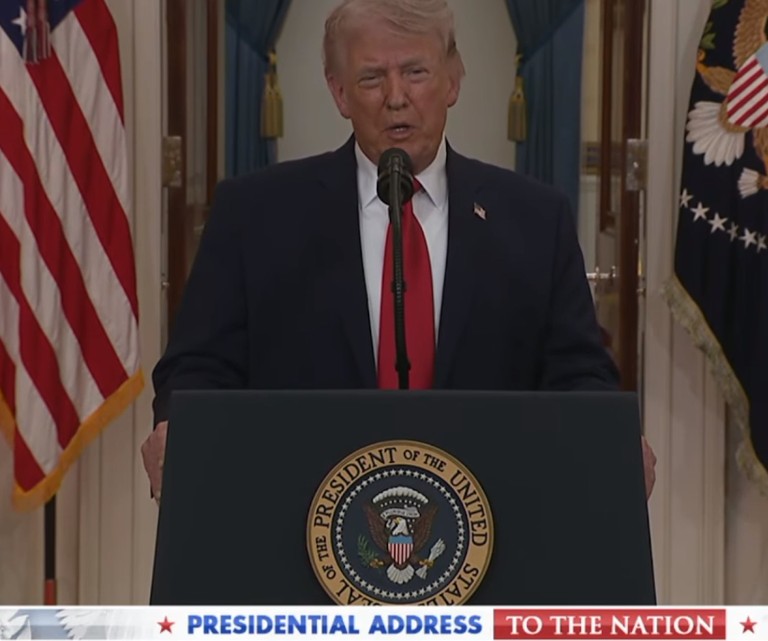
President Donald Trump delivered a prime-time address from the White House on April 1, 2026, providing an “important update” on the U.S. involvement in the Iran conflict. In the speech and preceding statements, Trump signaled strong optimism: U.S. military operations could wrap up in “two to three weeks,” the Strait of Hormuz would “open naturally” or “automatically” once American forces exit, and Iran had reportedly requested a ceasefire—though he conditioned any deal on the strait being “open, free, and clear.” He repeatedly emphasized that securing the waterway is no longer America’s responsibility, telling allies and Gulf states to “go get your own oil” and “build up some delayed courage.”
The message was clear: mission largely accomplished, quick exit ahead, and energy markets should prepare for relief. Markets initially cheered the de-escalation tone. Stocks rallied on hopes the conflict would not drag into a prolonged U.S. commitment, while oil futures saw an immediate dip as traders priced in the possibility of a faster wind-down.
Yet Brent crude remains firmly above the $100 mark (trading near $104–105 early April 2), and energy analysts are urging caution. While the speech projects a short timeline, the physical realities of reopening the world’s most critical oil chokepoint suggest a much slower recovery for global supply chains.
The Optimism in the Speech vs. the Logistics on the Ground
Trump’s view aligns with his earlier comments that the strait will reopen “automatically” once Iran is “decimated” and U.S. forces depart. He has argued that whoever controls the oil fields post-conflict will want to resume exports quickly.
However, energy executives, shipping analysts, and oil-market veterans paint a more complex picture. Even if Tehran lifts its effective blockade tomorrow, full normalization of flows through the Strait of Hormuz—handling roughly 20% of global oil and 25% of LNG—will not happen overnight. Key bottlenecks include:
Restarting shut-in production: Many Gulf oil fields have been operating at reduced rates or fully idled for weeks due to attacks, threats, and storage constraints. Restarting a partially shut-in field typically takes 2–3 weeks; a complete shutdown can require 1.5 months or more, including safety inspections and maintenance.
Tanker crews and vessel availability: Hundreds of tankers have been idled, diverted (e.g., via the Red Sea bypass), or held in place. Crews have been rotated or repatriated amid war-risk premiums that skyrocketed. Re-manning, re-insuring, and repositioning vessels to resume normal rotations will take weeks.
Container ships and broader logistics: The conflict has snarled not just crude tankers but container vessels, LNG carriers, and general cargo. Backlogs at ports, insurance-rate normalization, and re-establishing secure routing could extend disruptions for months.
Infrastructure and damage assessment: War-related strikes on Gulf facilities, pipelines, and export terminals mean repairs and certifications will be needed before full throughput resumes. Analysts note that even undamaged fields face logistical hurdles in a post-crisis environment.
Shipping and trade experts summarize the outlook bluntly: “The short answer is that it would take months to get shipping supply chains back to normal because of the backlog.” Full normalization of Hormuz traffic could take 6–8 weeks after reopening, with some refiners waiting even longer for steady crude deliveries.
How Long Will Oil Prices Hold at the $100 Mark?
Oil has already surged more than 30% since the conflict intensified, with Brent briefly topping $110 before settling in the low $100s. Trump’s jawboning has provided some downward pressure, but physical supply shortfalls (estimated at 4.5–5 million barrels per day, potentially doubling by mid-April without relief) are the dominant force.
Consensus among analysts:
Short-term (next 2–4 weeks): Prices likely remain elevated near or above $100 even if the speech triggers a ceasefire. Markets will wait for concrete signs of tankers moving and production restarting.
Medium-term (1–3 months): As fields ramp up and the first cargoes clear the strait, a gradual decline is expected—but not a crash. Persistent logistical friction, elevated war-risk insurance, and potential lingering geopolitical risks (e.g., sporadic incidents or Bab al-Mandab tensions) will keep a floor under prices.
Longer-term: Once supply chains normalize (potentially by late Q2 or early Q3 2026), structural oversupply could push Brent back toward $60–70, assuming no new shocks. However, any delay in reopening or renewed threats could extend the $100+ environment well into summer.
Refiners, airlines, and consumers should brace for sustained high energy costs that ripple into gasoline (already above $4/gallon in many U.S. markets), heating, food, and fertilizer prices.
Market Reaction Outlook
Equities: Short-term relief rally likely continues if no escalation occurs, but energy-sector volatility will persist.
Oil & Gas: Futures may trade in a wide range ($95–$115) as traders balance Trump’s timeline against physical constraints. Volatility will remain high until the first post-reopening cargoes load.
Broader economy: Inflationary pressure from energy costs could complicate Fed policy; prolonged $100+ oil risks tipping fragile growth into slowdown territory.
President Trump’s speech offers hope for a swift U.S. exit and a naturally reopening strait. Energy markets, however, trade on barrels moved, not press releases. The coming weeks will test whether optimism on the podium can outpace the hard realities of tanker crews, drilling restarts, and clogged supply chains. Energy News Beat will continue tracking developments live—stay tuned for updates on flows, prices, and the real-world timeline to normalcy.
Appendix: Sources
All information drawn from publicly available reporting as of April 2, 2026. Full links provided for transparency:
NPR – Trump to address nation on Iran war (April 1–2, 2026 coverage)
https://www.npr.org/2026/04/01/nx-s1-5769805/iran-war-trump
Politico – Trump says war in Iran will not end until Strait of Hormuz reopened
https://www.politico.com/news/2026/04/01/trump-iran-war-strait-of-hormuz-ceasefire-00853870
Reuters, Washington Post, CNN, CNBC, Al Jazeera, and others reporting Trump’s statements on 2–3 week timeline and “open naturally” comments (aggregated April 1 coverage).
CNBC – Oil executives warn Hormuz must reopen by mid-April or disruptions worsen
https://www.cnbc.com/2026/03/28/oil-gas-prices-iran-war-hormuz.html
Al Jazeera & DW – Post-reopening supply-chain recovery timelines (months for normalization)
https://www.aljazeera.com/amp/news/2026/3/31/after-strait-of-hormuz-opens-turmoil-would-still-last-months-analysts-say
https://www.dw.com/en/after-the-iran-war-how-fast-could-global-trade-recover/a-76526954
Trading Economics & market data services – Brent crude pricing near $104–105 on April 2, 2026.
Additional analyst commentary from Macquarie, Kpler, and industry executives on tanker/logistics delays.
Energy News Beat – Delivering unfiltered energy intelligence. Questions or comments? Reach out at the Energy Podcast network.