9 Big stories on the ENB Standup
We had 9 big stories today on the Energy News Beat Channel.
We have new trading blocs forming around the world, and where will your country end up? Well, the US will be at the center, and I should ask, where will your state end up? Will it be in the Democratic Socialist Camp of failure, or are we going to get the Save America Act passed and save some of our states?
We need to get involved locally and be more informed nationally.
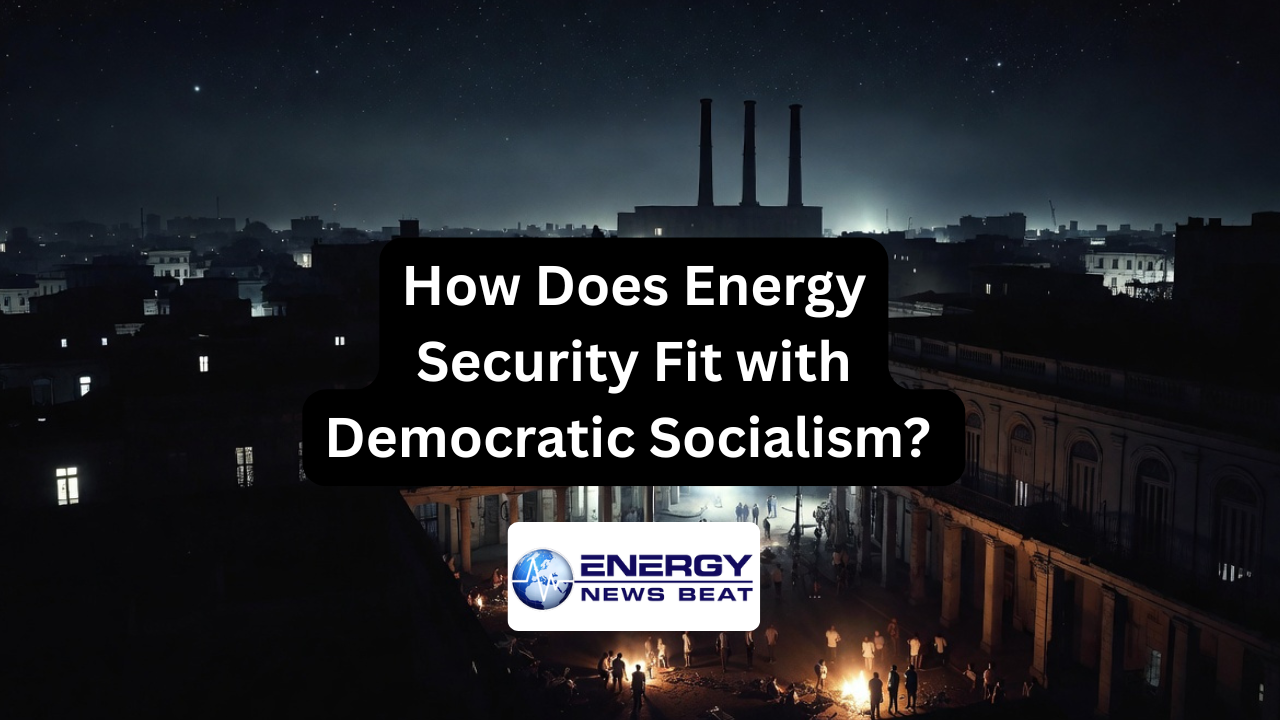
1. Cuba’s Energy Crisis & Socialism’s Failures
The podcast opens with Cuba’s blackout crisis, where the communist government admits fuel shortages. The host uses this as a cautionary tale about socialist and democratic socialist policies, comparing it to energy challenges in states like California, Ohio, Virginia, and New York, which have 38% higher electricity prices than the rest of the US.
2. UK’s Oil & Gas Policy & Energy Security
The UK’s decision to permanently ban North Sea oil and gas licenses is criticized as economically damaging. Despite 75% of UK energy coming from oil and gas, the country imports most of it rather than drilling domestically. The host argues this undermines energy security and will contribute to broader EU economic decline.
3. UAE’s Strategic Energy Expansion
The UAE is accelerating oil export infrastructure after leaving OPEC, planning to increase capacity from 3.5 to 5 million barrels per day. This is framed as a model of energy security through strategic infrastructure investment.
4. China-US Trade Relations & Energy Alignment
The Trump-Xi meetings show potential alignment on energy and trade. The host predicts a reshaping of global trading blocks around energy, with the US, Russia, China, Saudi Arabia, Japan, UAE, and India forming a major bloc, while the EU, UK, and Canada fall behind.
5. UN Climate Panel’s Admission on Failed Predictions

The IPCC quietly admitted that extreme climate doomsday scenarios driving climate policy and trillions in spending were unrealistic. The host criticizes this as wasteful and links net-zero policies to “Democrat Socialism.”
6. Data Centers & Water/Farm Protection
The surge in AI data center construction (especially in Texas) raises concerns about water depletion and farmland loss. The host advocates for data center development but demands accountability and protection of agricultural resources.
7. Iran Conflict & Global Oil Supply
Drone strikes on Iranian oil facilities threaten global oil supplies. The host warns that if the conflict continues, the world will face severe energy shortages within weeks.
8. NextEra Energy Potentially Acquiring Dominion Energy
This utility merger is analyzed as a strategic response to unprecedented power demands from AI data centers, though the host expresses uncertainty about its long-term benefits.
9. Political Engagement & Voting
The podcast concludes with a call for civic participation—voting, local involvement, and accountability from politicians regarding energy policy and infrastructure.
Overall Theme: Energy security, the failures of socialist policies, the need for domestic energy production, and the importance of strategic infrastructure investment.

1.As Cuba Falls into Darkness, People See How Communism and Socialism Cannot Keep the Lights On
But let’s be clear: the crisis was baked into the system long before the last tanker failed to arrive. Since Fidel Castro’s 1959 revolution, Cuba has nationalized its energy sector, refineries, and power plants. Soviet-era thermal plants—built for cheap, heavy fuel oil—were never properly maintained under central planning. Domestic production has never exceeded about one-third of needs. When the Soviet Union collapsed in 1991, Cuba plunged into the “Special Period” of blackouts, rationing, and economic free-fall. Venezuela’s subsidies merely delayed the inevitable. Decades of corruption, mismanagement, and ideological hostility to private investment left the grid decaying, and the economy hollowed out.
Economists and analysts have called this a “self-induced crisis.” Centralized control stifled innovation, discouraged maintenance, and prioritized political loyalty over competence. The result? An energy infrastructure so fragile that even modest supply shocks expose its fatal flaws. As one longtime observer noted, the embargo is real—but it accounts for only a fraction of the problem. The core failure is socialism itself.
Now the Cuban people are paying the price. Nationwide blackouts have become routine. Food rations are shrinking. Private businesses—once demonized as “capitalist evils”—are the only thing keeping some neighborhoods fed. Over 9,200 small and medium enterprises now handle more retail sales than state stores. Diaspora entrepreneurs are quietly importing fuel, generators, solar panels, and basics via online marketplaces. The regime is reluctantly turning to these “cuentapropistas” (self-employed) and private importers to stave off total collapse. It is a tacit admission that the socialist model cannot deliver.
Protests are spreading. Communist Party offices have been attacked. The government cracks down while blaming the U.S. “blockade,” but the Cuban people increasingly see the truth: communism and socialism cannot keep the lights on, the refrigerators running, or the hospitals open.
What Comes Next? Trump’s Focus and the Light at the End of the Tunnel
President Trump has been blunt. After handling operations in Iran, he has repeatedly signaled that Cuba is next. In public remarks, he has spoken of finishing one job before turning to the next, floating everything from deals with “the highest people in Cuba” to a potential “friendly takeover” or stronger pressure. The administration’s May 1, 2026 executive order broadens sanctions on regime officials and entities tied to repression, corruption, and security forces. Humanitarian aid has been offered—$100 million routed through the Catholic Church—but only alongside demands for real change.
This is just a perfect example of what not to do. Compare that with the next story.
3.The UAE is Doubling Down On Exports Around the Strait of Hormuz
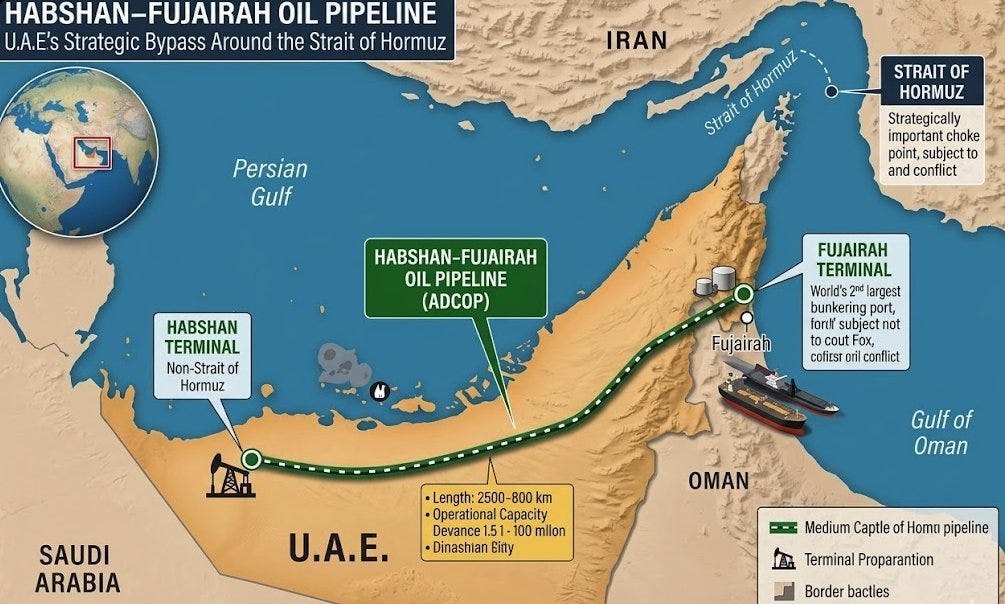
The new second pipeline, construction of which began in 2024, will effectively double Fujairah’s crude export throughput to an estimated 3–3.6 million bpd once operational in 2027. ADNOC has been ramping up utilization of the existing line during the disruptions, with exports via Fujairah surging as a percentage of total shipments. Fujairah’s role as a major storage, refining, and export hub on the Indian Ocean side further cements its strategic importance for Asia-bound cargoes.
This infrastructure push comes just weeks after the UAE’s formal exit from OPEC (and OPEC+) effective May 1, 2026. Previously constrained by quotas of roughly 3.0–3.5 million bpd despite having built out significant upstream capacity, the UAE is now free to pursue full production potential. ADNOC’s current crude production capacity stands at approximately 4.85 million bpd, with a stated target of 5 million bpd by 2027 (advanced from an earlier 2030 timeline) through ongoing $150 billion-plus investments in upstream projects. Some analysts project output could reach 4.4 million bpd as early as next year and climb toward 5 million bpd (or higher in optimistic scenarios) by the end of the decade once export bottlenecks ease.
In the near term, the Hormuz closure has forced ADNOC to curtail exports and seek creative workarounds, including limited tanker transits with transponders off and ship-to-ship transfers. The Fujairah bypass has been a game-changer, though the existing pipeline’s capacity has limited full monetization of production. With the expansion, the UAE will be positioned to bring significantly more oil to global markets independently—potentially an additional 1.5–2 million bpd or more via the secure bypass route alone, depending on utilization and overall output ramps. This represents a major increase in non-OPEC (or post-OPEC) supply from one of the world’s most reliable producers.
What This Means for the UAE, Investors, and Consumers
For the UAE, the strategy delivers enhanced energy security and economic resilience. By reducing dependence on the volatile Strait of Hormuz—through which roughly one-fifth of global seaborne oil normally flows—the country protects vital oil revenues that underpin its economy and diversification ambitions (Vision 2031 and beyond). Fujairah’s growth as an international hub will create jobs, attract investment, and strengthen the UAE’s standing as a dependable energy supplier even amid geopolitical headwinds. The move also aligns with broader regional efforts, such as Saudi Arabia’s East-West pipeline expansions, collectively eroding the strait’s strategic leverage over Gulf producers.
Investors stand to benefit from ADNOC’s accelerated growth trajectory. The company’s upstream expansions, pipeline projects, and related infrastructure (including Fujairah terminal upgrades) represent tangible opportunities in a now-unconstrained environment. ADNOC has already raised billions through listings and partnerships; further capacity utilization could drive higher revenues, dividends, and project pipelines. Globally, an increased reliable supply from the UAE may moderate price volatility, offering a hedge against future chokepoint risks for energy portfolios focused on midstream, shipping, and Asian refining plays.
For global consumers, the implications are largely positive over the medium term. A UAE capable of ramping production and exports without OPEC constraints or Hormuz vulnerabilities adds flexible, non-cartel supply to the market. This could help stabilize or ease oil prices once full flows resume, benefiting households, airlines, and industries worldwide—particularly in major importers like India, China, Japan, and South Korea that already rely heavily on UAE and Fujairah-sourced crude. In the immediate crisis, the bypass has helped prevent even sharper supply shocks.
In summary, the UAE’s doubling down on Fujairah exports is more than an infrastructure upgrade—it is a geopolitical and commercial masterstroke. By engineering away reliance on a contested chokepoint while unleashing production potential, Abu Dhabi is securing its future as a top-tier energy player. As the second West-East pipeline comes online in 2027, expect the UAE to deliver more barrels, more reliably, to a world that desperately needs them.
4.Who are the Winners and Losers from the China-US Meetings?
I think we are entering a new world for peace and a stop to endless wars.
The new Trading Blocs will include India, China, Russia, Saudi Arabia, Japan, the UAE, and the US. There will be some others in the mix, but those look to be the main group.
I could be wrong, but with our chip production ramping up, I saw more trade potential with China than with going to war. I think the world is dividing along the China / US split, with most of the world trading with both countries, as the main group. The losers in the mix are the EU, the UK, and Canada.
Net Zero because of lies?
UN Climate Panel Quietly Admits Its Doomsday Climate Scenarios Were ‘Implausible’ – How much money has been spent on Net Zero because of lies?
ENB Publisher Picks Energy Crisis Energy Policy Energy Regulations Energy Storage Energy Transition International News Regulations Renewables Not Sustainable Solar Top News Wind
The United Nations’ Intergovernmental Panel on Climate Change (IPCC) has quietly conceded that the extreme “doomsday” climate scenarios that have driven global energy policy, media headlines, and trillions in spending for more than a decade were never realistic.
In a major update to its modeling framework for the upcoming Seventh Assessment Report (CMIP7), the IPCC has demoted the high-end “exploratory” scenarios — including the notorious RCP8.5 and SSP5-8.5 pathways — as implausible. These scenarios, which assumed massive coal expansion far beyond recoverable reserves and projected up to 4–5°C of warming by 2100, dominated climate research, policy, and public discourse for years.
As climate policy expert Roger Pielke Jr. noted: “The IPCC and broader research community have now admitted that the scenarios that have dominated climate research, assessment, and policy during the past two cycles of the IPCC assessment process are implausible. They describe impossible futures.”
The admission, buried in technical guidelines published earlier this year and only recently gaining attention, confirms what energy realists have argued for years: policies rushed toward Net Zero were built on exaggerated worst-case assumptions rather than sound science or economics.
Trillions Wasted on Fearmongering and Failed Policies
For over two decades, governments, corporations, and international institutions poured resources into wind, solar, hydrogen, and related “green” infrastructure — all justified by these now-discredited doomsday projections. The world was told that without immediate, drastic action, civilization faced imminent collapse. Politicians and activists amplified the panic: Alexandria Ocasio-Cortez warned the world had only 12 years left; others labeled climate change an “existential threat.”
According to BloombergNEF and IEA data, global energy transition investment hit a record $2.3 trillion in 2025, with roughly $690 billion going directly to renewable energy (primarily wind and solar). Clean energy spending overall reached $2.2 trillion that year.
Over the past 20 years, the world has spent approximately $10 trillion on green energy initiatives — much of it driven by subsidies, mandates, and regulations rooted in the now-admitted implausible scenarios.
The Energy Realities Podcast will be covering this Live on Monday at 8:00 Eastern
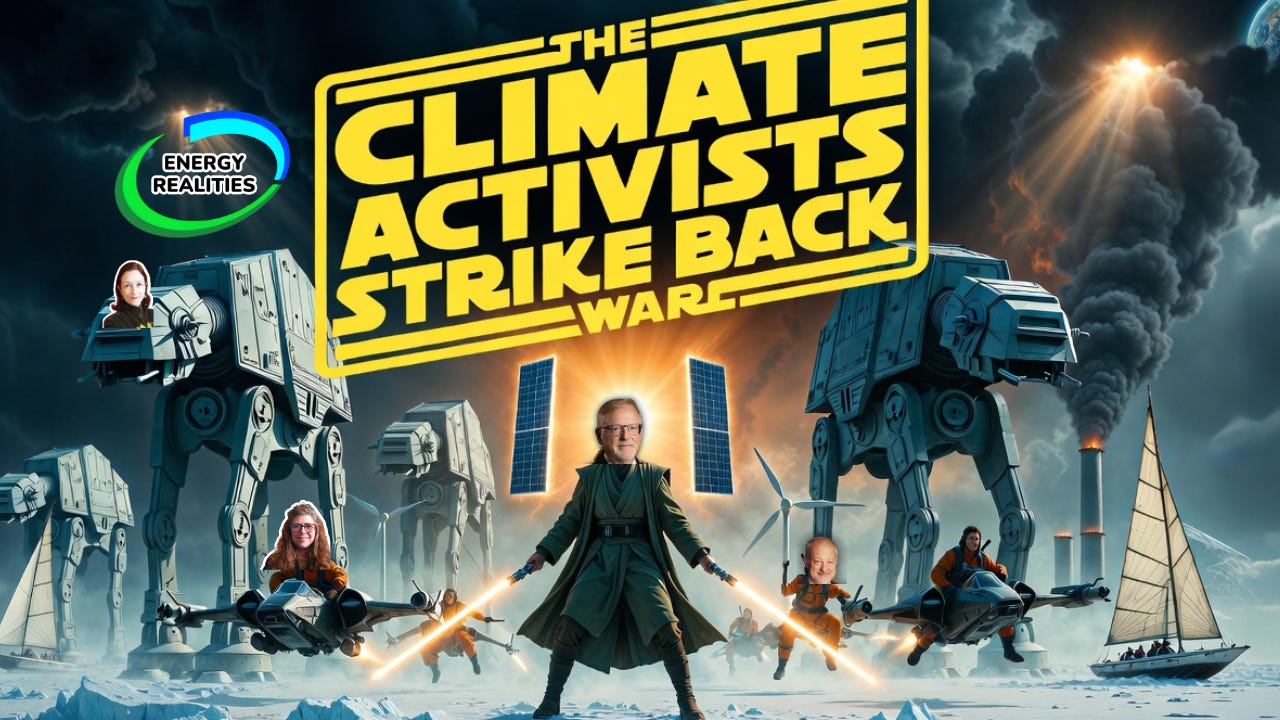
.6.The data center doomers must be defeated – But not at the cost of our family farms and water
This is a huge story, and we will be covering more of this soon.
7.Iran Attacks UAE Nuclear Plant: Drone Strike Hits Barakah Facility Amid Escalating Tensions
Power still on, but it leaves open the question how long will Iran’s finances and oil hold on?
9.AI Investments Keep Lining Up, But Are We Sure About Returns?
Thank you to all of our great subscribers, patrons, and followers. We appreciate all of you, and we are going to have a great week!!
Check out the Energy News Beat SubStack

A shout-out to Steve Reese and the Reese Energy Consulting group for sponsoring the Podcast https://reeseenergyconsulting.com/
.

Data2 if you have any business systems, can you trust A? Well, they have the patent on validation. . https://data2.zoholandingpage.com/energy
And we have WellDatabase rolling in as a new sponsor.