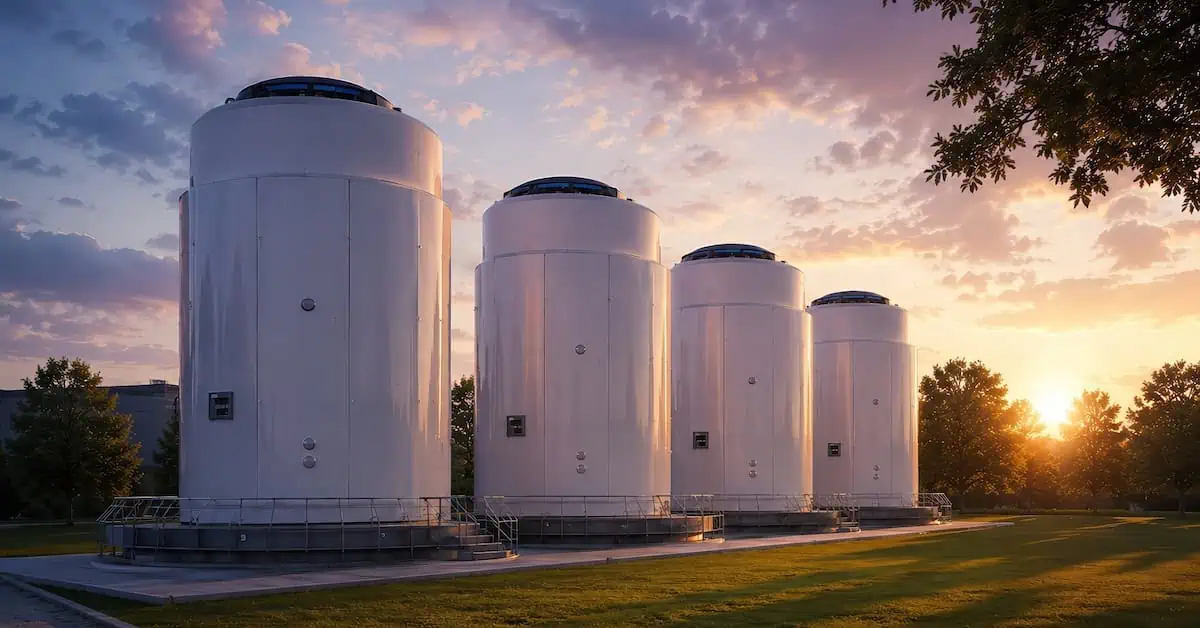
When Rwandan President Paul Kagame stood up at the Nuclear Energy Summit in Paris earlier this year, he didn’t talk like a leader hedging his bets on energy policy. He talked like a determined man in a hurry. Kagame told the assembled audience that nuclear-generated electricity technology “is evolving in ways that benefit countries with small grids, allowing Africa to be among the early adopters,” and that small modular reactors in particular are “especially suited to Africa’s requirements.” He went further, predicting that Africa will become one of the most important global markets for Small Modular Reactors (SMRs), and Rwanda isn’t just talking. The country has signed agreements with Holtec to deploy SMR-300 units, with a potential combined capacity approaching 5 GW, and Kagame has set a target of having Rwanda’s first SMR operational in the early 2030s.
A Whole New World: This is a remarkable change in direction. For decades, nuclear electricity was treated as the exclusive domain of wealthy, industrialized nations with deep pockets, massive grids, and decades of institutional experience. Kagame’s message flips that script. Small modular reactors are not a watered-down version of nuclear power for countries that can’t afford the real thing. They are, in many ways, a better fit for the world that’s actually emerging in reality – one defined by distributed populations, smaller grids, off-grid industrial sites, and an insatiable new appetite for electricity driven by data centers and AI infrastructure.
That last point deserves more attention than it’s getting. The conversation around SMRs has, for years, centered on remote communities, mining operations, and developing-world electrification. All of that remains true. But the most urgent driver of SMR demand right now is coming from somewhere else entirely: the data center industry.
AI training and inference workloads are pushing electricity demand curves in directions grid planners didn’t model for. Hyperscalers are now openly discussing co-locating reactors with their facilities because waiting in a multi-year interconnection queue for new transmission capacity is no longer an option when your competitors are racing to bring compute online. A reactor that can be sited close to load, built in a fraction of the time of a traditional gigawatt-scale plant, and scaled in modular increments as demand grows, is exactly the kind of asset this moment calls for.
And this is where the real bottleneck lives, not in the technology, but in the paperwork. As of early 2026, the global SMR pipeline includes more than 80 designs tracked by the International Atomic Energy Agency across over 20 countries, yet only a handful of units are actually under construction anywhere in the world. In the United States, despite years of hype and tens of billions in announced investment, no SMR construction license had been issued as of early 2026, though GE Hitachi and X-energy applications are working their way through the Nuclear Regulatory Commission’s review process. Canada has placed one commercial order, and as of January 2026, that project hadn’t broken ground. The gap between ambition and concrete poured is the defining tension of this entire sector.
It doesn’t have to be this way. And South Africa, of all places, proved it more than sixty years ago.
Nuclear Success in South Africa: In 1960, South Africa began planning a 20MW research reactor at Pelindaba, near Pretoria, as part of the Atoms for Peace program. Construction started the following year. By March 1965 (roughly five years after planning began, and about four years after groundbreaking), the SAFARI-1 reactor went critical. Five years. From a standing start, with 1960s-era technology, a country with no prior nuclear infrastructure built and commissioned a working reactor in less time than it currently takes many wealthy nations just to get an SMR design through licensing review.
What’s even more striking is what that reactor is still doing today. More than sixty years later, SAFARI-1 remains one of the world’s most heavily utilized research reactors, and it supplies up to a quarter of the world’s workhorse radioisotope behind the majority of medical imaging procedures performed globally. A reactor built in five years, during the Cold War, with none of today’s design tools, computational safety modeling, or manufacturing precision, has been quietly underpinning global cancer diagnostics and cardiac imaging for two generations. That’s not a quaint historical footnote. It’s a direct challenge to anyone who claims modern nuclear projects inherently require a decade or more of regulatory runway before a single weld gets made.
The contrast with today’s licensing timelines is not a technology problem. SMR designs benefit from passive safety systems, factory fabrication, standardized components, and decades of operational data from existing light-water reactor fleets that SAFARI-1’s builders simply didn’t have access to. If anything, the case for moving faster is stronger now than it was in 1960, not weaker. What’s changed is the regulatory apparatus surrounding nuclear power built up over decades, often for good intentions, but now calcified into review processes that treat every SMR application as though it were a novel gigawatt-class plant requiring the same exhaustive, sequential scrutiny.
The Strategic Opportunity: This is precisely the gap Kagame is pointing at when he talks about institutions, regulation, and workforce as the prerequisites for nuclear deployment. It is notable that the IAEA’s own review of Rwanda’s preparations cited strong government coordination and commitment as a key strength. Rwanda isn’t waiting for a perfect regulatory template to be handed down from Washington or Paris. It’s building the institutional capacity to run a streamlined, IAEA-aligned approval process in parallel with its infrastructure planning, precisely because it understands that the country that solves the regulatory bottleneck first will be the one that actually gets reactors built.
The implications extend well beyond Africa. Every government currently sitting on stacks of SMR applications, whether in North America, Europe, or Asia, should be looking at both ends of this story. On one end, a 1960s reactor built in five years that still does meaningful work for the world six decades later. On the other hand, a 2026 landscape where dozens of modern, safer, more efficient designs sit in review queues while data centers go without power and rural grids stay underserved.
Decentralized power isn’t a future scenario anymore. It’s the operating reality for data centers, mines, industrial parks, and grids too small or too remote to justify gigawatt-scale plants. SMRs are the technology built for that reality. The only question left is whether regulators can move at the speed the moment demands? Or whether they will let history’s fastest reactor build remain, embarrassingly, the fastest one on record.
Please share this information with teachers, students, and friends to encourage Energy Literacy conversations at the family dinner table.
Click this Link to Sign up for Energy Literacy from Ronald Stein.