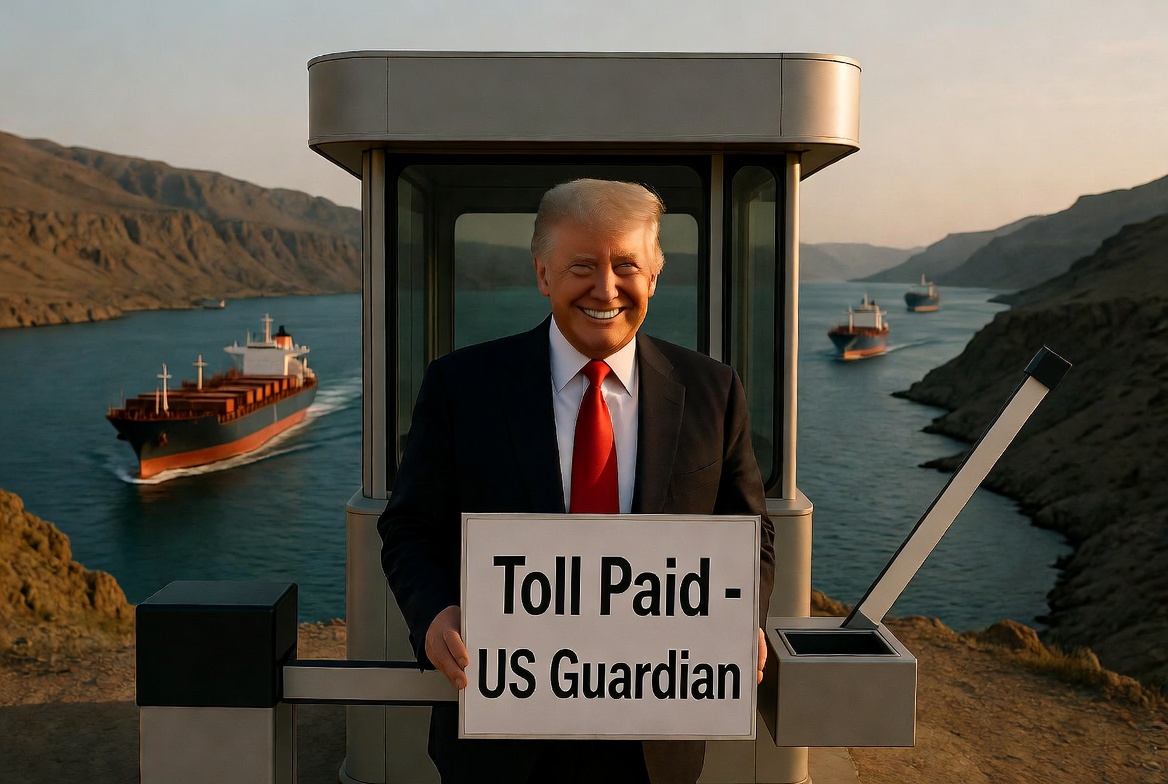
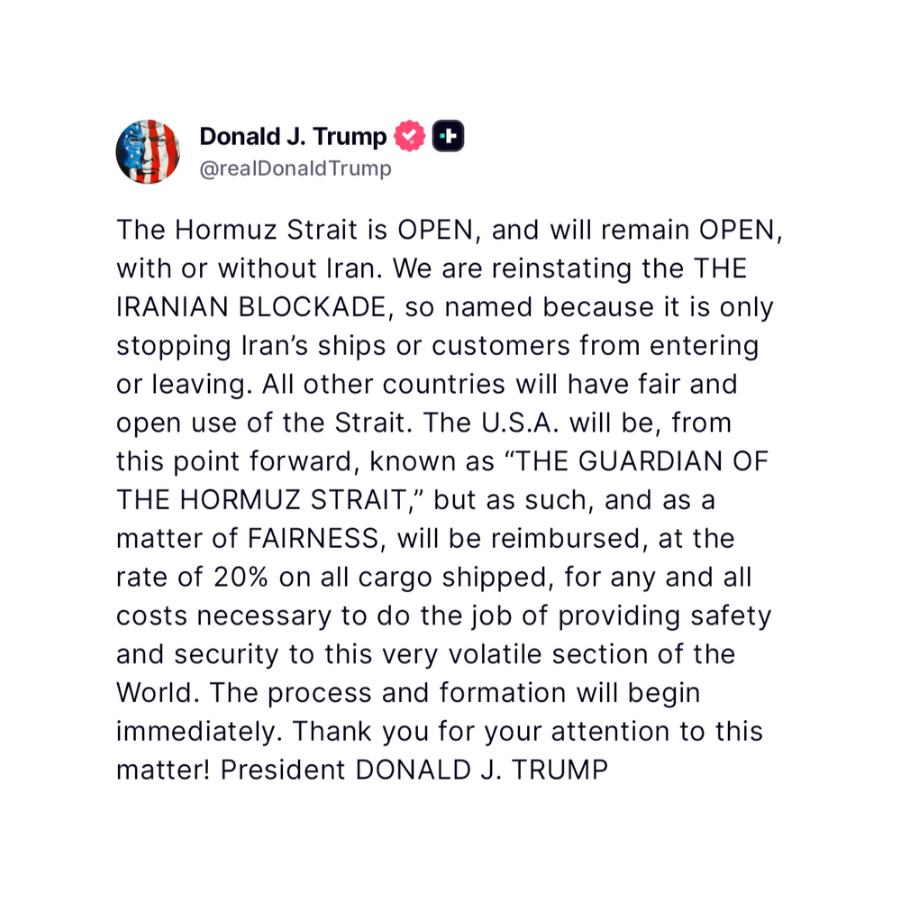
President Donald Trump announced today that the United States would reinstate a blockade on Iranian ships transiting the Strait of Hormuz while demanding a 20% reimbursement on all other cargo shipped through the critical waterway. Trump declared the US would become the waterway’s “GUARDIAN,” positioning the move as reimbursement for security costs amid heightened US-Iran tensions.
The statement, reported by Bloomberg, escalates an ongoing dispute over control and access to the Strait of Hormuz — the narrow chokepoint at the mouth of the Persian Gulf through which roughly 20% of global oil trade normally flows (around 20 million barrels per day in peacetime, including crude, condensate, and petroleum products.
Strategic Context and Recent Developments
The announcement follows reported breakdowns in ceasefires and recent US and Iranian strikes. Trump framed the 20% rate as compensation for US military protection of shipping lanes, effectively proposing a US-imposed toll on non-Iranian traffic while blocking Iranian vessels.
Historically, the Strait has operated under international norms of freedom of navigation. Iran has previously denied seeking tolls or service fees on transiting ships, with Trump himself noting in June 2026 that Tehran assured the US there would be “NO TOLLS, NO INSURANCE COSTS, & NO OTHER CHARGES.” The shift to a US “guardian” role with a 20% reimbursement marks a significant policy pivot.
Bypass Initiatives Accelerating
While the proposed US reimbursement could generate short-term revenue to offset military costs, multiple regional projects are rapidly advancing to reduce dependence on the Strait of Hormuz entirely. These efforts suggest any toll-based revenue model — whether Iranian or American — faces structural limits as traffic diversifies.
United Arab Emirates (UAE) Developments
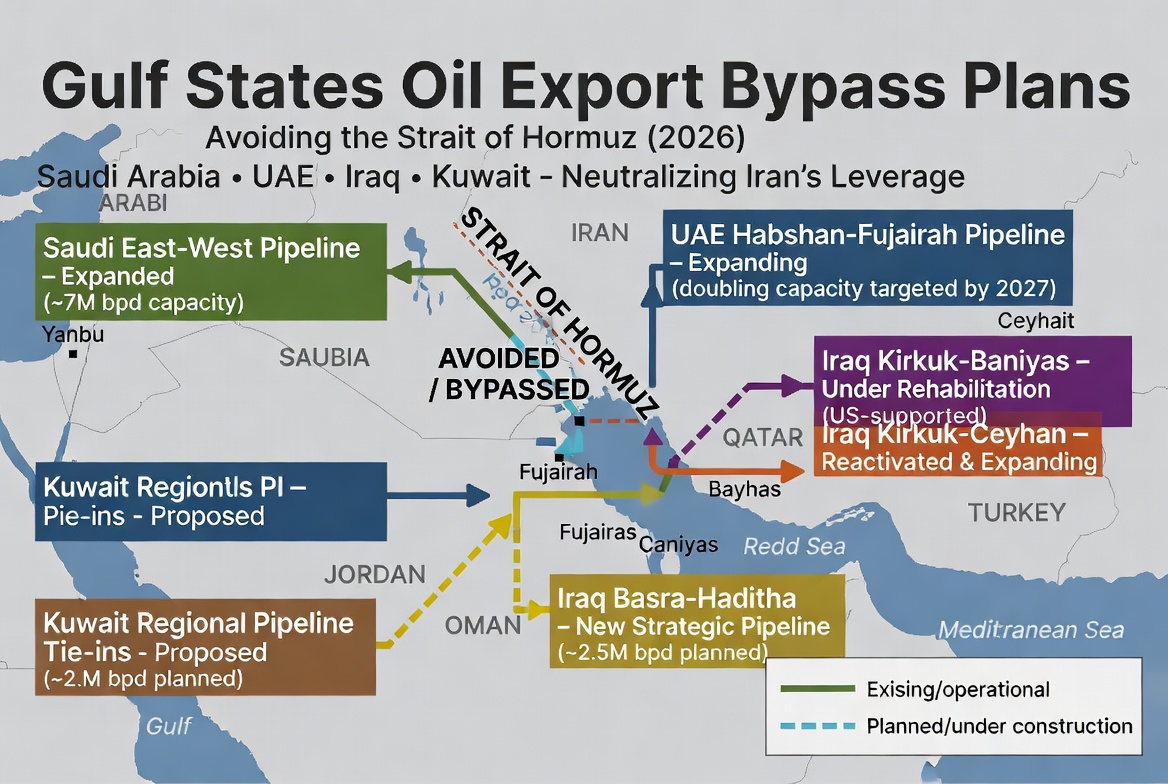
The UAE is fast-tracking infrastructure outside the Strait. DP World is in advanced talks to develop a new multipurpose port and container terminal in Fujairah on the Gulf of Oman (east coast of the UAE). This would allow containers to bypass the Strait entirely, with goods then trucked overland to Dubai, Abu Dhabi, and other Gulf destinations.
On the energy side, the UAE is accelerating a new West-East oil pipeline to Fujairah, expected to double Abu Dhabi’s export capacity via the existing Habshan-Fujairah pipeline (currently up to ~1.8 million barrels per day). The new line is targeted for operation by 2027.
Iraq Pipeline Revival
Iraqi Prime Minister Ali al-Zaidi is scheduled to meet President Trump in Washington in the coming days to discuss major energy projects. A key focus is the revival of the historic Kirkuk-Baniyas oil pipeline — a roughly 500-mile route from northern Iraq’s Kirkuk fields through Syria to the Mediterranean port of Baniyas.
The pipeline, originally built in the 1950s with a capacity of around 300,000 barrels per day, has been inactive since the 1980s and damaged in subsequent conflicts. Repairs are estimated in the billions (one figure cited around $4.5 billion), with a US consortium potentially involved. The project would give Iraq direct access to Mediterranean export routes, significantly reducing its near-total reliance on Hormuz (where Iraqi seaborne exports recently dropped to just 8% of prior averages).
Iraq is also advancing other internal pipelines (e.g., Basra to Haditha) to enable exports via Jordan’s Aqaba or the revived Syrian route.independent.co.uk
Broader Regional Pipeline Network
Saudi Arabia continues to utilize its East-West Pipeline (capacity up to 5+ million barrels per day exportable to Yanbu on the Red Sea), ramping up flows significantly in 2026 amid disruptions.
Combined capacity of major existing and planned alternatives (Saudi East-West, UAE Habshan-Fujairah and expansion, Iraq routes) has been estimated at around 9 million barrels per day — meaningful diversification but still well short of fully replacing the Strait’s ~20 million bpd peacetime throughput.
Additional projects include rail corridors, expanded ports (Fujairah, Khor Fakkan, etc.), and overland trucking options that are already being used during current disruptions.
Short-Term Revenue vs. Long-Term Reality
The proposed 20% US reimbursement on Hormuz traffic represents a potential short-term mechanism to help fund American military presence in the region. However, as bypass infrastructure comes online — particularly the UAE’s Fujairah expansions and Iraq’s Mediterranean outlet — the volume of oil and cargo still transiting the Strait is likely to decline over time.Iran’s potential toll revenue would similarly be constrained. For the US, treating Hormuz fees as a reliable, ongoing revenue stream to offset military costs appears optimistic given accelerating regional efforts to reroute trade and energy flows.
Key Questions Raised
- Enforceability: How would a 20% US fee be collected and enforced on international shipping in international waters? What are the legal and diplomatic implications?
- Impact on Global Markets: Would higher shipping costs from a Hormuz fee push more cargo to bypass routes faster, accelerating infrastructure investment?
- Allied and Commercial Reactions: How will major importers (Asia, Europe) and shipping companies respond to added costs or restrictions?
- Sustainability: Can the US sustain a “guardian” role long-term if traffic volumes drop due to successful bypasses?
- Iranian Response: Will Tehran accept a US-imposed fee structure, or will tensions escalate further?
These developments underscore a broader strategic shift: Gulf producers and global traders are actively building resilience against Hormuz vulnerabilities, whether from conflict, blockades, or new toll regimes.
The coming weeks — including the Trump-Zaidi meeting and further clarity on US policy implementation — will be critical in determining whether the 20% reimbursement becomes a temporary measure or part of a longer-term restructuring of energy security in the region.
Appendix: Sources and Links
- Bloomberg: “Trump Says US Will Be Reimbursed 20% Rate for Hormuz Traffic” (July 13, 2026)
https://www.bloomberg.com/news/articles/2026-07-13/trump-says-us-will-be-reimbursed-20-rate-for-hormuz-traffic - Middle East Eye: “Exclusive: Syria, Iraq and US plan to unveil Mediterranean pipeline deal to bypass Strait of Hormuz” (July 2026)
https://www.middleeasteye.net/news/exclusive-syria-iraq-and-us-plan-unveil-mediterranean-pipeline-deal-bypass-hormuz - X Trending / Reports on Iraq PM visit and Kirkuk-Baniyas pipeline (July 11, 2026)
https://x.com/i/trending/2075916409604026447 - DP World Fujairah new port plans (July 13, 2026)
https://x.com/i/trending/2076667787288666510 - Reuters / ADNOC: UAE accelerating West-East pipeline to Fujairah by 2027 (May 2026)
https://www.reuters.com/business/energy/uae-accelerate-oil-pipeline-project-help-bypass-hormuz-2026-05-15/ - Al Jazeera: “Saudi, UAE, Iraq: Can three pipelines help oil escape Strait of Hormuz?” (March 2026, with ongoing relevance)
https://www.aljazeera.com/economy/2026/3/27/saudi-uae-iraq-can-three-pipelines-help-oil-escape-strait-of-hormuz - Additional context from Reuters, CNBC, The Guardian, and regional reports on pipeline capacities and bypass efforts (2026).
Images: Maps and Fujairah port visuals sourced via web search for illustrative purposes (publicly available news graphics and port imagery). This article reflects the latest available reporting as of July 13, 2026. Developments are fluid.