

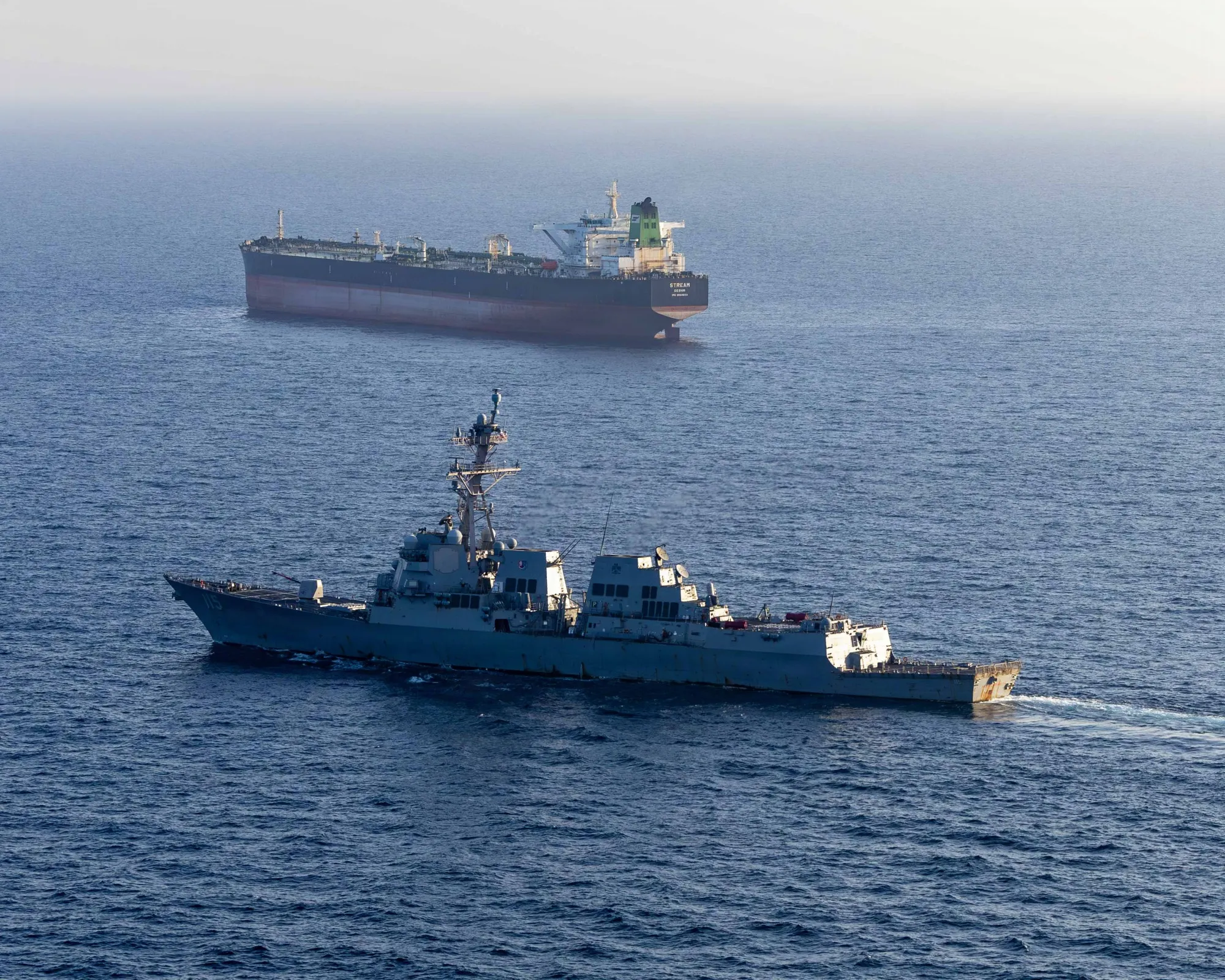
President Donald Trump stated on August 14, 2026, that he plans to declare the Strait of Hormuz a territory of the United States once the ongoing conflict with Iran concludes. Speaking at the Nassau County Police Academy (also referenced as the David S. Mack Center) in Garden City, New York, Trump said: “After we finish defeating Iran, which is being very badly defeated, pretty soon I’ll be declaring the Hormuz Strait a territory of the United States… Essentially that’s what we have. We have the blockade. No ships get through unless we want them to.” The remark drew applause from the audience.
This comes amid a war that began in late February 2026 with joint U.S.-Israeli strikes on Iran that killed Ayatollah Ali Khamenei. The conflict has centered heavily on control of the Strait of Hormuz, the narrow waterway linking the Persian Gulf to the Gulf of Oman and the wider Indian Ocean. Roughly 20% of the world’s seaborne oil (historically around 20-21 million barrels per day pre-war) and significant volumes of LNG and other commodities typically transit the strait. Current flows remain constrained well below pre-war levels due to the fighting, a U.S. naval blockade targeting Iranian shipping and ports, Iranian harassment or attacks on commercial vessels, and competing claims of control. U.S. officials have cited recent seven-day averages approaching 9 million barrels per day through the strait (with additional volumes via pipelines), while independent tanker tracking shows lower confirmed figures and continued disruptions.
In July 2026, Trump had already floated a related idea: the U.S. becoming the “guardian” of the strait, reimposing a blockade on Iranian traffic while allowing other nations free use, and seeking reimbursement at a rate of 20% on all cargo shipped to cover security costs. He argued the U.S. had guarded the waterway for decades without compensation.
Iran rejected the latest comments. Deputy Foreign Minister Kazem Gharibabadi stated that the Strait of Hormuz “cannot be seized by tweet, nor by aircraft carrier, nor by issuing an order, nor by an election speech,” insisting it remains under Iranian management and control and that Iran does not fear threats or shows of force. Tehran has previously asserted authority to regulate or close the waterway and has floated its own fee or service-charge mechanisms.
Potential Issues
Declaring the strait U.S. territory would face profound legal, diplomatic, economic, and military obstacles.International law and sovereignty: The Strait of Hormuz at its narrowest is about 21 nautical miles wide and lies primarily within the territorial seas (up to 12 nautical miles) of Iran and Oman. Under the United Nations Convention on the Law of the Sea (UNCLOS)—widely regarded as reflecting customary international law even though neither the U.S. nor Iran has ratified it—the strait is an international strait used for navigation between high seas or exclusive economic zones. Vessels enjoy a non-suspendable right of transit passage. Coastal states may regulate safety and navigation in limited, non-discriminatory ways but cannot impede transit, demand prior authorization for most traffic, or claim exclusive sovereignty that extinguishes the rights of third states. A unilateral U.S. territorial declaration would directly conflict with these norms, the sovereignty claims of Iran and Oman, and long-standing U.S. advocacy for freedom of navigation (including in places such as the South China Sea). Historical precedents and ICJ rulings (e.g., Corfu Channel) reinforce rights of passage through international straits.
Diplomatic and regional fallout: Oman, which shares the strait and has historically maintained a neutral mediator role between the U.S. and Iran, would face an existential challenge to its territorial waters. Gulf Arab states, China (a major oil importer dependent on Hormuz flows), European allies, Russia, and others relying on open energy transit would likely view such a claim as destabilizing and precedent-setting. It could fracture coalitions, invite reciprocal claims elsewhere, and complicate any residual diplomacy.
Earlier tensions already arose when Oman and Iran discussed possible “service” fees, prompting sharp U.S. warnings.Energy market and economic risks: The strait’s status as a global energy chokepoint means any formal territorial claim or intensified enforcement could further suppress tanker traffic, elevate insurance costs, encourage more “dark” shipping, and drive oil and LNG prices higher. Pre-war volumes of ~20+ million barrels per day of petroleum liquids have already been sharply reduced; prolonged uncertainty or conflict over sovereignty would amplify volatility, hit Asian importers hardest, and pressure U.S. consumers already facing elevated gasoline prices (above $4/gallon nationally in some reports). Trump has urged Americans to accept “a tiny little bit more” for gasoline as the price of preventing a nuclear-armed Iran, while emphasizing energy security goals. Alternative pipelines (e.g., East-West, Fujairah) provide partial bypass but cannot fully replace Hormuz capacity.
Military and operational burdens: Sustaining a permanent U.S. territorial claim would require an indefinite large-scale naval and military presence to enforce it against Iranian resistance, mines, drones, missiles, or asymmetric attacks. Defense Secretary Pete Hegseth has noted the Navy can maintain the current blockade “indefinitely” via rotations, but formal territorial status raises the stakes for any Iranian challenge and risks mission creep or escalation. U.S. forces and commercial shipping would remain exposed in a confined, high-threat environment.
Impact on the Iran-U.S. Conflict
The statement escalates rhetoric at a moment of stalemate. A nominal ceasefire and memorandum of understanding earlier in 2026 broke down, with Iran resuming vessel attacks (including recent drone strikes blamed on Tehran by the UAE) and the U.S. enforcing its blockade to cripple Iran’s oil-dependent economy. Trump frames the war as necessary to eliminate Iran’s nuclear threat and argues the U.S. already effectively controls the strait via the blockade.
Declaring the waterway U.S. territory would signal permanent American dominance rather than a temporary wartime measure or negotiated return to free transit. This hardens Iranian resolve, reduces incentives for compromise (Tehran has conditioned reopening on recognition of its role, reparations, blockade lifts, and force withdrawals), and makes de-escalation harder ahead of U.S. midterm elections. It shifts the conflict from countering nuclear capabilities and regime pressure toward long-term territorial control of a global commons, potentially prolonging hostilities, increasing the risk of broader regional involvement, and complicating efforts to restore full energy flows.
For global energy markets, the core issue remains reliable, open transit of oil and gas. Unilateral sovereignty claims—whether by Iran seeking control and fees or the U.S. asserting territory—undermine the international legal framework that has historically kept the strait functional. Markets will continue watching tanker data, pipeline utilization, insurance rates, and diplomatic signals for signs of stabilization or further disruption. Any durable resolution will need to prioritize non-suspendable transit rights for all nations while addressing security concerns, rather than exclusive national claims over the waterway itself.
Higher energy prices and supply uncertainty already represent a domestic political liability; formalizing territorial ambitions could lock in those costs for longer while testing alliances and international norms that undergird global energy trade.
Appendix: Sources and Links
- Just the News (original referenced article): https://justthenews.com/government/security/trump-declare-strait-hormuz-us-territory
- USA Today: https://www.usatoday.com/story/news/politics/2026/08/14/trump-straight-of-hormuz-territory-iran-war/91310185007/
- Al Jazeera: https://www.aljazeera.com/news/2026/8/14/trump-says-he-will-declare-strait-of-hormuz-a-us-territory
- Times of Israel: https://www.timesofisrael.com/trump-says-hell-hit-iran-hard-economically-will-soon-declare-hormuz-us-territory/
- Washington Examiner: https://www.washingtonexaminer.com/policy/infrastructure/4688168/trump-says-soon-would-declare-strait-of-hormuz-united-states-territory-prices/
- POLITICO (July guardian/fee proposal): https://www.politico.com/news/2026/07/13/donald-trump-strait-of-hormuz-fee-00994508
- CBS News (July guardian remarks): https://www.cbsnews.com/news/trump-iran-war-us-guardian-strait-of-hormuz-get-paid/
- Reuters explainer on tolls and law: https://www.reuters.com/world/middle-east/can-iran-legally-impose-tolls-strait-hormuz-2026-04-16/
- Chatham House on shipping and law: https://www.chathamhouse.org/2026/04/strait-hormuz-shipping-and-law
- Just Security analysis: https://www.justsecurity.org/153505/iran-conditions-hormuz-international-law/
- Washington Institute: https://www.washingtoninstitute.org/policy-analysis/countering-irans-latest-smart-control-gambit-strait-hormuz
- EIA/related oil volume context via Rigzone and tanker reports (e.g., AGBI, Yahoo Finance/Fortune coverage of flows).
- X clip of Trump remarks (via Acyn): https://x.com/Acyn/status/2088354041294422391
Additional contemporaneous coverage from Yonhap, South China Morning Post, ABC (Australia), CBC, The Guardian, and others confirms the core statements and Iranian responses. Legal analyses draw on UNCLOS provisions (Articles 37–44 on transit passage) and customary law as reflected in multiple expert sources.