Chinese-headquartered companies have delivered more than 70 GW of inverters to America’s commercial and utility solar plants, while each U.S. grid is designed to ride through the sudden loss of roughly 2.8 to 3.9 GW. Replacing one big transformer now takes about two and a half years. What has actually been found, what Washington has done since 2019, and what the record says about the “Biden put them back” story.
Think about what you would lose first. Food in the fridge is only safe for up to four hours without power; a full freezer lasts about two days. Insulin needs to stay cool. An oxygen concentrator or a CPAP machine needs a wall plug. In January the furnace blower stops; in August the air conditioning does. The diner down the street throws out its walk-in cooler and sends its cooks home. Most of us have lived through a storm outage that lasted a few hours or a few days. The question behind this piece is whether someone overseas could cause one on purpose, and whether we could fix it quickly if they did.
The short answer, based on the public record: nobody has shown that China has a switch that can turn off the American grid. But the pieces that would make such an attack possible are real and well documented. Much of the electronics on new solar and battery plants comes from Chinese companies. Security researchers keep finding holes in it. And the heavy equipment you would need for repairs takes years to order. Here is what we know, what we don’t, and what changed this summer.
| Stu’s Take
Our grids are built to survive losing roughly 2.8 to 3.9 gigawatts of power plants at once. Chinese-headquartered companies have delivered more than 70 GW of inverters to U.S. commercial and utility solar over the last decade. Nobody has publicly proven there is a kill switch in that gear. But the government’s own July 2026 security determination says foreign firms could use inverters to “turn off” equipment or pull data, and Reuters reported undocumented radios inside some units. The part that matters for your power bill and your fridge: if it ever happened, the fix is not a software patch. It is a transformer that takes 128 weeks to arrive. DOE’s comment window on the new grid emergency order closes Oct. 9. If you work in this industry, file your comments. This article also fact-checks several ENB articles we published on this and clarifies a few points. Being upfront about sources and sourcing methods helps set the standard that seems missing. |
What investigators have actually found
The headline that set this off came from Reuters on May 14, 2025. Two people familiar with the matter told the news agency that U.S. experts taking apart Chinese-made solar inverters and batteries had found communication devices, including cellular radios, that were not listed in product documents. The finds came over nine months, in equipment from several suppliers. Reuters did not name the manufacturers or say how many units were affected, and the U.S. government had not publicly confirmed the findings. The Energy Department told Reuters that such functions “may not have malicious intent” but that buyers need “a full understanding” of what they are installing (Reuters via Yahoo). This is the strongest public report of hidden hardware, and it rests on unnamed sources.
There is also a documented case of remote shutdown, though not a sinister one. In November 2024, some Deye-made inverters sold under the Sol-Ark name in the United States stopped working after a remote authorization message. Deye said only “a few” units were affected, that it involved no human intervention, and that they were gray-market units sold outside authorized channels (heise; Solarboi). Whatever the reason, it proved a manufacturer can reach installed gear over the internet.
Software holes are better documented than hardware ones. In March 2025, Forescout reported 46 new vulnerabilities in inverters from Sungrow, Growatt and SMA, all since patched. It also found that 53% of inverter makers and 58% of storage suppliers it reviewed are based in China. Europe’s cyber agencies have taken note: Germany’s BSI sees “substantial risk potential” (Clean Energy Wire), and the Czech agency NÚKIB has warned against remote administration from China (NÚKIB). The Dutch economy minister was more skeptical, calling hidden hardware “highly unlikely” and “easily detectable” (pv magazine).
Batteries got the same scrutiny. Duke Energy disconnected CATL batteries at Camp Lejeune in December 2023 and agreed in February 2024 to decommission them (House China Select Committee). For big transformers, the record is thinner still, as we explain in the corrections section below.
How much Chinese equipment is in the U.S. grid?
It depends on which piece of the grid you mean, and every answer comes with an asterisk.
Inverters. These are the boxes that turn solar and battery DC power into grid AC power and take orders from operators. Wood Mackenzie says more than 200 GWac of commercial and utility-scale inverters were delivered in the U.S. over 10 years. More than 90% were imported, and more than 70 GW came from Chinese-headquartered makers, mostly built in Southeast Asian factories. Chinese vendors held nearly half the U.S. market in 2024 and 2025 (Wood Mackenzie). Wood Mackenzie research analyst Joe Shangraw, quoted by Canary Media, put their share of the utility and commercial segment at about 60%, while SolarEdge, Enphase and Tesla hold about 80% of rooftop inverters (Canary Media). Strider counted nearly half of U.S. inverter shipment records from 2015 to 2024 (30,253 of 64,566) as tied to Chinese makers with direct risks (Strider). Customs figures understate all this because Chinese brands ship from Vietnam, Thailand and elsewhere.
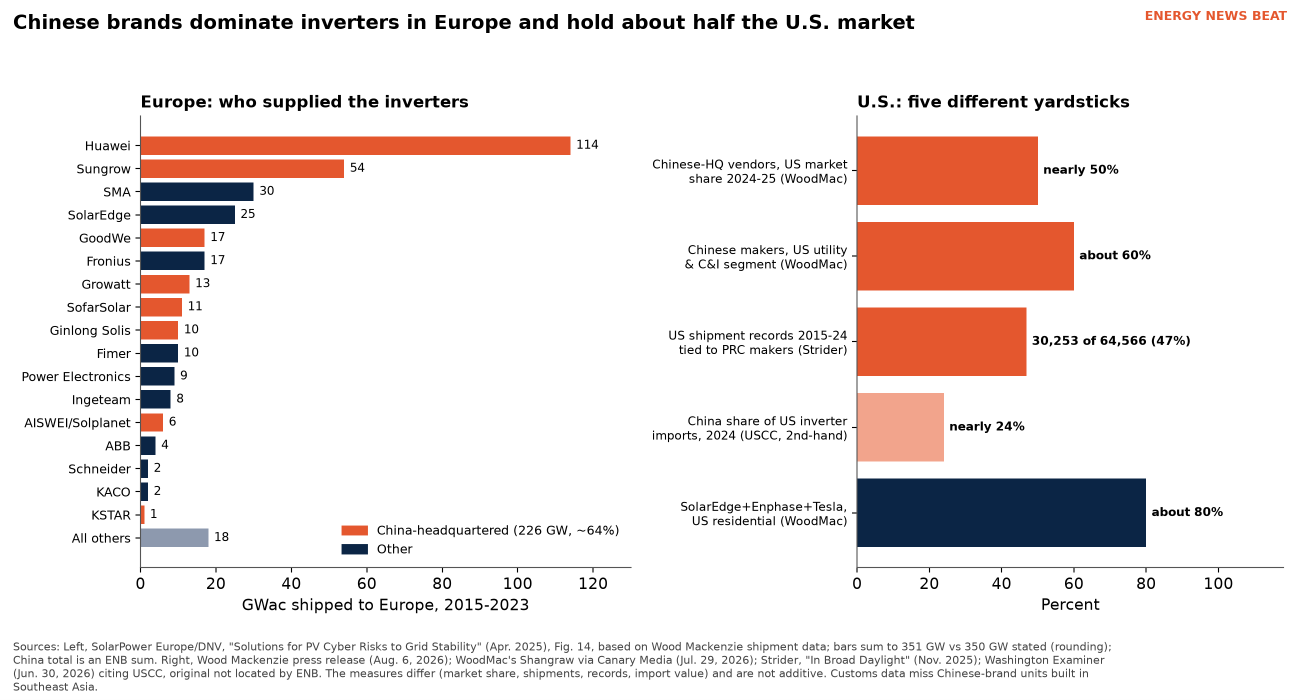
Chart 2. Chinese brands supplied about 64% of Europe’s inverters shipped from 2015 to 2023 and roughly half of the U.S. market. Sources: SolarPower Europe/DNV; Wood Mackenzie; Canary Media; Strider; Washington Examiner.
Large transformers. Here China is a small player by origin. U.S. imports of the biggest oil-filled transformers (above 10,000 kVA) climbed from $0.97 billion in 2019 to $4.15 billion in 2025. China’s share of that value was just 0.8% to 4.5% a year, 2.2% in 2025, or 147 units. Mexico, South Korea, Brazil and Austria lead (UN Comtrade; ENB calculation). That matters because the U.S. imports most of its big transformers. DOE says 82% of large power transformers were imported in 2019 (DOE 2024). A DOE counterintelligence official said in 2019 that more than 200 Chinese transformers had entered the U.S. grid over the prior decade, “before that, there were zero” (E&E News
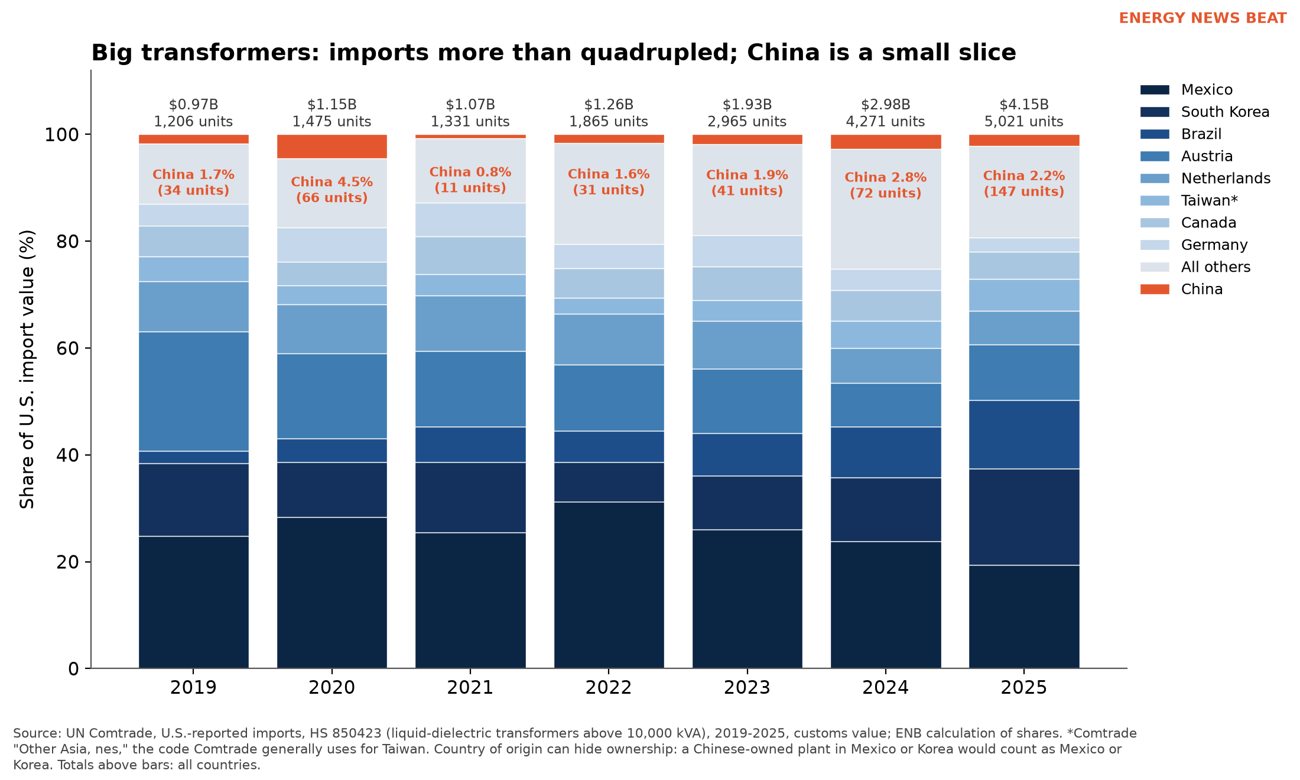
Chart 1. China supplied 0.8% to 4.5% a year of U.S. large-transformer import value from 2019 to 2025. Source: UN Comtrade, HS 850423; ENB calculation.
Batteries and control systems. China supplied 69% of U.S. lithium-ion battery imports by value in 2024 and 59% in 2025 (UN Comtrade). Those figures include car and laptop batteries, so they only hint at grid storage. For SCADA and control systems, ENB found no public count of Chinese-made equipment in U.S. utilities. That is a real data gap.
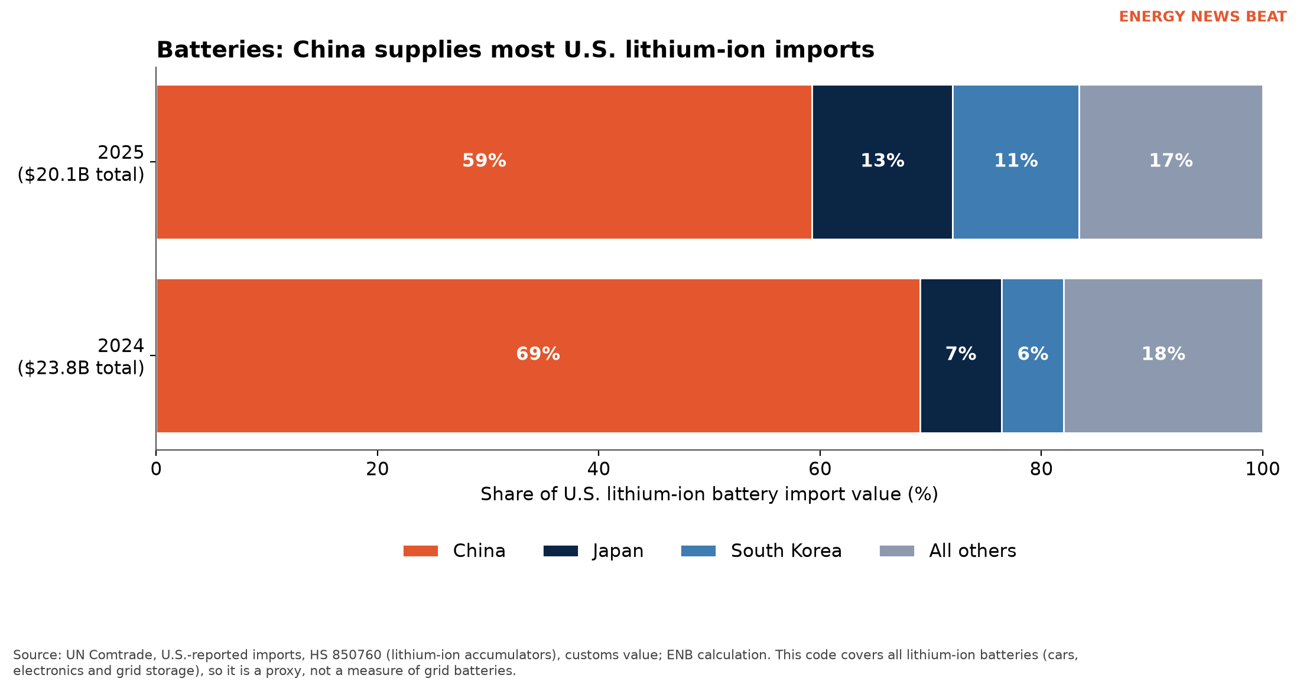
Chart 6. China’s share of U.S. lithium-ion battery imports fell from 69% to 59% but still leads by far. Source: UN Comtrade, HS 850760; ENB calculation.
How much power could be switched off remotely?
No one has published a measured figure, so any honest answer is a range. Start with what the grid is built to handle. NERC’s 2025 frequency-response analysis sets each interconnection’s “resource loss protection criteria,” the two largest losses it must ride through: 2,805 MW for Texas, 2,918 MW for the West and 3,875 MW for the East (NERC). Continental Europe plans for a 3,000 MW reference incident. The industry study done by DNV for SolarPower Europe says a targeted hit on 3 GW “can have significant implications” and that losing more than 10 GW would “most likely trigger a cascading outage” (SolarPower Europe/DNV).
We have seen what inverters do when they misbehave by accident. In the 2016 Blue Cut fire in California, about 1,200 MW of solar dropped offline after a line fault. Near Odessa, Texas, 1,112 MW of solar cut back in May 2021, and 2,555 MW of resources tripped in June 2022. None of these caused a blackout, partly because they stayed below those design limits.
Now the exposure. Strider identified at least 5.4 GW at 66 solar sites in 22 states using equipment from Chinese companies it rates high-risk (Strider). That is a floor, not a full count. The ceiling for Chinese-brand commercial and utility inverters is the 70-plus GW WoodMac counts, which is more than 18 times the largest U.S. design loss (ENB calculation). In Europe, Chinese brands shipped about 226 GW of inverters from 2015 to 2023 in DNV’s data (ENB sum), and DNV estimates seven manufacturers could each reach more than 10 GW if they hold remote access to 70% of their fleets (SolarPower Europe/DNV).
The catch is reach. Many utility plants sit behind plant controllers and firewalls, and Sungrow says its U.S.-bound inverters lack remote upgrade and communication functions (ESS News). So the honest range for remotely controllable Chinese-linked capacity in the U.S. runs from zero proven to tens of gigawatts in theory. Even a few gigawatts, timed badly, would test those limits.
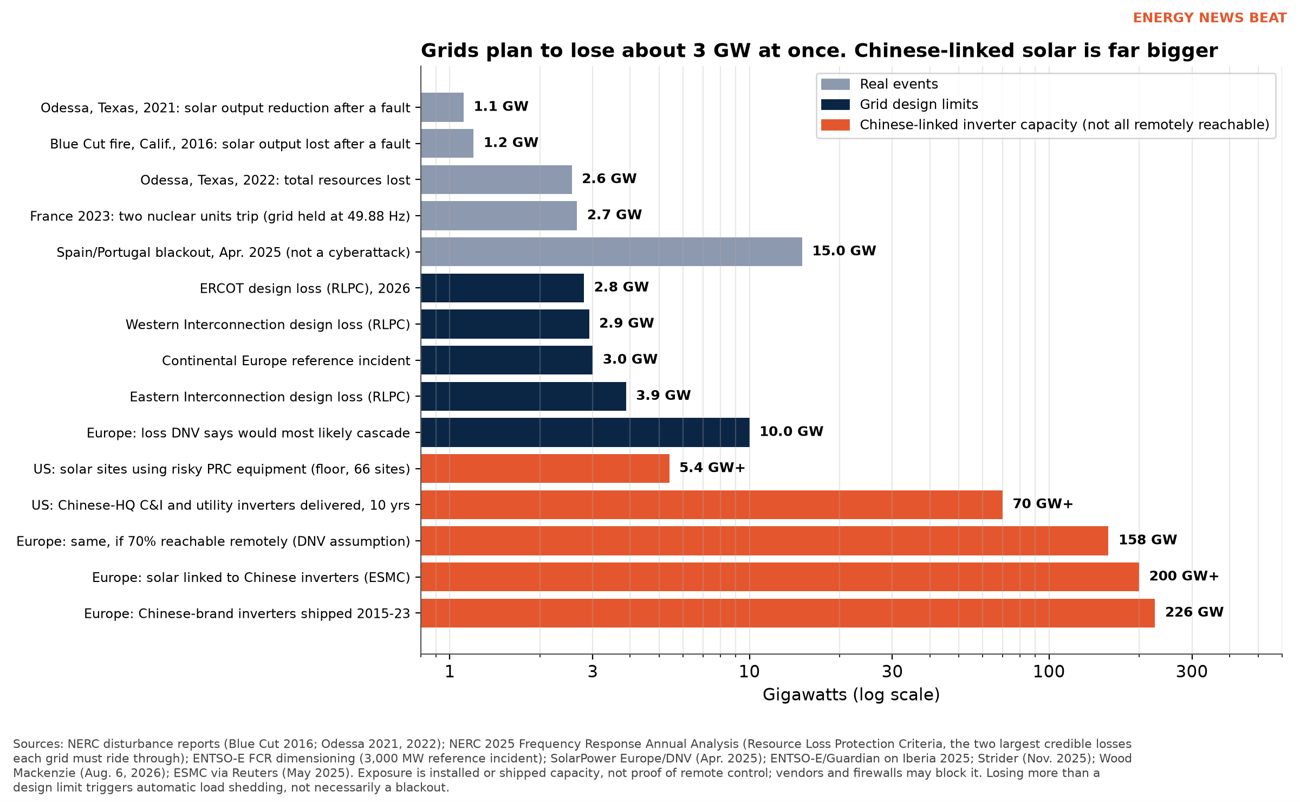
Chart 5. Chinese-linked inverter capacity compared with the losses grids are designed to survive. Exposure is not the same as proven remote control. Sources: NERC; ENTSO-E; SolarPower Europe/DNV; Strider; Wood Mackenzie; ESMC via Reuters.
Why the lights could stay off: the transformer problem
Inverters are the door. Transformers are why a break-in could be so costly. Large power transformers weigh 150 to 400 tons, are custom-built, and carry about 90% of the electricity Americans use at some point (DOE 2024). Before COVID you could get one in under a year. Now DOE says 36 months is commonly quoted, with some orders at 60. NIAC found average lead times rose from about 50 weeks in 2021 to 120 weeks in 2024 (NIAC). Wood Mackenzie put power transformers at 128 weeks and generator step-up units at 143 weeks in the second quarter of 2025 (Wood Mackenzie). Prices are up 77% since 2019 for power transformers (Wood Mackenzie), and GAO says a single unit can cost “as high as $10 million” (GAO).
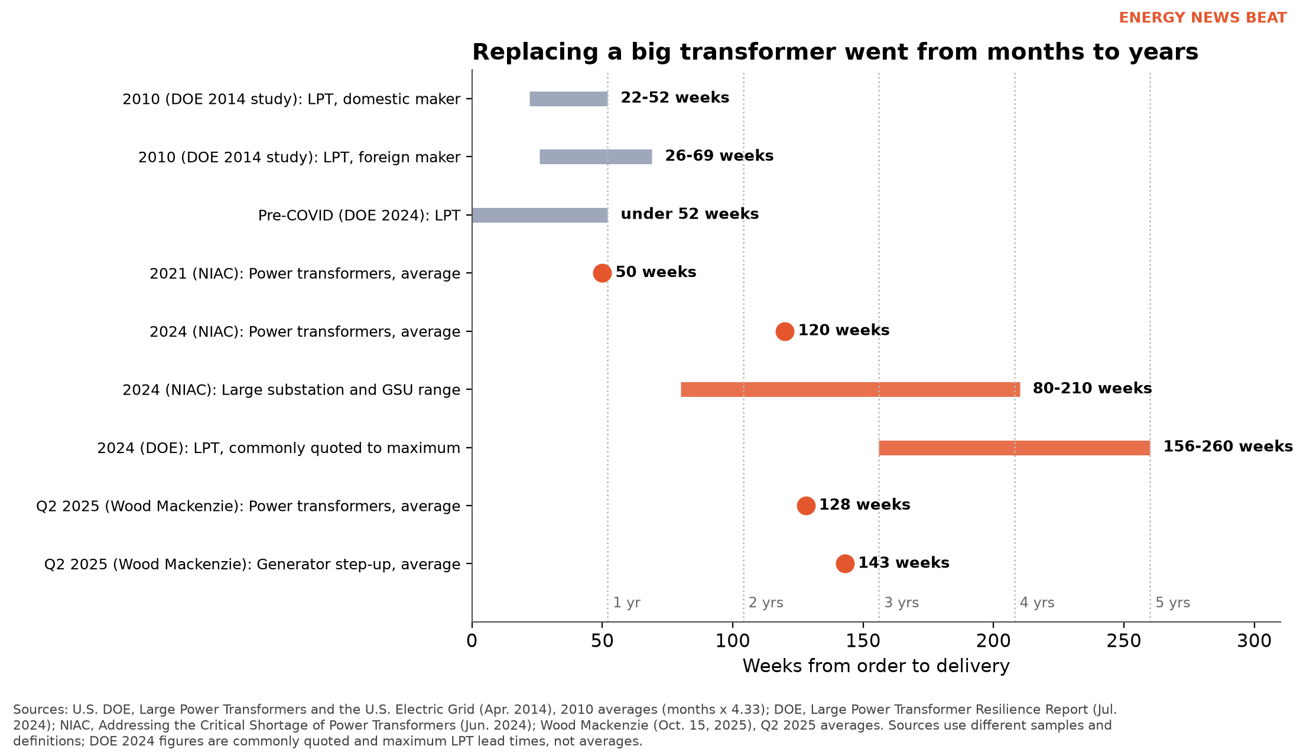
Chart 3. Large-transformer lead times went from under a year to two to five years. Sources: DOE (2014, 2024); NIAC (2024); Wood Mackenzie (2025).
Spare programs exist but have never been tested at scale. The industry’s Spare Transformer Equipment Program has more than 50 members, but it can only be triggered by a presidentially declared attack or emergency and has “never been utilized.” Grid Assurance has 31 subscribers in 23 states and “has not yet actually provided a replacement LPT,” DOE reported. Even with a spare on hand, swapping it in takes three to four weeks (DOE 2024). And in 2014, a FERC analysis reported by the Wall Street Journal found that knocking out just nine of about 55,000 substations could cause a coast-to-coast blackout (IEEE Spectrum). Manufacturers are adding capacity: GE Vernova’s electrification backlog hit $40.6 billion in the second quarter of 2026, up 69% including its Prolec GE deal (GE Vernova). But new plants take years.
We have seen the playbook before
In December 2015, Russian-attributed hackers cut power to about 225,000 customers in Ukraine by taking over control systems at three distribution companies (CISA). A year later, the Industroyer malware blacked out part of Kyiv for about an hour (Wired). In February 2024, CISA and partners warned that China’s Volt Typhoon group had planted itself in U.S. critical-infrastructure networks to be ready for disruption in a crisis (CISA). One victim, the small Littleton Electric Light and Water Department in Massachusetts, learned of the intrusion from the FBI in November 2023 and said no customer data was compromised (LELWD).
Physical attacks show how slow repairs can be. Gunmen hit 17 transformers at PG&E’s Metcalf substation in 2013. There was no major blackout, but repairs took about a month (LA Times). In Moore County, N.C., gunfire on two substations in December 2022 cut power to about 45,000 Duke Energy customers for up to four days (Duke Energy).
Corrections to early reports
Fast-moving stories pick up errors. Here is what the documents show on three claims that keep circulating, including two that ran on Energy News Beat. (ENB checked these against primary records; see Appendix D.)
Claim: Trump removed 30-plus large Chinese grid parts and Biden put them back. What the record shows: ENB found documentation of one Chinese-built transformer that was stopped before installation, not 30. In 2019, a Jiangsu Huapeng transformer bound for WAPA’s Ault substation in northern Colorado was trucked from the Port of Houston to Sandia National Laboratories instead (WSJ; Vice). E&E News reported that sources disputed the word “seizure,” because WAPA is part of DOE (E&E News). WAPA ordered a replacement through a separate contract in September 2019 (Vice). ENB found no record that the Sandia unit or any other removed equipment was ever reinstalled.
The policy timeline is also different from the story. Trump’s EO 13920 (May 1, 2020; 85 FR 26595) declared a grid supply-chain emergency and let the Energy Secretary bar foreign-adversary equipment deals; DOE issued only one order. That order, a December 2020 prohibition covering utilities that serve military bases, took effect Jan. 16, 2021. Biden suspended the executive order for 90 days on his first day (EO 13990). DOE then revoked the order in April 2021 and asked for public comment (Federal Register; RFI). DOE had said in 2020 that “no equipment is prohibited” yet, and Norton Rose Fulbright says the order “was never fully implemented” (Norton Rose Fulbright). The “30” may come from a DOE 2014 line noting “more than 30” transformer manufacturers in China (DOE 2014). Fact-checkers rated the “Biden let China into the grid” posts false in 2021 (PolitiFact; Newsweek).
Claim: Sandia found hardware back doors in Chinese transformers. Our April 2026 article said investigations “including Sandia National Laboratories analysis” found such back doors (ENB, April 2026). The public record does not support that. The Wall Street Journal reported that what Sandia found “still isn’t publicly known.” The back-door claim came from consultant Joe Weiss, who spoke to CBN without public evidence (CBN), and SANS ICS researchers gave it a credibility score of zero (Vice).
Claim: 85% of U.S. utilities use Chinese-tied inverters. The same article said “approximately 85% of U.S. utilities surveyed.” Strider’s figure is 86% of the utilities it surveyed, and those firms represent only about 12% of U.S. installed capacity (Strider). It is not a national figure.
What Washington, the states and Europe are doing (as of 1 p.m. CT, Oct. 8, 2026)
After the 2021 revocation, the issue moved through other channels for four years: a 100-day supply-chain review in June 2021, Defense Production Act support for transformers in June 2022, a Pentagon ban on batteries from six Chinese makers starting October 2027 (Arnold & Porter), and the FY2026 NDAA’s ban on Defense Department purchases of solar gear and inverters from foreign entities of concern (Reuters via AOL).
This summer the pace picked up. On July 28, the FCC added foreign-produced power inverters to its Covered List, blocking authorization of new models (FCC). On Aug. 20 the FCC narrowed the listing to grid-connected (utility-interactive) inverters with wired or wireless remote connectivity and exempted inverters eligible for the Section 45X manufacturing tax credit (FCC DA 26-870; Troutman Pepper Locke; KPMG). On Aug. 26, Trump signed EO 14421, a new national emergency for the bulk-power system that lets the Energy Secretary block deals with foreign-adversary suppliers, which the order calls covered foreign entities, and even order existing equipment to be “disconnect[ed], replace[d], or remove[d]” with reliability in mind (Federal Register). It covers equipment at 69 kV and above. DOE’s request for information closes tomorrow, Oct. 9, and rules are due by Dec. 24.
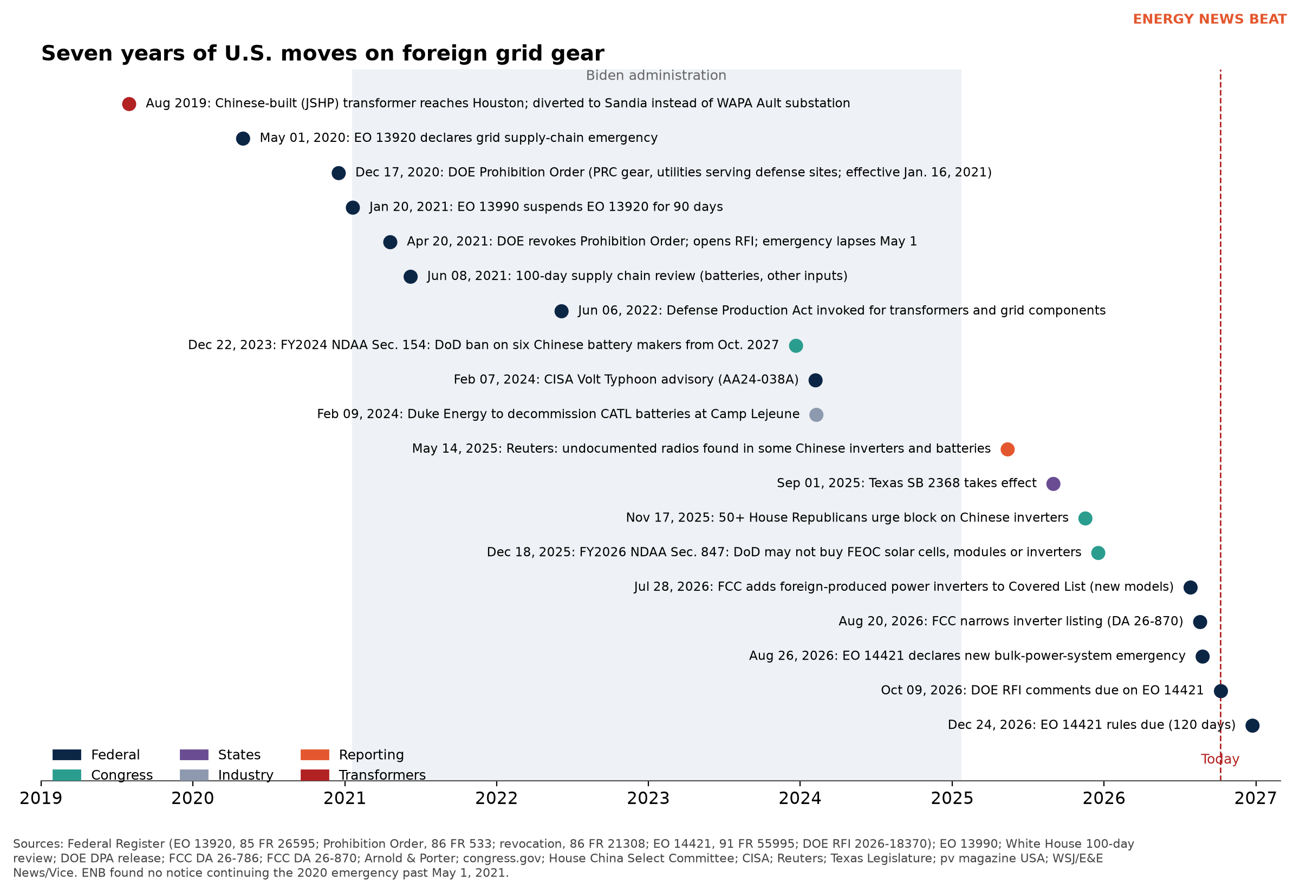
Chart 4. U.S. actions on foreign grid equipment, 2019 to 2026. Sources: Federal Register; White House; DOE; FCC; Congress; CISA; Texas Legislature.
Texas has gone furthest among states. Its 2021 law bars grid-access deals with companies tied to China, Iran, North Korea and Russia (SB 2116), and a 2025 law adds penalties up to $1 million per violation (SB 2368). Florida considered a similar bill in 2026 (SB 1178). It died, and ENB could not confirm whether the enacted HB 905 carries those provisions. Europe is moving too. Lithuania now bars remote access from China to sites over 100 kW (LRT). The European Commission says it will keep its Nov. 1 deadline to keep high-risk inverters out of EU-funded projects (Euronews).
How consumers and investors see it
Consumers are worried and expect a long recovery. In a May 2025 Napolitan News Service poll of 1,000 registered voters, 79% said a foreign or terrorist attack causing outages was likely, and 49% expected restoration to take weeks (28%) or months (21%) (Napolitan News Service; Just The News). That instinct matches the transformer math above. It also points to costs: someone will pay for replacement gear and security upgrades, and utilities usually pass those costs to customers through rates.
Investors have mostly shrugged so far. When the FCC acted, TD Cowen’s John Miller called it “kind of a non-event,” and Jefferies’ Julien Dumoulin-Smith saw “minimal impact today” but a “long, gradual shift in market share” (Canary Media). SolarEdge shares jumped 8% after UBS upgraded the stock, citing the import curbs (24/7 Wall St.). Sungrow says the U.S. is 15% to 20% of its revenue and expects that business to shrink gradually (ESS News). Wood Mackenzie expects U.S. inverter plants to reach more than 100 GWac a year by the end of 2027 (pv magazine). Some lenders still write replacement-cost covenants into project loans (Norton Rose Fulbright).
What to watch
- DOE’s rule under EO 14421 (due Dec. 24): whether it orders existing equipment out, and how fast. A forced swap during a transformer shortage could itself strain reliability.
- FCC exemptions and the CATT Act in Congress, which would limit future Covered List additions (JD Supra).
- Firmware updates. Wood Mackenzie flags updates to installed inverters as an open risk (Wood Mackenzie). This is where a ban on new imports does not reach.
- Transformer lead times. Whether new factories bring them back under two years.
For more ENB coverage, see our earlier reports on the proposed inverter ban and the grid equipment shortage. A downloadable data file with the figures and chart data behind this article is available with this post.
As we prepare for several key podcast episodes, this article is AI-assisted research show notes research/preparation for an upcoming interview. We are cross-checking the data and including all sources and links for verification. Staff will update the articles as new information rolls out and will note corrections. This deeper dive allowed us to triple-check what actually happened with Chinese equipment in the US Grid. As it stands now, Stu is more concerned with the solar equipment at scale, rushed, and not knowing when the sleeper connection will activate. Nothing like fact-checking yourself before your wife hits you in the back of the head – just saying.
Check out the World’s Greatest Podcast Show Notes at EnergyNewsBeat.co or EnergyNewsBeat.com. And subscribe to: The Energy News Beat Substack.
Appendix A. Sources (titled and dated)
Appendix B. Key figures
| Item | Figure | Source |
| Chinese-HQ C&I/utility inverters delivered in U.S., 10 yrs | >70 GW of >200 GWac total; >90% of all imported | Wood Mackenzie |
| Chinese vendors’ U.S. inverter market share | Nearly 50% (2024 and 2025) | Wood Mackenzie |
| Chinese share, U.S. utility and C&I inverters | About 60%; residential: SolarEdge, Enphase, Tesla ~80% | Canary Media |
| China share of U.S. inverter imports, 2024 | Nearly 24% (USCC, second-hand; original not located) | Washington Examiner |
| Strider: sites with risky PRC equipment | ≥5,400 MW, 66 sites, 22 states; 51 Sungrow, 10 BYD, 4 CHINT, 1 CATL | Strider |
| Strider: shipment records tied to PRC makers | 30,253 of 64,566 (2015–2024); 2.68B kg of PRC inverters imported since 2015 | Strider |
| Strider utility survey | 86% rely on ≥1 risky PRC supplier; sample ≈12% of U.S. capacity | Strider |
| U.S. imports of transformers >10 MVA (HS 850423) | $0.97B (2019) → $4.15B (2025); 1,206 → 5,021 units | UN Comtrade; ENB calc. |
| China share of HS 850423 import value | 0.8%–4.5% (2019–25); 2025: 2.2% ($90.5M, 147 units) | UN Comtrade; ENB calc. |
| Top 2025 sources, HS 850423 | Mexico 19.4%, South Korea 18.0%, Brazil 12.8%, Austria 10.4% | UN Comtrade |
| LPTs imported, 2019 | 617 of 754 (82%); 137 domestic (18%) | DOE 2024 |
| China share, U.S. lithium-ion imports (HS 850760) | 69.0% of $23.85B (2024); 59.3% of $20.08B (2025) | UN Comtrade |
| Grid design losses (RLPC), 2026 | Texas 2,805 MW; West 2,918 MW; East 3,875 MW | NERC FRAA 2025 |
| Continental Europe reference incident | 3,000 MW | ENTSO-E |
| DNV thresholds | 3 GW “significant implications”; >10 GW “most likely trigger a cascading outage” | SolarPower Europe/DNV |
| Europe inverter shipments 2015–23 | 350 GWac total; Chinese brands 226 GW (~64%, ENB sum); 7 firms >10 GW at 70% remote access | SolarPower Europe/DNV |
| Europe solar linked to Chinese inverters | >200 GW (ESMC) | Reuters via Yahoo |
| Inverter-caused events | Blue Cut 2016 ~1,200 MW; Odessa 2021 1,112 MW solar; Odessa 2022 2,555 MW total | NERC; NERC; NERC |
| Lead times | ~50 wk (2021) → 120 wk (2024); 80–210 wk range; Q2 2025: 128 wk power, 143 wk GSU; DOE: 36 months common, up to 60 | NIAC; Wood Mackenzie; DOE 2024 |
| Prices | Power transformers +77% since 2019; GSU +45%; distribution +78–95%; up to $10M per LPT | Wood Mackenzie; GAO |
| GE Vernova electrification backlog | $40.6B, +69% y/y (2Q26, incl. Prolec GE) | GE Vernova |
| Public opinion | 79% say attack likely; 49% expect weeks (28%) or months (21%) to restore (n=1,000 RV, ±3.1 pts; May 7–8, 2025) | Napolitan News; Just The News |
Appendix C. Timeline of U.S. actions, 2019–2026
| Date | Event | Source |
| 2019-08 | Chinese-built (JSHP) transformer reaches Houston; diverted to Sandia instead of WAPA Ault substation | WSJ; Vice |
| 2020-05-01 | EO 13920 declares grid supply-chain emergency | Federal Register |
| 2020-12-17 | DOE Prohibition Order (PRC gear, utilities serving defense sites; effective Jan. 16, 2021) | 86 FR 533 |
| 2021-01-20 | EO 13990 suspends EO 13920 for 90 days | EO 13990 |
| 2021-04-20 | DOE revokes Prohibition Order; opens RFI; emergency lapses May 1 | Revocation; RFI |
| 2021-06-08 | 100-day supply chain review (batteries, other inputs) | White House |
| 2022-06-06 | Defense Production Act invoked for transformers and grid components | DOE |
| 2023-12-22 | FY2024 NDAA Sec. 154: DoD ban on six Chinese battery makers from Oct. 2027 | Arnold & Porter |
| 2024-02-07 | CISA Volt Typhoon advisory (AA24-038A) | CISA |
| 2024-02-09 | Duke Energy to decommission CATL batteries at Camp Lejeune | House Select Cmte. |
| 2025-05-14 | Reuters: undocumented radios found in some Chinese inverters and batteries | Reuters |
| 2025-09-01 | Texas SB 2368 takes effect | Texas SB 2368 |
| 2025-11-17 | 50+ House Republicans urge block on Chinese inverters | pv magazine USA |
| 2025-12-18 | FY2026 NDAA Sec. 847: DoD may not buy FEOC solar cells, modules or inverters | GovInfo; Baker McKenzie |
| 2026-07-28 | FCC adds foreign-produced power inverters to Covered List (new models) | FCC |
| 2026-08-20 | FCC narrows inverter listing (DA 26-870) | FCC DA 26-870; Troutman |
| 2026-08-26 | EO 14421 declares new bulk-power-system emergency | White House; FR |
| 2026-10-09 | DOE RFI comments due on EO 14421 | Federal Register |
| 2026-12-24 | EO 14421 rules due (120 days) | Federal Register |
Other items: Huawei stopped direct U.S. inverter orders in June 2019 (PV Tech). Sens. Rick Scott and Marsha Blackburn sought an investigation in June 2025 (Sen. Scott). Last summer the National Energy Dominance Council asked Commerce to draft an inverter ban, which stalled (Reuters via AOL). FY2025 NDAA Sec. 883 requires a DoD battery strategy (CRS). S. 450 (introduced Feb. 2025) would bar DHS from buying batteries from six Chinese firms; ENB did not confirm enactment.
Appendix D. Fact-check: EO 13920, the WAPA Ault transformer and “30-plus parts”
| Date | What the document shows | Document |
| Sept. 26, 2017 | WAPA orders a 345/230 kV transformer from Jiangsu Huapeng (JSHP); contract $2.8M | Vice; WSJ |
| Jun. 2019 | WAPA drops JSHP installation and warranty for a $400,000 credit | WSJ |
| Aug. 2019 | Unit (>500,000 lb) lands in Houston; trucked to Sandia, not Ault. “What engineers at Sandia found still isn’t publicly known.” | WSJ |
| Sept. 25, 2019 | WAPA issues $6.1M sole-source contract (Taurean) including an Ault transformer; performance location listed as Croatia | Vice |
| May 1, 2020 | EO 13920: emergency; Energy Secretary may bar transactions; identify existing gear for possible isolation or replacement | 85 FR 26595 |
| May 29, 2020 | Sources say not a seizure (WAPA is part of DOE); JSHP: “never had any cybersecurity incident” | E&E News |
| 2020 | DOE FAQ: “As of today, no equipment is prohibited”; utilities asked to refrain from installing during review | Norton Rose Fulbright; PolitiFact |
| Dec. 17, 2020 | DOE Prohibition Order: PRC-linked gear at utilities serving critical defense facilities; effective Jan. 16, 2021 (published Jan. 6, 2021) | 86 FR 533 |
| Jan. 20, 2021 | EO 13990 Sec. 7(c) suspends EO 13920 for 90 days | EO 13990 |
| Feb. 2021 | Fact-checks rate “Biden let China into grid” posts False | Newsweek; PolitiFact |
| Apr. 20, 2021 | DOE revokes the Prohibition Order “before the emergency declaration made by E.O. 13920 expires on May 1, 2021”; RFI opened | 86 FR 21308 revocation; RFI |
| May 1, 2021 | Emergency expires; ENB found no continuation notice | DOE |
| Dec. 13, 2023 | WAPA document: an Ault KV1A transformer re-energized after an oil spill (does not identify the maker) | WAPA |
| Aug. 26, 2026 | EO 14421 revives the approach; Norton Rose: Biden “never ultimately reinstated” the 2020 order | EO 14421; Norton Rose Fulbright |
Verdict. The user-recalled claim does not hold up as stated. Documented: one Chinese-built transformer diverted before it was installed. Not found: any list of 30-plus parts removed, any removal of installed Chinese equipment under EO 13920, or any reinstallation after 2021. What Biden did was suspend EO 13920, revoke the one DOE order (which had been in force about three months and had no record of enforcement), and open a new review. The likely source of “30” is DOE’s 2014 line that “more than 30 power transformer manufacturers existed in China” (DOE 2014). Coincidentally, Comtrade records 34 Chinese-origin transformers above 10 MVA imported in 2019; that is an import count, not a removal count. A 2021 public comment asserting a Chinese transformer operates at Ault (Bardin) could not be verified.
Appendix E. Incidents and vulnerability disclosures
| Date | Finding | Source |
| Nov. 2024 | Deye/Sol-Ark inverters in U.S. disabled by remote authorization pop-up; Deye: “a few” gray-market units, no human intervention; Sol-Ark offered discounted replacements | heise; Solarboi |
| Nov. 2024 | Inverters “from China” disabled; Reuters could not determine how many (three sources) | Reuters via Yahoo |
| Mar. 27, 2025 | Forescout SUN:DOWN: 46 new vulnerabilities in Sungrow, Growatt, SMA (patched); 80% of 93 prior disclosures high/critical | Forescout |
| May 14, 2025 | Undocumented comms devices incl. cellular radios in some Chinese inverters and batteries (two unnamed sources); no makers or counts named | Reuters; Utility Dive |
| Before Apr. 2025 | Bitdefender vulnerabilities in the Solarman platform, which DNV says reaches about 200 GW | SolarPower Europe/DNV |
| Dec. 2023–Feb. 2024 | Duke disconnects, then agrees to decommission, CATL batteries at Camp Lejeune | House Select Cmte. |
| Jan. 2025 | Germany BSI: “substantial risk potential” | Clean Energy Wire |
| Jul. 2025 | Netherlands: hidden hardware “highly unlikely” and “easily detectable” | pv magazine |
| Sept. 2025 | Czech NÚKIB warning; 95–99% of small-PV inverters there are Chinese | NÚKIB; pv magazine |
| Jul. 27, 2026 | U.S. national security determination on power inverters | Determination |
Appendix F. Restoration and spares
| Item | Detail | Source |
| STEP (EEI, 2006) | >50 members; $10,000 enrollment; triggered only by presidentially declared terrorist attack or emergency; “never been utilized” | DOE 2024 |
| RESTORE | Buyer pays replacement cost | DOE 2024 |
| Grid Assurance | AEP, FirstEnergy, Berkshire; 31 subscribers in 23 states; “has not yet actually provided a replacement LPT” | DOE 2024 |
| Federal reserve | GAO found a federal LPT reserve faces challenges; recommendations open | GAO |
| Swap time with spare on site | About 3–4 weeks (DOE Table 1) | DOE 2024 |
| Domestic share | ~18–20% of LPT supply; NIAC goal 50% by 2029 | DOE 2024; NIAC; Wood Mackenzie |
| Supply deficit, 2025 | 30% power transformers; 10% distribution | Wood Mackenzie |
| Price history | $2M–$7.5M for 75–500 MVA (2010); up to $10M (GAO); +60–80% since Jan. 2020 (WoodMac 2024) | DOE 2014; GAO; Wood Mackenzie |
| Critical substations | FERC study: nine of ~55,000 substations could cause nationwide blackout (WSJ, 2014) | IEEE Spectrum |
Appendix G. Precedent attacks
| Date | Target | Type | Impact | Source |
| 2013-04-16 | Metcalf substation, Calif. | Physical (rifle fire) | 17 transformers damaged; no major blackout; about a month to repair; $15.4M per CPUC staff deck | LA Times; CPUC |
| 2015-12-23 | Ukraine, three distribution companies | Cyber (Russia-attributed) | about 225,000 customers lost power; hours | CISA |
| 2016-12-17 | Ukraine, Kyiv transmission substation (Industroyer) | Cyber (Sandworm) | about an hour; “a fifth” of Kyiv’s power use per Wired | Wired |
| 2022-12-03 | Moore County, N.C., two substations | Physical (gunfire) | about 45,000 Duke customers; restored by Dec. 7 | Duke Energy |
| 2023-2024 | Littleton, Mass. (LELWD), Volt Typhoon | Cyber pre-positioning (China) | FBI alert Nov. 2023; no customer data compromised; no outage | LELWD; CISA |
Not a cyberattack: the April 28, 2025 Iberian blackout (15 GW, about 60% of demand, lost in seconds) was ruled not to be a cyberattack (Guardian; ENTSO-E).
Appendix H. Data gaps, conflicting figures and items that did not check out
- No measured “remotely controllable” figure exists for the U.S. or Europe. ENB’s range (zero proven to tens of GW in theory) brackets Strider’s 5.4 GW floor and WoodMac’s >70 GW exposure.
- Hidden radios: Reuters’ two sources; no makers, models or counts; no U.S. government confirmation found.
- Sandia findings: never released. Claims of discovered transformer back doors (Weiss/CBN; ENB, April 2026) are unsupported in public records.
- “30-plus parts removed” and “Biden put them back”: no documentary support found (Appendix D).
- Strider 86% vs. ENB’s earlier “85%”: corrected; survey covers ~12% of capacity.
- USCC “nearly 24%” of U.S. inverter imports (2024): second-hand via the Washington Examiner; original not located.
- Executive order number: ESS News called the August order “EO 14420”; the Federal Register lists EO 14421.
- DNV Figure 14 bars sum to 351 GW vs. 350 GW stated (rounding). Europe installed base: 337 GW (DNV) vs. 338 GW (SolarPower Europe via Reuters).
- Customs data record country of origin, not ownership; Chinese-brand inverters made in Southeast Asia and Chinese-owned transformer plants abroad are not counted as China. HS 850760 covers all lithium-ion batteries, not only grid storage. HS 850440 (static converters, incl. inverters) is too broad to use.
- SCADA/control systems: no public count of Chinese-made units in U.S. utilities.
- Florida: SB 1178 died; whether enacted HB 905 (Ch. 2026-66) covers grid remote access is unverified.
- CATT Act (H.R. 10453): introduction date unclear in the source.
- Lithuania: transition date for existing sites (reported as May 31, 2026) not confirmed in a primary source.
- Not used: an anonymous lead-time index citing 50–58 months for one maker; a MITRE-Harris poll figure ENB could not open; reports of Enphase stock gains in June 2026.
- Wired phrasing on Industroyer’s scale (“a fifth” of Kyiv’s power capacity) is a press description, not a utility figure.