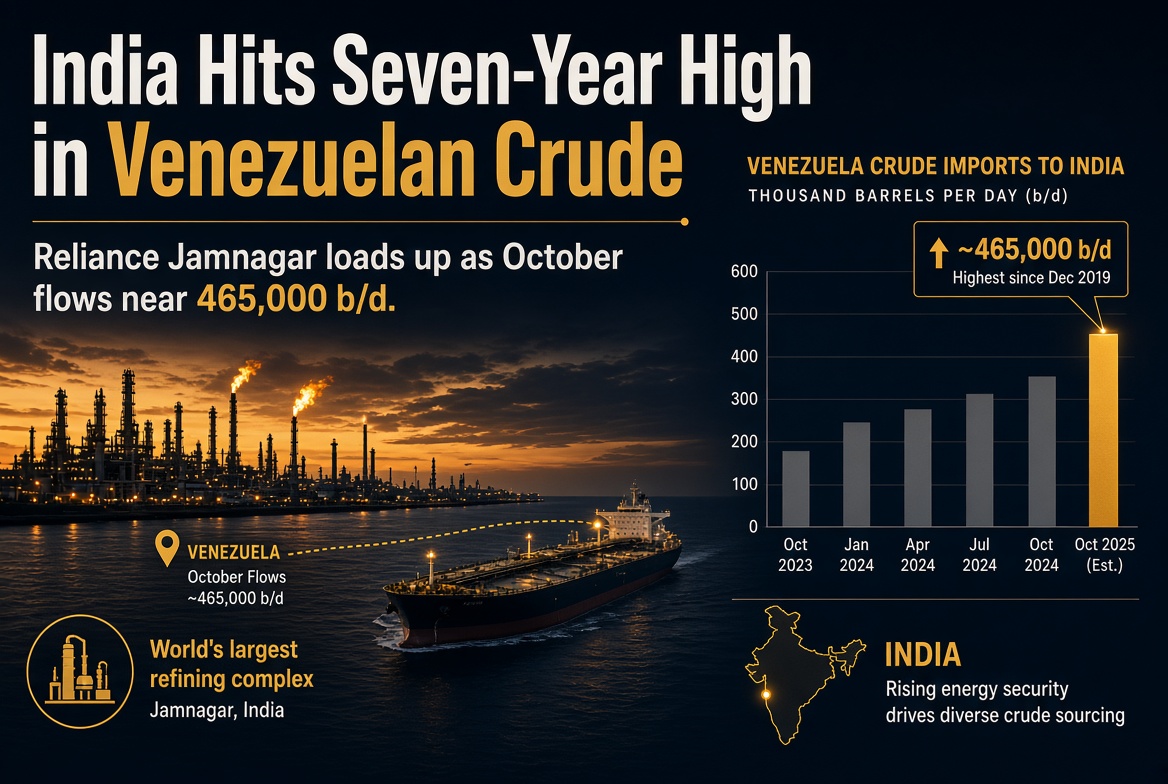
India Hits Seven-Year High in Venezuelan Crude as Reliance Loads Up Jamnagar
October flows could top 465,000 b/d—the strongest since 2019—while India’s decade-long import reshuffle and its No. 2 global refined-product export role show how discounted heavy barrels still clear through the world’s most complex refineries.
India’s Venezuelan crude imports are on track for a seven-year high in October 2026, with Kpler estimating deliveries could reach about 465,000 barrels per day if scheduled cargoes arrive on time—more than double September’s roughly 196,000 b/d and the strongest monthly flow since December 2019. The rebound is led by Reliance Industries’ Jamnagar complex, the world’s largest refining hub, which is taking essentially all of the Venezuelan barrels arriving at Sikka port.
The shift is price-driven. Venezuelan Merey has been offered at steep discounts to ICE Brent (around $16/bbl in recent trader reports), while Russian Urals—India’s largest supplier for the past three years—has become costlier amid tighter logistics and higher freight. Kpler’s Sumit Ritolia has noted that Venezuelan crude has become a more important part of India’s diversification since early 2026, following the easing of U.S. restrictions after the January capture of Nicolás Maduro and the grant of licenses allowing direct purchases. Actual October arrivals may land closer to 350,000 b/d if late-month vessels do not discharge before month-end.
Jamnagar’s complex configuration is well suited to heavy, high-sulfur Venezuelan grades. Most other Indian refineries can process only limited volumes of such crudes, which is why Reliance has accounted for the large majority of recent Venezuelan cargoes (roughly three-quarters in September data shared with media).
Ten-year shift in India’s crude slate
India’s import basket has been rewritten twice in the past decade: first by the collapse of Iranian and then Venezuelan flows under U.S. sanctions, and second by the surge in discounted Russian barrels after 2022. Russia’s share rose from under 2% in FY2021-22 to roughly 36% in 2023 and 2024 (DGCIS/PPAC and Kpler figures). Iraq has remained the steadiest large supplier at roughly 19–24%, while Saudi Arabia’s share has eased from the high teens toward the low teens. The United States rebounded into the mid-single digits after earlier dips. Venezuela, which held roughly 6–7% of the basket in FY2018 (and higher volumes earlier in the decade, often 300,000–400,000 b/d range in shipping data), fell to near zero by 2021–23 before the 2026 recovery.
The chart below uses approximate annual shares compiled from DGCIS, PPAC, and Kpler reporting (The Hindu, CNBC-TV18, Informist, and related analyses). Exact country-level series are not uniformly published by PPAC for recent years; figures are rounded and should be read as directional.
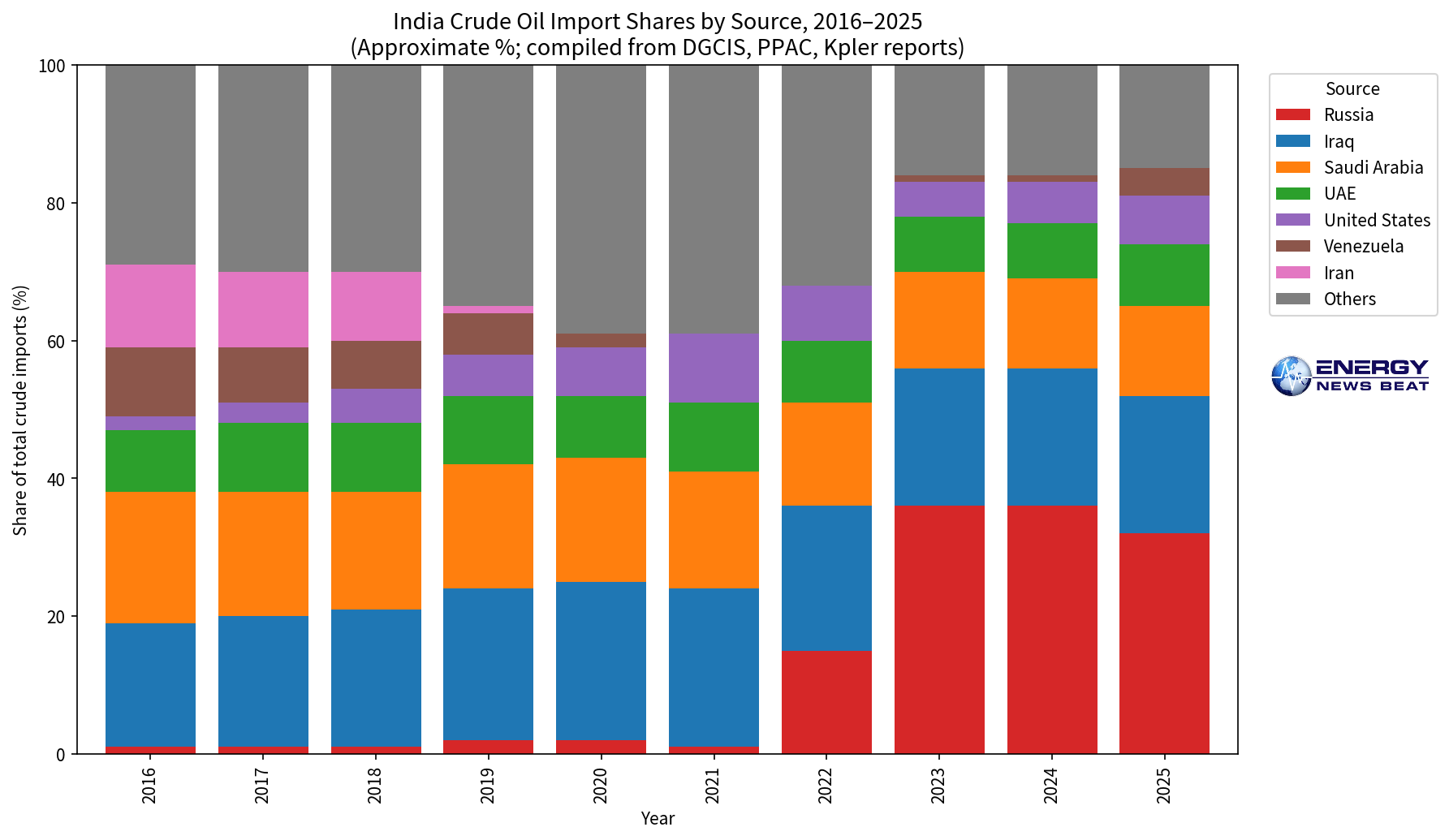
Middle East suppliers (Iraq, Saudi Arabia, UAE, and others) still anchor a large share of volumes even after Russia’s rise, and Hormuz exposure has declined but remains material. Total crude imports have hovered near 4.7–5.0 million b/d in recent full years (about 1.78 billion barrels in calendar 2024).
India as a global refining and product-export hub
Separately, India’s refining system—roughly 5.2–5.6 million b/d of capacity across 23 refineries, fourth-largest globally after the United States, China, and Russia—has turned the country into a consistent net exporter of petroleum products. Complex coastal plants, especially Jamnagar, run imported crude (including discounted barrels) and export surplus diesel, gasoline, jet fuel, and other products.
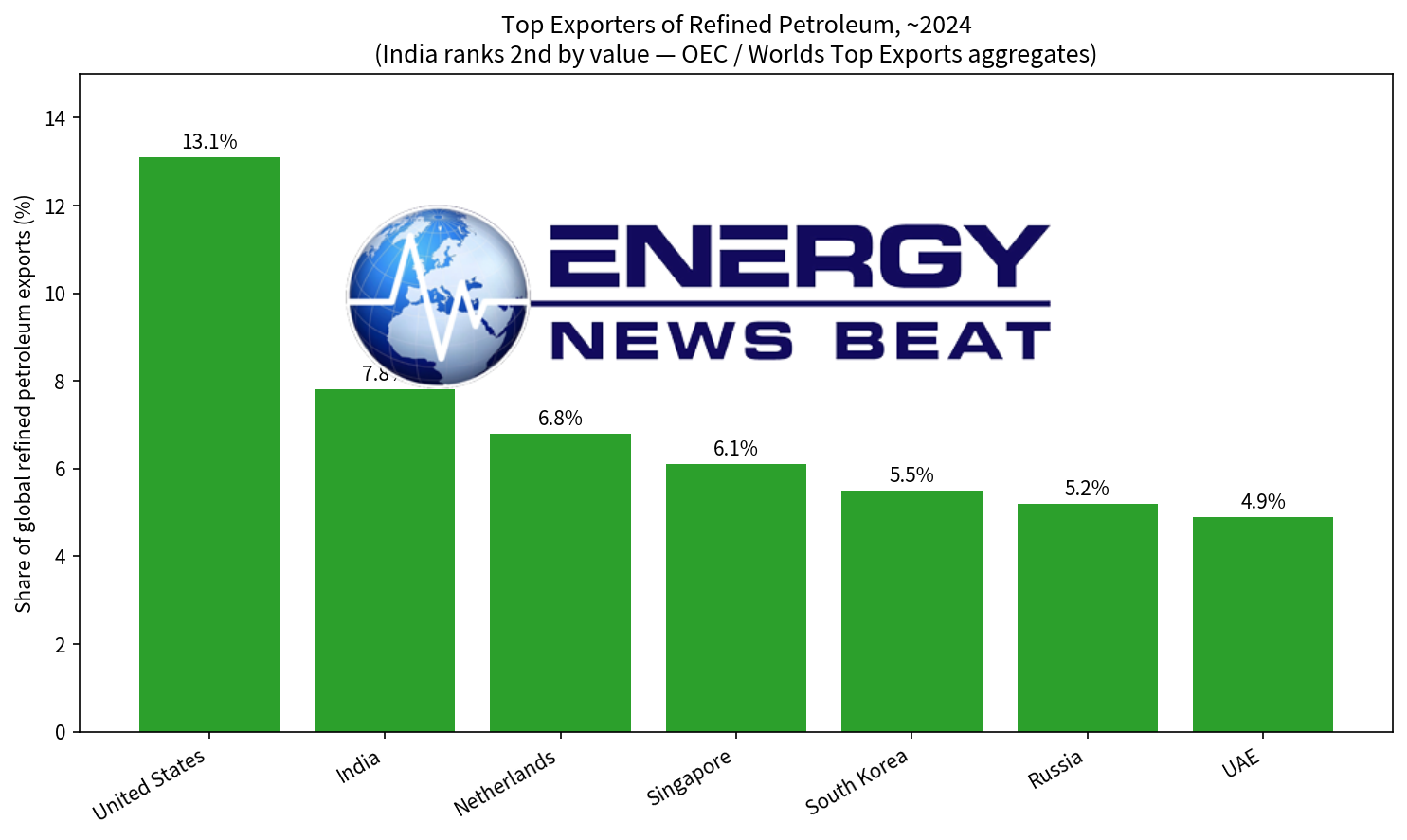
In 2024, India exported about $65.4 billion of refined petroleum (HS 2710), ranking second globally by value with roughly 7.3% of world refined-petroleum exports, behind the United States (Observatory of Economic Complexity). Other aggregates place India’s share near 7.8%. Diesel and jet fuel have typically accounted for around half of product export volumes; gasoline exports have risen toward multi-year highs as ethanol blending frees domestic barrels and refinery runs increase. Kpler data showed Indian fuel exports reaching a record 1.28 million b/d in 2025, with Reliance accounting for about 71% of the total.
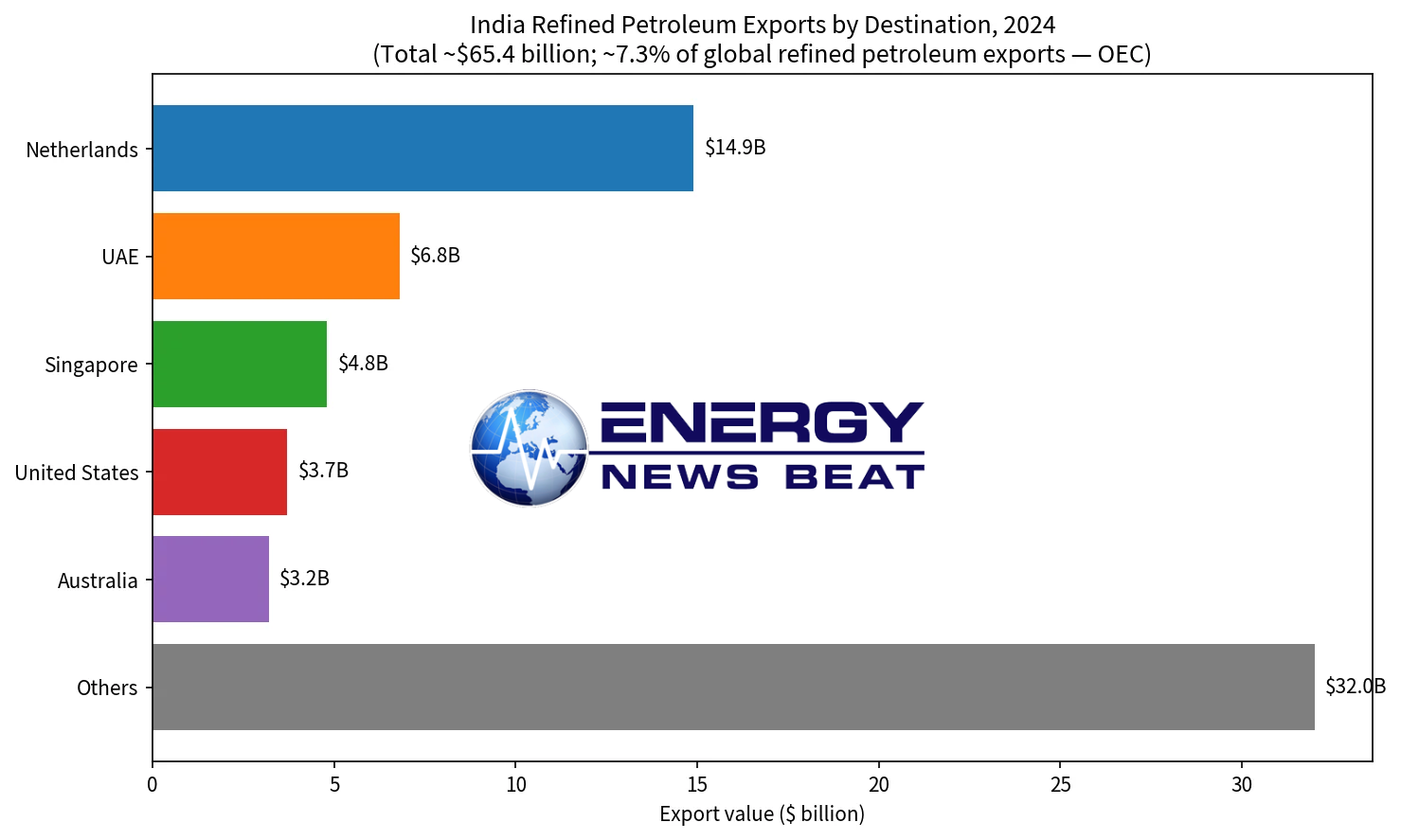
Top 2024 destinations by value (OEC) were the Netherlands ($14.9 billion, largely via Rotterdam as a European hub), the UAE ($6.8 billion), Singapore ($4.8 billion), the United States ($3.7 billion), and Australia ($3.2 billion). Destination mixes shift with European stockpiling, Middle East maintenance, and sanctions rules—Europe has been a major buyer of Indian gasoil and jet, while Asia, Africa, and Latin America have gained share in periods when traditional buyers pulled back.
Product exports are not immune to policy or geopolitics. Volumes have dipped in months of heavy maintenance, domestic demand spikes, or export duties (for example, special additional excise duties on diesel and ATF). FY26 provisional figures showed petroleum products’ share of India’s total merchandise exports falling to multi-year lows near 9%, even as absolute refining capacity continues to expand (new and expanded units at Barmer and Panipat are among the additions).
The October Venezuelan surge fits the same pattern that has defined India’s oil trade since 2022: refiners buy the most economic heavy or medium barrels available under the prevailing sanctions and freight regime, run them through high-complexity plants, and place the products into global markets where netbacks are strongest. Whether the Venezuelan volumes hold at the October pace will depend on sustained discounts, freight, license continuity, and competition from U.S. Gulf Coast refiners also seeking heavy crude.
Check out the World’s Greatest Podcast Show Notes at EnergyNewsBeat.co or EnergyNewsBeat.com. And subscribe to: The Energy News Beat Substack.
- Bloomberg / The Hindu BusinessLine, “India’s Venezuelan oil imports to surge as Russian crude gets costlier” (Kpler estimates of ~465,000 b/d in October 2026 vs. 196,000 b/d in September; highest since December 2019): https://www.bloomberg.com/news/articles/2026-10-07/reliance-drives-india-s-venezuela-oil-imports-to-seven-year-high
- OilPrice.com, “Reliance Drives India’s Venezuelan Oil Imports to Seven-Year High,” 8 October 2026: https://oilprice.com/Latest-Energy-News/World-News/Reliance-Drives-Indias-Venezuelan-Oil-Imports-to-Seven-Year-High.html
- Economic Times, “Ambani’s Reliance drives India’s Venezuela oil imports to seven-year high,” 8 October 2026: https://m.economictimes.com/industry/energy/oil-gas/ambanis-reliance-drives-india-venezuela-oil-imports-to-seven-year-high-kpler-data/articleshow/134760129.cms
- BusinessToday, “India’s Venezuelan oil imports set to hit seven year high as Russian crude gets costlier,” 7 October 2026: https://www.businesstoday.in/latest/economy/story/indias-venezuelan-oil-imports-set-to-hit-seven-year-high-as-russian-crude-gets-costlier-report-560158-2026-10-07
- The Hindu, “How India’s oil basket has changed over the years” (DGCIS: Russia <2% in 2021-22, 21.6% in 2022-23, 35.9% in 2023-24, 35.8% in 2024-25; Iran share history): https://www.thehindu.com/business/how-indias-oil-basket-has-changed-over-the-years/article70443877.ece
- CNBC-TV18, “Where does India get its crude oil from” (Kpler shares: Russia ~1.2% in 2021 to ~35–38% in 2023–25; Iraq, Saudi, UAE, U.S., Kuwait): https://www.cnbctv18.com/market/commodities/where-does-india-get-its-crude-oil-from-and-what-happens-if-it-stops-kpler-19925618.htm
- Informist, India’s 2024 crude imports 1.78 billion barrels, Russia 36.3% share: https://informistmedia.com/CommodityWire/27095/India-s-2024-crude-oil-imports-up-3-37-at-1-78-bln-barrels-Russia-s-share-36-3-37-
- ET Energyworld / Rubix, Venezuela share from ~6.7% in FY2018 to near-zero then partial recovery: https://energy.economictimes.indiatimes.com/news/oil-and-gas/from-6-7-to-0-3-why-venezuela-has-almost-disappeared-from-indias-crude-basket/126405665
- Observatory of Economic Complexity, India refined petroleum exports $65.4 billion in 2024, 7.34% global share, destinations: https://oec.world/en/profile/bilateral-product/refined-petroleum/reporter/ind
- Business Standard, India’s petroleum product exports record 1.28 million b/d in 2025 (Kpler; Reliance ~71%): https://www.business-standard.com/economy/news/india-s-exports-of-petroleum-products-touched-record-high-in-2025-126011100623_1.html
- Reuters, India fuel exports and refining runs (Wood Mackenzie / Kpler gasoline and gasoil export forecasts): https://www.reuters.com/business/energy/india-fuel-exports-surge-multi-year-highs-higher-refinery-runs-ethanol-blending-2025-09-24/
- Reuters commentary on India refining capacity (~5.6 million b/d) and product export role: https://www.reuters.com/commentary/reuters-open-interest/india-may-be-best-placed-fill-china-sized-hole-fuel-exports-2026-10-05/
- PPAC / Ministry of Petroleum & Natural Gas import-export data portal (aggregate crude and product volumes): https://ppac.gov.in/import-export
- KAPSARC compilation of PPAC crude and product import series: https://datasource.kapsarc.org/explore/dataset/crude-oil-and-petroleum-product-imports/
Chart note: The stacked import-share chart is an approximate compilation from the DGCIS, PPAC, and Kpler figures cited above, normalized for display. It is illustrative of the documented shifts (Iran/Venezuela collapse, Russia surge, Middle East resilience) rather than an official PPAC time series.