


Three Republican lawmakers asked the Oklahoma Supreme Court to overturn the Corporation Commission’s approval of OG&E’s power deals with a Google subsidiary. The commission says Google must pay 100% of dedicated grid costs. Rep. Tom Gann’s $17 billion ratepayer claim is his — and Energy News Beat could not independently confirm it.
Three Republican state representatives — Tom Gann of Inola, Rick West of Heavener and Kevin West of Moore — have asked the Oklahoma Supreme Court to overturn the Corporation Commission’s approval of power agreements between Oklahoma Gas & Electric and Alliance Site & Grid, a wholly owned Google subsidiary, for three planned data centers in Muskogee and Stillwater.
The lawmakers say ordinary ratepayers never got a real chance to intervene, the contract terms are confidential, and the arrangement violates House Bill 2992, which requires separate tariffs for large data-center loads. Commission spokesman Jack Damrill told The Oklahoman the June 1 intervention deadline had been set in an earlier order, that the attorney general and several other parties did participate, and that the approval requires Google to pay 100% of dedicated transmission and distribution costs.
That is the same “who pays to wire AI data centers” question Energy News Beat asked on Nov. 13 in a PJM article built around a $29.4 billion monitor figure. Oklahoma is not in PJM. OG&E sits in the Southwest Power Pool. Gann said in a statement that “the consequences for OG&E, (Oklahoma Natural Gas) and (Public Service Company of Oklahoma) ratepayers now exceed $17 billion.” That figure is his claim. Energy News Beat could not independently confirm what it covers or would mean for a typical residential bill.
What the lawmakers say went wrong
According to a Nov. 15 account in The Oklahoman, and a free recap published the same day, the petition was filed this month. Energy News Beat could not open the court filing or confirm a docket number on Nov. 15.
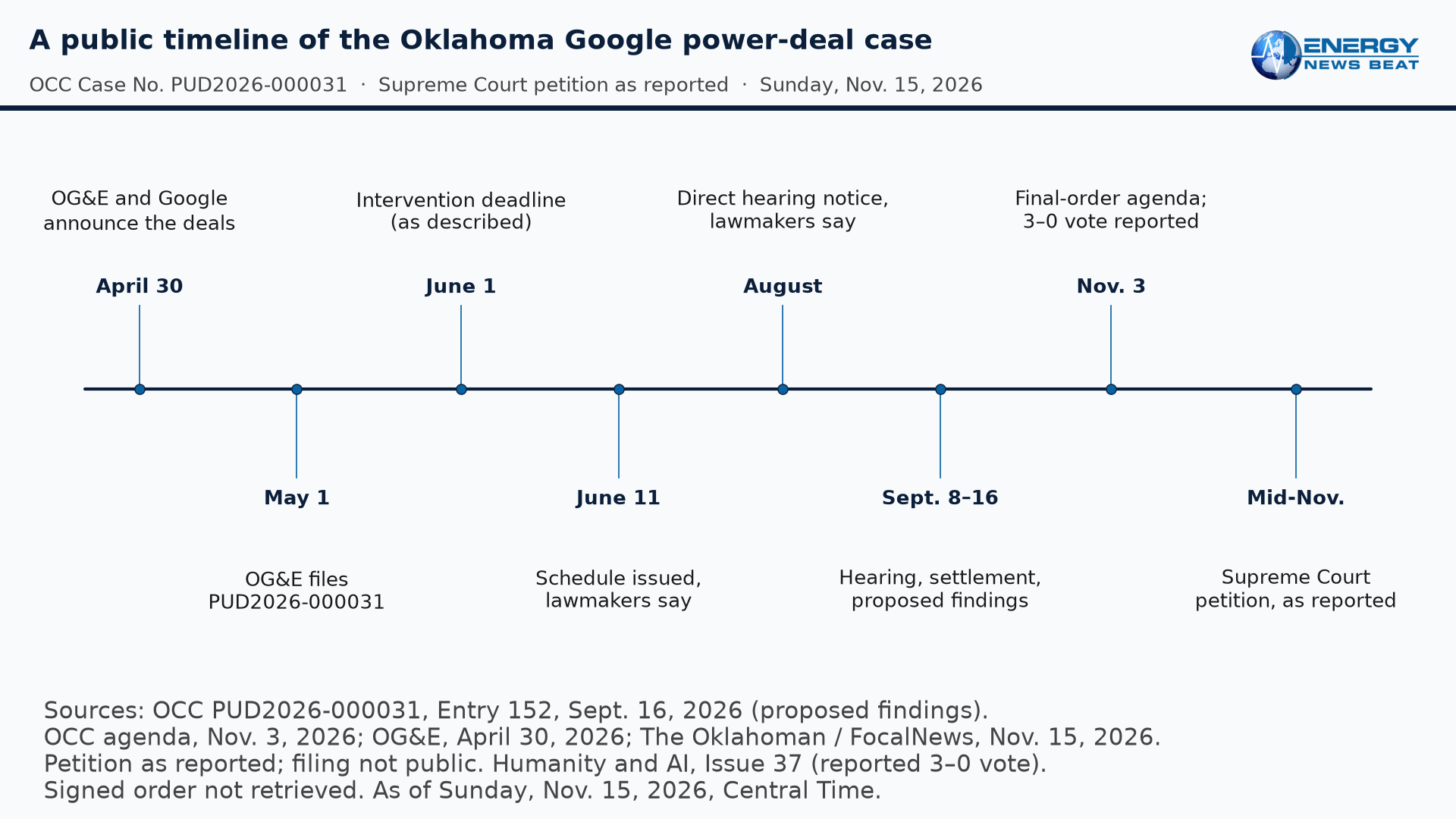
The lawmakers say the commission released a procedural schedule on June 11, 10 days after a June 1 intervention deadline, and that OG&E customers did not receive direct notice of a pending hearing until August. “No interested party who had not already been notified about the case and intervened ever had a chance to do so before the deadline,” the filing said, as quoted in the recap. Gann said the order classifies the agreements as “highly sensitive, confidential information,” and that this “violates HB 2992, which requires electricity companies to ‘create and maintain separate tariffs’ applicable to data centers. Tariffs are public documents, not secret contracts.” The appeal, as reported, also says hundreds of pages of public comments he submitted never made it into the official record.
The filing, as reported, also asks the court to find that Commissioner Todd Hiett should not have voted, citing 2017 groping allegations that prosecutors declined to investigate in 2025 because of the statute of limitations. That is the lawmakers’ argument, not a finding. Hiett’s term ends in January, when Brad Boles, a principal author of HB 2992, is scheduled to take office.
What the commission says is already in the order
Damrill said the June 1 deadline was set in a separate order issued nine days earlier. Energy News Beat did not retrieve it; the findings cite notice Order No. 758316. He said the attorney general and several other parties participated, along with OG&E, Google and commission staff.
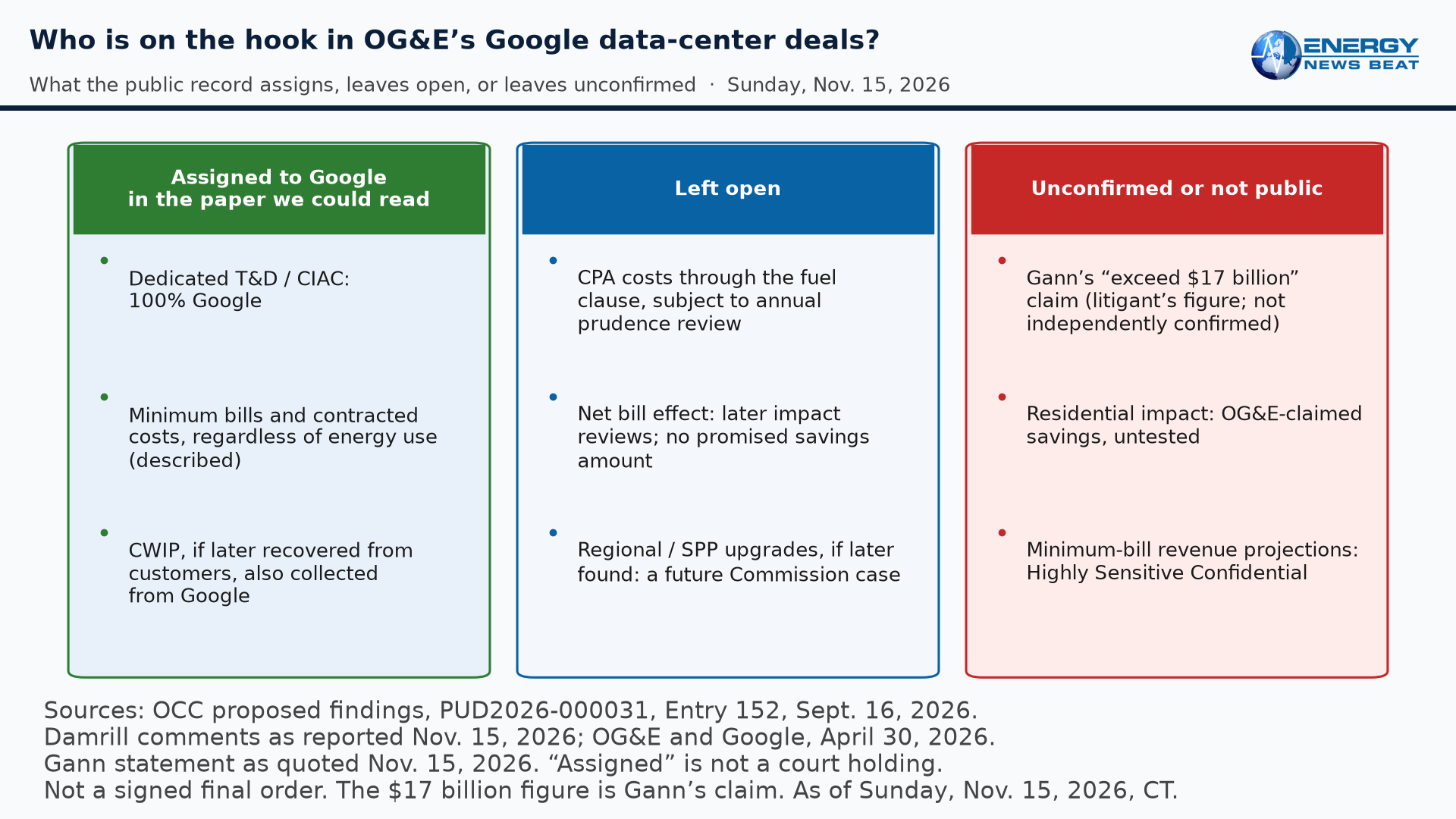
The protections he listed track a document Energy News Beat did open: the Proposed Joint Findings of Fact and Conclusions of Law in Case No. PUD2026-000031, filed Sept. 16 as Entry 152. It would approve three Electric Service Agreements with Alliance Site & Grid, a wholly owned Google subsidiary, and preapprove two Capacity Purchase Agreements, named Rush Springs and High Spring. Google “is required to fund 100 percent of dedicated transmission and distribution infrastructure as CIAC.” The ESAs include long-term commitments, minimum billing, credit support, and later review if serving Google starts to hurt other customers. If the Southwest Power Pool later identifies regional upgrades, OG&E would propose a method in a future case.
The same proposal would let OG&E recover the costs of the two 15-year capacity contracts through its Fuel Adjustment Clause, subject to annual prudence review. As summarized there, the contracts provide about 360 megawatts of accredited summer capacity and 120 megawatts of accredited winter capacity. Google and OG&E have said Google will pay contracted costs regardless of its energy use, and its share of generation needed to serve the sites. The settlement, as Oklahoma Energy Today reported, does not promise other customers a specific amount of savings. Minimum-bill revenue projections would be given to the attorney general and the Public Utility Division “as Highly Sensitive Confidential,” so a customer cannot check those figures in the public file.
OG&E applied on May 1, after an April 30 announcement with Google. Judge Shawnae Robey recommended approval after a Sept. 8–9 hearing on a joint stipulation signed by OG&E, the Public Utility Division, the attorney general and Google. On Nov. 3, Election Day, the case was on the commission’s agenda as a final order. Humanity and AI reported a 3–0 vote and a revision at paragraph D-3 “involving the Ratepayer Protection Act.” Energy News Beat has not independently listened to that recording, and has not retrieved a signed order.
The new law, and the “deemed tariff”
Energy News Beat opened the enrolled HB 2992 on the legislature’s site. Officially the Data Center Customer Ratepayer Protection Act of 2026, it was signed by Gov. Kevin Stitt, a May 13 House release said, and took effect July 1. The act requires every electric supplier to “create and maintain separate tariffs” for large-load customers, with credit requirements and a term of at least 10 years. A “large load customer” is a new data center, cryptocurrency mine, or AI computing facility that contracts to add 75 megawatts or more “after July 1, 2026.” Energy News Beat did not find a public megawatt rating for the three sites.
That is the hinge Gann wants the court to test. The proposed findings say the ESAs comply with the act’s customer-protection requirements and would approve them “as special contracts under OAC 165:35-1-2 and deemed tariffs under OAC 165:35-5-1(d).” That commission rule says a special contract “shall be deemed a tariff for the purpose for which approved.” Gann says a tariff is a public document, not a confidential special contract. Witnesses for the attorney general and the Public Utility Division, as summarized in the same proposal, also said the ESAs comply with HB 2992. The court, not a press release, will decide whether “deemed” is enough.
What is still open on the bill — and the PJM rhyme
Dedicated lines built only for Google are the cleanest “Google pays” item in the paper we could read, but they are not the whole bill. Gann’s $17 billion figure remains untested. A July 7 House release on earlier Gann appeals cited a stack of challenges involving those same utilities’ customers totaling about $16 billion. The later “exceed $17 billion” line may be a running total across many cases, not an exposure from this deal alone. Energy News Beat could not confirm either reading.
Google has said, in its April 30 blog and in the White House Ratepayer Protection Pledge it signed in March, that households should not foot the bill for its growth. Gann says confidential contracts are not what that pledge, or HB 2992, promised. Those are competing claims about the same principle. That is why this story belongs next to our Nov. 13 PJM piece, not inside it. The monitor’s $29.4 billion figure is a PJM capacity-market counterfactual, not an Oklahoma electric bill. What travels is the fight over who pays, and how much of the deal the public is allowed to see.
Consumer and Investor Views
For an OG&E household, the commission’s assurance is that Google pays for wires built only for the data centers, makes minimum payments even if the sites use less power, and is re-examined if a later review finds other customers worse off. Fuel-clause recovery of the capacity contracts is allowed, then reviewed. Later regional upgrades go to a new case. The minimum-bill projections are not in the public file. OG&E claims household savings of $1.83 a month by 2027, up to $6.84 by 2036, per Oklahoma Energy Today, Aug. 18; none independently tested.
For investors, this is a legal cloud over a large-load deal at OGE Energy Corp. (NYSE: OGE), whose OG&E unit serves about 913,000 customers in Oklahoma and western Arkansas. Watch whether the court stays the agreements, and the January change on the commission, when Boles is scheduled to replace Hiett.
Caveats and Criticism
This article is not a ruling on the petition. Energy News Beat could not open the Supreme Court filing or a signed final commission order. The Nov. 3 vote and the D-3 revision are reported from a newsletter account of the posted recording, not from our own listen, and the revised paragraph has not been read. Damrill’s participant list is his; commission minutes show Public Service Company of Oklahoma withdrew its bid to intervene Aug. 19. The settlement was signed by OG&E, Google, the attorney general and the Public Utility Division; an industrial-customer group declined to oppose it. An industrial-customer witness, as summarized in the proposal, said Google’s load provides a net system benefit “at this time,” not a guarantee. Coverage calls this Gann’s 17th petition since 2024, a figure Energy News Beat did not independently count. Nothing here is investment advice.
Stu’s Take
Oklahoma families should not have to subsidize a Google data center. The commission says they will not, at least for the wires built only for Google. That is the cleanest protection in the paper we could read. It is not the whole bill. Capacity costs can still move through the fuel clause, subject to a yearly review. If the regional grid later needs upgrades, that fight is parked for another day. And the dollar terms of the minimum bills are confidential.
Rep. Gann’s $17 billion figure should be treated as his claim until someone shows the arithmetic. The court can decide whether a “deemed tariff” and a missed intervention window violate the new law and due process. The question for Oklahoma ratepayers is the same one we asked in PJM: who pays, and can you see the terms.
Appendix A — Sources
Primary documents and accounts used for this article. Access date is Sunday, Nov. 15, 2026, unless a different access date is noted. Full excerpts are in Appendix B; data tables are in Appendix C. Energy News Beat opened the items marked “opened.” Items marked “not opened” were not independently retrieved in this window.
- Oklahoma Corporation Commission imaging, Case No. PUD2026-000031, Entry 152, filed Sept. 16, 2026: “Proposed Joint Findings of Fact and Conclusions of Law,” nine pages, plus the unsigned report of Administrative Law Judge Shawnae Robey. Opened. This is a proposed document, not a signed final order https://public.occ.ok.gov/WebLink/ElectronicFile.aspx?dbid=0&docid=21347415&repo=OCC
- Enrolled House Bill 2992, official PDF from the Oklahoma Legislature, Data Center Customer Ratepayer Protection Act of 2026, to be codified at 17 O.S. §§ 900–906. Opened. Section 8 sets an effective date of July 1, 2026; Section 9 declares an emergency https://www.oklegislature.gov/cf_pdf/2025-26%20ENR/hb/HB2992%20ENR.pdf
- Oklahoma Legislature bill-information page for HB 2992, 2026 regular session. Measure and emergency passed both chambers May 5; “Approved by Governor 05/11/2026.” Opened https://www.oklegislature.gov/BillInfo.aspx?Bill=HB2992&Session=2600
- Oklahoma House release, May 13, 2026, “Boles, Green Applaud Governor for Signing Bill Protecting Consumers from Rising Utility Costs Tied to New Data Centers.” Announces that Gov. Kevin Stitt signed HB 2992 and says the act becomes effective July 1. The release uses “Consumer” in the headline; the enrolled act says “Customer.” Opened https://www.okhouse.gov/posts/News-20260513_1
- Okla. Admin. Code § 165:35-5-1(d), Filing of rate schedules, contracts, agreements, and rules, via Cornell LII (text consistent with the Commission’s Chapter 35 Electric Utility Rules). Opened https://www.law.cornell.edu/regulations/oklahoma/OAC-165-35-5-1
- OG&E press release, April 30, 2026, “OG&E Announces Landmark Contract with Google.” Opened https://www.oge.com/web/portal/-/200-press-release
- Google blog, Will Conkling, April 30, 2026, “How we’re protecting energy affordability in Oklahoma.” Opened https://blog.google/innovation-and-ai/infrastructure-and-cloud/global-network/oklahoma-energy-affordability-agreement/
- The White House, March 5, 2026, “President Trump Secures Historic Commitment to Keep Electricity Costs Down Amid Data Center Boom.” Ratepayer Protection Pledge signing. Opened https://www.whitehouse.gov/releases/2026/03/president-trump-secures-historic-commitment-to-keep-electricity-costs-down-amid-data-center-boom/
- Google blog, Amanda Peterson Corio, March 4, 2026, “Supporting the White House Ratepayer Protection Pledge.” Google says it is signing the pledge. Opened https://blog.google/innovation-and-ai/infrastructure-and-cloud/global-network/affordability-pledge-responsible-energy-growth/
- Oklahoma Corporation Commission special-meeting agenda, Nov. 3, 2026. Lists Case Number PUD2026-000031, Order Type Final. Separately mentions Oklahoma Supreme Court Case No. 124,351, Tom Gann et al. v. OCC, in connection with PUD2025-000084 — a different case, not treated here as the mid-November Google petition. Opened https://oklahoma.gov/content/dam/ok/en/occ/documents/ajls/jls-courts/court-clerk/meetings/2026/2026-11-03-special-meeting-agenda.pdf
- Oklahoma Corporation Commission special-meeting minutes, Aug. 19, 2026. Page 1: Agenda item III was not taken up “due to Public Service Company of Oklahoma (‘PSO’) having filed a Withdrawal of their motion for intervention in Case No. PUD2026-000031.” No votes or actions were taken on that item. Opened https://oklahoma.gov/content/dam/ok/en/occ/documents/ajls/jls-courts/court-clerk/meetings/minutes-commission-meetings/2026-archive-minutes/2026-august/2026-08-19.pdf
- The Oklahoman, Nov. 15, 2026, “Lawmakers fight regulatory approval of Google data center power plan,” https://www.oklahoman.com/story/news/state/2026/11/15/lawmakers-sue-over-secret-google-data-center-power-deal/92759829007/. Paywalled to Energy News Beat in this window (402 / Payment Required on a direct fetch). Search snippets of the original match the Damrill customer-protection list, including his description of “the commission’s order approving” the deals, Gann’s Nov. 13 statement on confidential terms, and a $17 billion quotation as published Nov. 15. Not opened in full
- FocalNews, Nov. 15, 2026, “Oklahoma Lawmakers Sue Over Secret Google Data Center Power Deal,” a free recap of The Oklahoman story. Opened. Used for the procedural claims, Damrill comments (including “the commission’s approval order”), Gann quotations, the Hiett argument, the “17th petition since 2024” characterization, and the note that Kevin West is set to be sworn in as labor commissioner in January https://focalnews.org/oklahoma-city-ok/politics/oklahoma-lawmakers-sue-over-secret-google-data-center-power-deal
- Oklahoma Energy Today, Sept. 10, 2026, “Judge urges regulator approval of OG&E & Google power agreement.” Opened https://okenergytoday.com/2026/09/judge-urges-regulator-approval-of-oge-google-power-agreement/
- Oklahoma Energy Today, Aug. 18, 2026, “OG&E seeks approval of Google electric supply contracts.” Reports OG&E testimony of residential customer benefits of “$1.83 per month by 2027 and up to $6.84 a month by 2036.” Opened https://okenergytoday.com/2026/08/oge-seeks-approval-of-google-electric-supply-contracts/
- Humanity and AI, Inference Issue 37, David Alan Birdwell, updated Nov. 11, 2026, “Oklahoma’s Utility Regulators Approved OG&E’s Contracts for Google’s Data Centers on Election Day…” Account of the Nov. 3 meeting recording, the 3–0 vote, the D-3 revision, and the note that a signed order was not in the public case file as of the Saturday after Nov. 3. Also official Corporation Commission election results for Brad Boles and a January 11 seating date. The newsletter discloses the editor’s advocacy interests. Opened. Energy News Beat did not independently re-listen to the recording https://humanityandai.com/inference/issue-37/
- Reuters, April 30, 2026, “OGE Energy unit to power three new Google data centers in Oklahoma.” Not opened (blocked); search summary only https://www.reuters.com/business/energy/oge-energy-unit-power-three-new-google-data-centers-oklahoma-2026-04-30/
- Oklahoma House, July 7, 2026, “Gann Files 12th Appeal, New Request at OK Supreme Court in Continued Fight Against Utility Bill Increases.” Cumulative figures then cited: “some $500 million in rate increases, $3.2 billion in 2021 Winter Storm bonds, $11 billion in fuel charges, and $1.3 billion in new capacity preapprovals.” Those four items add to about $16 billion. Used only as context for Gann’s later “exceed $17 billion” statement. Opened https://www.okhouse.gov/posts/news-20260707_1
- Energy News Beat, Nov. 13, 2026, “PJM’s Monitor Put $29.4 Billion on Data-Center Load. The Policy Fight Is Who Pays Next.” Prior ENB main article. No public permalink is attached here because that article had not been given a live URL at the time of this writing
- The lawmakers’ Oklahoma Supreme Court petition. Not opened. No docket number for this filing was confirmed. Supreme Court Case No. 124,351 is a different, earlier Gann appeal tied to PUD2025-000084 and is not used as the number for this petition
- A signed final Commission order in PUD2026-000031, including the Nov. 3 revision at paragraph D-3. Not retrieved from the public imaging system on the evening of Nov. 15, 2026
- Order No. 758316, cited in the Sept. 16 proposed findings as the notice order. Not retrieved. Energy News Beat did not independently confirm that this is the deadline order Damrill described
Appendix B — Key excerpts
Proposed Joint Findings, PUD2026-000031, Entry 152, filed Sept. 16, 2026, on the application: “The Application of Oklahoma Gas and Electric Company (‘OG&E’ or ‘Company’) filed on May 1, 2026, requesting approval of three Electric Service Agreements (‘ESAs’) with Alliance Site & Grid, LLC, a wholly-owned subsidiary of Google, LLC (‘Google’), and preapproval of two Capacity Purchase Agreements (‘CPAs’) pursuant to 17 O.S. § 286(C), and authorization to recover CPA costs through OG&E’s Fuel Adjustment Clause (‘FCA’).”
Same document, on the stipulation: “OG&E, the Public Utility Division of the Oklahoma Corporation Commission (‘PUD’), the Office of the Oklahoma Attorney General (‘Attorney General’), and Google submitted a Joint Stipulation and Settlement Agreement… resolving the issues in this proceeding. Oklahoma Industrial Energy Consumers (‘OIEC’) did not join the Joint Stipulation but stated that it did not intend to present testimony in opposition. Oklahoma Sustainability Network (‘OSN’) was excused from the hearing and did not participate.”
Same document, on notice: “THE COMMISSION FURTHER FINDS that notice in this Case was proper, provided as required by law, Commission rules, and Order No. 758316.” A customer-notice affidavit “was filed of record on September 3, 2026.”
Same document, on customer protections and HB 2992: “The ESAs contain reasonable and substantial customer protections designed to mitigate stranded-cost risk, cost shifting, and other financial risks to existing OG&E customers and comply with the customer-protection requirements of House Bill 2992 (2026), codified at 17 O.S. §§ 900–906.” “The three ESAs should be approved as special contracts under OAC 165:35-1-2 and deemed tariffs under OAC 165:35-5-1(d).”
Same document, on dedicated infrastructure and later upgrades: “THE COMMISSION FURTHER FINDS that Google is required to fund 100 percent of dedicated transmission and distribution infrastructure as CIAC.” “OG&E, consistent with cost causation principles as required by 17 O.S. Section 900–906, has not identified any necessary regional or network upgrades as a direct result of the Google load.” “Should the Southwest Power Pool identify any regional or network upgrades as a result of the Google load, OG&E and Google will negotiate regarding such costs and OG&E will propose a methodology to the Commission in a future proceeding.” “If CWIP is approved by the Commission to be recovered from customers, CWIP shall also be collected from Google.”
Same document, on confidential minimum-bill projections: “It is reasonable and appropriate for OG&E to provide as Highly Sensitive Confidential to the Attorney General and the Public Utility Division a 12-month projection of minimum bill revenues per site until each site reaches full Contract Demand as set forth in the Joint Stipulation.”
Same document, on the capacity contracts: OG&E witness Matthew J. Schuermann “testified that the two 15-year CPAs provide approximately 360 MW of accredited summer capacity and 120 MW of accredited winter capacity and are priced below the capacity alternatives available to OG&E through its 2024 All-Source Request for Proposals.” The proposed order would preapprove the Rush Springs and High Spring CPAs and authorize recovery “through [OG&E’s] Fuel Adjustment Clause, subject to annual prudence review.” The document also approves a Supplemental Resource Administrative Charge, which Attorney General witness Frank J. Beling, as summarized, said “is acceptable because it is between Google and OG&E and does not affect other customers’ rates.”
Same document, on a future large-load tariff: OG&E witness Gwin Cash, as summarized, “testified that the agreements preserve the ability for Google’s rates to migrate to a future Commission-approved large-load tariff if applicable, while the non-rate contractual protections remain in effect according to the agreements through the term of the ESAs.”
Enrolled HB 2992, Section 1 / official title: “This act shall be known and may be cited as the ‘Data Center Customer Ratepayer Protection Act of 2026’.”
Enrolled HB 2992, Section 2(4), large-load definition: “’Large load customer’ means new data centers, new cryptocurrency mining operations and new facilities whose primary function is artificial-intelligence computing facilities that contract with an electric supplier to add seventy-five (75) megawatts or greater electric load per facility or in aggregate behind a single point of interconnection to an electric supplier’s load after July 1, 2026.”
Enrolled HB 2992, Section 4 (17 O.S. § 903): “All electric suppliers shall establish and maintain separate terms and conditions of electric service applicable to any large load customer and shall create and maintain separate tariffs applicable to such large load customers.” Those tariffs “shall include credit requirements and any other measures necessary to ensure that such customers reimburse the electric supplier for all costs fairly allocated to them,” including unrecovered costs “if the customer departs the system or materially reduces load.” “The term of service for a large load customer shall be at least ten (10) years.”
Enrolled HB 2992, Sections 8 and 9: “This act shall become effective July 1, 2026.” An emergency is declared, “by reason whereof this act shall take effect and be in full force from and after its passage and approval.” The bill history shows the measure and emergency passed both chambers May 5 and was approved by the governor May 11; Section 8 sets July 1, which the House release also gives.
OAC 165:35-5-1(d): “A special contract or agreement other than a filed tariff under which electric service is furnished to a consumer shall be deemed a tariff for the purpose for which approved and for purposes of this Chapter. No special contract for electric service shall become effective until it has been filed with and approved by order of the Commission, after notice and hearing when directed by the Commission.”
OG&E, April 30, 2026: “Under this agreement, Google is committing to pay 100% of the costs to connect the data center sites to the grid as well as all contracted costs regardless of the company’s energy use. Google will also pay its share of power generation required to serve these data centers.” Chairman, President and CEO Sean Trauschke said the agreement “forms the basis for a new large-load tariff that OG&E will submit in the coming weeks.” The company said it provides service to “approximately 913,000 customers” in Oklahoma and western Arkansas.
Jack Damrill, as reported by The Oklahoman / FocalNews, Nov. 15, 2026, listing protections in the approval: Google is responsible for 100% of the costs of dedicated transmission and distribution infrastructure; OG&E must conduct customer-impact assessments comparing costs and benefits with a no-Google-demand scenario; costs associated with Google’s share of construction work in progress, if approved for recovery, must be collected from Google; OG&E must monitor and report certain revenues; and the commission retains authority to review cost allocations in future rate proceedings. “These requirements provide ongoing oversight as the facilities develop and their electricity demands increase,” Damrill said.
Rep. Tom Gann, as quoted in the Nov. 15 coverage: “The OCC’s order even classifies the agreements as ‘highly sensitive, confidential information,’ meaning the public will likely never know the terms of these secret agreements cut behind closed doors. This is not what Google and OG&E committed to when they signed President Trump’s White House Ratepayer Protection Pledge. It also violates HB 2992, which requires electricity companies to ‘create and maintain separate tariffs’ applicable to data centers. Tariffs are public documents, not secret contracts.” That quotation is from a statement to The Oklahoman on Friday, Nov. 13. The same Nov. 15 coverage also quotes Gann as saying, in a statement: “The OCC’s violations of utility customers’ due process rights are clear, and the consequences for OG&E, (Oklahoma Natural Gas) and (Public Service Company of Oklahoma) ratepayers now exceed $17 billion.”
Lawmakers’ filing, as quoted in the FocalNews recap: “No interested party who had not already been notified about the case and intervened ever had a chance to do so before the deadline.”
Oklahoma Energy Today, Sept. 10, 2026: “The settlement does not promise customers a specific amount of savings. It establishes a process for measuring the effect after the data centers begin operating and more information becomes available.” “OG&E said it has not identified any broader power-grid upgrades caused directly by the Google projects. If that changes, the company must notify the commission and the parties within 30 days.”
Oklahoma Energy Today, Aug. 18, 2026: “One OG&E official testified the agreements include a ‘cost shifting’ which will create residential customer benefits of $1.83 per month by 2027 and up to $6.84 a month by 2036.” The same account said the company representative “further said the cost shifting that occurs with Google as a customer ‘can mitigate future rate increases.’”
OCC special-meeting minutes, Aug. 19, 2026, p.1: Commissioner David announced that Agenda item III would not be taken up “due to Public Service Company of Oklahoma (‘PSO’) having filed a Withdrawal of their motion for intervention in Case No. PUD2026-000031.” “No votes or actions were taken on this agenda item on this date.”
Appendix C — Full data tables (with as-of dates)
Tables below summarize the public timeline, the cost-allocation record Energy News Beat could read, and the capacity figures as they appear in the Sept. 16 proposed findings. As-of: Sunday, Nov. 15, 2026, Central Time. None of these tables is a Commission finding that other customers will, or will not, see a bill increase.
Table C-1. Public timeline of PUD2026-000031 and the reported Supreme Court petition
| Date | Event | How Energy News Beat knows it |
| April 30, 2026 | OG&E and Google announce the agreements for three data centers in Muskogee and Stillwater | OG&E release and Google blog, opened |
| May 1, 2026 | OG&E files Case No. PUD2026-000031 | Proposed findings, Entry 152, opened |
| Late May 2026 | Damrill says a separate order issued nine days earlier set the intervention deadline (possibly notice Order No. 758316; not confirmed) | Nine days earlier, per Damrill; order not retrieved |
| June 1, 2026 | Intervention deadline, as described by Damrill and by the lawmakers | News accounts of the petition; Damrill comments |
| June 11, 2026 | Lawmakers say the commission released a procedural schedule, 10 days after the deadline | News accounts of the petition; schedule document not independently retrieved |
| August 2026 | Lawmakers say customers first received direct notice of a pending hearing | News accounts of the petition |
| Aug. 19, 2026 | Commission minutes: Public Service Company of Oklahoma withdrew its motion to intervene in PUD2026-000031; a proposed order denying the motion was not voted on | OCC special-meeting minutes, Aug. 19, 2026, p.1, opened |
| Sept. 3, 2026 | Customer Notice Affidavit filed of record | Proposed findings, opened |
| Sept. 8–9, 2026 | Pre-hearing conference and hearing on the merits before ALJ Shawnae Robey; joint stipulation presented | Proposed findings; Oklahoma Energy Today, Sept. 10 |
| Sept. 16, 2026 | Proposed Joint Findings filed as Entry 152, with an unsigned ALJ report block | OCC imaging, opened |
| Oct. 20, 2026 | ALJ written recommendation, as reported by Humanity and AI | Humanity and AI, Issue 37; document not opened |
| Nov. 3, 2026 | Case listed on the commission agenda as a final order. A newsletter review of the posted recording reported a 3–0 vote and a D-3 revision involving the Ratepayer Protection Act | OCC agenda, opened; Humanity and AI, Issue 37. Signed order not retrieved. Recording not independently re-listened |
| This month / mid-November 2026 | Gann, Rick West and Kevin West petition the Oklahoma Supreme Court, as reported Nov. 15 | The Oklahoman / FocalNews. Petition itself not opened; docket number not confirmed |
As-of: Sunday, Nov. 15, 2026, Central Time. This table is a document-status timeline, not a complete official docket index.
Table C-2. What the public record assigns, leaves open, or leaves unconfirmed
| Item | What the record we opened says | Status |
| Dedicated transmission and distribution (CIAC) | Google “is required to fund 100 percent” as CIAC (proposed findings); Damrill and OG&E/Google April 30 statements agree | Assigned to Google in the proposed findings and in commission/company comments |
| Minimum bills / contracted costs regardless of use | ESAs include minimum billing; OG&E and Google said Google pays contracted costs regardless of energy use | Described; dollar terms not public |
| Google’s share of generation to serve the sites | OG&E and Google April 30 statements | Company claim; not independently quantified here |
| Rush Springs and High Spring CPA costs | Proposed findings would authorize recovery through the Fuel Adjustment Clause, subject to annual prudence review; Google is to pay contracted costs and its share of generation; later customer-impact reviews; no promised savings amount | Open as to net incidence on other customers |
| Accredited CPA capacity | About 360 MW summer and 120 MW winter, 15-year term, priced below 2024 all-source RFP alternatives, per Schuermann as summarized in the proposed findings | As summarized; not independently recalculated |
| Regional / SPP network upgrades | None identified as a direct result of the Google load; if later identified, negotiate and propose a method in a future case; notify within 30 days if that changes (OK Energy Today) | Open, contingent |
| Construction work in progress | If approved for recovery from customers, “shall also be collected from Google” | Conditional protection in the proposed findings |
| 12-month minimum-bill revenue projections | To be provided as Highly Sensitive Confidential to the attorney general and PUD until each site reaches full contract demand | Not in the public file |
| Typical residential bill impact | OG&E testimony, as reported Aug. 18: $1.83/month benefit by 2027, up to $6.84 by 2036 | Company claim; not independently tested |
| Gann’s “exceed $17 billion” claim | Litigant’s statement, as quoted Nov. 15, covering OG&E, ONG and PSO ratepayers. A July 7 House release on earlier appeals cited a stack totaling about $16 billion | Unconfirmed. May be a running total across many cases |
| Site megawatt ratings for the three data centers | Not found in the documents opened | Not established in the public papers we read |
As-of: Sunday, Nov. 15, 2026, Central Time. “Assigned” is not a court holding. The Sept. 16 proposal is not a signed final order.
Table C-3. Capacity purchase agreements as summarized in the Sept. 16 proposed findings
| Item | Figure or term | Source in the record |
| Agreements | Rush Springs and High Spring | Proposed findings |
| Term | 15 years | Schuermann testimony, as summarized |
| Accredited summer capacity | About 360 MW | Schuermann testimony, as summarized |
| Accredited winter capacity | About 120 MW | Schuermann testimony, as summarized |
| Pricing claim | Below alternatives from OG&E’s 2024 All-Source RFP | Schuermann testimony, as summarized; not independently recalculated |
| Statutory hook | Preapproval under 17 O.S. § 286(C) | Proposed findings |
| Cost recovery proposed | Through OG&E’s Fuel Adjustment Clause, subject to annual prudence review | Proposed findings, order section |
| Administrative charge | Supplemental Resource Administrative Charge approved; AG witness said it is between Google and OG&E and does not affect other customers’ rates | Proposed findings / Beling summary |
As-of: Sunday, Nov. 15, 2026, Central Time, from Entry 152, filed Sept. 16, 2026. Nameplate energy from any earlier Google solar PPAs is not treated here as the same figure as accredited CPA capacity.
Table C-4. Documents sought and their status on Nov. 15, 2026
| Document | Status |
| Proposed Joint Findings, Entry 152, Sept. 16, 2026 | Opened from OCC imaging |
| Enrolled HB 2992 | Opened from oklegislature.gov |
| OAC 165:35-5-1(d) | Opened via Cornell LII |
| OG&E April 30 release and Google April 30 blog | Opened |
| White House pledge release and Google pledge blog | Opened |
| OCC Nov. 3, 2026, special-meeting agenda | Opened |
| FocalNews Nov. 15 recap; Oklahoma Energy Today Aug. 18 and Sept. 10; Humanity and AI Issue 37; House May 13 and July 7 releases | Opened |
| OCC special-meeting minutes, Aug. 19, 2026 | Opened |
| The Oklahoman, Nov. 15 (and Nov. 9) | Not opened in full (paywall). Snippets used with the free recap |
| Reuters, April 30, 2026 | Not opened (blocked); search summary only |
| Signed final OCC order, including paragraph D-3 as revised Nov. 3 | Not retrieved |
| Lawmakers’ Supreme Court petition and docket number | Not opened / not confirmed |
| Order No. 758316 | Not retrieved |
| Nov. 3 meeting recording, first-hand listen | Not independently re-listened |
As-of: Sunday, Nov. 15, 2026, Central Time.
Appendix D — Background
The Oklahoma Corporation Commission is the elected three-member body that regulates investor-owned utilities in the state, including OG&E. OG&E, a subsidiary of OGE Energy Corp. (NYSE: OGE), provides electric service in Oklahoma and western Arkansas and said on April 30 that it serves about 913,000 customers. OG&E is in the Southwest Power Pool, not in PJM Interconnection. The $29.4 billion data-center capacity figure discussed in Energy News Beat’s Nov. 13 article is a PJM capacity-market monitor counterfactual. It is not an Oklahoma retail bill and is not used here as an OG&E cost.
HB 2992, authored principally by then-Rep. Brad Boles and Sen. Grant Green, creates the Data Center Customer Ratepayer Protection Act of 2026. A May 13 House release announced that Gov. Kevin Stitt had signed the bill; the act took effect July 1, 2026. Boles won the open Corporation Commission seat on Nov. 3, 2026. Humanity and AI, citing official State Election Board results as of Nov. 11, reported Boles with 647,395 votes (58.42%) and Democrat Rhonda Eastman with 460,830 (41.58%), and said he is scheduled to take office January 11, when Commissioner Todd Hiett’s term ends. Those election figures were not independently recertified for this article.
Alliance Site & Grid, LLC, is described in the Sept. 16 proposed findings as “a wholly-owned subsidiary of Google, LLC.” A redacted testimony summary in the same docket described the company as “a subsidiary of Google Energy, LLC.” This article uses the proposed-findings wording and does not resolve that subsidiary-name discrepancy.
The proposed findings would treat the three ESAs as special contracts “deemed tariffs” under OAC 165:35-5-1(d). They also refer, in a confidentiality provision, to an “XLPL Tariff customer class.” OG&E’s April 30 release said the Google agreement would form the basis for a new large-load tariff to be submitted “in the coming weeks.” Energy News Beat did not independently confirm a later general XLPL tariff filing in this window. A separate OG&E data-center case, set for hearing Jan. 12, was reported by Humanity and AI; not independently opened.
Rep. Tom Gann has repeatedly challenged Corporation Commission orders at the Oklahoma Supreme Court. The Nov. 15 coverage calls the present filing his 17th petition since 2024; Energy News Beat did not independently count those filings. In Gann v. State of Oklahoma, 2026 OK 24, decided April 21, the court rejected an earlier appeal and wrote that public comments “are not evidence but merely argument.” Humanity and AI notes that the copy it read was marked as not yet released for publication. Supreme Court Case No. 124,351 is a separate Gann appeal of another OG&E order, tied in the Nov. 3 agenda to PUD2025-000084, and is not the docket number of the mid-November Google petition.
Construction-work-in-progress language in the Sept. 16 proposal — if CWIP is later approved for recovery from customers, it “shall also be collected from Google” — is a conditional protection. The Supplemental Resource Administrative Charge is described in the same proposal as a charge between Google and OG&E.
HB 2992’s large-load definition applies to facilities that “contract … to add seventy-five (75) megawatts or greater … after July 1, 2026.” The agreements were announced April 30 and filed May 1. Energy News Beat did not find a public megawatt rating for the three sites and does not resolve whether every timing clause in that definition reaches those contracts. The proposed findings say the ESAs comply with the act’s customer-protection requirements.
Appendix E — Methodology and limits
This article is a document-based account, not a court ruling and not a cost-of-service study. The reporting window is Sunday evening, Nov. 15, 2026, America/Chicago. Times are Central.
Primary legal and regulatory texts were opened from oklegislature.gov (enrolled HB 2992), OCC imaging (the Sept. 16 proposed findings), the Nov. 3 OCC agenda on oklahoma.gov, and OAC 165:35-5-1(d) via Cornell LII. Company statements were opened from OG&E’s April 30 release, Google’s April 30 and March 4 blogs, and the White House March 5 pledge release. News accounts used for the petition and for the Nov. 3 vote are identified in Appendix A, including the paywall on The Oklahoman and the second-hand nature of the meeting-recording account.
Energy News Beat could not retrieve a signed final Commission order, the lawmakers’ Supreme Court petition, a confirmed appellate docket number, or Order No. 758316; those items are flagged and attributed in the body. Gann’s $17 billion figure is treated as a litigant’s claim. A July 7 House release on earlier appeals is cited only as context for a similar cumulative stack; the later $17 billion arithmetic was not confirmed. Capacity figures (about 360 MW summer and 120 MW winter accredited) were not independently recalculated. Nothing in this article is investment advice.
