German companies are delaying investments and increasingly eyeing production moves abroad as stubbornly high energy costs erode competitiveness, according to the latest survey from the German Chambers of Industry and Commerce (DIHK). The findings, highlighted in a July 27, 2026 Bloomberg report drawing on the DIHK’s Energiewende Barometer 2026, underscore deepening structural pressures from Germany’s energy transition amid the lingering effects of the post-2022 energy crisis.
The DIHK surveyed around 3,100 companies in June 2026 (roughly half in services, nearly a quarter in industry, and 14% in trade). Nearly half reported rising electricity costs over the prior 12 months, while more than two-thirds saw increases in gas, district heating, and heating oil prices. One-third deferred investments in core processes due to these costs, and one-quarter delayed climate-protection measures. Overall, 20% of firms (rising to 40% in industry) have already relocated capacity abroad or are considering it—slightly higher than in prior years. Forty percent of respondents viewed the Energiewende’s effects as negative or very negative for their competitiveness, versus 24% positive or very positive and 35% neutral. Northern firms were more positive (renewables as a local economic factor), while western and southern companies highlighted transformation challenges.
DIHK President Peter Adrian summed up the bind: global crises meet unresolved structural issues at the German business location, keeping energy costs high and producing “sinking competitiveness, deferred investments and the relocation of production capacities abroad.” Nearly 80% of companies called for further cuts in electricity taxes and levies plus faster energy infrastructure expansion. Companies broadly support climate neutrality goals but warn that current cost levels put them at a disadvantage internationally.
Energy costs in Germany have jumped in recent years due to factors including gas shortages triggered by Russia’s war on Ukraine, rising oil prices resulting from the US-Israeli war on Iran, and Germany’s transition to renewable energy.
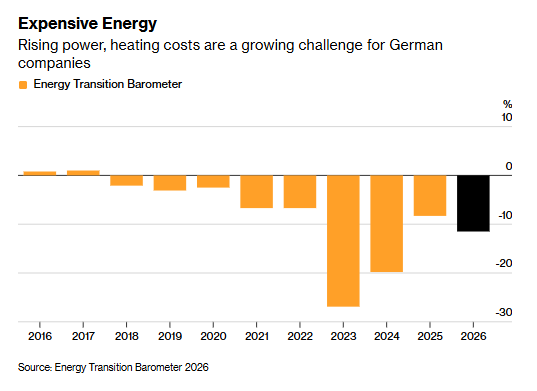
Expensive Energy
Rising power, heating costs are a growing challenge for German companies
Source: Energy Transition Barometer 2026
The DIHK’s latest “Energy Transition Barometer,” a measure of the transition’s impact on competitiveness, dropped to -11.5 in 2026, down three points compared with a year earlier and the first decline since 2023. The scale ranges from -100 (very negative) to +100 (very positive). Source: Bloomberg
Germany’s Business Energy Prices Among Europe’s Highest
Eurostat data for the second half of 2025 show non-household (business) electricity prices highest in Ireland (€0.2552/kWh), Cyprus (€0.2429/kWh), and Germany (€0.2264/kWh). The EU average was €0.1837/kWh (medium band: 500–2,000 MWh annual consumption, including non-recoverable taxes/levies). Lowest were Finland (€0.0748) and Sweden (€0.0970). Prices for energy-intensive industries across the EU remained roughly double U.S. levels and more than 50% above those in China and India in 2025, continuing a gap that has widened since pre-crisis years.
Germany’s industrial prices reflect wholesale levels often in the €80–100+/MWh range (higher during gas spikes), plus network charges, taxes, and levies—though energy-intensive users receive partial reliefs. Residential prices ranked even higher (Germany near the top of the EU at around €0.39/kWh in H2 2025). International comparisons consistently place major European economies with high renewable shares or import dependence (Germany, Ireland, parts of the UK, Belgium, Denmark, Italy) well above the U.S. (~half or less for industry in many metrics), China, and low-price European peers reliant on nuclear or hydro.
Energy Mixes, Net Zero Ambitions, and Carbon Pricing
Germany’s 2025 electricity mix reached approximately 59% clean sources—entirely renewables after the 2023 nuclear exit—with wind ~27% and solar ~18% (combined wind+solar ~45%). Fossil fuels supplied ~41% (coal around 21%, gas significant). This lags the EU average of ~71% clean. Coal has fallen sharply from over 50% historically, but intermittency requires fossil backup and imports.
Contrast this with lower-price peers: France relies heavily on nuclear (~60–70% historically, supporting more stable/lower industrial prices); Nordic countries (Finland, Sweden) lean on hydro and nuclear; Poland retains substantial coal. High-price Ireland and Cyprus depend more on gas, oil, and imports with limited domestic baseload diversity.
The EU Emissions Trading System (ETS) price has hovered in the €70–85/tCO₂ range recently (around €80+ in mid-2026 periods), covering power and industry. Germany operates a national emissions trading system for fuels (price corridor €55–65/t in 2026, transitioning toward broader EU rules), plus renewable surcharges historically embedded in prices, network expansion costs for intermittent generation, and other levies. Carbon pricing and Net Zero targets (Germany aims for climate neutrality by 2045; EU by 2050 with interim goals) drive investment in renewables and efficiency but add direct and indirect costs—particularly where backup capacity, grid upgrades, and storage lag.
The Trade-Off: Net Zero Compliance Costs vs. Economic Vitality
Aggressive Net Zero pathways raise system costs through intermittency management, subsidized capacity buildout, and carbon pricing that competitors (U.S. with cheaper gas and less stringent federal carbon rules; China with coal dominance and industrial policy support) often face at lower intensity. German industry argues these costs are already translating into delayed capital spending, margin pressure, and offshoring risk—especially in energy-intensive sectors—potentially hollowing out the manufacturing base that underpins growth, employment, and the fiscal capacity for further green investment. Survey data and IEA observations of persistent EU-U.S./China industrial price gaps illustrate the competitive drag. A scenario of sustained high costs, investment flight, and slower growth would itself undermine the resources and political support needed for the transition. Balanced approaches that prioritize affordable, reliable power (including proven low-carbon firm capacity) appear more sustainable than pure intermittency-plus-backup models that keep prices elevated. Empirical outcomes so far—rising relocation consideration, deferred investment—suggest the current cost trajectory carries material economic risks.
Parallel Outcomes in U.S. Blue States Following Similar Policies
A comparable pattern has emerged in several U.S. states with Democratic (blue) leadership that have pursued aggressive renewable portfolio standards, carbon-free or 100% clean electricity mandates, restrictions on natural gas infrastructure, net-metering policies, and premature retirements or constraints on dispatchable generation (coal and, in some cases, nuclear)—policies that echo key elements of Germany’s Energiewende. These approaches prioritize rapid emissions reductions and intermittent renewables while limiting firm, affordable baseload options, producing elevated costs and economic relocation pressures.
Analyses of U.S. Energy Information Administration (EIA) data show that blue states, on average, pay approximately 37% more for electricity than red states (one detailed comparison using EIA figures and political leanings). Nine of the top 10 most expensive states for electricity have been blue-leaning. A December 2025 Institute for Energy Research report found that 86% of continental U.S. states with electricity prices above the national average (around 13.54 ¢/kWh all-sectors in early-to-mid 2025 data) were reliably blue (Democratic in recent presidential elections), while 80% of the 10 lowest-price states were reliably red.
California’s all-sectors and residential rates have frequently run near or above double the national average (residential often 33–35+ ¢/kWh in recent EIA and market data). New York’s rates have been 50–58% or more above the national average and substantially higher than those in Florida or Texas. In contrast, Texas, Florida, and many red states with greater reliance on natural gas, fewer restrictive mandates, and more flexible permitting show markedly lower prices (Texas residential often in the mid-teens ¢/kWh range; Florida similarly competitive).
These higher costs contribute to broader affordability challenges. IRS Statistics of Income migration data document sustained net outflows of residents and adjusted gross income (AGI) from high-cost blue states such as California, New York, and Illinois toward lower-cost red or purple states including Texas, Florida, North Carolina, South Carolina, and Tennessee. Recent releases covering 2022–2023 filings show California and New York losing tens of thousands of filers and billions in AGI (California net AGI losses in the $10+ billion range in analyzed periods; New York similar multi-billion outflows), while Texas and Florida recorded multi-billion AGI gains. High-income households have been disproportionately represented in these shifts in multiple analyses. Population and investment trends reinforce the pattern: business headquarters and capital have moved toward more affordable energy and regulatory environments, paralleling German industry’s reported relocation considerations.
Other factors (housing costs, taxes, climate, remote work) clearly influence migration, yet energy prices are a documented and quantifiable contributor. States prioritizing rapid renewable mandates and constraints on gas/nuclear without sufficient storage, transmission, or firm capacity have replicated the German outcome of elevated prices and eroded competitiveness. Red states emphasizing abundant domestic resources, faster permitting, and balanced mixes have generally avoided the same degree of cost escalation and outward wealth/investment flows.
Paths to Lower Energy Costs After Russian Gas, Nuclear Exit, and Coal Constraints
Germany ended dependence on Russian pipeline gas after 2022, completed its nuclear phase-out in 2023, and continues coal phase-down (with targets extending into the 2030s). Remaining options to rein in industrial costs include:
Targeted industrial electricity price relief: The government has advanced a subsidized “industrial electricity price” (aiming near €50/MWh or around 5 ct/kWh for eligible portions of consumption for energy- and trade-intensive firms from 2026, with conditions such as reinvestment in transformation). Network charge and tax reductions form part of the package.
Diversified gas/LNG supply and flexible capacity: Expanded LNG import terminals and long-term contracts from non-Russian sources, plus new gas plants designed for later hydrogen conversion, provide dispatchable power while renewables scale.
Accelerated renewables + storage + grids: Faster permitting, more wind/solar, battery and other storage, demand-side flexibility, and north-south transmission to reduce curtailment and price spikes from weather-driven intermittency. But this is not going to fix the AC vs DC grid imbalance and resiliency issues that wind and solar bring to the grid. Costs for grid resiliency have been underestimated globally, as we have seen in Spain.
Efficiency, electrification, and hydrogen: Industrial efficiency gains, process electrification where economical, and green hydrogen for hard-to-abate sectors—supported by infrastructure funding.
Cross-border trade and potential policy recalibration: Greater imports from nuclear-heavy neighbors (e.g., France) during tight periods; limited discussion of extending remaining coal flexibility or revisiting nuclear (politically constrained) as bridging options.
Broader cost containment: Further cuts to taxes/levies on power, streamlined regulation, and ensuring carbon costs do not create unilateral disadvantages (via CBAM and free allocation phase-outs managed carefully).
Starting to look at nuclear again in micro reactors would also be highly recommended, but judging by their past behavior, it won’t happen.
These measures can mitigate the immediate shock, but durable competitiveness requires addressing the structural price premium tied to the current energy mix and regulatory framework. Without reliable, affordable baseload alongside variable renewables, German industry—and similarly positioned U.S. blue states—risk continued erosion of investment and growth foundations. The parallel experiences underscore that policy choices prioritizing intermittent sources and restrictions on firm capacity, without adequate cost safeguards, reliably produce higher prices and capital flight.
Additional EIA state rate summaries and market reports (Electric Choice, Choose Energy, etc.) for 2026 residential/commercial figures
Context on California/New York renewable mandates and comparisons to German Energiewende from policy analyses and historical reporting
All data reflect the most recent publicly summarized figures available as of late July 2026; exact band-specific industrial prices and migration periods vary with relief schemes, contracts, and filing years. Correlation with policy choices is strong in the cited analyses, though multiple factors influence prices and migration.