
Regular is already $3.78 and has fallen about 12 percent from a month ago. Diesel has come down only about 5 percent, just slipped under $6, and is still supported by tight stocks and a New York Harbor margin near $87 a barrel last week.
Diesel finally did the thing drivers have been waiting for since early September. On Monday, the AAA national average slipped to $5.9989 a gallon, just under $6 for the first time since early September. This morning, Tuesday, Nov. 17, it is $5.9848. That is real money if you fill a pickup, a tractor or a truck. It is not, yet, the same relief gasoline has already delivered.
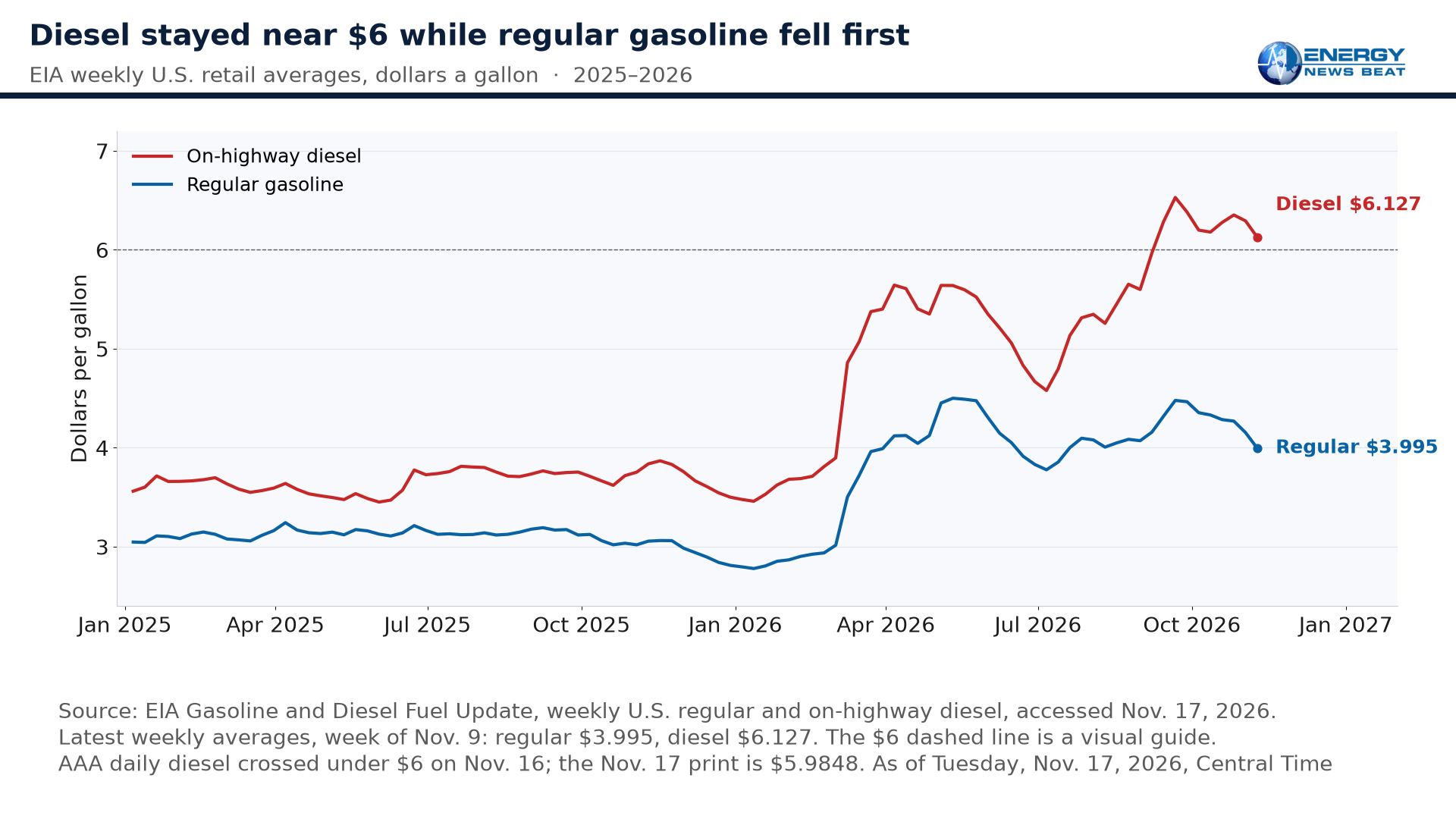
Regular is $3.7818, down 53 cents, or about 12 percent, from a month ago. Diesel is down 34 cents, or about 5 percent, over the same stretch, and it is still $2.22 higher than a year ago. We have written about this lag before, when crude crashed and diesel barely budged, and again when gasoline was already falling ahead of the midterms. The new fact is the $6 line. The old fact is why the workhorse fuel is taking longer to come down, and what that still costs truckers, farmers, grocery bills and, on the other side of the ledger, refiners.
What the pump actually shows
AAA’s all-time diesel high is $6.5276, set on Sept. 22. From that peak, today’s $5.9848 is down 54 cents, or about 8 percent — a meaningful step, and still a historically expensive gallon. The Energy Information Administration’s weekly survey, which lags the daily AAA print, last peaked at $6.529 in the week of Sept. 21 and was still $6.127 in the week of Nov. 9, the latest weekly reading. The daily average is what crossed $6 on Monday. Transport Topics, citing Bloomberg, put Monday’s figure at $5.9989 and the late-September peak above $6.50, which matches the AAA record.
The official weekly record before this year was $5.81, in the week of June 20, 2022, on EIA’s retail diesel series. Even after this week’s dip, the national average is still above that earlier peak. Gasoline is in a different place. EIA regular peaked at $4.50 in the week of May 11 and had already fallen about 8 percent from a month earlier by the week of Nov. 9, to $3.995. AAA has taken it further since then. From Oct. 12 to Nov. 9, EIA diesel only went from $6.179 to $6.127, down 0.8 percent. That is the lag in one sentence.
The tank is still short of a normal fall
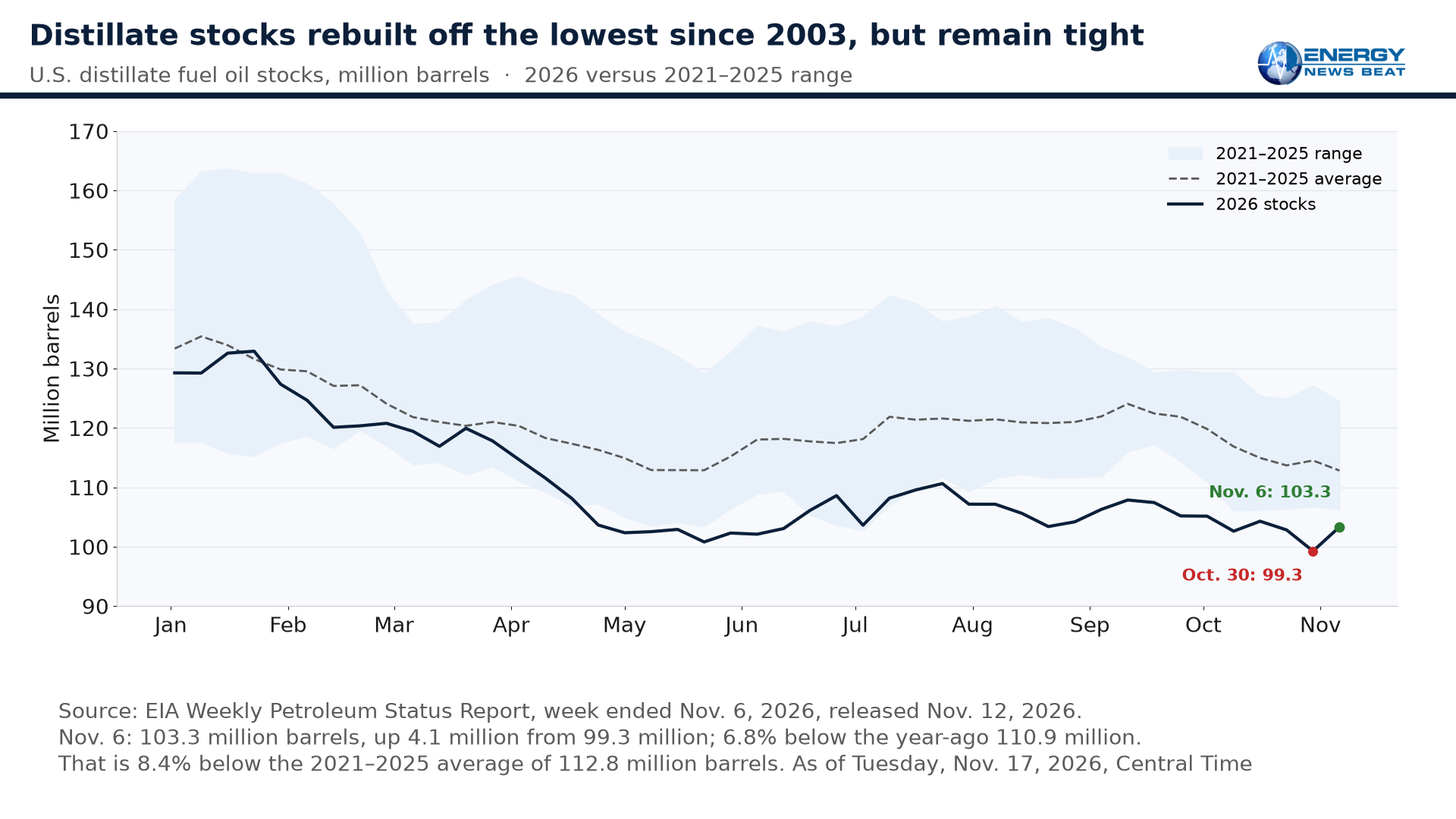
Diesel and heating oil come out of the same distillate tank. EIA’s Weekly Petroleum Status Report for the week ended Nov. 6, released Nov. 12, put those stocks at 103.3 million barrels, up 4.1 million from 99.3 million the week before. That bounce matters: the Oct. 30 reading was the first weekly total under 100 million barrels since May 2003. It is not enough to call the shortage over. Stocks are still 6.8 percent below the year-earlier 110.9 million, and 8.4 percent below the 2021–2025 average of 112.8 million for the comparable week, which Energy News Beat calculated from EIA’s weekly series WDISTUS1. They also sit below the lowest of those five comparable weeks, 106.3 million in early November 2022. The next weekly report is due Nov. 18.
Gasoline tanks tell a different story. The same report had total motor gasoline stocks at 210.8 million barrels, 2.8 percent above a year earlier. When one side of the rack is rebuilding and the other is still short, pump prices will not move together. Bloomberg, in the Transport Topics dispatch, also noted that crude cargoes have recovered more than fuels since the Iran war disrupted shipments through the Strait of Hormuz, and that Russia — in normal times the world’s second-largest diesel exporter — is curbing diesel shipments through the end of January after Ukrainian strikes on its refineries. Those are product problems, not a crude-headline problem.
The margin is still wide, and the official outlooks are still tight
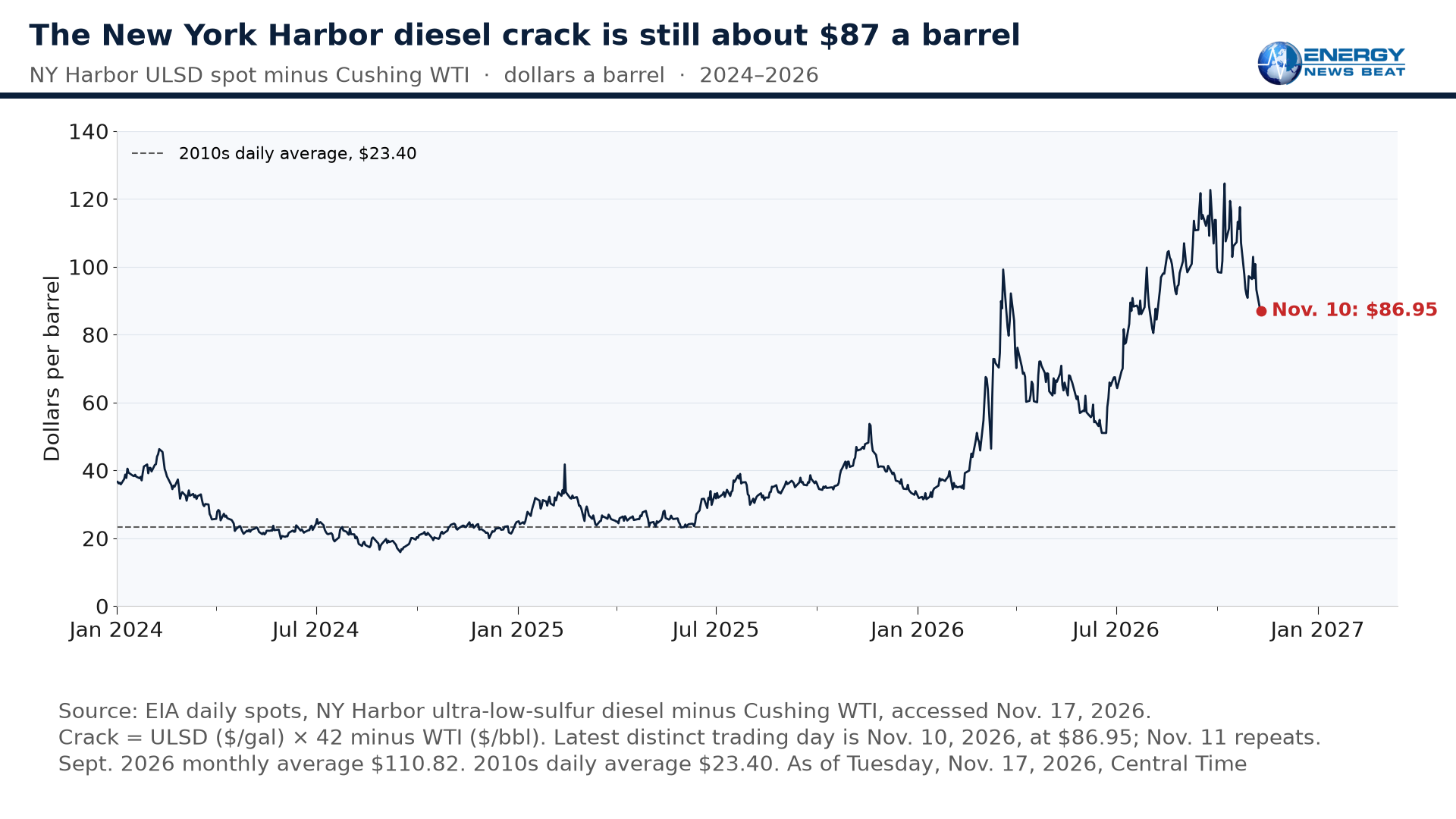
The cleanest official measure of the diesel shortage premium is the New York Harbor ultra-low-sulfur diesel spot minus Cushing WTI, both from EIA daily series. On Nov. 10, the latest distinct trading day in that file, Harbor diesel was $4.204 a gallon and WTI was $89.62 a barrel, a crack of $86.95 a barrel, or about $87. The November 11 line repeats those same prices, apparently a Veterans Day carry-forward. That margin is off an October peak of $124.55, but it is still nearly four times the 2010s daily average of $23.40. September’s monthly average was $110.82. When a gallon of diesel still pays refiners that kind of premium over crude, retail diesel will not fall one-for-one with oil.
EIA is not treating this dip as the end of the story. In the November Short-Term Energy Outlook, released Nov. 10, the agency wrote: “We now assume global petroleum product markets will face continued supply constraints through the end of 2027.” In the same outlook, “the U.S. retail diesel price averages $5.03 per gallon (gal) next year, 12% higher than we forecast last month.” The 2026 annual average in that outlook is $5.25. EIA locked its model inputs on Nov. 5 and said the forecast does not specifically account for market events after that day.
The International Energy Agency’s November Oil Market Report, published Nov. 13, made the same distinction we have been making: crude supply is recovering faster than diesel. The public highlights say “severe tightness in product supply, especially for diesel, remains the overriding concern of the broader market and consumers,” and that “the accelerated release of IEA emergency diesel stocks over the coming months will provide a critical bridge across the supply gap until the global refinery system and product output recover.” Reuters, quoting that monthly report, said member countries will make about 71 million barrels of emergency oil and products available through the end of February 2027, including about 15 million barrels of diesel, almost entirely from government stocks in France and Germany. Those two totals do not appear in the public highlights on iea.org.
Consumer and Investor Views
If you drive a truck for a living, $5.98 is better than $6.53, and some fleets already pay less than the posted retail average under supply contracts, as the Bloomberg dispatch noted. Owner-operators who buy at the pump feel the retail number more directly. A 54-cent drop from the September high helps a long week on the road. It does not put diesel back in the $3 range you were paying a year ago, when AAA’s average was $3.7655.
If you farm, diesel is still in the fall fieldwork, the fertilizer spreader and the next planting season. The same gallon that moves freight also runs the equipment that puts food into the system. A slip under $6 is welcome after two months above it. It is not cheap fuel, and it will not, by itself, undo a season of elevated input costs.
If you buy groceries, diesel is in the cost of getting food to the shelf — the long-haul truck and the last mile. That does not mean the price of milk falls the same week diesel does. It does mean the workhorse fuel is still one of the reasons this year’s relief at the gasoline pump has not shown up the same way in the rest of the household budget.
If you follow refiners, the $87 New York Harbor crack is the other side of that lag. EIA says continued supply constraints will “support wider petroleum product crack spreads next year and incentivize elevated U.S. refinery operations.” High runs and a still-tight diesel market are why this dip can be real for drivers and still profitable at the plant gate. This is not investment advice, and a crack this wide can compress if stocks rebuild faster than expected.
Caveats and Criticism
AAA’s daily national average and EIA’s weekly survey are different samples. The $6 break is a daily AAA event as of Nov. 16; EIA’s latest weekly diesel average, for the week of Nov. 9, was still $6.127. Distillate stocks are as of the week ended Nov. 6 and were released Nov. 12; they will be one report behind until the Nov. 18 update. The $86.95 crack uses EIA’s New York Harbor ultra-low-sulfur diesel spot minus Cushing WTI; it is not a company-reported refining margin. The 8.4 percent gap versus the five-year norm is Energy News Beat’s calculation from EIA’s WDISTUS1 series, not a figure copied from a secondary website. The 71 million and 15 million barrel IEA totals are from Reuters quoting the November Oil Market Report; they are not in the public highlights on iea.org. Russia’s export curb through the end of January is reported by Bloomberg via Transport Topics, not from a document we opened on a Russian government site. The November STEO finalized inputs on Nov. 5. This article updates our earlier diesel coverage; it does not replace it. None of this is investment advice.
Stu’s Take
Diesel under $6 is welcome, and it was overdue. It is not a return to normal. Gasoline has already done more of the work — about 12 percent lower than a month ago on today’s AAA average, versus about 5 percent for diesel — and the workhorse fuel is still expensive because the tank is still short and the New York Harbor margin is still about $87 a barrel. EIA is still writing 2027 as a year when product markets stay constrained and retail diesel averages $5.03. If you drive a truck, run a farm, or watch the grocery bill, treat this as a first step down, not a finish line. If you follow refiners, the remaining tightness is why margins have not collapsed with crude. The tests that matter next are whether the $6 break holds and whether the Nov. 18 stocks report keeps filling the tank.
One key point – the refineries are running far past their normal maintenance schedules. This will be impacted through accidents for forced shutdowns soon. As normal winter blends and demand destruction falls in from seasonal consumer travel is good, and should be a welcome break for the refineries. We still need the Trump Administration to focus on the Defense Production Act and California for our military. The diesel, jet fuel and gasoline in California will remain a national security risk until action is taken. Thank you for your attention to this matter. – Stu.
Sources
Primary sources opened for this article, with access on Tuesday, Nov. 17, 2026, unless a different date is noted.
- AAA, Fuel Prices, national averages as of Nov. 17, 2026: regular $3.7818 (yesterday $3.8118, week ago $3.9788, month ago $4.3085, year ago $3.0729, record $5.0165 on June 14, 2022); diesel $5.9848 (yesterday $5.9989, week ago $6.1572, month ago $6.3276, year ago $3.7655, record $6.5276 on Sept. 22, 2026) https://gasprices.aaa.com/
- Will Kubzansky, Bloomberg News, via Transport Topics, “Diesel dips below $6 for first time since September,” Nov. 16, 2026, 10:00 a.m. EST. AAA diesel $5.9989; late-September peak above $6.50; Russia curbing diesel shipments through the end of January; crude cargoes have recovered more than fuels https://www.ttnews.com/articles/diesel-falls-below-6-nov-16
- U.S. Energy Information Administration, Weekly Petroleum Status Report, week ending Nov. 6, 2026, released Nov. 12, 2026. Distillate fuel oil stocks 103.3 million barrels, up 4.1 million from 99.3 million the week of Oct. 30; year-ago 110.9 million, down 6.8 percent. Total motor gasoline stocks 210.8 million, up 2.8 percent from 205.1 million a year earlier. Overview and Table 6 https://www.eia.gov/petroleum/supply/weekly/
- EIA weekly distillate stocks series WDISTUS1, Weekly U.S. Ending Stocks of Distillate Fuel Oil. Energy News Beat calculation of the 2021–2025 average for the comparable week: 112.8 million barrels. The Nov. 6, 2026, level of 103.3 million is 8.4 percent below that average and below the five-year low for the comparable week, 106.3 million in early November 2022. Accessed Nov. 17, 2026 https://www.eia.gov/dnav/pet/hist/LeafHandler.ashx?n=PET&s=WDISTUS1&f=W
- EIA, Gasoline and Diesel Fuel Update, weekly U.S. retail regular (EMM_EPMR_PTE_NUS_DPG) and on-highway diesel (EMD_EPD2D_PTE_NUS_DPG). Week of Sept. 21, 2026: regular $4.478, diesel $6.529 (the 2026 weekly diesel peak). Week of Nov. 9: regular $3.995, diesel $6.127. Pre-2026 weekly diesel peak: $5.81 in the week of June 20, 2022. 2026 weekly regular peak: $4.50 in the week of May 11. Accessed Nov. 17, 2026 https://www.eia.gov/petroleum/gasdiesel/
- EIA daily spot prices, New York Harbor Ultra-Low Sulfur No. 2 Diesel (EER_EPD2DXL0_PF4_Y35NY_DPG) and Cushing, OK WTI (RWTC). On Nov. 10, 2026, the latest distinct trading day in the EIA file accessed Nov. 17, Harbor diesel was $4.204 a gallon and WTI was $89.62 a barrel, a crack of $86.95 a barrel. The Nov. 11 line repeats those prices (apparently a Veterans Day carry-forward). September 2026 monthly average $110.82; 2010s daily average $23.40; 2026 peak $124.55 on Oct. 8. Accessed Nov. 17, 2026 https://www.eia.gov/dnav/pet/pet_pri_spt_s1_d.htm
- EIA, Short-Term Energy Outlook, November 2026, PDF archive. Released Nov. 10, 2026; model inputs finalized Nov. 5, 2026. Exact wording: “We now assume global petroleum product markets will face continued supply constraints through the end of 2027.” And: “In our forecast, the U.S. retail diesel price averages $5.03 per gallon (gal) next year, 12% higher than we forecast last month.” 2026 annual diesel average $5.25; gasoline 2027 average $3.73. Accessed Nov. 17, 2026 https://www.eia.gov/outlooks/steo/archives/Nov26.pdf
- EIA press release, “EIA raises November natural gas storage forecast after warm start to month,” Nov. 10, 2026. Confirms the $5.03 diesel and $3.73 gasoline 2027 averages and the assumption that global supplies of refined fuels remain tight through the end of 2027 https://www.eia.gov/pressroom/releases/press594.php
- International Energy Agency, Oil Market Report — November 2026, published Nov. 13, 2026. Public highlights: “severe tightness in product supply, especially for diesel, remains the overriding concern of the broader market and consumers,” and “the accelerated release of IEA emergency diesel stocks over the coming months will provide a critical bridge across the supply gap until the global refinery system and product output recover.” The public highlights do not list the 71 million or 15 million barrel totals https://www.iea.org/reports/oil-market-report-november-2026
- Reuters (Alex Lawler), “World oil market is returning to surplus as Gulf exports recover, IEA says,” Nov. 13, 2026, and the related Reuters dispatch “Oil releases from IEA emergency stocks to pick up through February, agency says.” Both quote the November Oil Market Report as saying about 71 million barrels of emergency oil and products will be made available through the end of February 2027, including about 15 million barrels of diesel, almost entirely from government stocks in France and Germany https://www.bnnbloomberg.ca/markets/oil/2026/11/13/world-oil-market-is-returning-to-surplus-as-gulf-exports-recover-iea-says/ ; related dispatch via BOE Report: https://boereport.com/2026/11/13/oil-releases-from-iea-emergency-stocks-to-pick-up-through-february-agency-says/
- Energy News Beat, “Oil Crashed. Your Diesel Didn’t,” Nov. 9, 2026; “EIA Raised Its 2027 Diesel Forecast to $5.03. Iran Says Hormuz Stays Shut. Oil Is Still Getting Through.” and “Trump Says the U.S. Doesn’t Need an Iran Deal. Oil Settled Sharply Higher. Your Pump Hasn’t Caught Up Yet.” Nov. 12, 2026; “Oil Swings Back to Surplus, Diesel Doesn’t,” Nov. 13, 2026; and “Gas Prices Were Already Down 32.5 Cents Before the Midterms. Diesel Is Still Near $6,” Nov. 16, 2026. Earlier coverage this article updates, rather than repeats
Excerpts
EIA, November 2026 Short-Term Energy Outlook, U.S. petroleum prices. “Although we expect the U.S. average retail price of gasoline and diesel to decline in 2027, we raised our forecast for those prices from last month’s outlook. In our forecast, the U.S. retail diesel price averages $5.03 per gallon (gal) next year, 12% higher than we forecast last month. Gasoline prices average $3.73/gal, 5% higher than last month. We now assume global petroleum product markets will face continued supply constraints through the end of 2027. These market conditions will support wider petroleum product crack spreads next year and incentivize elevated U.S. refinery operations.” The outlook also states: “We finalized inputs into the model on November 5, 2026. This month’s forecast does not specifically account for market events after that day.”
IEA, Oil Market Report — November 2026, public highlights. “For now, the severe tightness in product supply, especially for diesel, remains the overriding concern of the broader market and consumers. Persistent attacks on Russian energy infrastructure continue to choke off the country’s diesel supplies to international markets, adding to losses from the Middle East. … Notably, the accelerated release of IEA emergency diesel stocks over the coming months will provide a critical bridge across the supply gap until the global refinery system and product output recover.”
Bloomberg, via Transport Topics, Nov. 16, 2026. “Retail diesel prices dropped to $5.9989 a gallon Nov. 16, according to AAA, down from a peak over $6.50 a gallon in late September. … And while crude oil cargoes have recovered, fuel remains curtailed. That shortage has since been exacerbated by Ukrainian drone strikes on Russian oil refineries, pushing the country — in normal times the world’s second-largest exporter of diesel — to curb diesel shipments through the end of January.”
Data tables
Figures below are from the primary sources listed above, accessed Nov. 17, 2026. AAA figures are daily national averages as of Nov. 17. EIA weekly retail figures are through the week of Nov. 9. Distillate stocks are for the week ended Nov. 6, released Nov. 12. The New York Harbor crack is Energy News Beat arithmetic on EIA daily spots. As of Tuesday, Nov. 17, 2026, Central Time.
Table A. AAA national averages, as of Nov. 17, 2026
| Regular | Diesel | |
| Current (Nov. 17) | $3.7818 | $5.9848 |
| Yesterday (Nov. 16) | $3.8118 | $5.9989 |
| Week ago | $3.9788 | $6.1572 |
| Month ago | $4.3085 | $6.3276 |
| Year ago | $3.0729 | $3.7655 |
| Change vs month ago | −$0.5267 (−12.2%) | −$0.3428 (−5.4%) |
| Change vs year ago | +$0.7089 (+23.1%) | +$2.2193 (+58.9%) |
| Record (date) | $5.0165 (June 14, 2022) | $6.5276 (Sept. 22, 2026) |
Source: AAA Fuel Prices, https://gasprices.aaa.com/, captured Nov. 17, 2026. Percentage changes are Energy News Beat arithmetic on those AAA averages.
Table B. EIA weekly U.S. retail prices, selected weeks, dollars a gallon
| Week | Regular | Diesel |
| May 11, 2026 (2026 regular peak) | 4.500 | — |
| June 20, 2022 (pre-2026 diesel peak) | — | 5.810 |
| Sept. 7, 2026 | 4.157 | 5.967 |
| Sept. 14, 2026 | 4.319 | 6.285 |
| Sept. 21, 2026 (2026 diesel peak) | 4.478 | 6.529 |
| Oct. 12, 2026 | 4.331 | 6.179 |
| Nov. 2, 2026 | 4.153 | 6.292 |
| Nov. 9, 2026 (latest weekly) | 3.995 | 6.127 |
Source: EIA Gasoline and Diesel Fuel Update, series EMM_EPMR_PTE_NUS_DPG and EMD_EPD2D_PTE_NUS_DPG, accessed Nov. 17, 2026. From Oct. 12 to Nov. 9, regular fell 7.8 percent and diesel 0.8 percent.
Table C. U.S. distillate stocks, week ended Nov. 6, 2026
| Measure | Million barrels |
| Week ended Nov. 6, 2026 | 103.3 |
| Week ended Oct. 30, 2026 | 99.3 |
| Change | +4.1 |
| Year earlier (Nov. 7, 2025) | 110.9 |
| Change vs year earlier | −6.8% |
| 2021–2025 average, comparable week | 112.8 |
| Change vs five-year average | −8.4% |
| Five-year low, comparable week (Nov. 4, 2022) | 106.3 |
Sources: EIA Weekly Petroleum Status Report, week ended Nov. 6, 2026, released Nov. 12, 2026 (103.3, 99.3, 110.9, −6.8%). Five-year average and low are Energy News Beat calculations from weekly series WDISTUS1, comparable weeks in 2021–2025: 124.5, 106.3, 108.0, 114.4 and 110.9 million barrels.
Table D. New York Harbor ULSD minus WTI, selected dates, dollars a barrel
| Date | ULSD ($/gal) | WTI ($/bbl) | Crack ($/bbl) |
| 2010s daily average | — | — | 23.40 |
| Sept. 2026 monthly average | — | — | 110.82 |
| Oct. 8, 2026 (2026 daily peak) | 5.305 | 98.26 | 124.55 |
| Nov. 10, 2026 (latest distinct day) | 4.204 | 89.62 | 86.95 |
| Nov. 11, 2026 (repeat of Nov. 10) | 4.204 | 89.62 | 86.95 |
Source: EIA daily spots, series EER_EPD2DXL0_PF4_Y35NY_DPG and RWTC, accessed Nov. 17, 2026. Crack = ULSD in dollars a gallon times 42, minus WTI in dollars a barrel. The Nov. 11 line repeats the Nov. 10 prices (apparently a Veterans Day carry-forward).
Table E. EIA November 2026 Short-Term Energy Outlook, retail diesel
| Item | Figure |
| 2026 annual average (current outlook) | $5.25 |
| 2027 annual average (current outlook) | $5.03 |
| 2027 average, October outlook | $4.49 |
| Change in the 2027 forecast | +12% |
| 2027 retail gasoline average | $3.73 |
| Model inputs finalized | Nov. 5, 2026 |
| Outlook released | Nov. 10, 2026 |
Source: EIA, Short-Term Energy Outlook, November 2026, https://www.eia.gov/outlooks/steo/archives/Nov26.pdf, accessed Nov. 17, 2026.
Background notes
This article is a sequel, not a rewrite, of Energy News Beat’s Nov. 9 piece on why cheaper crude did not immediately cheapen diesel; the Nov. 12 Iran/Hormuz diesel updates; the Nov. 13 IEA surplus-versus-diesel piece; and the Nov. 16 midterms gasoline article, which already recorded Monday’s $5.9989 AAA print as it appeared that day. The new reporting is Tuesday’s AAA confirmation that diesel is still under $6, the live comparison with regular’s 12 percent month-ago decline, an EIA-based 8.4 percent stocks gap and an EIA-based $86.95 New York Harbor crack, plus the consumer and investor implications for truckers, farmers, groceries and refiner margins. The Reuters copy of the Nov. 13 IEA dispatch was read via BNN Bloomberg syndication, and the related stock-release dispatch via BOE Report. No numbers or quotations were invented.
Methodology
As-of times are Central Time, taken from the clock at build on Tuesday, Nov. 17, 2026.
AAA national averages were read from the live Fuel Prices page at https://gasprices.aaa.com/ on Nov. 17, 2026, which displays “Price as of 11/17/26.” Month-ago, week-ago, year-ago and record figures, and the percentage changes from them, are arithmetic on that same table.
EIA weekly retail gasoline and diesel, daily New York Harbor diesel and WTI spots, and weekly distillate stocks were downloaded as official Excel series on Nov. 17, 2026 (EMM_EPMR_PTE_NUS_DPG, EMD_EPD2D_PTE_NUS_DPG, EER_EPD2DXL0_PF4_Y35NY_DPG, RWTC, WDISTUS1) and checked against the Weekly Petroleum Status Report PDF for the week ended Nov. 6, 2026, released Nov. 12 (overview and Table 6). The 103.3 million barrel stock figure is the rounded official WPSR total; the underlying weekly series is 103,330 thousand barrels.
The 8.4 percent gap versus the five-year norm is Energy News Beat’s calculation: the 2021–2025 average of the comparable week (124.509, 106.263, 108.001, 114.415 and 110.909 million barrels) is 112.819 million; (103.330 − 112.819) / 112.819 = −8.4 percent. The New York Harbor crack is ULSD in dollars a gallon times 42, minus Cushing WTI in dollars a barrel. The Nov. 10 value is $86.95, reported in the body as about $87.
The November STEO wording on supply constraints through the end of 2027 and on the $5.03 2027 diesel average was copied from the official PDF at https://www.eia.gov/outlooks/steo/archives/Nov26.pdf.
The IEA “critical bridge” and “severe tightness” sentences were copied from the public highlights of the November Oil Market Report on iea.org. The 71 million and 15 million barrel totals do not appear in those highlights; they are attributed to Reuters quoting the monthly report and are not presented as text we pulled from the public iea.org page.
Russia’s diesel export curb through the end of January is attributed to Bloomberg, as published by Transport Topics. Charts were built only from the official EIA series named above. No numbers or quotations were invented. This is not investment advice.