
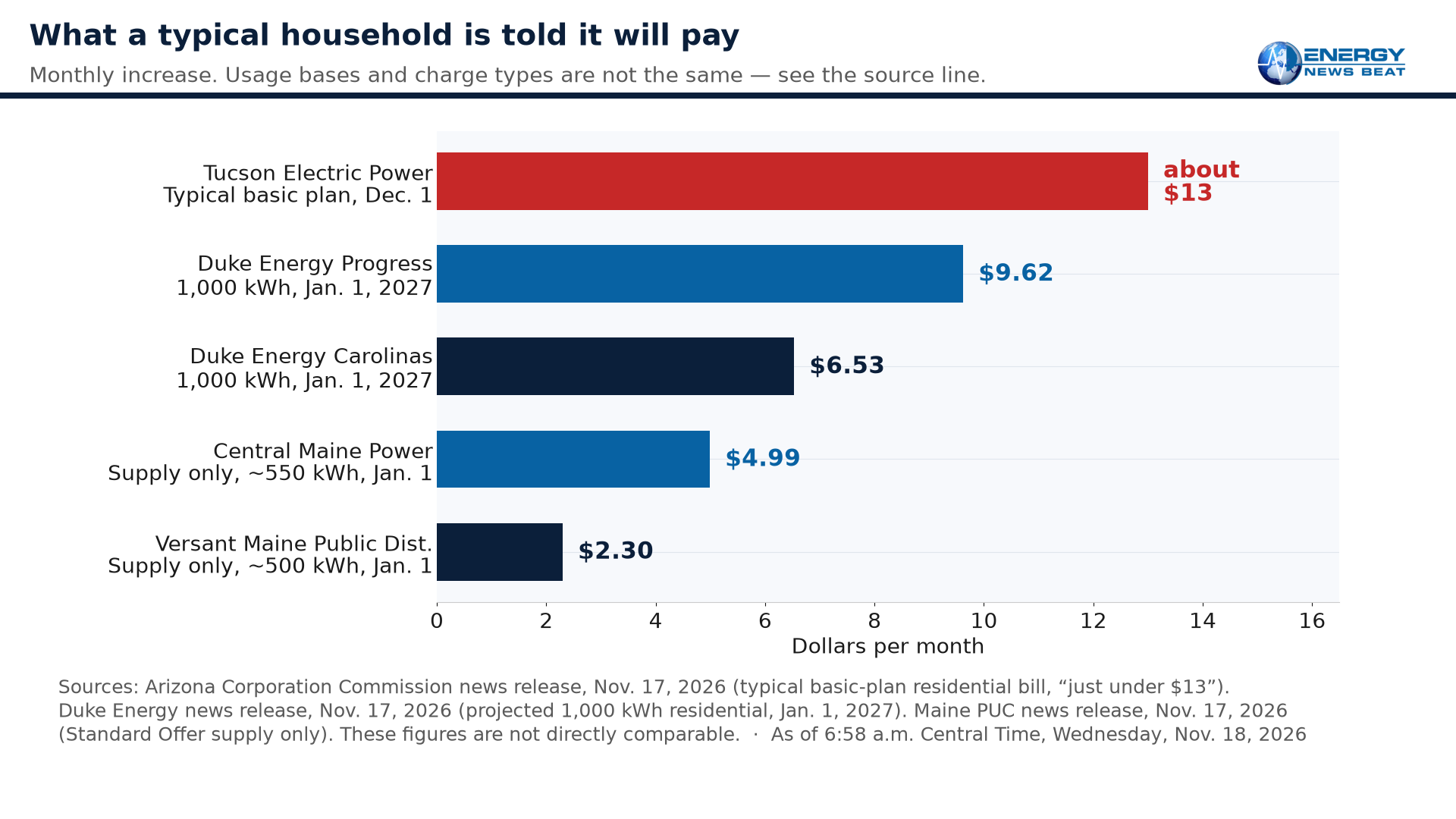
Duke Energy said a typical North Carolina household using 1,000 kilowatt-hours a month faces a projected increase of $6.53 or $9.62 in January 2027. Tucson Electric Power bills rise just under $13 starting Dec. 1. Maine’s default supply adds about $4.99 for an average Central Maine Power customer. In Arizona, one yes vote came from a commissioner who had already lost.
Two weeks after the midterms, regulators in three states signed off on higher electric bills. On Monday, Nov. 16, the North Carolina Utilities Commission issued written orders in the Duke Energy Carolinas and Duke Energy Progress rate cases. On Tuesday, Nov. 17, the Arizona Corporation Commission voted 4-1 to raise Tucson Electric Power rates, and the Maine Public Utilities Commission accepted new default supply bids for Central Maine Power and Versant Power’s northern district.
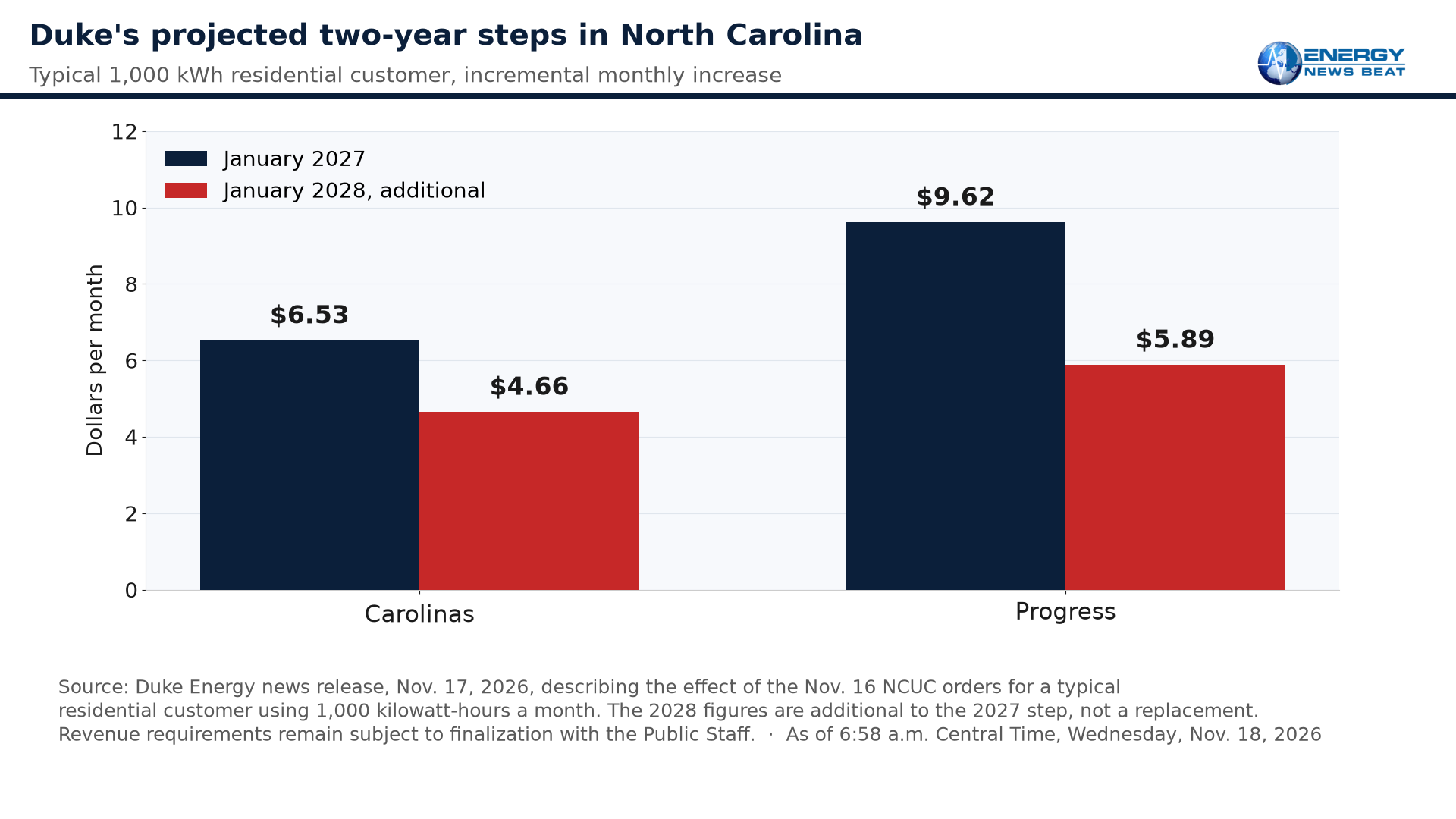
Duke said a typical residential customer using 1,000 kilowatt-hours a month would see a projected increase of $6.53 in January 2027 on the Carolinas system and $9.62 on the Progress system. Arizona’s commission said a typical Tucson Electric Power customer on a basic plan may see a monthly bill rise by just under $13, or about 9.4 percent, to about $150, starting Dec. 1. Maine’s commission said an average residential Central Maine Power customer using about 550 kilowatt-hours would pay about $4.99 more a month for default supply beginning Jan. 1, 2027; a typical Versant Maine Public District customer using about 500 kilowatt-hours would pay about $2.30 more.
Those are not the same kind of increase. North Carolina locked in a two-year rate plan. Arizona approved an annual formula that can bring the company back before the next full rate case. Maine’s increase is only the supply half of the bill, reset through a yearly competitive bid.
What each household will pay
The North Carolina orders, in Docket No. E-7, Sub 1329 and Docket No. E-2, Sub 1380, approve the Duke settlements. Duke said they produce an average annual increase of about 3.7 percent over two years for Carolinas customers, or 4.8 percent residential, and about 3.4 percent over two years for Progress customers, or 4.7 percent residential. New rates are expected Jan. 1, 2027, with a further projected $4.66 a month in January 2028 for a typical Carolinas household and $5.89 for Progress. Duke’s Form 8-K put the two-year revenue increase at $496 million and $338 million, “subject to finalization with Public Staff based on NCUC Order.” Both orders authorize a 9.8 percent return on equity and a 53 percent equity ratio, below the company’s 10.95 percent request and later 10.48 percent rebuttal request.
Arizona’s case, Docket No. E-01933A-25-0103, starts sooner. The commission said the rate changes became effective Dec. 1, 2026, and that the decision establishes an approximately 10 percent overall net revenue increase. The 9.4 percent in its release is the typical residential bill increase, not a statement of the authorized return on equity, which the news release did not give.
Maine’s action is not a delivery-rate case. In Docket No. 2026-00065, the commission accepted Standard Offer supply bids that apply only to customers who have not chosen a competitive supplier. The residential and small-business supply rate rises from 12.72 cents a kilowatt-hour to 13.63 cents for Central Maine Power, and from 14.88 cents to 15.34 cents for Versant’s Maine Public District. Supply is about half the bill. Versant’s Bangor Hydro District was not part of Tuesday’s decision. The commission said regional supply prices are largely driven by natural gas, limited pipeline capacity and “the conflicts in Ukraine and Iran.”
Who voted, and who is still in office
The Arizona commission said Commissioner Lea Márquez Peterson cast the lone no vote. Chair Nick Myers, Vice Chair Rachel Walden, Kevin Thompson and René Lopez made up the majority. Reagan Priest of the Arizona Capitol Times reported that the four yes votes supported the annual adjustment mechanism and that Márquez Peterson opposed that formula.
Thompson was on the Nov. 3 ballot, in an election where costs were “a top issue for voters,” the Tucson Sentinel reported. Unofficial returns on Arizona’s election results site, updated Nov. 17, show Democrats Clara Pratte and Jonathon Hill leading a two-seat race, with Thompson third. The Arizona Capitol Times reported that Thompson had conceded, and that Pratte and Hill are set to take office in January. “I hope formula rates are given a chance,” he said at Tuesday’s meeting, the Capitol Times reported. Márquez Peterson said in the commission’s release she was “not comfortable with the outcome of this rate case and could not support it.” Myers stressed that “this is not an automated process.”
North Carolina’s orders carry names as well. Chairman William M. Brawley and Commissioners Floyd B. McKissick, Jr., Tommy Tucker and John W. Gajda participated in the Carolinas case; Commissioner Donald R. van der Vaart did not. In the Progress case, he concurred in part and dissented in part, including from the 9.80 percent return on equity.
Who pays for the data centers
North Carolina’s orders also create a new data-center schedule. A “DC Customer” is a customer with an applicable demand of at least 50 megawatts that functions, or is expected to function, as a data center. The orders and Duke’s 8-K fact sheets add minimum 15-year contracts for data centers above 100 megawatts, a 75 percent minimum billing demand, upfront payments for dedicated facilities, security for transmission upgrades and a stranded-generation charge to be defined. Separately, Duke will refund customers, with interest, if planned upgrades are late.
McKissick and Gajda concurred in the Carolinas order but wrote that “a large load tariff should be applicable to all large load users, not just data centers.” Van der Vaart, dissenting in part in the Progress order, wrote that data-center contracts run 15 years while the plants last about 35: “The mismatch is like financing a house over 35 years for a tenant who promises to stay only 15.” He also said he could not agree with the 9.80 percent return on equity, “which does not reflect the risk this Order shifts from Duke to its customers.”
The Tucson Sentinel, in a Nov. 17 account by Blake Morlock, reported that commissioners told Tucson Electric Power to come back in 180 days on the triggers for cost-of-service studies on large loads. “These cost-of-service studies are important to make sure growth pays for growth,” Walden said, according to the Sentinel.
When, if ever, the bills ease
Arizona approved an Annual Rate Adjustment Mechanism, with the first annual update due Sept. 1, 2027. The Tucson Sentinel reported that yearly adjustments would run until a new full rate case in 2032. The Arizona Capitol Times noted that intervenors may challenge the formula, and that a later commission could review those updates.
North Carolina’s increases are locked in for a two-year plan. The 8-K says the companies will evaluate delaying the next base-rate filing until no earlier than Nov. 1, 2028, if they are allowed to defer costs of certain new plants. Maine’s Standard Offer prices are for the 2027 supply year; customers who do not want the default product can shop, and the delivery charge was not reset on Tuesday.
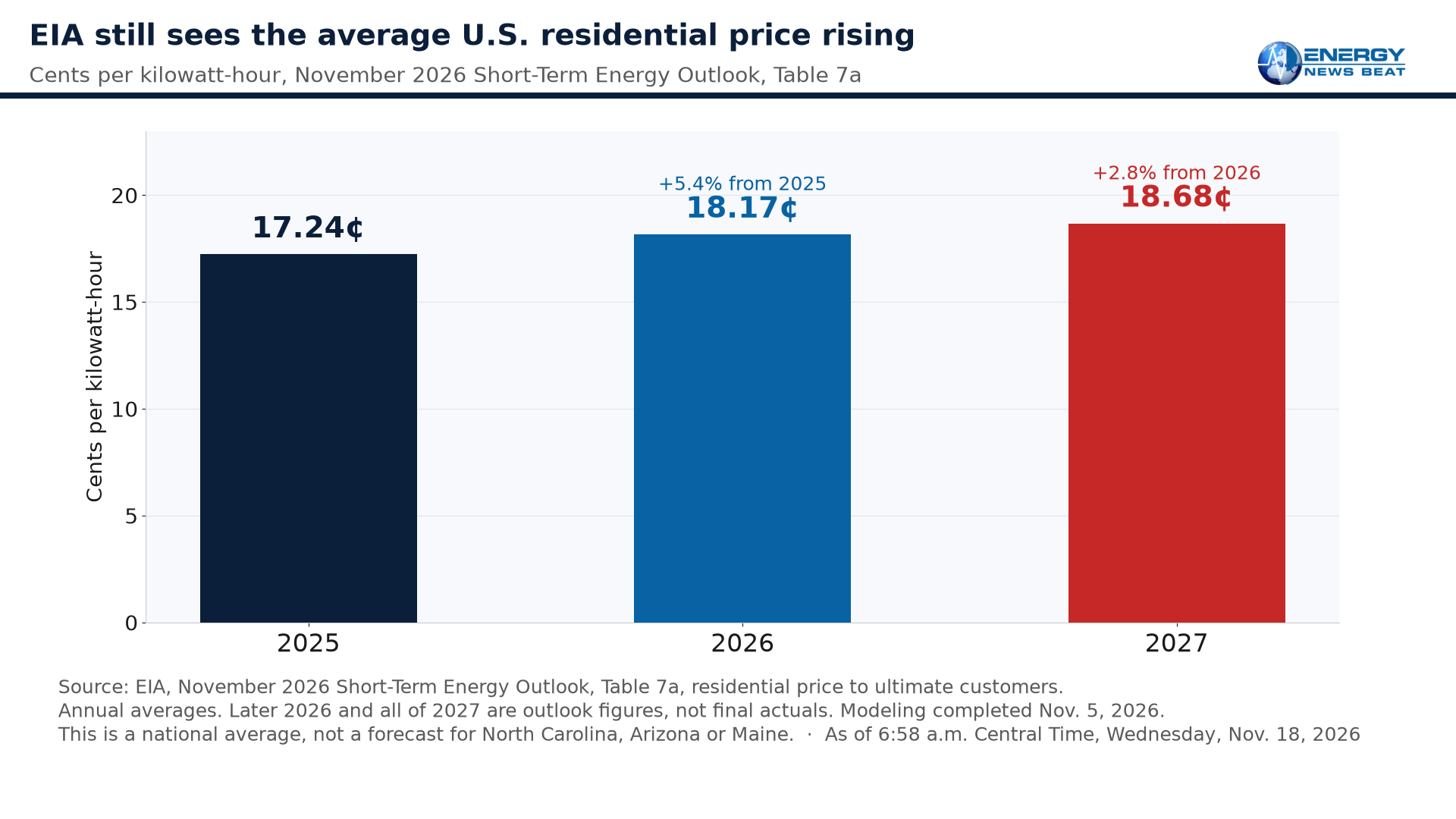
The U.S. Energy Information Administration’s November 2026 Short-Term Energy Outlook, Table 7a, puts the average U.S. residential price at 17.24 cents a kilowatt-hour in 2025, 18.17 cents in 2026 and 18.68 cents in 2027. That is a national average, not a forecast for these three states. It does not show that average falling next year.
Consumer and Investor Views
For consumers, Tucson Electric Power customers feel the increase first, on Dec. 1. Duke customers see the first step on Jan. 1, with another in 2028 on a 1,000-kilowatt-hour yardstick. Maine’s figures are for default supply only, about half the bill, and do not apply to households that already shop for a supplier. Duke pointed to $20 million in new shareholder funding for customers in need. Arizona’s Residential Utility Consumer Office opposed the formula.
For investors, both Duke utilities received a 9.8 percent return on equity and a 53 percent equity ratio, holding Progress at its last authorized return and lowering Carolinas from 10.1 percent. The two-year revenue increases remain subject to finalization with the Public Staff. Tucson Electric Power is an indirect wholly owned subsidiary of Fortis Inc., according to TEP’s latest 10-Q. The commission’s release did not state the authorized return. Walden’s docketed amendment proposed a 9.40 percent return on equity, down from the judge’s 9.65 percent; the Tucson Sentinel reported it passed. TEP’s 2025 application sought 10.50 percent. Myers and Thompson described the annual mechanism as a way to reduce regulatory lag, the outcome utilities want; every intervenor opposed it, the Capitol Times reported.
Caveats and What We Could Not Confirm
The household figures are typical-bill illustrations. Duke’s monthly amounts are projected increases for a customer using 1,000 kilowatt-hours, and the revenue requirements remain subject to Public Staff finalization. Arizona’s “just under $13” and “about $150” figures describe a typical basic-plan customer. Maine’s figures are tied to about 550 and 500 kilowatt-hours. The Arizona Corporation Commission’s written decision had not been posted when this article was prepared. Vote, typical-bill and Dec. 1 figures are from its Nov. 17 news release. The 9.4 percent authorized return, the 2032 next full rate case, and the 180-day data-center study are attributed to the Tucson Sentinel and were not independently read in an official order. Election results for Thompson remain unofficial. Maine’s Tuesday decision covers only Central Maine Power and Versant’s Maine Public District and is a Standard Offer supply award, not a delivery-rate order.
Stu’s Take
Voters spent the fall arguing about household costs. Then, in two days, three state commissions locked in higher electric bills — and in Arizona, they did it with a yes vote from a commissioner who had already lost. The dollars are real: just under $13 a month for a typical Tucson Electric Power customer starting Dec. 1, a projected $6.53 or $9.62 in January for typical Duke households using 1,000 kilowatt-hours, and about $4.99 a month more in default supply for an average Central Maine Power customer. North Carolina at least wrote a separate rate class for data centers above 50 megawatts, though two commissioners said those protections should cover all large loads, and one warned that 15-year contracts do not match 35-year power plants. The EIA’s November outlook still has the average U.S. residential price rising in 2027, not falling. Names were on these votes. That is the accountability test, in January and at the next hearing.
What we need to watch are the reasons for the increases to consumers rates. Patterns matter.
Sources
Primary and named secondary sources opened for this article. Access dates are Wednesday, Nov. 18, 2026, unless a different date is noted. The Arizona Corporation Commission’s written decision in Docket No. E-01933A-25-0103 had not been posted to the public eDocket when these sources were opened.
- North Carolina Utilities Commission, Order Accepting Stipulations in Part, Granting Partial Rate Increase, Granting Accounting Order, and Requiring Public Notice, Docket Nos. E-7, Sub 1329 and E-7, Sub 1355 (Duke Energy Carolinas), issued Nov. 16, 2026. Authorized ROE of 9.80 percent and a capital structure of 53 percent common equity and 47 percent long-term debt (Findings of Fact 9–14). Defines a DC Customer as a customer with an applicable demand of at least 50 MW that functions, or is expected to function, as a data center. Commissioners Floyd B. McKissick, Jr., and John W. Gajda concurred, writing that a large-load tariff should apply to all large-load users, not just data centers. Commissioner Donald R. van der Vaart did not participate. Official order PDF opened from a Southern Environmental Law Center posting of the Commission document; PDF metadata is dated Nov. 16, 2026, 3:57 p.m. Central Time https://www.selc.org/wp-content/uploads/2026/11/2026-Duke-Energy-Carolinas-Rate-Adjustment-Order.pdf
- North Carolina Utilities Commission, Order Accepting Stipulations in Part, Granting Partial Rate Increase, Granting Accounting Order, and Requiring Public Notice, Docket Nos. E-2, Sub 1380 and E-2, Sub 1405 (Duke Energy Progress), issued Nov. 16, 2026. Same 9.80 percent ROE and 53 percent equity ratio as in the Carolinas order. Commissioner van der Vaart concurred in part and dissented in part, including from the 9.80 percent ROE, and wrote that 15-year data-center contracts do not match plants that last about 35 years. Official order PDF opened from a Southern Environmental Law Center posting of the Commission document https://www.selc.org/wp-content/uploads/2026/11/2026-Duke-Energy-Progress-Rate-Adjustment-Order.pdf
- Duke Energy Corporation, Duke Energy Carolinas, LLC, and Duke Energy Progress, LLC, Form 8-K dated for the Nov. 16, 2026, event and filed Nov. 17, 2026, accession 0001104659-26-128747. Item 8.01: the NCUC issued written orders approving the Comprehensive Settlements, including a 9.8 percent return on equity based on a 53 percent equity component, retail rate bases of approximately $25.7 billion (DEC) and $17.8 billion (DEP), about $3.8 billion and $3.4 billion of North Carolina retail MYRP capital, and an agreement to evaluate a stay-out until no earlier than Nov. 1, 2028, if certain deferrals are granted. The companies expect to implement revised rates Jan. 1, 2027. “There are no material changes to the Comprehensive Settlements as a result of the Orders.” https://www.sec.gov/Archives/edgar/data/1326160/000110465926128747/tm2629986d1_8k.htm
- Duke Energy Carolinas, LLC, Form 8-K Exhibit 99.1, “Updates Regarding the 2025 Rate Case Filings in North Carolina (Docket E-7 Sub 1329),” furnished Nov. 17, 2026. Comprehensive Settlement revenue requirement of $496 million over two years, an average annual rate increase of 3.7 percent over two years, “subject to finalization with Public Staff based on NCUC Order.” Original request 10.95 percent ROE; last-case authorized ROE 10.1 percent, both with a 53 percent equity component. Rebuttal request 10.48 percent. Data-center schedule terms, including 15-year contracts for data centers above 100 MW and a 75 percent minimum billing demand. $10 million shareholder contribution https://www.sec.gov/Archives/edgar/data/1326160/000110465926128747/tm2629986d1_ex99-1.htm
- Duke Energy Progress, LLC, Form 8-K Exhibit 99.2, “Updates Regarding the 2025 Rate Case Filings in North Carolina (Docket E-2 Sub 1380),” furnished Nov. 17, 2026. Comprehensive Settlement revenue-requirement increase of $338 million over two years, an average annual rate increase of 3.4 percent over two years, subject to Public Staff finalization. Last-case authorized ROE was already 9.8 percent with a 53 percent equity component. Same data-center schedule terms as in Exhibit 99.1. $10 million shareholder contribution https://www.sec.gov/Archives/edgar/data/1326160/000110465926128747/tm2629986d1_ex99-2.htm
- Duke Energy, “North Carolina regulators approve more cost-effective path to strengthen reliability and power the state’s future,” investor news release dated Nov. 17, 2026. Residential average annual increases of 4.8 percent (Carolinas) and 4.7 percent (Progress) over two years; overall average annual increases of 3.7 percent and 3.4 percent. Projected typical 1,000 kWh residential increases of $6.53 on Jan. 1, 2027, and $4.66 on Jan. 1, 2028, for Carolinas, and $9.62 and $5.89 for Progress. New data-center schedule for loads above 50 megawatts; refunds with interest if upgrades are late; $20 million in new shareholder funding. The release also says the two utilities will be combined as of Jan. 1 but that rates will remain separate https://investors.duke-energy.com/news/news-details/2026/North-Carolina-regulators-approve-more-cost-effective-path-to-strengthen-reliability-and-power-the-states-future/default.aspx
- Arizona Corporation Commission, “ACC Votes on TEP Rate Case,” news release by Nicole Garcia, posted Nov. 17, 2026, 17:52 (as displayed on azcc.gov). 4-1 vote at the Nov. 17, 2026, Open Meeting; Commissioner Márquez Peterson dissenting. Approximately 10 percent overall net revenue increase, including surcharges. Typical residential customer on a basic plan may see a monthly bill increase of just under $13.00, or approximately 9.4 percent, to about $150.00. Annual Rate Adjustment Mechanism approved; first Annual Update due Sept. 1, 2027. Rate changes became effective Dec. 1, 2026. Quotes from Chairman Nick Myers and Commissioner Lea Márquez Peterson. The release does not state an authorized return on equity, a 2032 next rate-case date, or a roll-call of the four yes votes by name https://azcc.gov/news/home/2026/11/18/acc-votes-on-tep-rate-case
- Arizona Corporation Commission, Revised Notice, Special Open Meeting, Tuesday, Nov. 17, 2026, 9:00 a.m., Hearing Room One. Lists sitting commissioners Chair Nick Myers, Vice Chair Rachel Walden, Lea Márquez Peterson, Kevin Thompson and René Lopez, and identifies the TEP rate case https://eventnotices.azcc.gov/d14964a5-6b68-41b7-b4b4-eda565eba548/11-17-2026%20REVISED%20COM.pdf
- Vice Chair Walden, Revised Proposed Amendment No. 2, Docket No. E-01933A-25-0103, docketed Nov. 16, 2026. The amendment would replace the recommended 9.65 percent return on equity with 9.40 percent, stating that it is reasonable to reduce the authorized ROE by 35 basis points, from 9.75 percent to 9.40 percent, to account for adoption of the ARAM, and that “we adopt an ROE of 9.40%.” The amendment is a proposed order change; the ACC news release does not state the authorized ROE, and passage of the amendment is attributed to the Tucson Sentinel. Official docket image https://docket.images.azcc.gov/E000055734.pdf
- Tucson Electric Power Company, Public Notice of Hearing, Docket No. E-01933A-25-0103. Confirms the docket caption and that TEP filed on June 17, 2025. The application as noticed proposed a return on equity of 10.50 percent. This is the original request, not the authorized return https://docs.tep.com/wp-content/uploads/TEP-2026-Rates-Public-Notice.pdf
- Tucson Electric Power Company, Form 10-Q for the quarterly period ended Sept. 30, 2026, filed with the SEC. Cover: “All shares of outstanding common stock of Tucson Electric Power Company are held by its parent company, UNS Energy Corporation, which is an indirect, wholly-owned subsidiary of Fortis Inc.” Notes to financial statements, 2025 Rate Case: on Oct. 20, 2026, an ACC administrative law judge issued a recommended opinion and order including a return on equity of 9.65 percent, a capital structure of approximately 55 percent common equity, and a new ARAM, with a proposed implementation by Dec. 1, 2026. The 10-Q predates the Nov. 17 vote and does not state the Commission’s final authorized ROE https://www.sec.gov/Archives/edgar/data/100122/000010012226000025/tep-20260930.htm
- Blake Morlock, Tucson Sentinel, “Arizona Corp Comm approves rate hike for Tucson Electric Power,” posted Nov. 17, 2026, 6:36 p.m. Reported the 4-1 vote; a typical residential increase of about $13; yearly adjustments until a new full rate case in 2032; Commissioner Kevin Thompson “was defeated for re-election earlier this month and cast a lame-duck vote in favor of the deal”; a Walden amendment “lowering the company’s return to investors at 9.4 percent,” with TEP having sought 9.75 percent and the judge having set 9.65 percent; and a 180-day cost-of-service-study directive for data centers, including a Walden quote that “growth pays for growth.” Items from this article that are not in the ACC news release are attributed in the body and are flagged in Table C https://www.tucsonsentinel.com/local/report/111726_tep_rates/arizona-corp-comm-approves-rate-hike-tucson-electric-power/
- Reagan Priest, Arizona Capitol Times, “Corporation Commission approves TEP rate increase, formula rate structure,” Nov. 17, 2026. Reported that Thompson, Myers, Walden and Lopez supported the ARAM and that Márquez Peterson was the lone no; quoted Thompson: “I hope formula rates are given a chance to see if they improve the ratemaking experience for customers and reduce regulatory lag.” Noted that Democrats Clara Pratte and Jonathon Hill are set to take office in January and that intervenors are likely to challenge the ARAM. Quoted RUCO director Cynthia Zwick describing a sister-company annual process as “a very fast process.” This article did not state an authorized ROE, a 2032 date, or a $13 typical-bill figure https://azcapitoltimes.com/news/2026/11/17/corporation-commission-approves-tep-rate-increase-formula-rate-structure/
- Arizona Capitol Times, “Democrats break up all-Republican majority on Corporation Commission,” Nov. 5, 2026. Reported that Clara Pratte and Jonathon Hill defeated incumbent Kevin Thompson and Ralph Heap, and that both Republicans conceded in Wednesday interviews https://azcapitoltimes.com/news/2026/11/05/democrats-break-up-all-republican-majority-on-corporation-commission/
- Arizona election results site (enhancedvoting / 2026 General Election, Corporation Commissioner, vote for 2), unofficial results last updated Tuesday, Nov. 17, 2026, at 12:32:29 p.m. Central Time (converted from the page’s asOf timestamp of 2026-11-17T18:32:29Z). Clara Pratte 1,276,108 (27.23%), Jonathon Hill 1,224,900 (26.14%), Kevin Thompson 1,091,206 (23.29%), Ralph Heap 1,020,919 (21.79%), Mike Cease 70,804 (1.51%). The page was still labeled unofficial. Counts are used only in this appendix, not as certified results https://app.enhancedvoting.com/results/public/Arizona/elections/110326GeneralElection/ballot-items/248c0000-c0a3-7204-82ca-08df11bc03d0
- Maine Public Utilities Commission, “Commission Accepts Bids for Standard Offer Electricity Supply for 2027 for Central Maine Power and Versant Power Maine Public District Standard Offer Customers,” news release, Nov. 17, 2026. Average residential CMP customer using approximately 550 kWh: about $4.99 a month more. Average residential Versant MPD customer using approximately 500 kWh: about $2.30 a month more. Residential/small-business rates: CMP 12.72 to 13.63 cents/kWh; Versant MPD 14.88 to 15.34 cents/kWh, effective Jan. 1, 2027. Applies only to default Standard Offer customers. Supply accounts for about half of the total residential bill. The release says electricity supply prices in Maine and New England are largely driven by the price of natural gas, limited pipeline capacity, and “the conflicts in Ukraine and Iran.” Versant Bangor Hydro District was not part of Tuesday’s decision. Official URL https://www.maine.gov/tools/whatsnew/index.php?topic=puc-pressreleases&id=13368594&v=article088
- Maine Public Utilities Commission, Standard Offer Bid Solicitations, Docket 2026-00065, Central Maine Power page, describing the RFP schedule, including final bids on Nov. 17, 2026, and service beginning Jan. 1, 2027 https://www.maine.gov/mpuc/regulated-utilities/electricity/rfps/standard-offer/2026-00065/cmp
- U.S. Energy Information Administration, Short-Term Energy Outlook, November 2026, archive PDF. Modeling and analysis completed Nov. 5, 2026 https://www.eia.gov/outlooks/steo/archives/nov26.pdf
- U.S. Energy Information Administration, Short-Term Energy Outlook, November 2026, Table 7a, U.S. Electricity Industry Overview. Prices to ultimate customers, residential sector, annual averages: 17.24 cents/kWh in 2025, 18.17 cents in 2026, 18.68 cents in 2027. Later 2026 and all of 2027 are outlook figures https://www.eia.gov/outlooks/steo/tables/pdf/7atab.pdf
Primary excerpts
NCUC, Duke Energy Carolinas order, issued Nov. 16, 2026, Findings of Fact 9 and 11. “In the Comprehensive Settlement, the Stipulating Parties agreed to an allowed ROE of 9.80% and a capital structure consisting of 53.0% common equity and 47.0% long-term debt. … The Comprehensive Settlement’s stipulated ROE of 9.80% and capital structure composed of 53% common equity and 47% long-term debt, when factoring in the embedded cost of DEC’s debt (4.57%), results in an overall rate of return under the Comprehensive Settlement of 7.34%.”
NCUC, Duke Energy Carolinas order, concurrence of Commissioners McKissick and Gajda. “We believe that a large load tariff should be applicable to all large load users, not just data centers. … [T]he appropriate resolution … would be to adopt a large load tariff applicable to all customers that meet specified load size and load factor thresholds, rather than adopting a tariff addressing only loads greater than 50 MW who meet the Commission’s definition of a ‘data center.’”
NCUC, Duke Energy Progress order, opinion of Commissioner van der Vaart, concurring in part and dissenting in part. “But on the most important question those rules must answer—who pays if the customers who caused that build-out leave—I cannot agree with the majority’s answer. Nor can I agree with the 9.80 percent return on equity the majority approves, which does not reflect the risk this Order shifts from Duke to its customers. … Those plants are built to last about 35 years. The data centers’ contracts run for 15. The mismatch is like financing a house over 35 years for a tenant who promises to stay only 15. The question this Order must answer is who pays the remaining balance when the tenant leaves.”
Duke Energy Form 8-K, Item 8.01, filed Nov. 17, 2026. “On November 16, 2026, the North Carolina Utilities Commission (“NCUC”) issued written orders … approving the Comprehensive Revenue Requirement Settlements. … The Orders approve all revenue requirement items resolved in the Comprehensive Settlements including, among other things, (i) a return on equity of 9.8% based on a 53% equity component in the capital structure … The Companies expect to implement revised customer rates effective January 1, 2027. … There are no material changes to the Comprehensive Settlements as a result of the Orders.”
Arizona Corporation Commission news release, Nov. 17, 2026. “By a vote of 4-1 the Arizona Corporation Commission approved an amended Recommended Order … during the November 17, 2026 Open Meeting after approximately six hours of deliberation. Commissioner Márquez Peterson cast the dissenting vote. The decision establishes an approximately 10% overall net revenue increase for the utility (including surcharges). The typical residential customer on a basic plan may see their future monthly bill increase by just under $13.00, or approximately 9.4%, bringing the new average monthly bill to about $150.00. … The rate changes became effective December 1, 2026.”
Chairman Nick Myers, quoted in the ACC Nov. 17, 2026, news release. “The ARAM method allows for reduced regulatory lag, reduced rate shock to customers, while giving the Commission real world data and clear off-ramps to financially protect customers. … I want to emphasize, this is not an automated process. Although the ARAM uses a pre-set formula, the Commission can still step in if the results are not just and reasonable.”
Commissioner Lea Márquez Peterson, quoted in the ACC Nov. 17, 2026, news release. “The Commission worked hard to create a rate case that balances the interests of the company and the ratepayers, however, with the ARAM (formula rate) in place and the lack of protections for ratepayers that I championed in my amendments that did not receive support, I am not comfortable with the outcome of this rate case and could not support it.”
Vice Chair Walden, Revised Proposed Amendment No. 2, Docket No. E-01933A-25-0103, docketed Nov. 16, 2026. “[W]e find it reasonable and appropriate to reduce the authorized ROE by 35 basis points, from 9.75% to 9.40%, to account for the adoption of the ARAM. … Based on the record, and for the reasons stated above, we adopt an ROE of 9.40%, which we find is in the range of COE evidence presented by the parties.”
Maine Public Utilities Commission news release, Nov. 17, 2026. “For an average residential customer of CMP using approximately 550 kWh of electricity per month, a monthly bill will increase by about $4.99 a month. For an average residential customer of Versant MPD using approximately 500 kWh of electricity per month, a monthly bill will increase by about $2.30 a month. … These changes apply to customers who do not purchase electricity from a competitive supplier of their choosing and instead receive Standard Offer Supply by default. Standard Offer electricity supply accounts for about half of the total residential customer bill in CMP and Versant territories.” The release adds: “Electricity supply prices in Maine and New England are largely driven by the price of natural gas. The limited pipeline capacity delivering natural gas to New England, along with the conflicts in Ukraine and Iran, drive higher natural gas prices for our region, which results in higher electricity supply prices.”
Data tables
Figures below are reproduced from the sources in the list above. As-of dates are the date of the underlying order, release or outlook, not the date this appendix was compiled, except where a live unofficial election page is noted. Cells that rest on a named secondary source, rather than an official order or commission release, are marked in the notes.
Table A. Typical monthly bill increases cited in the article
| Utility / class | Typical monthly increase | Usage or basis | Effective | Source |
| Duke Energy Carolinas, residential | $6.53, then $4.66 more in Jan. 2028 | 1,000 kWh, projected | Jan. 1, 2027 | Duke release, Nov. 17, 2026 |
| Duke Energy Progress, residential | $9.62, then $5.89 more in Jan. 2028 | 1,000 kWh, projected | Jan. 1, 2027 | Duke release, Nov. 17, 2026 |
| Tucson Electric Power, basic-plan residential | Just under $13.00 (about 9.4%), to about $150 | Commission typical-bill language | Dec. 1, 2026 | ACC release, Nov. 17, 2026 |
| Central Maine Power, default supply | About $4.99 | About 550 kWh | Jan. 1, 2027 | Maine PUC release, Nov. 17, 2026 |
| Versant Maine Public District, default supply | About $2.30 | About 500 kWh | Jan. 1, 2027 | Maine PUC release, Nov. 17, 2026 |
These are typical-bill illustrations and are not directly comparable. The Maine figures are Standard Offer supply only. Duke amounts are company projections of the orders’ effect and are subject to Public Staff finalization of the revenue requirement. As of the dates of the cited releases.
Table B. North Carolina authorized terms from the Nov. 16, 2026, orders and the Nov. 17 8-K
| Item | Duke Energy Carolinas | Duke Energy Progress | Source |
| Docket | E-7, Sub 1329 (and Sub 1355) | E-2, Sub 1380 (and Sub 1405) | NCUC orders |
| Order date | Nov. 16, 2026 | Nov. 16, 2026 | NCUC orders |
| Authorized ROE | 9.80% | 9.80% | Orders; 8-K / Ex. 99.1–99.2 |
| Equity ratio | 53% | 53% | Orders; 8-K |
| Last authorized ROE | 10.1% | 9.8% | Ex. 99.1 and 99.2 |
| Original request, ROE | 10.95% | 10.95% | Ex. 99.1 and 99.2 |
| Two-year revenue increase | $496 million | $338 million | Ex. 99.1 and 99.2, subject to Public Staff finalization |
| Average annual increase, overall | 3.7% over two years | 3.4% over two years | Ex. 99.1 and 99.2; Duke release |
| Average annual increase, residential | 4.8% over two years | 4.7% over two years | Duke release, Nov. 17, 2026 |
| Historic rate base (approx.) | $25.7 billion | $17.8 billion | 8-K |
| MYRP capital, NC retail (approx.) | $3.8 billion | $3.4 billion | 8-K |
| Data-center threshold | At least 50 MW, as a data center | At least 50 MW, as a data center | NCUC orders; Duke release |
| Shareholder assistance | $10 million | $10 million | Ex. 99.1 and 99.2 |
| Q4 2026 one-time pre-tax charge | $10 million, treated as a special item | $10 million, treated as a special item | 8-K |
| Data-center Schedule | Still assessing that portion of the Orders | Still assessing that portion of the Orders | 8-K |
| Stipulations | Approved without modification, except the Stipulation of Settlement on Large Load Tariff | Approved without modification, except the Stipulation of Settlement on Large Load Tariff | Ex. 99.1 and 99.2 |
Revenue-requirement dollar totals and percentage increases in the 8-K exhibits are expressly “subject to finalization with Public Staff based on NCUC Order.” Residential percentage increases appear in Duke’s Nov. 17 news release, not in the 8-K table of “net annualized customer rate increase,” which is an overall figure. The 8-K says DEC and DEP each expect a $10 million one-time pre-tax accounting charge in the fourth quarter of 2026, treated as a special item and excluded from adjusted earnings, and that the companies are “still assessing” the data-center Schedule portion of the Orders. Exhibits 99.1 and 99.2 say the NCUC approved the Comprehensive Settlement and all other rate case stipulations “without modification, except the Stipulation of Settlement on Large Load Tariff.” As of Nov. 17, 2026.
Table C. Arizona Corporation Commission TEP decision, Nov. 17, 2026
| Item | Figure or fact | Source and status |
| Docket | E-01933A-25-0103 | TEP public notice; ACC meeting notice |
| Vote | 4-1; Márquez Peterson dissenting | ACC news release |
| Yes votes | Myers, Walden, Thompson, Lopez | Inferred from the official 4-1 with a named dissent among five sitting commissioners; named as ARAM supporters by the Arizona Capitol Times |
| Typical residential increase | Just under $13.00, or about 9.4%, to about $150 | ACC news release |
| Overall net revenue increase | Approximately 10%, including surcharges | ACC news release |
| Effective date | Dec. 1, 2026 | ACC news release |
| ARAM first update due | Sept. 1, 2027 | ACC news release |
| Authorized ROE | 9.40% in Walden Revised Amendment No. 2 (docketed); passage per Tucson Sentinel | Walden Revised Amendment No. 2, docketed Nov. 16, 2026; passage per Tucson Sentinel. Written decision not posted |
| Original requested ROE | 10.50% | TEP public notice of the June 17, 2025, application |
| ALJ recommended ROE | 9.65% | TEP 10-Q, quarter ended Sept. 30, 2026; also Tucson Sentinel |
| Next full rate case | 2032 | Tucson Sentinel only |
| Data-center study | Return in 180 days on study triggers | Tucson Sentinel only |
| Parent | UNS Energy, an indirect wholly owned subsidiary of Fortis Inc. | TEP 10-Q |
Rows marked “Tucson Sentinel only” were not independently read in an official ACC decision, because that written decision had not been posted when this article was prepared. As of Wednesday, Nov. 18, 2026.
Table D. Maine Standard Offer supply, Docket 2026-00065, accepted Nov. 17, 2026
| Class | 2026 rate | 2027 rate | Typical bill impact |
| CMP residential / small business | 12.72 ¢/kWh | 13.63 ¢/kWh | About $4.99/month at ~550 kWh |
| CMP medium business (weighted avg.) | 12.37 ¢/kWh | 12.03 ¢/kWh | Illustrative; prices vary by month |
| Versant MPD residential / small business | 14.88 ¢/kWh | 15.34 ¢/kWh | About $2.30/month at ~500 kWh |
| Versant MPD medium business (weighted avg.) | 14.68 ¢/kWh | 16.09 ¢/kWh | Illustrative; prices vary by month |
| Versant MPD large business (weighted avg.) | 17.16 ¢/kWh | 17.30 ¢/kWh | Illustrative |
Source: Maine PUC news release, Nov. 17, 2026. Applies only to default Standard Offer customers. Supply is about half of the residential bill; delivery was not reset in this action. Versant’s Bangor Hydro District was not part of Tuesday’s decision and is not in this table. As of Nov. 17, 2026.
Table E. EIA November 2026 STEO, U.S. average residential electricity price
| Year | Cents per kWh | Change from prior year | Status |
| 2025 | 17.24 | — | Historical / estimated in Table 7a |
| 2026 | 18.17 | +5.4% | Outlook for later months; annual average in Table 7a |
| 2027 | 18.68 | +2.8% | Outlook; modeling completed Nov. 5, 2026 |
Source: EIA Short-Term Energy Outlook, November 2026, Table 7a, prices to ultimate customers, residential sector, annual averages, not adjusted for inflation. This is a U.S. average, not a state forecast. Percentage changes are Energy News Beat arithmetic from the annual averages (18.17 / 17.24 − 1 = 5.4 percent; 18.68 / 18.17 − 1 = 2.8 percent).
Table F. Arizona Corporation Commissioner election, unofficial returns
| Candidate | Party | Votes | Share |
| Clara Pratte | Democratic | 1,276,108 | 27.23% |
| Jonathon Hill | Democratic | 1,224,900 | 26.14% |
| Kevin Thompson (incumbent) | Republican | 1,091,206 | 23.29% |
| Ralph Heap | Republican | 1,020,919 | 21.79% |
| Mike Cease | Green | 70,804 | 1.51% |
Source: Arizona 2026 General Election results page, Corporation Commissioner (vote for 2), unofficial, last updated Nov. 17, 2026, at 12:32:29 p.m. Central Time (converted from the page’s asOf timestamp of 2026-11-17T18:32:29Z). Write-in lines on the page are omitted here. These counts were not used as certified results in the article. The Nov. 5, 2026, Arizona Capitol Times article reported that Thompson and Heap had conceded.
Background notes
This article covers three different kinds of regulatory action that landed in the same two-day window after the Nov. 3, 2026, midterm election: a pair of general rate-case orders in North Carolina on Nov. 16, a general rate-case vote in Arizona on Nov. 17, and a Standard Offer supply-auction award in Maine on Nov. 17. Maine’s action is not a delivery-rate case and does not set a utility return on equity. Arizona’s written decision had not been posted when this version was prepared, so several Arizona details that appeared in contemporaneous news accounts — including the authorized return, a 2032 next full rate case, and a 180-day data-center study — are attributed and not treated as order text. Commissioner Kevin Thompson finished third in unofficial Nov. 3 returns in a two-seat race; those results remained unofficial as of the Nov. 17 update used here, and the Arizona Capitol Times reported that he had conceded. Versant’s Bangor Hydro District was not part of Tuesday’s decision.