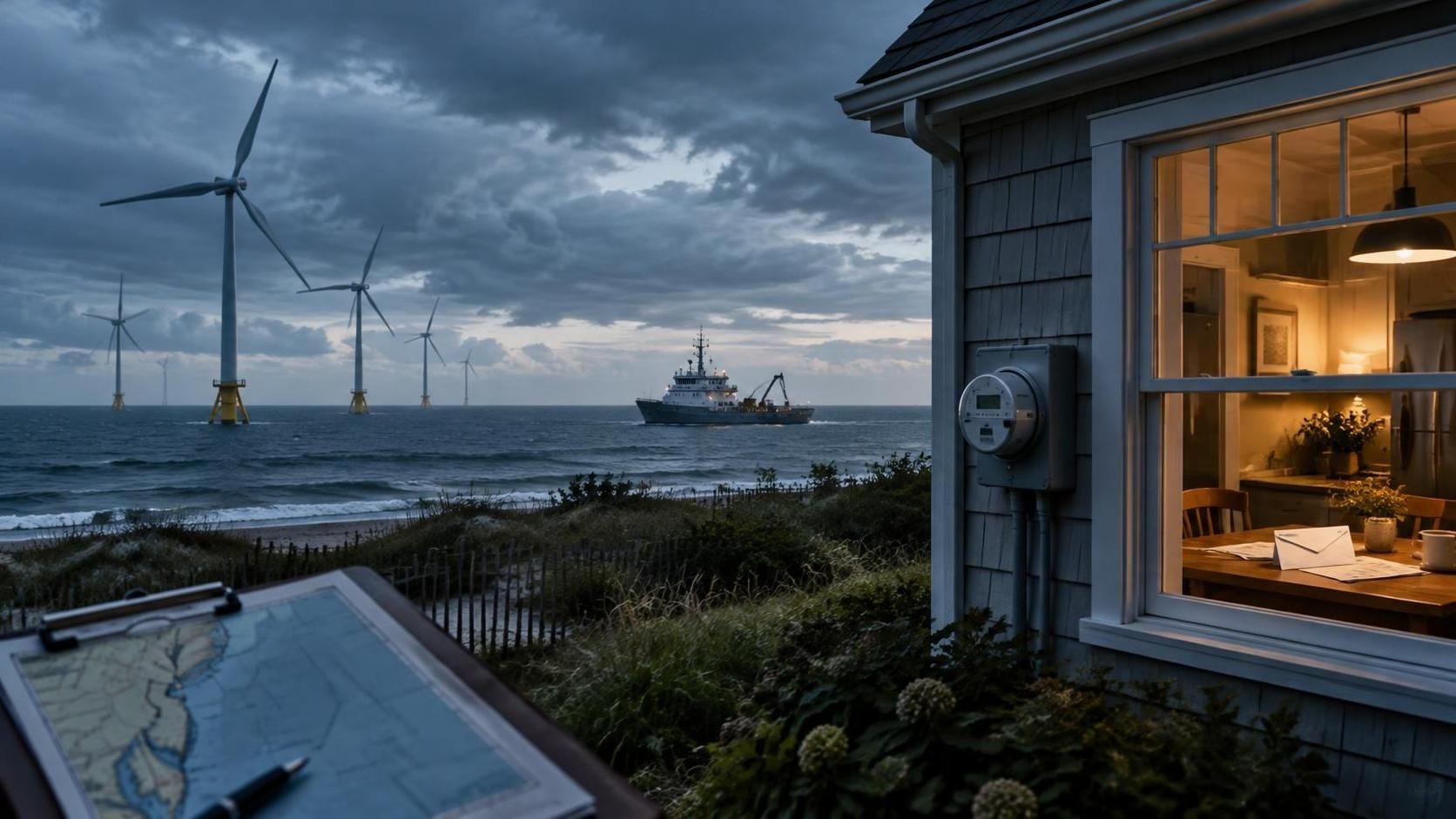
The Tuesday action, reported by Bloomberg, is a Corps look-back at Atlantic Shores South — not a court-ordered shutdown. New Jersey still gets nearly all of its in-state, utility-scale power from gas and nuclear. The bigger documented driver of high bills is PJM capacity, not a carbon-tax line.
On Tuesday, Nov. 17, 2026, Bloomberg reported that the U.S. Army Corps of Engineers is reevaluating its earlier approval for Atlantic Shores South. A Bloomberg Law dispatch by Ari Natter, posted at 12:26 p.m. Central Time, said the Corps “is reevaluating an approval for EDF Renewables North America’s Atlantic Shores South, which has proposed constructing as many as 200 wind turbines about 9 miles off the coast of Atlantic City.”
In an Oct. 1, 2024, release, the Bureau of Ocean Energy Management approved the Construction and Operations Plan for Atlantic Shores South Projects 1 and 2. Director Elizabeth Klein said the projects “have the potential to generate up to 2,800 megawatts of clean, renewable energy—enough to power nearly one million homes.” The plan includes “up to 197 total locations for wind turbine generators, offshore substations, and a meteorological tower,” both areas “approximately 8.7 miles offshore New Jersey at their closest points,” with cables that could land in Atlantic City and Sea Girt.
What “reopens” actually means
“Reopens,” in the coverage, is the Army Corps taking another look at an earlier approval — most likely the Department of the Army permit under Rivers and Harbors Act Section 10 and Clean Water Act Section 404 — not a new court order. No Corps public notice or Federal Register entry posted Tuesday was located, so the account rests on Bloomberg. A 33 CFR 325.7 reevaluation can lead to suspension, modification or revocation; it is not yet clear which approval is under review.
BOEM approved the Construction and Operations Plan on Oct. 1, 2024. On Aug. 10, 2026, U.S. District Judge Jia M. Cobb granted the federal government’s motion for a voluntary remand in Save Long Beach Island, Inc. v. U.S. Department of Commerce, No. 25-cv-2211 (D.D.C.), and stayed the litigation during that review. Save Long Beach Island, in an Aug. 11, 2026, release, said the remand is without vacatur, “meaning the existing COP approvals remain in effect unless and until BOEM takes affirmative action to modify or revoke them.” Bloomberg’s visible text reports no suspension or revocation.
The path from approval to today’s review
A joint Record of Decision was noticed in the Federal Register on July 8, 2024 (89 Fed. Reg. 55,977). EPA issued the project’s Outer Continental Shelf air permit, number OCS-EPA-R2 NJ 02, on Sept. 30, 2024, according to a later BPU order. BOEM approved the COP the next day.
On Jan. 20, 2025, President Trump issued a presidential memorandum withdrawing the Outer Continental Shelf from new or renewed wind-energy leasing, beginning Jan. 21, 2025. It leaves existing leases in place: “Nothing in this withdrawal affects rights under existing leases in the withdrawn areas.” It also paused new wind permits pending review; on Dec. 8, 2025, a federal judge vacated the agencies’ blanket pause.
EPA sought a remand of the air permit on Feb. 28, 2025; the Environmental Appeals Board granted it on March 14, 2025, over Atlantic Shores’ objection, according to the BPU. On June 4, 2025, Atlantic Shores asked the Board to end the June 30, 2021, OREC order that had designated its 1,509.6-megawatt Project 1 as a Qualified Offshore Wind Project. On Aug. 13, 2025, in dockets QO20080555 and QO21050824, the Board vacated that order. “The Board finds that the record demonstrates that the Project is no longer viable under the terms of the OREC Order.” In late 2025, Shell announced that it was withdrawing from Atlantic Shores and assigning its membership interest to EDF power solutions.
Where New Jersey’s power actually comes from
In 2025, the latest full year in the Energy Information Administration’s state historical generation tables (released September 2026), in-state utility-scale plants generated 61.0 million megawatthours. Natural gas supplied 30.1 million megawatthours, or 49.3 percent. Nuclear supplied 27.9 million, or 45.8 percent. Utility-scale solar was 1.6 million megawatthours, or 2.6 percent. Wind was 20,309 megawatthours, or 0.03 percent. Coal was zero.
Through August 2026, the Electric Power Monthly shows the same mix. Utility-scale generation was 41.5 million megawatthours, 48.4 percent gas, 45.7 percent nuclear, 3.3 percent utility-scale solar, and 0.03 percent wind. Those tables count utility-scale plants only. In 2024, the latest official State Electricity Profile (Table 10, released November 10, 2025), New Jersey was a net importer of 19.2 million megawatthours, or 24.2 percent of total supply. The state’s lights already depend on the neighbors, not on a wind farm that has not been built.
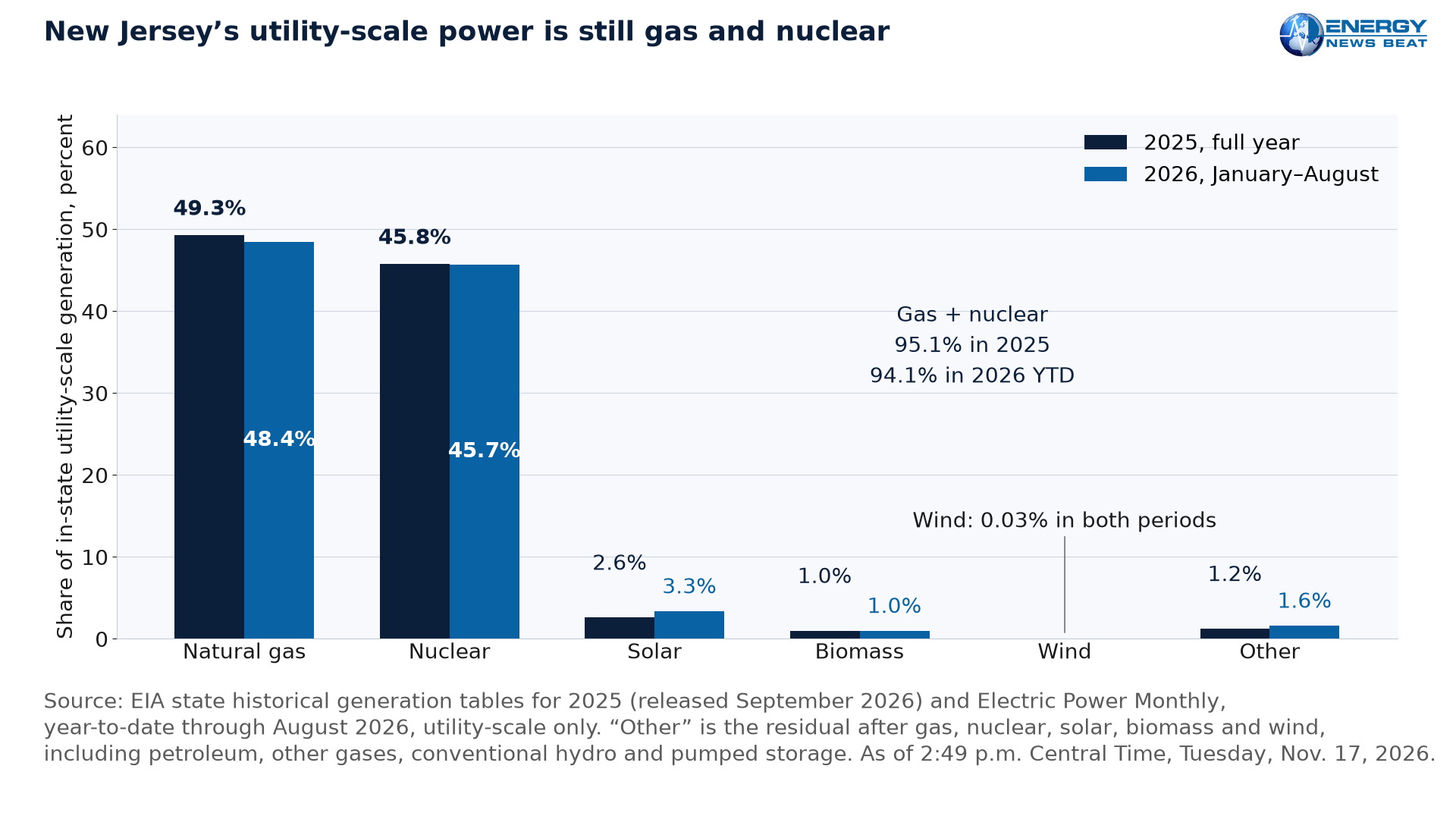
New Jersey utility-scale net generation by fuel, 2025 full year and year-to-date through August 2026, as a share of in-state utility-scale generation. Wind is 0.03 percent in both periods. Source: EIA state historical generation tables for 2025 (released September 2026) and Electric Power Monthly, year-to-date through August 2026.
What households and businesses are paying
For the full year 2025, EIA’s Electric Power Annual Table 2.10 puts New Jersey’s average residential price at 22.48 cents per kilowatthour, 11th highest among 51 jurisdictions and 30.5 percent above the U.S. average of 17.23 cents. In Table 5.6.A for August 2026, the residential average was 24.61 cents, against a U.S. average of 18.16 cents, a 35.5 percent premium. Commercial and industrial prices were 18.71 and 16.24 cents, against U.S. averages of 14.47 and 9.64 cents. Nearby August 2026 residential rates were 28.65 cents in New York, 24.51 in Connecticut, 21.77 in Pennsylvania, 21.40 in Maryland and 18.70 in Delaware.
For June 1, 2025, the Board of Public Utilities published official 650-kilowatthour residential examples: Atlantic City Electric rose $28.02, or 17.23 percent, to $190.62; Jersey Central Power & Light rose $22.67, or 20.20 percent, to $134.92; Public Service Electric & Gas rose $26.87, or 17.24 percent, to $182.71; and Rockland Electric rose $25.48, or 18.18 percent, to $165.64. “PJM’s recent capacity auction results are the main driver of these increases,” said BPU President Christine Guhl-Sadovy.
For June 1, 2026, before credits or offsets, the Board’s Feb. 12, 2026, table showed Atlantic City Electric up 22 cents, or 0.11 percent, to $201.76; Jersey Central up $2.23, or 1.6 percent, to $137.47; PSE&G down $3.23, or 1.8 percent, to $180.23; and Rockland down $1.17, or 0.7 percent, to $168.93, all at 650 kilowatthours. The Board credited a PJM collar, described there as a $325 per megawatt-day cap and a $175 floor. On July 7, 2026, Governor Mikie Sherrill announced a $25 Residential Universal Bill Credit for all 3.6 million ratepayers.
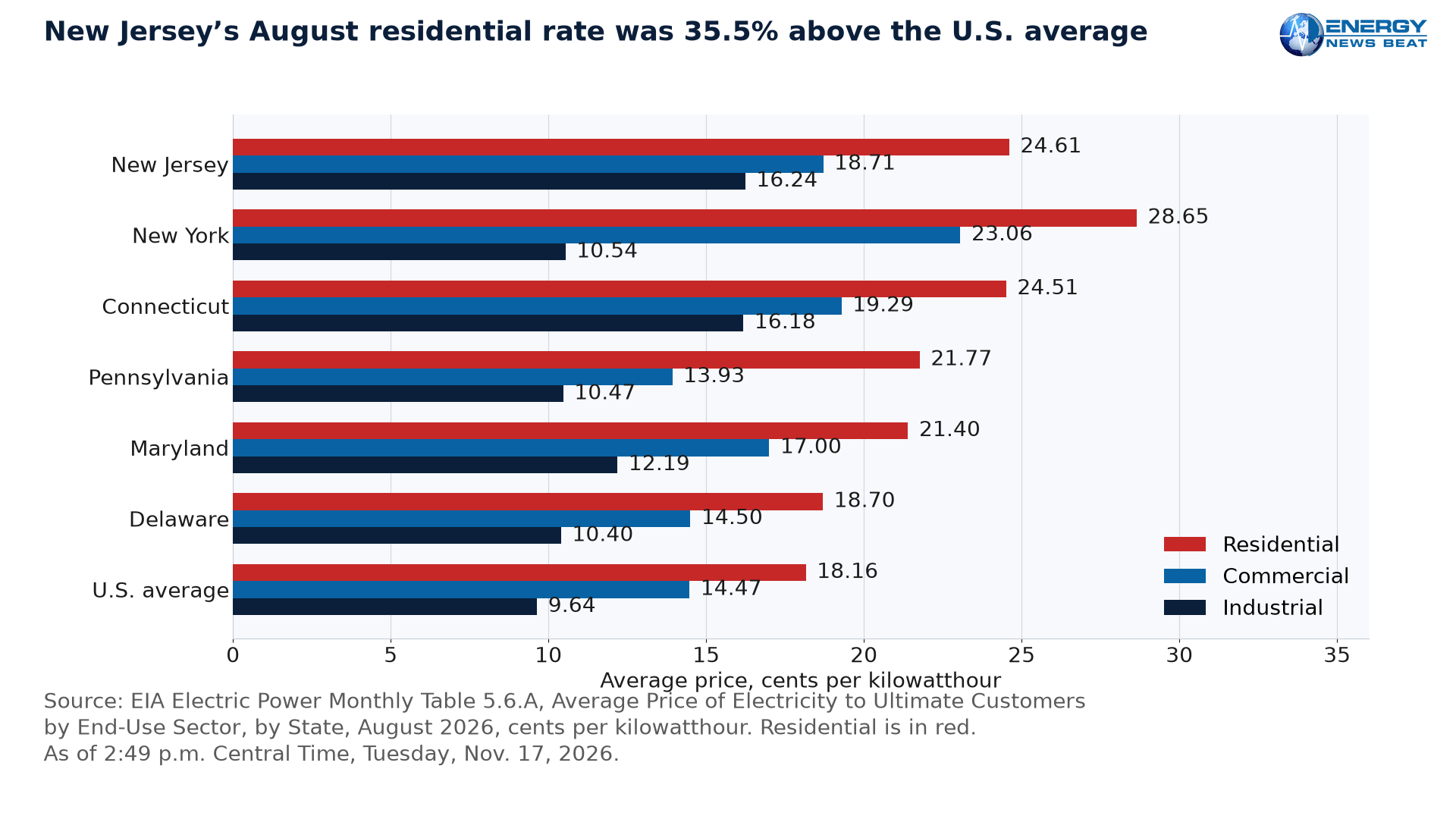
Average price of electricity to ultimate customers, August 2026, in cents per kilowatthour, for New Jersey, nearby states and the U.S. average, by sector. New Jersey is highlighted. Source: EIA Electric Power Monthly Table 5.6.A, August 2026.
Why New Jersey Pays More
Why is the rate so high if the mix is almost entirely gas and nuclear? There is no stand-alone carbon-tax line on a New Jersey electric bill. The state is in the Regional Greenhouse Gas Initiative; Pennsylvania is not. Allowance costs are baked into wholesale prices. The September 2026 auction cleared at $37.65 a short ton, and New Jersey’s cumulative proceeds after that sale were $1.58 billion. ENB estimates the net retail effect at a fraction of a cent to about 1 cent per kilowatthour. There is no official current estimate, and it is not why bills jumped last year.
The bigger documented driver is PJM’s EMAAC capacity price. Results went from $54.95 per megawatt-day for 2024/2025 to $269.92 for 2025/2026, then to the cap of $329.17 for 2026/2027. The BPU called the 2025/2026 auction the main driver of the June 2025 17-to-20 percent increase. A representative PSE&G residential tariff (Oct. 1, 2026, unless noted) lists 6.88 cents for transmission, 1.04 cents for the Societal Benefits Charge and 0.80 cents for Green Programs (a June 1, 2025 rate still posted). New Jersey builds a 6.625 percent sales tax into those rates; Pennsylvania exempts residential electricity from sales tax, though utilities recover a 5.9 percent gross receipts tax. The 0.4-cent nuclear Zero Emission Certificate surcharge ended June 1, 2025 and is now a temporary credit. BPU Staff has estimated that spend-to-date plus six remaining offshore-wind State Agreement Approach transmission projects is about $400 million.
New Jersey’s 2025 residential rate was 3.19 cents a kilowatthour higher than Pennsylvania’s 19.29 cents. Pennsylvania households used more power — about 839 kilowatthours a month versus about 670 in New Jersey — so Pennsylvania’s average monthly bill,
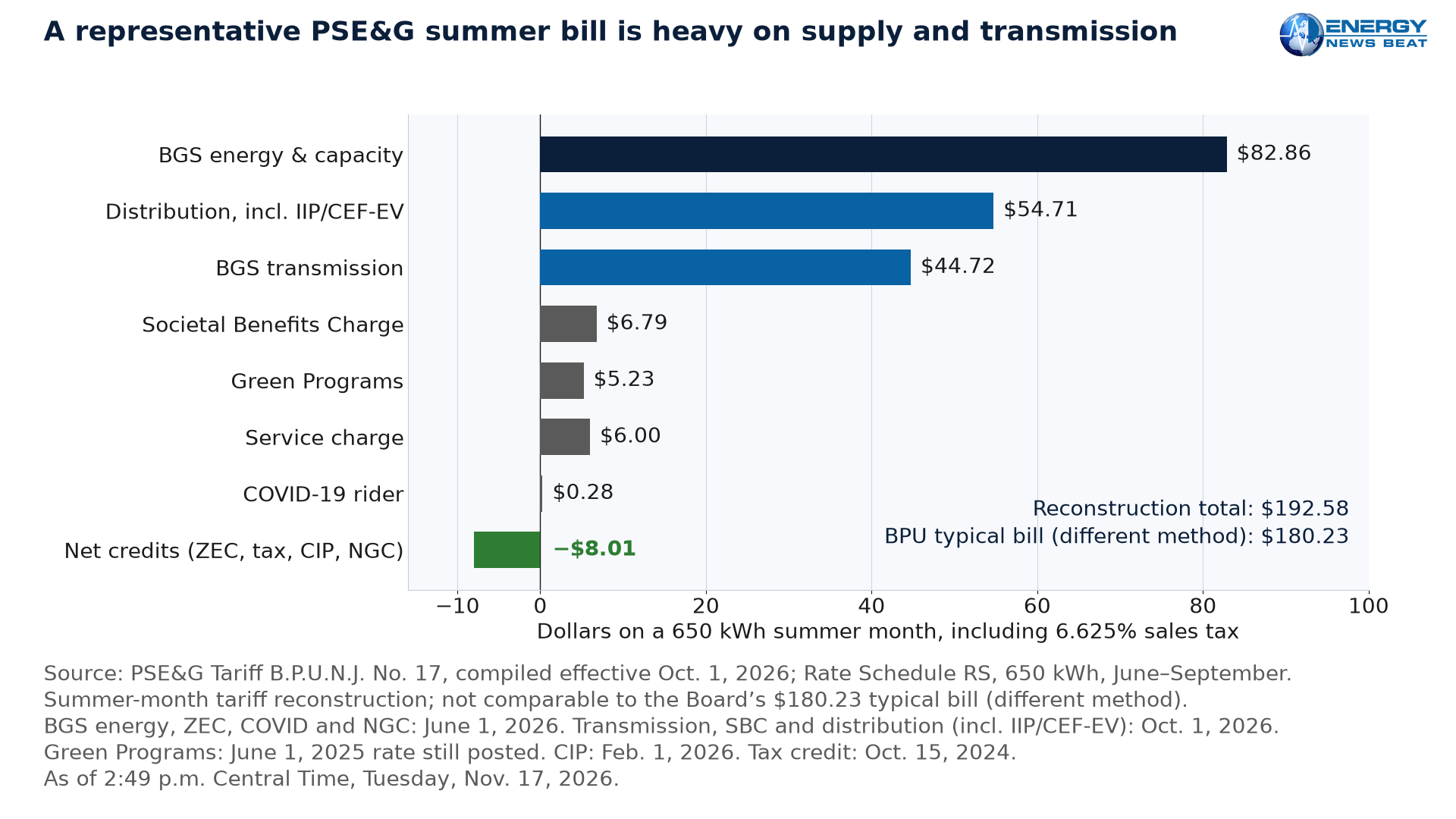
Representative PSE&G Rate Schedule RS bill components for a 650-kilowatthour summer month, including the 6.625 percent New Jersey sales tax. This is a summer-month tariff reconstruction. It is not comparable to the Board’s $180.23 typical bill, which uses the Board’s own method (shown before credits or offsets); summer distribution rates are higher than October–May rates. BGS energy and capacity, Zero Emission Certificate, COVID and non-utility generation charges are effective June 1, 2026; transmission, Societal Benefits and distribution, including the Infrastructure Improvement Program, are effective Oct. 1, 2026; Green Programs is the June 1, 2025 rate still posted; the Conservation Incentive Program credit is effective Feb. 1, 2026; the tax-credit sheet is effective Oct. 15, 2024. Source: PSE&G Tariff B.P.U.N.J. No. 17, compiled effective Oct. 1, 2026.
Consumer and Investor Views
If you pay a New Jersey electric bill, the Corps’ Tuesday look-back does not change the fuel mix in the socket or last year’s capacity charge. Atlantic Shores South has not delivered a kilowatthour of the power counted in those EIA tables. Investors and EDF face a stack of reviews, not a notice to proceed: a COP still in effect but under BOEM reconsideration, an air permit remanded in March 2025, a state OREC vacated in August 2025, and now a Corps permit being reevaluated. This is not investment advice.
Caveats and criticism
Supporters of offshore wind will note that Atlantic Shores South was designed to add in-state generation in a state that already imports about a quarter of its power, and that BOEM framed 2,800 megawatts as enough for nearly one million homes. Inflation, supply-chain costs and federal uncertainty were why the developer asked out of the 2021 contract. The Board agreed the project was “no longer viable under the terms of the OREC Order.”
The Jan. 20, 2025, memorandum is not a one-line veto. It cites reliable-energy demand, marine life, “effects on energy costs for Americans,” “especially those who can least afford it,” and the fishing industry, and it leaves existing lease rights in place. Tuesday’s Corps reevaluation should be read with the August remand, the remanded air permit and the vacated offtake, not as a substitute for them.
Stu’s Take
New Jersey households already know what expensive power feels like. They got a 17 to 20 percent jump in the standard 650-kilowatthour examples on June 1, 2025, and the Board itself pointed at the PJM capacity auction, not a carbon-tax line and not a wind farm off Atlantic City that has not generated a recorded megawatthour. Gas and nuclear still supply about 95 percent of the state’s utility-scale power; about a quarter of 2024 supply was imported. A Corps reevaluation, as Bloomberg reported it, and a BOEM remand without vacatur are legal events, not electrons. They should be described carefully, and they should not be waved away. If the review is serious, say what standard it is using and when it will finish. If the project comes back, say what it would cost on the bill. Until then, the meter is still running on gas, nuclear, the neighbors, and a capacity price that is no longer $54.95 a megawatt-day.
It makes no sense why New Jersey citizens pay so much for electricity, other than Blue State Net Zero policies.
Sources
Primary and official sources opened for this article, with access on Tuesday, Nov. 17, 2026, unless a different date is noted.
- Ari Natter, Bloomberg Law, “Trump Administration Reevaluates Permit for New Jersey Wind Farm,” Nov. 17, 2026, 6:26 p.m. UTC (12:26 p.m. Central Time). The U.S. Army Corps of Engineers “is reevaluating an approval for EDF Renewables North America’s Atlantic Shores South, which has proposed constructing as many as 200 wind turbines about 9 miles off the coast of Atlantic City.” EDF did not immediately comment. The Bloomberg.com article of the same date was not retrieved past a robot wall https://news.bloomberglaw.com/environment-and-energy/trump-administration-reevaluates-permit-for-new-jersey-wind-farm
- Bloomberg, “Trump administration reopens permit for wind farm off New Jersey,” Nov. 17, 2026. The trigger URL. The site returned a robot/captcha wall during this reporting https://www.bloomberg.com/news/articles/2026-11-17/trump-administration-reopens-permit-for-wind-farm-off-new-jersey
- Bureau of Ocean Energy Management, “BOEM Approves Construction and Operations Plan for Atlantic Shores South Offshore Wind Projects,” Oct. 1, 2024. Director Elizabeth Klein: the projects “have the potential to generate up to 2,800 megawatts of clean, renewable energy—enough to power nearly one million homes.” Up to 197 total locations; both lease areas approximately 8.7 miles offshore New Jersey at their closest points; cables potentially landing in Atlantic City and Sea Girt https://www.boem.gov/newsroom/press-releases/boem-approves-construction-and-operations-plan-atlantic-shores-south
- Federal Register, Notice of Availability of a Joint Record of Decision for the Proposed Atlantic Shores Offshore Wind South Project, July 8, 2024, 89 Fed. Reg. 55,977. Federal Register document 2024-14908, publication date July 8, 2024, citation 89 FR 55977 https://www.federalregister.gov/d/2024-14908
- Presidential memorandum, “Temporary Withdrawal of All Areas on the Outer Continental Shelf From Offshore Wind Leasing and Review of the Federal Government’s Leasing and Permitting Practices for Wind Projects,” Jan. 20, 2025 https://www.whitehouse.gov/presidential-actions/2025/01/temporary-withdrawal-of-all-areas-on-the-outer-continental-shelf-from-offshore-wind-leasing-and-review-of-the-federal-governments-leasing-and-permitting-practices-for-wind-projects/
- Shell, official U.S. page, “Shell withdraws from Atlantic Shores Offshore Wind, assigning its membership interest to existing joint venture partner, EDF power solutions.” Released about Oct. 29–Nov. 3, 2025; a Nov. 3, 2025, energy-pedia republication carries that date, and the official page as retrieved did not display a date stamp https://www.shell.us/about-us/news-and-insights/media/2025-media-releases/shell-withdraws-from-atlantic-shores-offshore-wind-assigning-its-membership-interest-to-existing-joint-venture-partner-edf-power-solutions.html
- New Jersey Board of Public Utilities, Order Vacating Offshore Wind Renewable Energy Certificate Order, dockets QO20080555 and QO21050824, Aug. 13, 2025. Recites EPA air permit OCS-EPA-R2 NJ 02 issued Sept. 30, 2024; EPA remand request Feb. 28, 2025; Environmental Appeals Board grant March 14, 2025; developer petition June 4, 2025; and “The Board finds that the record demonstrates that the Project is no longer viable under the terms of the OREC Order” https://www.nj.gov/bpu/pdf/boardorders/2025/20250813/8D%20ORDER%20ASOW%20Petition%20to%20Terminate.pdf
- Save Long Beach Island, Inc., press release, Aug. 11, 2026, describing the Aug. 10, 2026, order of U.S. District Judge Jia M. Cobb in Save Long Beach Island, Inc. v. U.S. Department of Commerce, No. 25-cv-2211 (D.D.C.): voluntary remand without vacatur, “meaning the existing COP approvals remain in effect unless and until BOEM takes affirmative action to modify or revoke them.” The opinion is posted on CourtListener at https://www.courtlistener.com/opinion/10943844/save-long-beach-island-inc-v-us-department-of-commerce/; a direct fetch of that page was blocked during this revision, so the description in the body is taken from the Save LBI release https://www.savelbi.org/_files/ugd/a85a2b_4e7b53ccf8b247a6bdff2e0bc33491a4.pdf
- NJBPU, “NJBPU Announces Conclusion of New Jersey’s Annual Electricity Supply Auction,” Feb. 12, 2025. Official 650 kWh residential examples effective June 1, 2025, and President Christine Guhl-Sadovy: “PJM’s recent capacity auction results are the main driver of these increases.” https://www.nj.gov/bpu/newsroom/2025/approved/20250212.html
- NJBPU, “New Jersey Board of Public Utilities Certifies 2026 Electricity Auction Results,” Feb. 12, 2026. Official 650 kWh table for 12 months starting June 1, 2026, “before credits or offsets are applied,” and a PJM collar described as a $325 per megawatt-day cap and a $175 floor https://www.nj.gov/bpu/newsroom/2026/approved/20260212.html
- Office of the Governor of New Jersey, July 7, 2026: a $25 credit to all 3.6 million ratepayers through the Residential Universal Bill Credit program, and an additional $150 through REAP for lower- to moderate-income families. This article does not independently verify that every account posted the $25 credit https://www.nj.gov/governor/news/2026/20260707a.shtml
- NJBPU, “Order on the State Agreement Approach (SAA) Mutual Termination,” Docket QO20100630, April 22, 2026. Staff estimates that “the cost of completing those six SAA Projects plus spend-to-date on SAA Projects amounts to approximately $400 million,” versus about $1.2 billion to complete all 58 projects https://www.nj.gov/bpu/pdf/boardorders/2026/20260422/LSA%20ORDER%20SAA%20Termination.pdf
- EIA, State Historical Tables for 2025, Net Generation by State by Type of Producer by Energy Source, released September 2026. New Jersey 2025 utility-scale total 60,963,388 MWh; natural gas 30,064,866 (49.3 percent); nuclear 27,917,718 (45.8 percent); utility-scale solar 1,592,695 (2.6 percent); wind 20,309 (0.03 percent); coal 0 https://www.eia.gov/electricity/data/state/annual_generation_state.xlsx
- EIA, Electric Power Monthly, data for August 2026, released about Oct. 23, 2026. Tables 1.3.B, 1.7.B, 1.9.B, 1.14.B and related fuel tables, year-to-date through August 2026; Table 1.17.B (solar, including estimated small-scale); Tables 5.6.A and 5.6.B (prices); Table 5.4.B (sales) https://www.eia.gov/electricity/monthly/
- EIA, New Jersey State Electricity Profile 2024, Table 10, Supply and disposition of electricity, profile released November 10, 2025. 2024 net interstate imports 19,217,516 MWh, or 24.2 percent of total supply of 79,392,761 MWh. The 2025 state profile had not been posted as of Nov. 17, 2026 https://www.eia.gov/electricity/state/NewJersey/index.php
- EIA, Electric Power Annual, data for 2025, released October 21, 2026. Table 2.10, average price by sector and state: New Jersey residential 22.48 cents, 11th highest of 51 jurisdictions; U.S. average 17.23 cents. Tables 2.8 (sales), 2.9 (revenue) and 2.11 (customers) used to compute 2025 average monthly use and bills https://www.eia.gov/electricity/annual/html/epa_02_10.html
- PJM, 2025/2026 Base Residual Auction Report. EMAAC / RTO resource clearing price $269.92 per MW-day for 2025/2026; comparison text: $54.95 in EMAAC for 2024/2025. Table 3 and Figure 1. A narrative line in the same report also cites $269.97 for four LDAs; this article uses the $269.92 table figure https://www.pjm.com/-/media/DotCom/markets-ops/rpm/rpm-auction-info/2025-2026/2025-2026-base-residual-auction-report.pdf
- PJM, 2026/2027 Base Residual Auction Report. EMAAC and the RTO cleared at the cap of $329.17 per MW-day. The report states a cap of $329.17 and a floor of $177.24 per MW-UCAP; a footnote says an approximate $325 / $175 cap and floor had been filed on a preliminary reference resource https://www.pjm.com/-/media/DotCom/markets-ops/rpm/rpm-auction-info/2026-2027/2026-2027-bra-report.pdf
- RGGI, Auction 73 State Proceeds and Allowances. New Jersey allowances sold 3,429,730; proceeds $129,129,334.50, implying a $37.65 clearing price; cumulative proceeds $1,580,246,191.97 https://www.rggi.org/auctions/auction-results
- PSE&G, Tariff B.P.U.N.J. No. 17, compiled effective Oct. 1, 2026. Rate Schedule RS including SUT: BGS energy and capacity summer $0.126743 / $0.136239 (June 1, 2026); BGS transmission $0.068806 (Oct. 1, 2026); distribution including the Infrastructure Improvement Program $0.083859 / $0.087934 (Oct. 1, 2026); Societal Benefits Charge $0.010443 (Oct. 1, 2026); Green Programs Recovery Charge $0.008049 (June 1, 2025 rate still posted); Zero Emission Certificate credit ($0.004265) (June 1, 2026); COVID-19 charge $0.000429 (June 1, 2026); Conservation Incentive Program credit ($0.000229) (Feb. 1, 2026); Tax Adjustment Credit ($0.007763) (Oct. 15, 2024); and a $6.00 service charge https://nj.pseg.com/-/media/pseg/public-site/documents/current-electric-tariff/electric-tariff-17-cefev-iap-nits-usf-effective-20261001.ashx
- Pennsylvania Department of Revenue, Gross Receipts Tax. Electric companies: “The tax is based on gross receipts from sales of electric energy within Pennsylvania at a rate of 59 mills,” or 5.9 percent https://www.pa.gov/agencies/revenue/resources/tax-types-and-information/corporation-taxes/gross-receipts-tax
- Saris, J., Memorandum and Order, New York v. Trump, No. 1:25-cv-11221-PBS (D. Mass. Dec. 8, 2025), Dkt. 234: the court “declares unlawful and VACATES the Wind Order,” the agencies’ implementation of the Jan. 20, 2025, memorandum’s permitting pause. The memorandum’s Outer Continental Shelf leasing withdrawal was not at issue in that case https://storage.courtlistener.com/recap/gov.uscourts.mad.284290/gov.uscourts.mad.284290.234.0.pdf
Key primary excerpts
Bloomberg Law, Ari Natter, Nov. 17, 2026. The US Army Corps of Engineers said Tuesday it is reevaluating an approval for EDF Renewables North America’s Atlantic Shores South, which has proposed constructing as many as 200 wind turbines about 9 miles off the coast of Atlantic City.
BOEM Director Elizabeth Klein, Oct. 1, 2024. I am proud to announce BOEM’s final approval of Atlantic Shores South Offshore Wind Projects 1 and 2, which have the potential to generate up to 2,800 megawatts of clean, renewable energy—enough to power nearly one million homes.
Presidential memorandum, Jan. 20, 2025. Nothing in this withdrawal affects rights under existing leases in the withdrawn areas.
Presidential memorandum, Section 2(a), Jan. 20, 2025. shall not issue new or renewed approvals, rights of way, permits, leases, or loans for onshore or offshore wind projects pending the completion of a comprehensive assessment and review of Federal wind leasing and permitting practices.
NJBPU order, dockets QO20080555 and QO21050824, Aug. 13, 2025. The Board finds that the record demonstrates that the Project is no longer viable under the terms of the OREC Order.
Save Long Beach Island, Inc., press release, Aug. 11, 2026, describing the Aug. 10 Cobb order. The remand is without vacatur, meaning the existing COP approvals remain in effect unless and until BOEM takes affirmative action to modify or revoke them.
NJBPU President Christine Guhl-Sadovy, Feb. 12, 2025. PJM’s recent capacity auction results are the main driver of these increases.
NJBPU Staff, SAA termination order, April 22, 2026. Staff estimates that the cost of completing those six SAA Projects plus spend-to-date on SAA Projects amounts to approximately $400 million.
Office of the Governor of New Jersey, July 7, 2026. Additionally, the Governor announced a $25 credit to all 3.6 million New Jersey ratepayers through the Residential Universal Bill Credit (RUBC) program, as well as an additional $150 credit to lower- to moderate-income families through the Residential Energy Assistance Payment (REAP) program, as we head into the summer months.
Saris, J., New York v. Trump, No. 1:25-cv-11221-PBS (D. Mass. Dec. 8, 2025), Dkt. 234. Accordingly, the Court ALLOWS Plaintiffs’ motions (Dkts. 172, 175), DENIES the Agency Defendants’ motion (Dkt. 179), and declares unlawful and VACATES the Wind Order.
Data tables
New Jersey utility-scale net generation, 2025 full year
| Source | MWh | Share |
| Natural gas | 30,064,866 | 49.3% |
| Nuclear | 27,917,718 | 45.8% |
| Solar (utility-scale) | 1,592,695 | 2.6% |
| Other biomass | 610,029 | 1.0% |
| Other | 611,907 | 1.0% |
| Other gases | 209,727 | 0.3% |
| Petroleum | 165,084 | 0.3% |
| Wind | 20,309 | 0.03% |
| Hydro (conventional) | 6,342 | 0.01% |
| Coal | 0 | 0.0% |
| Pumped storage (net) | −235,287 | −0.4% |
| Total | 60,963,388 | 100% |
EIA state historical generation tables for 2025, released September 2026. Shares of 60,963,388 MWh.
New Jersey utility-scale net generation, January–August 2026 (preliminary)
| Source | MWh | Share |
| Natural gas | 20,121,629 | 48.4% |
| Nuclear | 18,970,931 | 45.7% |
| Solar (utility-scale) | 1,386,975 | 3.3% |
| Other | 400,402 | 1.0% |
| Other biomass | 394,905 | 1.0% |
| Petroleum | 300,168 | 0.7% |
| Other gases | 102,478 | 0.2% |
| Wind | 12,943 | 0.03% |
| Coal | 0 | 0.0% |
| Pumped storage (net) | −148,939 | −0.4% |
| Total | 41,541,495 | 100% |
EIA monthly state generation file and Electric Power Monthly, through August 2026, released about Oct. 23, 2026. Shares of 41,541,495 MWh.
New Jersey supply and disposition, 2024 (latest official Table 10)
| Item | MWh |
| Total net generation (utility-scale) | 60,175,245 |
| Net interstate imports | 19,217,516 |
| Total supply | 79,392,761 |
| Total electric industry sales | 73,531,424 |
| Direct use | 1,848,153 |
| Estimated losses | 3,430,943 |
| Unaccounted | 582,241 |
| Net interstate trade | −19,217,516 |
| Imports as a share of total supply | 24.2% |
EIA New Jersey State Electricity Profile 2024, Table 10, released November 10, 2025.
Average residential electricity prices, 2025 full year and August 2026
| Jurisdiction | Residential 2025 | Residential Aug. 2026 |
| New Jersey | 22.48 | 24.61 |
| United States | 17.23 | 18.16 |
| New York | 26.39 | 28.65 |
| Connecticut | 29.31 | 24.51 |
| Pennsylvania | 19.29 | 21.77 |
| Maryland | 19.53 | 21.40 |
| Delaware | 17.15 | 18.70 |
2025: EIA Electric Power Annual Table 2.10, released Oct. 21, 2026. August 2026: Electric Power Monthly Table 5.6.A. Cents per kilowatthour.
August 2026 prices by sector, cents per kilowatthour
| Jurisdiction | Residential | Commercial | Industrial |
| New Jersey | 24.61 | 18.71 | 16.24 |
| New York | 28.65 | 23.06 | 10.54 |
| Connecticut | 24.51 | 19.29 | 16.18 |
| Pennsylvania | 21.77 | 13.93 | 10.47 |
| Maryland | 21.40 | 17.00 | 12.19 |
| Delaware | 18.70 | 14.50 | 10.40 |
| U.S. Total | 18.16 | 14.47 | 9.64 |
EIA Electric Power Monthly Table 5.6.A, August 2026.
NJBPU official 650 kWh residential BGS examples, June 1, 2025
| Utility | Prior bill | New bill | Change | Percent |
| Atlantic City Electric | $162.60 | $190.62 | +$28.02 | 17.23% |
| Jersey Central Power & Light | $112.25 | $134.92 | +$22.67 | 20.20% |
| PSE&G | $155.84 | $182.71 | +$26.87 | 17.24% |
| Rockland Electric | $140.16 | $165.64 | +$25.48 | 18.18% |
NJBPU press release, Feb. 12, 2025.
NJBPU official 650 kWh residential BGS examples, June 1, 2026, before credits or offsets
| Utility | Prior bill | New bill | Change | Percent |
| Atlantic City Electric | $201.54 | $201.76 | +$0.22 | 0.11% |
| Jersey Central Power & Light | $135.24 | $137.47 | +$2.23 | 1.6% |
| PSE&G | $183.46 | $180.23 | −$3.23 | −1.8% |
| Rockland Electric | $170.10 | $168.93 | −$1.17 | −0.7% |
NJBPU press release, Feb. 12, 2026. ACE’s “current” $201.54 is not the June 2025 “new” $190.62; other rate changes occurred in between.
PJM EMAAC / RTO Base Residual Auction clearing prices
| Delivery year | Auction | Price | Note |
| 2024/2025 | 2023 | $54.95 | EMAAC, comparison text in the 2025/26 report |
| 2025/2026 | July 2024 | $269.92 | Table 3; a narrative line also cites $269.97 |
| 2026/2027 | July 2025 | $329.17 | FERC-approved cap; BPU described a $325 / $175 collar |
Official PJM BRA reports. Dollars per megawatt-day.
2025 average monthly residential use and bills, calculated from EIA Electric Power Annual
| Jurisdiction | Avg. price, ¢/kWh | Avg. monthly use, kWh | Avg. monthly bill |
| New Jersey | 22.48 | 669.8 | $150.59 |
| Pennsylvania | 19.29 | 839.3 | $161.89 |
| New York | 26.39 | 586.3 | $154.75 |
| Delaware | 17.15 | 920.2 | $157.74 |
| Maryland | 19.53 | 944.5 | $184.42 |
| U.S. Total | 17.23 | 874.3 | $150.68 |
Use from Table 2.8 sales and Table 2.11 customers; bills from Table 2.9 revenue and Table 2.11 customers. Prices in Table 2.10.
Representative PSE&G Rate Schedule RS, 650 kWh summer month, including 6.625% SUT
| Component | Amount |
| BGS energy and capacity | $82.86 |
| Distribution, including IIP and CEF-EV | $54.71 |
| BGS transmission | $44.72 |
| Societal Benefits Charge | $6.79 |
| Service charge | $6.00 |
| Green Programs | $5.23 |
| COVID-19 rider | $0.28 |
| Net credits (ZEC, tax, CIP, NGC) | −$8.01 |
| Reconstruction total | $192.58 |
| BPU typical bill (different method) | $180.23 |
Summer-month tariff reconstruction from the compiled tariff effective Oct. 1, 2026, not comparable to the BPU’s $180.23 typical bill, which uses a different method. See Methodology for arithmetic and effective dates.
Timeline
July 8, 2024. Federal Register notice of a joint Record of Decision for Atlantic Shores Offshore Wind South (89 Fed. Reg. 55,977).
Sept. 30, 2024. EPA issued Outer Continental Shelf air permit OCS-EPA-R2 NJ 02, according to the later BPU order.
Oct. 1, 2024. BOEM approved the Construction and Operations Plan for Atlantic Shores South Projects 1 and 2.
Jan. 20, 2025. Presidential memorandum withdraws the Outer Continental Shelf from new or renewed wind-energy leasing and directs a review of federal wind permitting practices; existing lease rights are left in place.
Feb. 28, 2025. EPA asked its Environmental Appeals Board to remand the air permit.
March 14, 2025. The Environmental Appeals Board granted that remand, over Atlantic Shores’ objection, according to the BPU.
June 1, 2025. New Basic Generation Service rates took effect. Official 650 kWh residential examples rose 17.23 to 20.20 percent. The 0.4-cent ZEC surcharge ended the same day.
June 4, 2025. Atlantic Shores asked the BPU to end the June 30, 2021, OREC order for its 1,509.6 MW Project 1.
Aug. 13, 2025. The BPU vacated that OREC order and the project’s Qualified Offshore Wind Project status.
Dec. 8, 2025. Judge Patti B. Saris, D. Mass., in New York v. Trump, No. 1:25-cv-11221, Dkt. 234, vacated the agencies’ blanket pause (the “Wind Order”) implementing the memorandum. The memorandum’s Outer Continental Shelf leasing withdrawal was not at issue in that case.
June 1, 2026. New BGS rates took effect and were largely flat before credits or offsets, according to the Board’s Feb. 12, 2026, table.
July 7, 2026. Governor Sherrill announced a $25 Residential Universal Bill Credit for all 3.6 million ratepayers.
Aug. 10, 2026. Judge Cobb granted the federal government’s motion for a voluntary remand of the BOEM COP decision, without vacatur, and stayed the litigation.
Nov. 17, 2026. Bloomberg, citing the Army Corps, reported that the Corps is reevaluating its earlier approval of Atlantic Shores South. This reporting did not locate a Corps public notice or Federal Register entry posted that day.
Methodology
Generation shares are calculated from EIA’s official utility-scale totals. For 2025, the latest full year in the state historical generation tables (released September 2026), the denominator is 60,963,388 MWh. For 2026 year-to-date, the denominator is 41,541,495 MWh through August. Percentages are rounded to one decimal place, except wind, which is shown to two decimals as 0.03 percent. “Other” on the generation chart is the residual after natural gas, nuclear, solar, biomass and wind. Tables count utility-scale plants only. Electric Power Monthly Table 1.17.B shows New Jersey estimated small-scale solar at 2,885 thousand megawatthours from January through August 2026, against 1,387 thousand megawatthours of utility-scale solar in the same period. Small-scale solar is not used as the headline mix.
Net interstate trade is taken from EIA State Electricity Profile Table 10 for 2024, the latest official table as of this reporting. Imports of 19,217,516 MWh are 24.2 percent of total supply of 79,392,761 MWh, which is not the same as a share of retail sales.
2025 residential rank (11th of 51) is calculated from Electric Power Annual Table 2.10, highest-first among 50 states and the District of Columbia. Average monthly use and bills for 2025 are calculated from Tables 2.8 (sales), 2.9 (revenue, million dollars) and 2.11 (customers): monthly use = annual kWh / customers / 12; monthly bill = annual revenue / customers / 12. New Jersey: 669.8 kWh and $150.59; Pennsylvania: 839.3 kWh and $161.89; U.S. Total: 874.3 kWh and $150.68. August 2026 and year-to-date prices are from Electric Power Monthly Tables 5.6.A and 5.6.B.
BPU 650 kWh examples are taken from the Board’s official auction press releases and are not the same as EIA’s statewide average cents per kilowatthour. The June 2026 table is “before credits or offsets.” ACE’s “current” $201.54 in that table is not the June 2025 “new” $190.62; other rate changes occurred in between. The $25 credit is taken from the Governor’s July 7, 2026, announcement; this article does not verify that every account posted it.
PJM EMAAC / RTO prices are taken from official Base Residual Auction reports: $54.95 (2024/2025, comparison text), $269.92 (2025/2026, Table 3), and $329.17 (2026/2027 cap). The BPU described the collar as a $325 cap and $175 floor; PJM’s 2026/2027 report states $329.17 and $177.24 per MW-UCAP and notes that $325 / $175 was an approximate filing figure.
RGGI’s $37.65 September 2026 price is implied by official Auction 73 proceeds of $129,129,334.50 on 3,429,730 New Jersey allowances, matching $37.65 a short ton, with cumulative proceeds of $1,580,246,191.97. The “fraction of a cent to about 1 cent per kilowatthour” range is an ENB estimate, not an official New Jersey figure, and there is no official current ¢/kWh estimate. It is bounded below by a consultant production-cost study (TCR, updated July 10, 2025): the $310 million is a modeled $20-per-short-ton scenario applied to 2025 sales, or about 0.42 cents per kilowatthour when spread across official 2025 all-sector retail sales of 74,001 million kWh. It is bounded above by an engineering ceiling: about 0.4 short ton per megawatthour for an efficient gas combined-cycle plant, or about 1.51 cents per kilowatthour on gas megawatthours only at $37.65. Nuclear pays no RGGI allowance, imports from non-RGGI Pennsylvania may avoid it, and proceeds can offset part of the gross cost, so the net retail effect is well below that ceiling. The TCR results were not scaled linearly to $37.65.
The PSE&G component chart is a summer-month tariff reconstruction for Rate Schedule RS at 650 kWh in a June–September month, with the 6.625 percent Sales and Use Tax already built into the rates, taken from the compiled tariff effective Oct. 1, 2026. It totals $192.58. It is not comparable to the Board’s $180.23 typical bill, which uses the Board’s own method (shown before credits or offsets); summer distribution rates are higher than October–May rates. The Board’s method is not stated in the Feb. 12, 2026, release. Arithmetic from the tariff: BGS energy and capacity, first 600 kWh at $0.126743 plus 50 kWh at $0.136239, equals $82.86 (effective June 1, 2026); transmission 650 × $0.068806 equals $44.72 (Oct. 1, 2026); distribution, including Infrastructure Improvement Program Charges, 600 × $0.083859 plus 50 × $0.087934, equals $54.71 (Oct. 1, 2026); service charge $6.00; SBC 650 × $0.010443 equals $6.79 (Oct. 1, 2026); Green Programs 650 × $0.008049 equals $5.23 (June 1, 2025 rate still posted); COVID 650 × $0.000429 equals $0.28 (June 1, 2026); net credits (ZEC $0.004265, June 1, 2026; tax credit $0.007763, Oct. 15, 2024; CIP $0.000229, Feb. 1, 2026; NGC $0.000065, June 1, 2026) equal −$8.01.
Today’s Corps action is attributed to Bloomberg citing the Corps. No Corps public notice or Federal Register entry posted Nov. 17, 2026, announcing the reevaluation was located. The Aug. 10, 2026, Cobb opinion is posted on CourtListener; a direct fetch of that page was blocked during this revision, so the description in the body is taken from Save Long Beach Island’s Aug. 11, 2026, release. As of 2:49 p.m. Central Time, Tuesday, Nov. 17, 2026.