Nvidia reported fiscal third-quarter 2027 results (ended October 25, 2026) with revenue of $115.8 billion, up 103% year-over-year and 20% sequentially. Data Center revenue reached a record $107.6 billion (up 110% year-over-year and roughly 93% of total sales). GAAP net income more than doubled to $65.3 billion. The company guided fourth-quarter revenue to $130 billion (±3%), above the roughly $125 billion consensus, while assuming zero Data Center compute revenue from China. It also raised its fiscal 2028 revenue growth outlook to approximately 75% from a prior 70%.Nvidianews.nvidia
These figures arrived days after founder and longtime CEO Jensen Huang’s resignation (effective November 12). Interim CEO and longtime CFO Colette Kress described operations as “business as usual,” highlighting the Vera Rubin NVL72 platform’s roughly $20 billion contribution in its first production quarter—the fastest product ramp in company history—along with a cloud industry backlog that grew to $2.5 trillion from $2 trillion. Token prices have fallen sharply (nearly 60% since May in some measures), yet GPU rental rates have risen (Hopper re-contracted at up to twice original pricing; B300 rates up more than 60%), signaling continued compute scarcity even as inference becomes cheaper and usage expands.I10x
Analysts largely viewed the print as evidence that AI infrastructure demand remains robust. Positive notes emphasized the backlog, rental pricing, and raised growth outlook. Some cautioned on the leadership transition, with a few price-target cuts citing uncertainty until a permanent CEO is named and product execution beyond the current roadmap is clearer. Overall sentiment supports the view that the AI build-out has not run out of demand.Tipranks
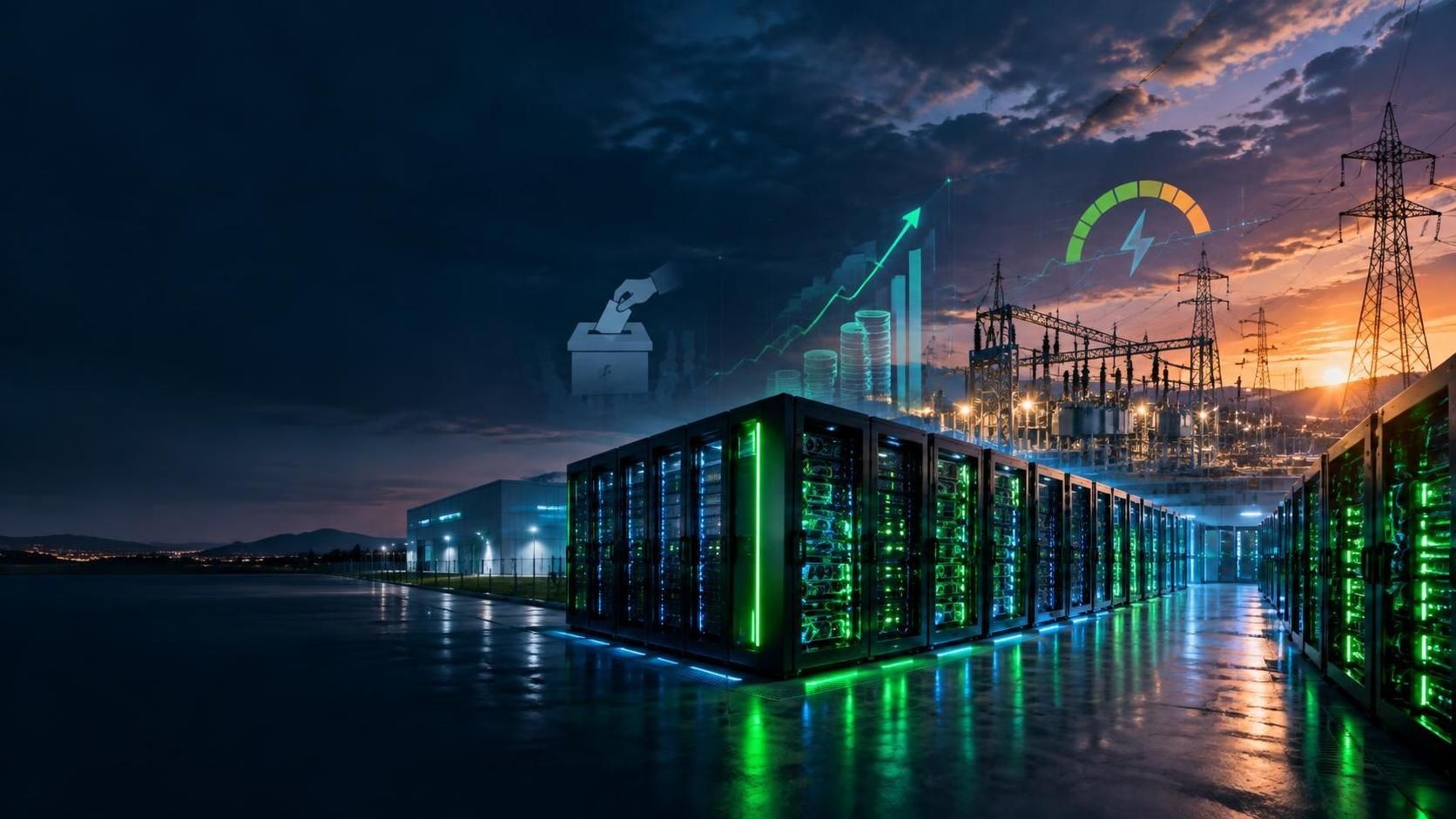
This aligns with the central argument in Energy News Beat’s recent piece, “The AI Boom Didn’t Run Out of Demand. It Ran Into Voters, Interest Rates and the Power Grid.” Even with Nvidia’s massive quarter, the next critical phase is securing land, power, and shell capacity. Market tape and local politics have created the impression of a slowdown, but underlying demand metrics (backlogs, pricing, and hyperscaler/enterprise spending) point the other way. The binding constraints are political and physical.Theenergynewsbeat.substack
The Power Grid Bottleneck and “Data Centers Done Right”
Data centers are a major driver of U.S. electricity demand growth. Projections vary, but multiple analyses see their share of U.S. power rising substantially by 2030 (some toward 9–17% ranges). Interconnection queues are long, gas turbine lead times stretch years, and local opposition has intensified—ballot measures, moratoriums or pauses in multiple states, and high rates of community pushback against nearby facilities. Texas and other key markets have seen audits, freezes, or tighter large-load rules.
A Cornell study published in Nature Energy found that data-center growth raised wholesale prices in affected regions and that data centers covered only about 38% of related infrastructure costs in 2025, with the balance disproportionately landing on residential customers—especially lower-income and rural households. Cost-allocation rules based on historical usage mean households in some states effectively help fund upgrades elsewhere. Other analyses note that high-utilization loads can absorb fixed costs and potentially moderate rates if properly structured, but current outcomes often socialize costs while concentrating benefits.News.cornell
“Data Centers Done Right” centers on avoiding these mismatches. Key elements include:
- Behind-the-meter or co-located generation (gas for firm capacity, paired with renewables and storage where practical) so facilities do not simply take from the existing grid.
- Large-load customers paying full interconnection and upgrade costs, with curtailment readiness during system stress.
- Efficiency gains (higher-voltage architectures, better cooling, reduced copper and conversion losses) that free power for compute.
- Community-aligned approaches: transparent water and noise management, workforce benefits, and hybrid power that supports reliability without excessive diesel reliance for primary use.
These practices matter because unconstrained grid draw raises bills and triggers political backlash that slows projects, while responsible designs can accelerate capacity and protect ratepayers.
Impacts on Consumers and Investors
Consumers. Poorly structured builds raise residential bills through higher wholesale prices, transmission investment allocated via historical-usage formulas, and potential stranded-asset risk if projected loads do not fully materialize. Rural and lower-income households have borne larger relative burdens in recent analyses. Done-right models that require data centers to bring or fully pay for power, plus flexible loads that can reduce demand at peaks, limit this transfer. Efficiency improvements and new firm capacity (gas, nuclear advances, or hybrid) can also expand overall supply. The political risk is real: continued cost shifts fuel local opposition and state-level restrictions that constrain supply and keep prices elevated longer.
Investors. Nvidia’s results and raised outlook reinforce that AI infrastructure spending remains a multi-year demand driver for chips, power equipment, gas infrastructure, cooling, and related industrials. Companies positioned for behind-the-meter solutions, firm generation, and efficient data-center architectures stand to benefit. Risks include project delays from permitting and community opposition, higher interest rates raising the cost of capital for long-lead builds, policy changes that force more cost internalization (or slow approvals), and execution risk during the CEO transition at Nvidia. Circular financing concerns and China export limits remain watch points, but the core demand signal from the latest quarter is strong.
The AI market is not demand-constrained. Nvidia’s $115.8 billion quarter and $130 billion guide, the growing backlog, and rising rental rates confirm continued appetite for compute. The limiting factors are the ability to secure reliable, affordable power without shifting undue costs onto households, navigate local political resistance, and finance large projects in a higher-rate environment. Operators and investors who treat “Data Centers Done Right”—full cost responsibility, on-site or co-located firm power, efficiency, and community alignment—as a core requirement will be better positioned as the build-out continues. Those who rely on socializing grid costs or ignoring local constraints face higher risk of delays, rate regulation, and political pushback.
Appendix: Sources and References
Below is a compiled list of the primary sources, earnings materials, analyst commentary, and supporting research referenced in the article on Nvidia’s results, the AI infrastructure market, and the implications of “Data Centers Done Right.”
- Nvidia Q3 FY2027 Earnings Release and Related Materials
Nvidia reported revenue of approximately $115.8 billion, with Data Center revenue of roughly $107.6 billion. Q4 guidance was set near $130 billion, and the company raised longer-term growth expectations (including FY2028) to around 75% in key segments.- Official earnings materials and investor relations page: https://investor.nvidia.com
- Press release and financial tables typically available at: https://nvidianews.nvidia.com and the company’s IR filings.
- Energy News Beat / Substack Analysis
“The AI Boom Didn’t Run Out of Demand”
https://theenergynewsbeat.substack.com/p/the-ai-boom-didnt-run-out-of-demand
Core thesis: Demand signals remain intact; the primary constraints are political (voters/ratepayers), capital costs/interest rates, and physical grid/interconnection limits rather than a collapse in AI demand itself. - GPU Rental Pricing and Cloud/Data-Center Capacity Signals
Observations of significant rental-rate increases (e.g., older Hopper-generation capacity up to roughly 2× in some markets; newer B300-class capacity seeing substantial premiums, on the order of +60% in reported spot or contracted rates). These were drawn from cloud provider pricing trends, secondary market reports, and hyperscaler commentary around the earnings period. - Cornell / Nature Energy Study on Data-Center Cost Allocation
Research indicating that data centers often cover only a fraction (around 38% in the cited analysis) of the full system costs associated with the power they consume, with the remainder potentially shifted to other ratepayers under traditional cost-allocation rules.- Nature Energy journal (relevant paper on electricity cost incidence and large loads).
- Backlog and Forward Demand Indicators
References to Nvidia’s multi-year cloud and hyperscaler backlog (cited in the ~$2.5 trillion range in aggregate forward commitments or visibility in certain analyses around the earnings period), alongside commentary on the Vera Rubin platform ramp and continued high utilization of data-center GPUs. - Analyst Commentary
Post-earnings notes from major sell-side firms covering Nvidia’s results, Data Center segment strength, guidance, and AI infrastructure outlook. Common themes included sustained demand, supply tightness, and the importance of power availability as a gating factor. (Specific notes vary by firm; primary sources are the earnings call transcript and subsequent research reports available via Bloomberg, FactSet, or firm portals.) - Grid, Interconnection, and “Data Centers Done Right” Framework
Discussions of interconnection queues, behind-the-meter generation, hybrid firm power, full cost internalization, efficiency improvements, and community/ratepayer alignment. These draw on utility filings, FERC/ISO materials, state regulatory proceedings, and industry analyses of large-load tariffs and power procurement for hyperscale facilities. - Leadership and Company Context
References to Nvidia leadership developments around the period (including any interim or transitional roles noted in contemporary coverage).