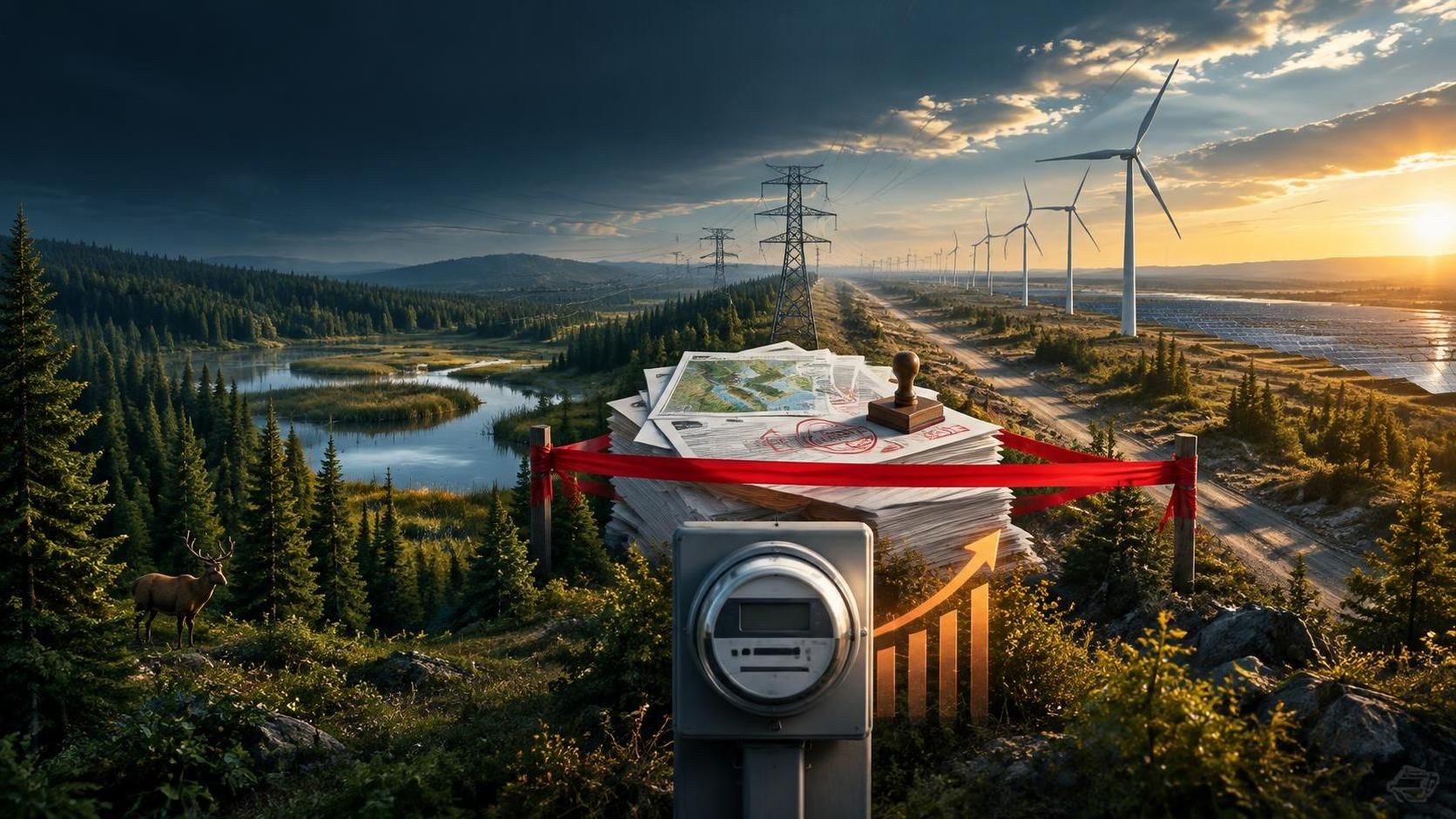
The Senate passed a sweeping permitting overhaul. Now climate scientists, green groups and tribes are squaring off against clean-energy companies and labor in the House. We tested my thesis that the climate movement’s own legal fights raise consumer costs and now block its own build-out.
For years the energy-building fight looked simple: companies wanted pipelines, and environmental groups sued to stop them. A bill that would make it easier to build nearly everything, from power lines and solar farms to gas pipelines and data centers, has split the coalition that passed the Inflation Reduction Act, Bloomberg reported Friday.
The Senate passed the Bipartisan American Affordability and Jobs Act 62 to 33 on Nov. 19, with 15 Democratic-caucus senators joining 47 Republicans. President Trump urged passage Nov. 8 and has said he would sign it if the House passes it, Al Jazeera and Reuters reported. Its authors are Republicans Shelley Moore Capito and Mike Lee and Democrats Sheldon Whitehouse and Martin Heinrich. Whitehouse says it will cut bills and emissions. More than 160 climate scientists are urging the House to vote no.
My thesis: the climate movement’s own lawsuits and permitting fights raised consumer costs, and the same tools now block the clean build-out it wants. We like facts, so here is the test.
What the Bill Does
The Senate rewrote H.R. 2347, so the House votes on a Senate amendment. According to the Bipartisan Policy Center and the Center for Climate and Energy Solutions, it would:
- Shrink the lawsuit window. Challenges under the National Environmental Policy Act (NEPA) would be due within 150 days, versus six years today. Plaintiffs must have raised the issue in comments and show direct harm. Cases go straight to appeals courts, and a flawed review goes back for a 180-day fix instead of the permit being canceled.
- Add deadlines. On top of 2023’s one- and two-year review limits, agencies get 45 days to decide and 90 to 120 days for remaining permits.
- Lock in permits. Agencies could not revoke or materially change permits in effect on or after Nov. 6, 2026, with six exceptions, and developers could sue over “disparate treatment.”
- Build the grid. FERC could permit lines of 230 kilovolts or more after a state has had a year, costs would follow benefits, and data centers would pay for upgrades they trigger.
- Ease fossil and water rules. Pipeline upgrades in existing corridors would skip NEPA, state water reviews of interstate pipelines and power lines would narrow to direct discharges, some wells into federal minerals would skip federal drilling permits, and Endangered Species Act consultations would drop from 90 days to 60. It also rewrites the historic-preservation consultation tribes rely on.
How We Got Here
Joe Manchin’s 2022 deal failed 47 to 47. The 2023 Fiscal Responsibility Act set NEPA deadlines and page limits and ordered the Mountain Valley Pipeline approved. Manchin and John Barrasso’s 2024 bill cleared committee 15 to 4 but never reached the floor. In May 2025 the Supreme Court ruled 8 to 0 in Seven County that courts owe agencies “substantial deference” on NEPA, a standard this bill would codify.
The Split
Supporters include the American Clean Power Association, which calls it “a clean energy bill,” the American Petroleum Institute, the AFL-CIO and Citizens’ Climate Lobby. One camp sees permitting reform as “the single most important thing we can do for the climate,” Columbia’s Noah Kaufman told Bloomberg.
Opponents include the Sierra Club, the National Wildlife Federation, the National Congress of American Indians and three House Democrats. Rep. Sean Casten says the U.S. “does not struggle to build” data centers, LNG terminals or gas pipelines, but does struggle with cheaper, cleaner power; he will vote no on the Senate text as is. Rep. Mike Levin says the harms “would be permanent” while the gains “aren’t guaranteed.” Rep. Jared Huffman calls the bill “the most sweeping rollback of environmental laws we’ve ever seen.” The scientists say its costs to the climate are “too high.”
Models disagree. A Third Way-backed Rhodium Group study finds household power bills $41 to $66 a year lower by 2035; another finds emissions 5 million to 148 million tons lower in 2040. Purdue’s Kevin Kircher finds emissions likely rise, about 120 million tons a year.
The Thesis Test
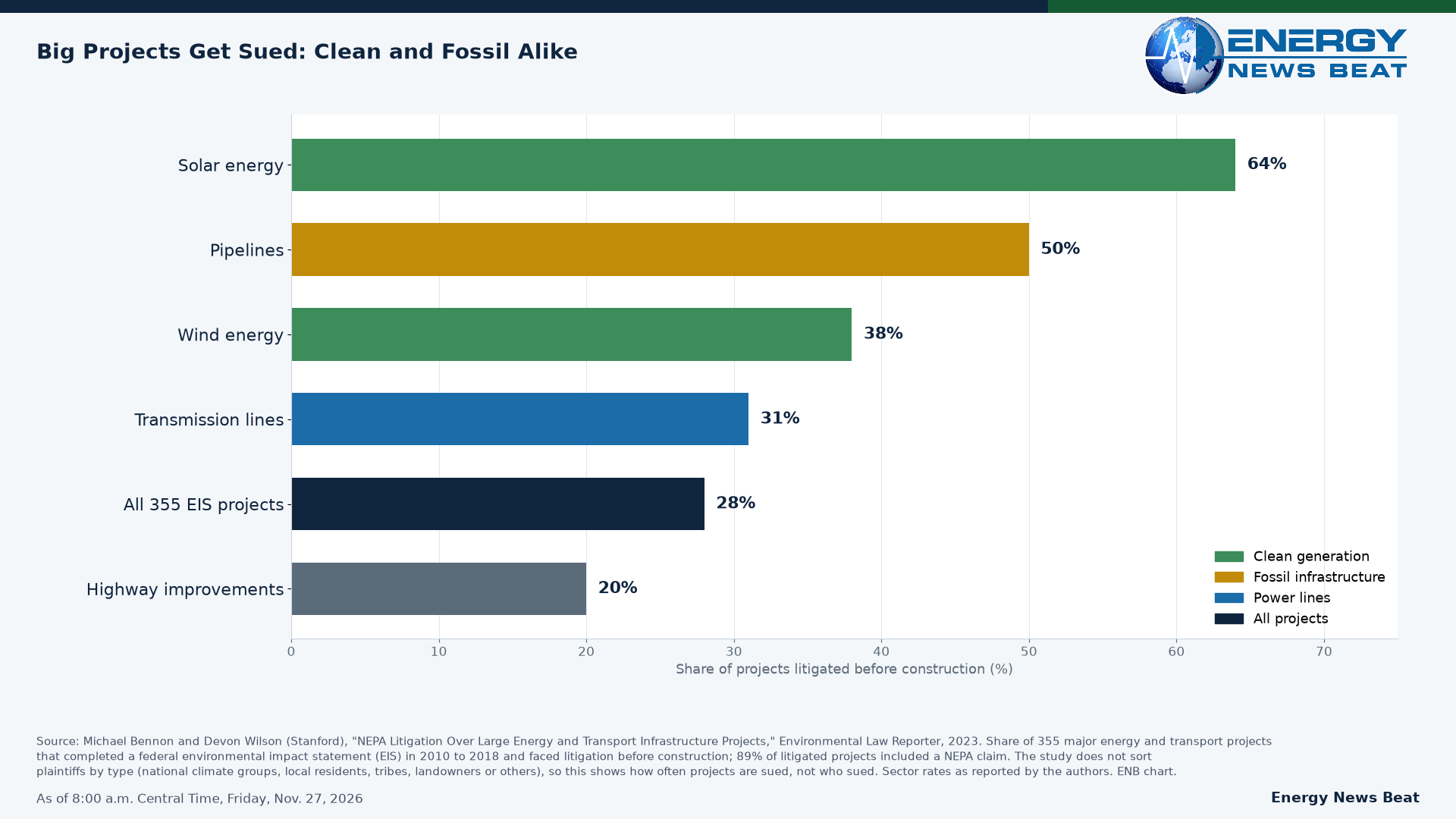
Where it holds. Big projects get sued. Of 355 major projects finishing federal impact statements in 2010 to 2018, 28% faced lawsuits before construction, including half of pipelines, 64% of solar, 38% of wind and 31% of transmission lines, a Stanford study found (Chart 1).
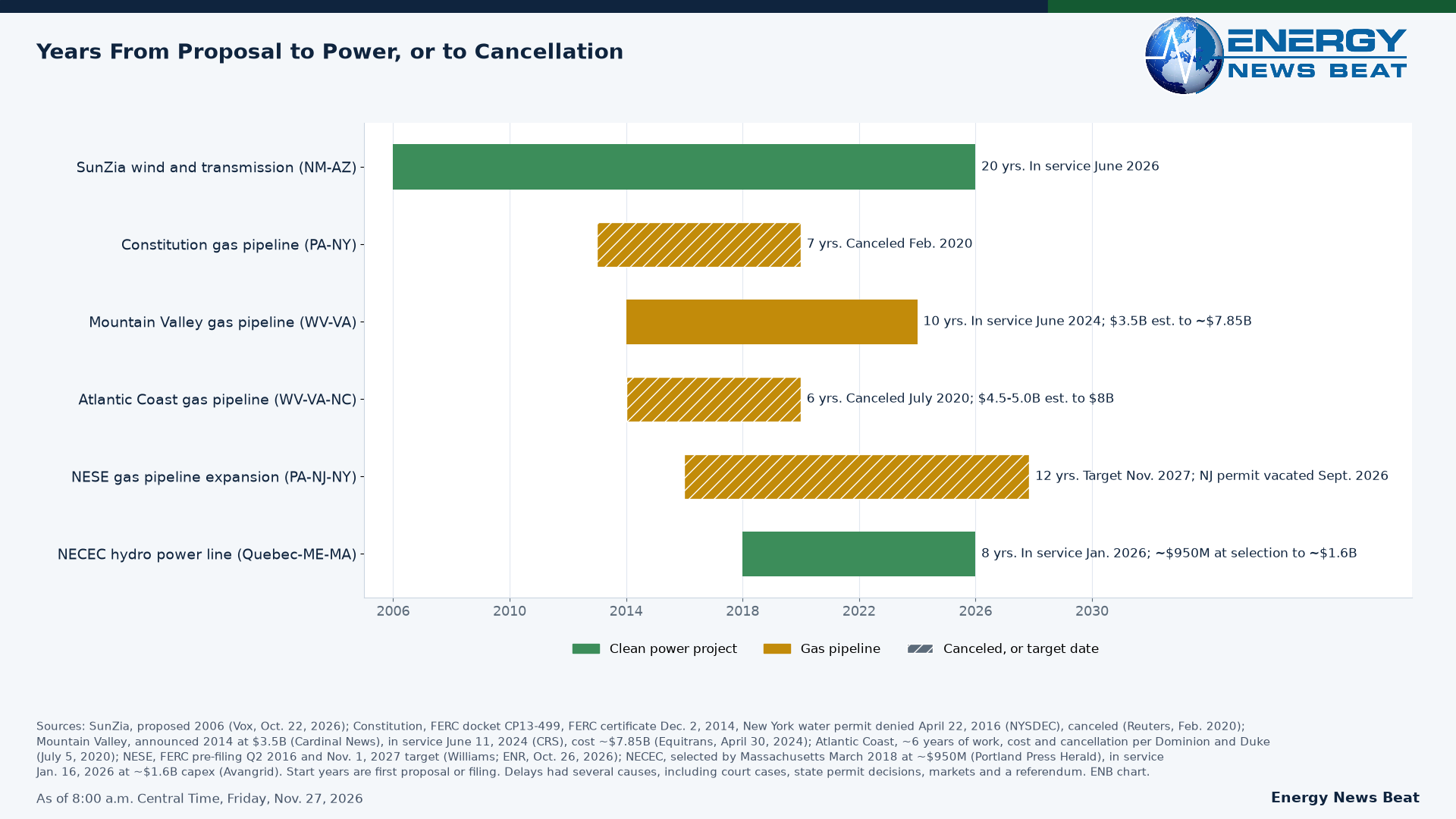
Dominion and Duke canceled the Atlantic Coast Pipeline in 2020, saying legal challenges pushed its cost from $4.5 billion to $5 billion up to $8 billion. Mountain Valley, announced in 2014 at $3.5 billion, opened in 2024 at about $7.85 billion after court fights repeatedly halted work. New York denied Constitution a water permit; it was canceled. Williams’ NESE expansion, first filed in 2016, lost its New Jersey water certificate in September after an environmental group sued.
During January’s Winter Storm Fern, New England’s Algonquin gas hub hit $122.58 per million Btu against $30.57 at Henry Hub, NGI reported. “We don’t have enough gas infrastructure to bring gas to New England,” FERC Chairman Laura Swett told Congress.
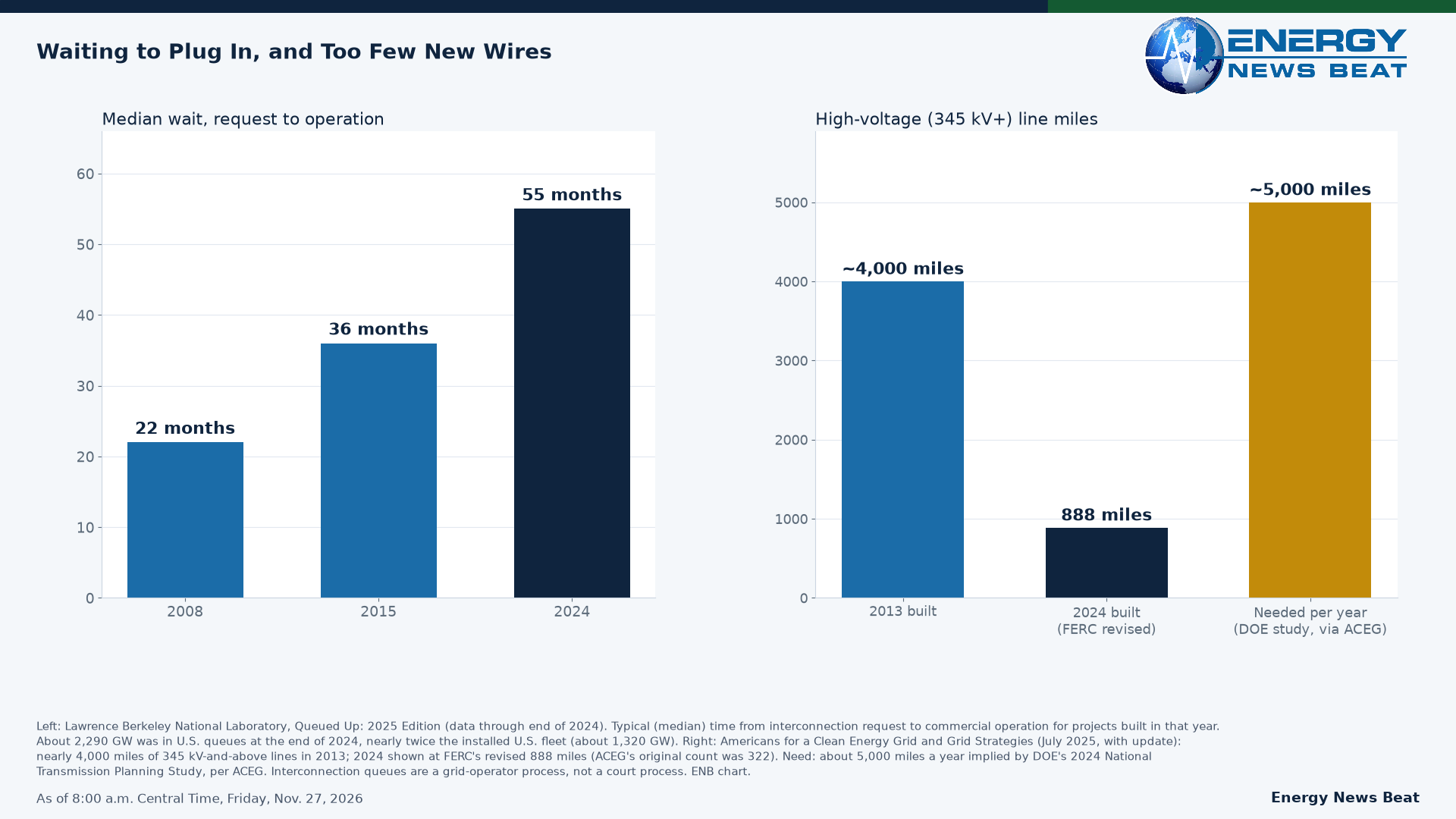
SunZia’s wind and power-line project, proposed in 2006, came online in June after permitting issues, lawsuits from tribes and local environmentalists and, above all, an unready market, Vox reported. Maine voters rejected the NECEC hydropower line in 2021 before a jury upheld its vested rights; it opened in January at about $1.6 billion. Projects built in 2024 took a median 55 months from grid request to operation, and just 888 miles of high-voltage line were built, against nearly 4,000 in 2013 (Charts 2 and 3).
Where it doesn’t. Bennon and Wilson don’t say who sued. For wind and solar, Resources for the Future found “regional or local environmental groups and Tribal representatives were the largest source of court challenges”; national groups sued on 5 of 14 litigated solar projects and 1 of 9 wind. Agencies usually win, RFF found, though court fights helped end three renewable projects. Much delay is in grid queues and cost fights, not courts. Gas does get built: Mountain Valley runs, and New York approved NESE. From April to July Algonquin averaged 43 cents below Henry Hub, EIA says. New England homes paid 29.56 cents per kilowatt-hour in September, versus 18.17 nationally, and power prices reflect far more than pipelines.
Verdict: The pattern holds in direction. Lawsuits and permit denials raised costs, by the companies’ own accounts, and delayed or killed pipelines; the same tools slow clean projects, though local groups and tribes filed most wind and solar suits. Proof that climate groups’ suits alone drive today’s bills is not established.
Timeline
- May 29, 2025: Supreme Court decides Seven County.
- 18, 2025: House passes the SPEED Act.
- 19: Senate passes it, 62 to 33.
- 23 to 24: Casten, Levin, Huffman, scientists and NCAI oppose.
- 30: House Rules Committee meets, 3 p.m. Central; a rule vote is reported for Dec. 1 (The Hill), a final vote possibly Dec. 2 or 3.
Consumer View
Don’t expect a lower bill this winter. Rhodium’s $41 to $66 a year, roughly $3.40 to $5.50 a month, arrives by 2035. NESE’s added gas won’t arrive before its November 2027 target. If the House changes the bill, it returns to the Senate, and January’s new Congress would start over.
Investor View (information, not investment advice)
Midstream: Litigation exposure drops to 150 days and corridor work skips NEPA. With the bill, Rhodium projects pipeline construction “still lower than its recent historical pace” in its low-emissions case but 12% and 34% higher in its mid and high cases, with LNG exports 8% to 15% above current policy.
Utilities and transmission: A FERC siting backstop, benefit-based cost sharing and data-center cost rules, which Rhodium says raise a 1-gigawatt data center’s costs 10% to 11%.
Developers: About 2,290 gigawatts sat in queues at the end of 2024, LBNL says; Rhodium models 17 to 249 gigawatts of added clean capacity by 2040.
Risks: Amendments, the clock and court rulings.
Caveats
The models covered earlier versions of the bill. The litigation study covers 2010 to 2018 and does not identify plaintiffs. ACEG first counted 322 transmission miles for 2024; FERC revised it to 888.
Stu’s Take
We like facts, and these cut both ways. For a decade, lawsuits and permit denials helped delay or kill pipelines like Constitution, Atlantic Coast and Mountain Valley, and New England families pay for tight pipeline capacity in cold snaps. Now the same legal tools slow wind, solar and power lines, and when climate hawk Sheldon Whitehouse writes a fix, a big part of the climate movement says no. Not every delay is a lawsuit, and the savings are modest. But if you can’t build, you can’t lower bills. Build the pipes and the wires.
Sources
- Bloomberg (Zahra Hirji and Eric Roston), “Permitting Reform Has Driven a Wedge Into the US Climate Movement,” Nov. 27, 2026: https://www.bloomberg.com/news/articles/2026-11-27/permitting-reform-has-driven-a-wedge-into-the-us-climate-movement
- Congress.gov, H.R. 2347, Bipartisan American Affordability and Jobs Act of 2026, all actions: https://www.congress.gov/bill/119th-congress/house-bill/2347/all-actions
- U.S. Senate Daily Press, Nov. 19, 2026 floor log (vote 62-33, Democratic-caucus yeas, Republican nays): https://www.dailypress.senate.gov/thursday-november-19-2026/
- NBC News, “Senate passes sweeping bill simplifying permitting rules,” Nov. 19, 2026: https://www.nbcnews.com/politics/congress/senate-passes-sweeping-bill-simplifying-permitting-rules-build-america-rcna610196
- Al Jazeera (with Reuters and AP), “US Senate passes bill to speed up energy project approvals,” Nov. 20, 2026: https://www.aljazeera.com/news/2026/11/20/us-senate-passes-bill-to-speed-up-energy-project-approvals
- Donald J. Trump, Truth Social post, Nov. 8, 2026, 7:05 p.m. ET (archived): https://www.trumpstruth.org/statuses/43532 ; original: https://truthsocial.com/@realDonaldTrump/117583560661477967
- Senate EPW Democrats, “Whitehouse Cheers Senate Passage,” Nov. 19, 2026 (endorsements): https://www.epw.senate.gov/press/dem/whitehouse-cheers-senate-passage-of-landmark-bipartisan-american-affordability-and-jobs-act/
- Senate Energy and Natural Resources Committee (Republicans), Senate passage release: https://www.energy.senate.gov/press/rep/senate-resoundingly-passes-chairman-lees-landmark-bipartisan-american-affordability-and-jobs-act/
- Bipartisan Policy Center, “Explaining the Senate Permitting Bill” (Senate-passed version): https://bipartisanpolicy.org/explainer/explaining-the-senate-permitting-bill-the-bipartisan-american-affordability-and-jobs-act/
- Center for Climate and Energy Solutions, “Comprehensive Summary of the Bipartisan American Affordability and Jobs Act”: https://www.c2es.org/document/comprehensive-summary-of-the-bipartisan-american-affordability-and-jobs-act/
- Congressional Research Service, R49510, BAAJA Division A, Title I analysis (via EveryCRSReport): https://www.everycrsreport.com/reports/R49510.html
- Holland & Knight, BAAJA section-by-section summary, October 2026: https://www.hklaw.com/-/media/files/insights/publications/2026/10/bipartisanamericanaffordabilityandjobsact_sectionbysection.pdf
- Rhodium Group, “Estimating the US Energy System Impacts of the Bipartisan American Affordability and Jobs Act,” Nov. 2, 2026: https://rhg.com/research/baaja-us-energy-system-impacts/
- Rhodium Group, “The Impact of Permitting Reform on State-level Residential Electricity Prices and Bills,” Nov. 12, 2026 (supported by Third Way): https://rhg.com/research/permitting-reform-state-electricity-prices/
- Kevin J. Kircher (Purdue), “Potential impacts of the Bipartisan American Affordability and Jobs Act on United States energy systems,” Nov. 16, 2026 version: https://kevinjkircher.com/wp-content/uploads/2026/11/BAAJA-potential-impacts.pdf
- Common Dreams, climate scientists’ letter to the House (“more than 160 climate scientists”), Nov. 24, 2026: https://www.commondreams.org/news/baaja-climate-scientists ; The Guardian, Nov. 24, 2026: https://www.theguardian.com/us-news/2026/nov/24/climate-scientists-lawmakers-baaja
- Rep. Sean Casten, statement on Senate permitting reform, Nov. 23, 2026: https://casten.house.gov/media/press-releases/casten-statement-on-senate-permitting-reform
- Rep. Mike Levin, statement calling for changes, Nov. 23, 2026: https://levin.house.gov/media/press-releases/rep-mike-levin-calls-for-changes-to-senate-passed-energy-permitting-bill
- Rep. Jared Huffman, “Ranking Member Huffman’s Plan for a Better Permitting Deal” (includes “the most sweeping rollback of environmental laws we’ve ever seen”), Nov. 24, 2026: https://huffman.house.gov/media-center/press-releases/ranking-member-huffmans-plan-for-a-better-permitting-deal
- CQ Roll Call, “Johnson banks on GOP unity as permitting bill vote nears,” Nov. 25, 2026: https://www.rollcall.com/2026/11/25/johnson-banks-on-gop-unity-as-permitting-bill-vote-nears
- Deseret News, “House Republican leaders tee up major permitting bill,” Nov. 25, 2026: https://www.deseret.com/politics/2026/11/25/house-republican-leaders-stress-attendance-for-permitting-bill/
- House Committee on Rules, Meeting Announcement for Nov. 30, 2026: https://rules.house.gov/media/announcement/meeting-announcement-november-30-2026
- Bommarito Consulting, BAAJA House vote schedule (citing The Hill), updated Nov. 25, 2026: https://bommaritollc.com/insights/baaja-house-vote/
- American Clean Power Association, statement on Senate passage, Nov. 19, 2026: https://cleanpower.org/news/american-clean-power-association-statement-on-senate-passage-of-baaja/
- American Petroleum Institute, statement on Senate passage, Nov. 19, 2026: https://www.api.org/news-policy-and-issues/news/2026/11/19/api-applauds-senate-passage-of-bipartisan-permitting-reform-legislation
- Sierra Club statement via CleanTechnica, Nov. 19, 2026: https://cleantechnica.com/2026/11/19/sierra-club-reacts-to-senate-passage-of-baaja-house-must-reject-the-senate-fast-tracked-bill/
- National Congress of American Indians, statement urging the House to reject BAAJA, Nov. 24, 2026: https://www.ncai.org/news/ncai-thanks-bipartisan-coalition-of-senators
- U.S. Senate, Roll Call Vote 394, 117th Congress, 2nd Session (Dec. 15, 2022): https://www.senate.gov/legislative/LIS/roll_call_votes/vote1172/vote_117_2_00394.htm
- Fiscal Responsibility Act of 2023, P.L. 118-5 (NEPA amendments, Sec. 321; Mountain Valley Pipeline, Sec. 324): https://www.congress.gov/bill/118th-congress/house-bill/3746
- U.S. Supreme Court, Seven County Infrastructure Coalition v. Eagle County, No. 23-975, May 29, 2025: https://www.supremecourt.gov/opinions/24pdf/23-975_m648.pdf
- House Clerk, Roll Call 356 (SPEED Act, H.R. 4776), Dec. 18, 2025: https://clerk.house.gov/evs/2025/roll356
- Michael Bennon and Devon Wilson, “NEPA Litigation Over Large Energy and Transport Infrastructure Projects,” Environmental Law Reporter, 2023: https://fsi9-prod.s3.us-west-1.amazonaws.com/s3fs-public/2023-09/nepa_litigation_over_large_energy_and_transport_infrastructure_projects.pdf
- Resources for the Future, “Taking Green Energy Projects to Court” (Takeaway 2 on plaintiffs; agencies and developers prevailed in most cases), Aug. 4, 2025 (updated Oct. 2, 2025): https://www.rff.org/publications/reports/taking-green-energy-projects-to-court-nepa-review-and-court-challenges-to-renewable-energy/
- Council on Environmental Quality, Environmental Impact Statement Timelines (2010-2018), June 12, 2020: https://nepa.gov/sites/default/files/documents/CEQ_EIS_Timeline_Report_2020-6-12.pdf
- Lawrence Berkeley National Laboratory, Queued Up: 2025 Edition, Dec. 15, 2025: https://emp.lbl.gov/sites/default/files/2025-12/Queued%20Up%202025%20Edition%20-%2012.15.2025.pdf
- Americans for a Clean Energy Grid and Grid Strategies, “Fewer New Miles” release and FERC-revision update, July 21 and 23, 2025: https://cleanenergygrid.org/new-report-reveals-u-s-transmission-buildout-lagging-far-behind-national-needs/
- Dominion Energy and Duke Energy, “Cancel the Atlantic Coast Pipeline,” July 5, 2020: https://news.dominionenergy.com/press-releases/press-releases/2020/Dominion-Energy-and-Duke-Energy-Cancel-the-Atlantic-Coast-Pipeline-07-05-2020/default.aspx
- Congressional Research Service, IN12032, “Mountain Valley Pipeline: Past the Finish Line,” updated June 13, 2024: https://www.everycrsreport.com/reports/IN12032.html
- Cardinal News, “Mountain Valley Pipeline final cost revised up to $7.85 billion,” April 30, 2024: https://cardinalnews.org/2024/04/30/mountain-valley-pipeline-final-cost-revised-up-to-7-85-billion/
- New York State DEC, Constitution Pipeline Project page: https://dec.ny.gov/environmental-protection/facilities-in-your-neighborhood/constitution-pipeline-project ; DEC denial of water quality certification, April 22, 2016: https://stoptheconstitutionpipeline.org/wp-content/uploads/2025/07/DEC_denies_401_WQC_4_22_16.pdf
- Reuters, “Williams cancels N.Y. Constitution natgas pipeline,” Feb. 2020: https://www.reuters.com/article/business/energy/williams-cancels-ny-constitution-natgas-pipeline-idUSL2N2AO11B/
- New York State DEC, statement approving NESE water quality certification, Nov. 7, 2025: https://dec.ny.gov/news/press-releases/2025/11/dec-statement-on-water-quality-certification-for-proposed-northeast-supply-enhancement-pipeline-project
- Williams, Northeast Supply Enhancement project page (timeline): https://www.williams.com/expansion-project/northeast-supply-enhancement/
- ENR, “Court Setback Puts Williams’ $1B Northeast Gas Pipeline Schedule at Risk,” Oct. 26, 2026: https://www.enr.com/articles/64083-court-setback-puts-williams-1b-northeast-gas-pipeline-schedule-at-risk
- NGI, “Winter Storm Fern Exposes Northeast Supply Constraints,” Feb. 6, 2026: https://naturalgasintel.com/news/winter-storm-fern-exposes-northeast-supply-constraints-sends-natural-gas-prices-soaring/
- EIA, Today in Energy, “New England natural gas prices have been trading near record discounts to Henry Hub,” Sept. 9, 2026: https://www.eia.gov/TodayinEnergy/detail.php?id=68124
- EIA, Electric Power Monthly, Table 5.6.A, September 2026: https://www.eia.gov/electricity/monthly/epm_table_grapher.php?t=epmt_5_6_a
- EIA, Electricity explained: factors affecting electricity prices: https://www.eia.gov/energyexplained/electricity/prices-and-factors-affecting-prices.php
- Vox, “The SunZia wind farm is a marvel. Why did it take 20 years to build?” Oct. 22, 2026: https://www.vox.com/future-perfect/507189/sunzia-wind-energy-transmission-project
- WGME, “Controversial CMP corridor begins commercial operations,” Jan. 16, 2026: https://wgme.com/news/local/controversial-cmp-corridor-begins-commercial-operations-central-maine-power-avangrid-new-england-clean-energy-connect-hydro-quebec
- Avangrid, “New England Clean Energy Connect Project Is Complete and Energized,” Jan. 16, 2026: https://www.avangrid.com/w/avangrid-s-new-england-clean-energy-connect-project-is-complete-and-energized
- Portland Press Herald, “In reversal, Massachusetts puts CMP in lead position for $950 million power line project,” March 28, 2018: https://www.pressherald.com/2018/03/28/massachusetts-ends-talks-with-transmission-line-developer-clears-way-for-cmp-project/
Appendix A: Key Numbers
| Measure | Value | Source |
| Senate passage, H.R. 2347 as amended, Nov. 19, 2026 | 62-33 (Record Vote 270); 15 Democratic-caucus yeas; Hawley, Rounds nay | Congress.gov; Senate Daily Press |
| Cloture on motion to proceed, Nov. 9 | 73-25 | Congress.gov |
| NEPA statute of limitations | 150 days (vs. 6-year APA default) | BPC; C2ES |
| Remand fix window | 180 days, remand without vacatur | C2ES |
| ESA consultation base period | 90 to 60 days | BPC |
| Permit-certainty cutoff | Permits in effect on or after Nov. 6, 2026 | BPC |
| FERC backstop threshold | 230 kV+, after 1 year of state action | BPC |
| Rhodium household bill savings | $41-66/yr by 2035; $50-78/yr by 2040 | Rhodium (Nov. 12; Nov. 2) |
| Rhodium emissions, 2040 | 5-148 Mt lower (mid 107) | Rhodium (Nov. 2) |
| Kircher emissions (2025 alternate history) | +120 Mt CO2e/yr (range -129 to +361) | Kircher (Nov. 16) |
| Litigation rate, 355 EIS projects, 2010-2018 | 28% overall; solar 64%, pipelines 50%, wind 38%, transmission 31% | Bennon and Wilson |
| Average / median EIS time, 2010-2018 | 4.5 / 3.5 years | CEQ |
| Interconnection queue, end 2024 | ~2,290 GW active | LBNL |
| Median wait, request to operation | 55 months (2024) vs. 36 (2015), 22 (2008) | LBNL |
| 345 kV+ line miles | ~4,000 (2013); 888 (2024, FERC revised; ACEG first 322) | ACEG; FERC |
| Atlantic Coast Pipeline cost | $4.5-5.0B to $8B; canceled July 5, 2020 | Dominion and Duke |
| Mountain Valley cost | $3.5B (2014) to ~$7.85B; in service June 2024 | Cardinal News; Equitrans; CRS |
| Algonquin vs. Henry Hub, Jan. 26, 2026 | $122.575 vs. $30.565/MMBtu | NGI |
| Algonquin vs. Henry Hub, Apr.-Jul. 2026 | 43 cents/MMBtu below | EIA |
| Residential power, Sept. 2026 | New England 29.56 vs. U.S. 18.17 cents/kWh | EIA |
| NECEC cost | ~$950M (2018 selection) to ~$1.6B capex; in service Jan. 16, 2026 | Press Herald; Avangrid |