In a significant move signaling renewed foreign investment in Venezuela’s oil sector, Chevron has executed a strategic asset swap with Petróleos de Venezuela S.A. (PDVSA) and its subsidiaries. Announced on April 13, 2026, and signed in Caracas in the presence of interim President Delcy Rodríguez, the deal allows Chevron to sharpen its focus on high-value heavy crude assets in the Orinoco Oil Belt while transferring non-core offshore gas and minor oil holdings back to PDVSA.
This transaction comes amid sweeping reforms to Venezuela’s oil law, a U.S.-backed $100 billion reconstruction plan following the removal of Nicolás Maduro, and easing sanctions that have opened the door for major international players. It underscores Chevron’s long-standing presence in the country (dating back to 1923) and positions the company to capitalize on the world’s largest extra-heavy oil reserves.
Key Companies and Assets Involved
Primary Parties: Chevron Corporation (through its Venezuelan subsidiaries)
PDVSA (Venezuela’s state-owned oil company)
Shell (in a related but separate gas development agreement)
Chevron’s Gains (Focus on Heavy Oil): An additional 13.21% working interest in the Petroindependencia S.A. joint venture, increasing Chevron’s stake from 35.8% to 49% (the legal maximum for foreign partners).
Development rights to the adjacent Ayacucho 8 block for the Petropiar S.A. joint venture (where Chevron holds 30%). Ayacucho 8 is a producing asset located near existing Petropiar infrastructure in the Orinoco Belt, enabling operational synergies and more capital-efficient heavy crude development.
Assets Transferred to PDVSA: Operated interests in the offshore Plataforma Deltana gas licenses: Block 2 (60% interest) — contains the Loran gas discovery (7.3 trillion cubic feet).
Block 3 (100% interest) — contains the Macuira gas discovery.
25.2% non-operated interest in the Petroindependiente S.A. joint venture (a small western Venezuela oil project).
Shell’s Related Move:
Shell is finalizing a separate agreement to develop the Loran gas field in a unified project with its existing Manatee field (which extends into Trinidad and Tobago waters). This will advance natural gas opportunities in the region.
Chevron described the swap as “mutually beneficial,” consolidating focus on strategic assets for all parties. Javier La Rosa, President of Chevron Base Assets and Emerging Countries, noted: “This agreement expands Chevron’s heavy oil position in two key joint ventures in Venezuela and reflects our disciplined development of the country’s significant resources.”
Current Oil Production and Export Volumes
Chevron’s joint ventures with PDVSA currently produce approximately 260,000 barrels per day (bpd) of crude — roughly 25% of Venezuela’s total output. Venezuela’s overall crude production reached 1.095 million bpd in March 2026 (up from 1.021 million bpd in February), while exports hit a six-month high of 1.09 million bpd of crude and fuel (plus petrochemicals and byproducts). Chevron’s own Venezuelan crude exports averaged 267,000 bpd in March.
These figures reflect a meaningful recovery from earlier lows, driven by recent policy shifts, license extensions, and operational optimizations in the Orinoco Belt.
Future Outlook and Production Predictions
Executives at Chevron anticipate a ~50% increase in the company’s Venezuelan output within its existing footprint over the next two years — potentially lifting its contribution from ~260,000 bpd to around 390,000 bpd. This growth would come from optimized development of Petroindependencia and Petropiar (including Ayacucho 8 synergies) without requiring massive new capital outlays.
Nationally, Venezuela’s oil sector stands to benefit from the $100 billion reconstruction push and foreign investment inflows. Independent models and analyst projections point to continued ramp-up: Short-term (2026–2027): Production could reach 1.3–1.5 million bpd.
Medium-term (2028): Potential to approach 2 million bpd as Orinoco Belt projects scale and infrastructure improves.
The chart below illustrates recent trends and these forward-looking estimates for Venezuela’s production/exports alongside Chevron’s projected output in the country.
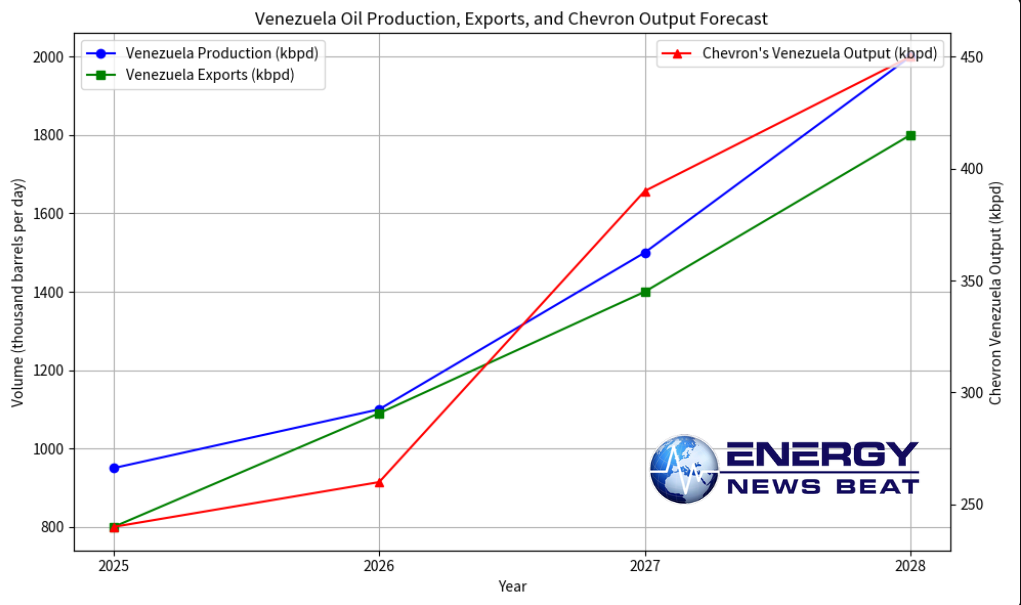
Note: Data compiled from recent shipping reports, PDVSA figures, Trading Economics projections, and Chevron guidance. Actual results will depend on investment levels, infrastructure upgrades, and geopolitical stability.
These developments not only boost revenue for Venezuela but also enhance regional energy security by increasing reliable heavy crude supply to U.S. and international refineries optimized for such grades. As one of the few Western majors with deep operational experience in Venezuela, Chevron is uniquely positioned to lead this resurgence.
The asset swap and related deals mark an optimistic new chapter for Venezuela’s energy sector — one that could deliver substantial economic benefits if reforms and investment momentum continue.
- Chevron Official Press Release (April 2026): https://www.chevron.com/newsroom/2026/q2/chevron-consolidates-venezuela-heavy-oil-position-in-asset-swap
- Reuters – “Chevron agrees to asset swap in Venezuela to focus on heavy oil projects” (April 13, 2026): https://www.reuters.com/business/energy/chevron-shell-sign-agreements-oil-gas-areas-venezuela-sources-say-2026-04-13/
- X Post by
@EnergyAbsurdity
(David Blackmon) detailing the deals, production figures, and context (April 14, 2026): https://x.com/EnergyAbsurdity/status/2044023767467245578
- Trading Economics – Venezuela Crude Oil Production (March 2026 data and forecasts): https://tradingeconomics.com/venezuela/crude-oil-production
- Reuters Shipping Data – Venezuela Exports Surpass 1 Million bpd (April 1, 2026): https://www.reuters.com/business/energy/venezuelas-oil-exports-surpassed-1-million-bpd-first-6-months-shipping-data-2026-04-01/
- Additional context from Energy Capital Power, Upstream Online, and World Oil reports on the Orinoco Belt and JV details (April 2026).
- Grok
Article prepared for Energy News Beat Channel. Data current as of April 15, 2026.