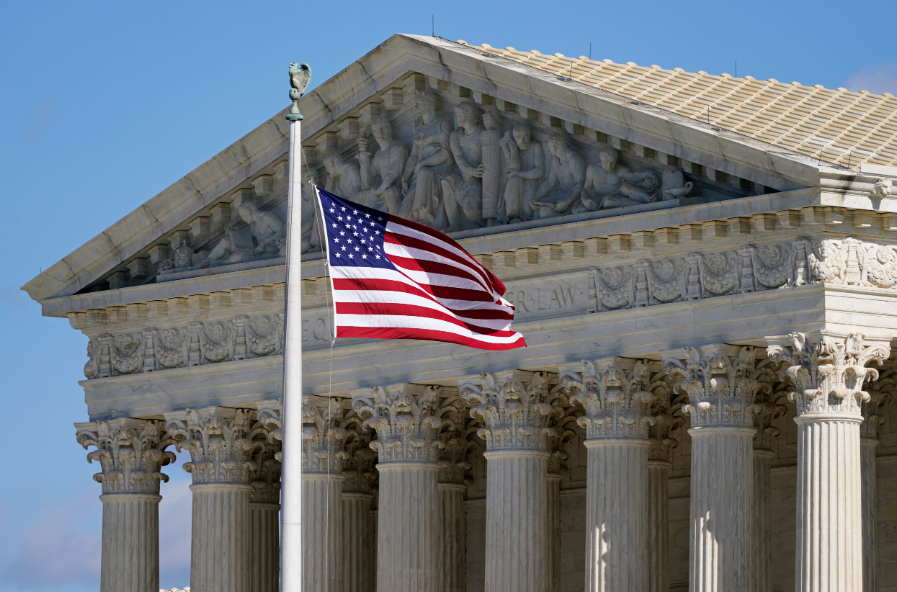
Justices debate whether local governments can sue energy giants for harms linked to climate change. Let’s talk about reparations for United States citizens who have to pay the bill for climate lawfare after the UN and others have admitted that the Climate change narrative was falsified.
The Supreme Court opened its new term Monday with a climate-liability case that could decide the fate of dozens of similar suits, and the eight justices who heard it did not hand the oil industry the clean kill it wanted. In Suncor Energy (U.S.A.) Inc. v. County Commissioners of Boulder County, No. 25-170, ExxonMobil and Suncor asked the Court to rule that federal law bars Boulder, Colorado, from suing them under state law for local costs of climate change. After nearly two hours, SCOTUSblog’s Amy Howe wrote that “it wasn’t clear whether a majority of the justices agreed with the energy companies.” Reuters said a 4-4 split looked possible. That would leave Boulder’s win in the Colorado Supreme Court standing.
For producers, refiners and anyone who finances or insures them, the stakes go beyond one Colorado county. Petitioners told the Court that “nearly 60 state and local governments” have filed suits like this one (Pet. Br. 8). The question is whether local juries get to price global emissions.
The case in brief
- Petitioners are Suncor Energy (U.S.A.) Inc., which operates Colorado’s only oil refineries (the Commerce City complex), and Exxon Mobil Corp. Respondents are the Board of County Commissioners of Boulder County and the City of Boulder (docket). The Trump administration argued as amicus supporting the companies.
- Question presented. “Whether federal law precludes state-law claims seeking relief for injuries allegedly caused by the effects of interstate and international greenhouse-gas emissions on the global climate.” When it granted review on Feb. 23, 2026, the Court added a second question: “Whether this Court has statutory and Article III jurisdiction to hear this case” (QP).
- The claims. Boulder pleads public and private nuisance, trespass, unjust enrichment and civil conspiracy. It alleges the companies “intentionally misled the public” about climate risks and “knowingly caused and contributed to the alteration of the climate” by producing and selling fossil fuels. Boulder says it seeks only damages, not an injunction or emissions limits ( Br. 4-5). Its complaint names no dollar figure. The companies say Boulder seeks “billions of dollars” (Pet. Br. 8).
- Who argued. Kannon Shanmugam of Davis Polk & Wardwell for the companies; Principal Deputy Solicitor General Sarah Harris for the United States; Kevin Russell (Russell & Woofter) for Boulder (transcript, p. 2).
- Eight justices. On Sept. 28 the Clerk told counsel that Justice Samuel Alito “will not continue to participate” (docket; SCOTUSblog). CBS reported his 2025 disclosure lists ConocoPhillips and Phillips 66 stock, not Exxon or Suncor (CBS News). The math matters: the companies need five votes, while Boulder needs four.
How we got here: eight years of procedural trench warfare
Boulder sued in Boulder County District Court in April 2018 (Chamber amicus n.2). The companies spent five years trying to move it to federal court and lost every round. A federal judge in Denver sent it back to state court in 2019. The Tenth Circuit affirmed in 2020 (10th Cir.). After the Supreme Court’s 2021 ruling in BP p.l.c. v. Baltimore widened appellate review of remand orders, the justices vacated and sent the Boulder case back. The Tenth Circuit affirmed again in 2022. On April 24, 2023, the Supreme Court denied review in Boulder’s case and in parallel Baltimore, Honolulu, Rhode Island and San Mateo cases. Alito sat out, and Justice Brett Kavanaugh noted he would have granted review in the Boulder case (Order List).
Back in state court, Judge Robert Gunning denied most of the motions to dismiss on June 21, 2024 (trial-court order; Reuters). He did dismiss Boulder’s Colorado Consumer Protection Act claim for lack of particularity. On May 12, 2025, the Colorado Supreme Court ruled 5-2 that the Clean Air Act and federal common law do not preempt Boulder’s claims. Justice Richard Gabriel wrote for the majority; Justice Carlos Samour, joined by Justice Brian Boatright, dissented (opinion via Justia). The companies petitioned on Aug. 8, 2025, and after repeated relistings the Court granted review (docket).
Chart 1. Suncor v. Boulder County, from filing to decision. Sources: Supreme Court docket 25-170; Order List 4/24/2023; Petitioners’ merits brief; Colorado Supreme Court; Boulder County District Court.
What the justices said
Shanmugam opened by calling the suit “an unprecedented effort to use state law to regulate global conduct” (Tr. 4:12-4:14). He warned that “some 90,000 municipalities” could “make national and international energy policy by asking juries to impose catastrophic damages on selected fossil-fuel producers” (Tr. 6:1-6:6). The bench’s response (transcript; audio):
- Chief Justice John Roberts pushed both sides. When Harris answered that Colorado would effectively ban production nationwide, he replied, “that’s a question of relief and what might be available” (Tr. 63:7-63:9). But he then warned Boulder that if it wins, “the next day, a municipality in every single state will file a lawsuit, they’ll probably copy your pleadings” (Tr. 94:8-94:10).
- Justice Brett Kavanaugh was the companies’ strongest vote. He said Milwaukee I, Milwaukee II, Ouellette and AEP “make crystal-clear that interstate air and water pollution are matters for federal law unless Congress specifically preserves state law” (Tr. 36:21-36:25). He called that “a wall of precedent” (Tr. 88:17-88:20). He warned that enough suits could “bankrupt” these and other defendants (Tr. 107:8-107:11).
- Justice Amy Coney Barrett rejected the companies’ broad constitutional theory as “a little slippery” (Tr. 51:16-51:17). Still, she pressed Boulder: “Everybody agrees that state tort law is a form of regulation. But what if Colorado passed a law purporting to cap emissions in the other 49 states?” (Tr. 104:11-104:14). Then: “So, the same thing can happen through the tort suit, though?” (Tr. 105:11-105:12).
- Justice Elena Kagan compared the case to the 1990s tobacco suits and the opioid litigation: “This is chapter 3. So, if this is chapter 3, were chapters 1 and 2 also preempted?” (Tr. 30:3-30:5). Yet she also offered the companies a narrower Clean Air Act route (Tr. 111:6-111:9).
- Justice Neil Gorsuch pressed the government. If the Clean Air Act displaced federal common law and also bars state law, then “nobody can sue at all?” (Tr. 68:22-68:25). Harris answered, “Again, I think that’s correct” (Tr. 69:1-2).
- Justice Clarence Thomas asked Boulder for a limiting principle and whether the theory reaches “large retailers” (Tr. 86:21-86:23). Russell answered: “Nothing in our theory prevents that” (Tr. 87:4-87:5).
- Justices Sonia Sotomayor and Ketanji Brown Jackson leaned toward Boulder or a jurisdictional exit. Sotomayor said the extraterritoriality argument may have been forfeited (Tr. 19:22-19:23). Jackson said “we’re really early in this case” and the review might be “premature” (Tr. 52:20-52:23).
Russell’s core answer: “Since the founding, states have had the power to provide tort remedies for injuries occurring within their borders even when the conduct causing those injuries occurred elsewhere” (Tr. 84:5-84:9). Damages, he said, merely require companies “to internalize a portion of the cost of their activities” (Tr. 105:16-105:19).
The case against the suits: an industrial-policy risk the U.S. cannot afford
The critics’ case, with the evidence offered for it. ENB has long argued that climate “lawfare” works as a back-door carbon tax that could deindustrialize the U.S. The court record supplies the evidence:
- Scale and multiplication. The U.S. Chamber’s brief lists “at least 33” government suits since 2017 (Chart 2) (Chamber). Petitioners put the number of suing governments at “nearly 60” ( Br. 8). API warns that “a single barrel of oil, cubic foot of natural gas, or ton of coal may be counted again and again by different states” (API amicus 15).
- The dollar figures are enormous where they exist. New York’s superfund law sets a $75 billion target ($3 billion a year for 25 years). Multnomah County, Oregon, seeks more than $1.5 billion in damages plus a $50 billion-plus abatement fund. California’s attorney general has talked of “tens of billions to hundreds of billions of dollars” (API amicus 26; Holland & Knight). For scale, ExxonMobil earned $28.8 billion in 2025 and Suncor $5.9 billion (Climate Economists amicus n.17) (Chart 3).
- An explicit “carbon tax” goal. Petitioners quote a member of Boulder’s legal team, David Bookbinder, describing the liability sought as a nationwide “carbon tax” that could “bankrupt[]” the industry ( Br. 38). That is petitioners’ characterization of a 2025 panel remark.
- What is exposed. PwC, in a study for API, estimates oil and gas supported 10.6 million U.S. jobs (4.9% of employment) and $2.06 trillion of GDP (7.4%) in 2023, including supply-chain and spending effects. Direct value added was $1.0 trillion (PwC/API). U.S. crude output reached a record 13.66 million b/d in 2025 (EIA) (Chart 4). Manufacturers, who run on that energy, account for 13 million jobs and $2.9 trillion a year (NAM amicus).
- Producing regions pay first. Nine western Colorado counties told the Court that oil and gas has historically supplied 40% to 50% of Montezuma County’s tax revenue (NW Colorado counties amicus). Alabama and 25 other states, backing the companies, warn that New York and Vermont seek to impose “billions of dollars of retroactive, strict liability on out-of-state energy producers” (Alabama et al. amicus).
- Insurance and capital. The American Property Casualty Insurance Association, whose members write 66% of the U.S. property-casualty market, and two other insurance groups say localized climate torts create “fragmented, inconsistent and extraterritorial exposures.” That makes the sector, already short of liability coverage, harder to insure (APCIA et al. amicus). Open-ended liability raises the cost of capital for refineries, pipelines and wells.
- Foreign competitors don’t face it. Shanmugam told the Court that “90 percent of greenhouse-gas emissions occur outside the United States” (Tr. 120:23-120:24). Domestic producers would bear liability that imported barrels and foreign plants do not, so jobs and emissions could move offshore.
Chart 2. Government climate-damages suits against energy companies, by year filed (33 cases). Source: U.S. Chamber of Commerce merits amicus brief, No. 25-170, n.2.
Chart 3. Dollar figures sought or assessed, compared with 2025 earnings of the two petitioners. Sources: Holland & Knight; Sidley; API amicus; Power the Future (Sept. 2026); Climate Economists amicus.
Chart 4. U.S. crude oil production, 2000–2025, with the industry’s economic footprint. Sources: U.S. EIA (MCRFPUS2); PwC for API (Oct. 2025).
The other side of the ledger
Counterarguments, presented fairly. Boulder, its allies and a number of scholars reject every link in that chain:
- It is a tort case, not regulation. Boulder says it seeks damages for local harm and deceptive marketing, not limits on emissions or production. It says the Clean Air Act “regulates point-source emissions, not the upstream production, sale, or marketing of products” ( Br. 4). Under the deception theory, Russell said, companies “can continue to produce as much fossil fuels as they like” (Tr. 97:7-11).
- Nineteen jurisdictions back Boulder. Colorado, California, New York, 16 other states and D.C. warn against “a new and unjustified preemption regime” that would leave injured parties “without a path to being made whole” (Colorado et al. amicus).
- Economists say the economy can absorb it. The Climate Economists brief argues that a damages award is “a transfer from the defendant to the plaintiff, not a destruction of productive capacity.” It notes that EPA’s 2023 social-cost estimate was $120 to $340 per ton of CO2. It cites Stanford’s EMF-32 finding that even aggressive carbon taxes cut GDP growth by “no more than about 0.1% points” (Climate Economists amicus).
- Pass-through is disputed. NYU’s Institute for Policy Integrity found New York’s superfund payments would be treated as one-time fixed costs and would be “unlikely to alter the price of gasoline at the pump” (Policy Integrity, 2022).
- Courts already have tools. Alejandro Camacho, writing on the Legal Planet blog, argues that limits on punitive damages and on in-state harm can address cross-border concerns without barring claims (Legal Planet). He cites Silkwood (nuclear) and Bates (pesticides), where state damages coexisted with federal regulation.
Neither side’s macro claim has been tested in a courtroom. No climate-damages case against an oil major has reached trial, judgment or settlement (Legal Planet).
When will we know?
Argument ran from 10:06 to 11:53 a.m. ET, and the case was submitted (transcript, pp. 1, 121). The Court sets no deadline, but it customarily releases opinions in all argued cases before its summer recess. Reuters, ABC News and Bloomberg Law all report a decision is expected by the end of June 2027. A jurisdictional dismissal would send the case back to Boulder County, with federal issues reviewable later.
What court watchers expect
- SCOTUSblog (Amy Howe): “mixed signals.” Kavanaugh was “the member of the court most supportive of the energy companies’ position.” The jurisdictional off-ramp “received little traction” beyond Sotomayor and Jackson.
- Legal Planet (Alejandro Camacho): the most likely outcome is a company win “on a narrower ground than constitutional structure.” He reads Kavanaugh, Barrett, Roberts and Thomas as leaning that way, so they need Gorsuch or Kagan for a fifth vote. Next most likely: a split ruling where deception claims survive. Then a 4-4 tie, then dismissal. A broad constitutional win “looks unlikely after today.”
- Bloomberg Law: several justices “suggested openness to letting at least a narrow class of claims go forward.” Kagan “resisted the companies’ sweeping constitutional arguments but was more receptive” to Clean Air Act preemption. AP: key justices “appeared wary about the potential sweep of litigation, but torn.”
ENB’s read of the transcript: Kavanaugh is a firm yes for the companies. Barrett and Thomas lean yes, Roberts is torn, Sotomayor and Jackson lean no, and Kagan and Gorsuch are the swing votes. The likeliest compromise is the one Kagan and Kavanaugh both pointed to: production- and emissions-based claims fall to the Clean Air Act, while deception claims survive.
Would an oil-company win end climate lawfare?
Almost certainly not. A win would reshape the fight, not end it:
- Deception and consumer-protection claims. Boulder’s brief, Kagan’s tobacco analogy and Camacho’s analysis all suggest a ruling could spare claims framed as marketing fraud. State AG suits in Massachusetts, Minnesota, D.C., Vermont and Connecticut rest mostly on consumer-protection statutes (Power the Future, Table 2).
- Climate superfund laws. New York’s $75 billion act was struck down twice: on Aug. 31, 2026 (N.D.N.Y., West Virginia v. James) and Sept. 23, 2026 (S.D.N.Y., United States v. New York). An appeal is expected (Holland & Knight; Sidley). Vermont’s uncapped Act 122 is still pending before Judge Mary Kay Lanthier (AP), and its cost assessment is due January 2027 (Vermont). Maryland has ordered a cost study due Dec. 1, 2026 (Power the Future).
- Honolulu’s suit survived a Supreme Court cert denial on Jan. 13, 2025 (Reuters). The trial court denied a stay pending Boulder on May 6, 2026 and set trial for May 8, 2029 (order). A federal judge dismissed DOJ’s suit to block Hawaii’s state case in April 2026 (Reuters); a Michigan judge did the same in January (Reuters).
- RICO and antitrust. Puerto Rico municipalities’ RICO case was dismissed as untimely in September 2025 and is on appeal (Reuters; CCI). Michigan has an antitrust suit in federal court, and private class and wrongful-death suits have appeared (Power the Future, Table 3).
- Germany’s Hamm court in Lliuya v. RWE (May 2025) dismissed the claim but accepted that major emitters can in principle be liable for climate harm abroad (Sabin Center). The ICJ’s July 23, 2025 advisory opinion adds material (ICJ). A U.S. ruling binds neither.
- Counter-moves. Oklahoma, Utah, Iowa and Tennessee have passed laws restricting such suits (Chamber amicus). The federal Stop Climate Shakedowns Act ( 4340; H.R. 8330) would void them nationally, but it sits in committee. Only Congress could end the fight outright.
What has lawfare cost consumers so far?
The honest answer: nobody has a solid number. Here is what the record does and does not show:
- Judgments and settlements: ENB found no reported judgment or settlement paid by an oil major in a U.S. government climate-damages suit. Legal Planet notes none has gone to trial (Legal Planet).
- Superfund assessments collected: New York’s $75 billion program is enjoined. Vermont’s amount has not been set.
- Defense costs: ExxonMobil, Suncor and other defendants have not publicly broken out climate-litigation legal spending, and ENB found no credible aggregate estimate. Eight years across 30-plus cases is not free, but no public figure exists.
- Forward-looking estimates (hypothetical, not costs incurred): Power the Future’s September 2026 report by E.J. Antoni and Daniel Turner estimates that if every pending suit, every proposed state superfund and a federal bill all succeeded, households would pay about $1,465 a year (range $1,248–$2,111). That works out to roughly 41 cents a gallon and 1.5 cents per kWh (Power the Future) (Chart 5). The Connecticut Energy Marketers Association put a Connecticut superfund at about 33 cents a gallon (Yankee Institute). On the other side, Policy Integrity projects no pump-price effect from New York’s law (Policy Integrity). These are advocacy and policy estimates, not measured pass-through.
Chart 5. A full-success scenario from an energy-advocacy group, not a measure of costs actually paid. Source: Antoni & Turner, “Who Really Pays?” (Power the Future, Sept. 2026), Table 1.
The bottom line
The oil companies came to Washington hoping to end the climate-liability movement in one ruling. On Monday’s evidence, they are more likely to get half a loaf: a ruling that knocks out claims tied to production and emissions while letting fraud-style claims grind on in state courts. Whatever the June ruling says, the superfund statutes, Hawaii’s cases, the RICO appeals and the next wave of filings will keep the industry’s legal budgets elevated. Watch three dates: Maryland’s cost study (Dec. 1, 2026), Vermont’s assessment (January 2027), and the last opinion day of June 2027.
All sources, the case timeline, transcript-cited quotes, a status list of related suits and laws, and our data-gap notes follow in the appendices.
At Energy News Beat, we Make Appendices Great Again.
Appendices
Appendix A. Sources (all accessed Oct. 5, 2026, CT)
Primary: U.S. Supreme Court (No. 25-170 and related)
- Supreme Court docket, No. 25-170, Suncor Energy (U.S.A.) Inc. v. County Commissioners of Boulder County (docketed Aug. 12, 2025; argued Oct. 5, 2026). https://www.supremecourt.gov/docket/docketfiles/html/public/25-170.html Accessed Oct. 5, 2026.
- Question presented and added jurisdiction question (cert. granted Feb. 23, 2026; Alito note Sept. 28, 2026). https://www.supremecourt.gov/qp/25-00170qp.pdf Accessed Oct. 5, 2026.
- Official argument transcript, No. 25-170 (Oct. 5, 2026), Heritage Reporting Corp., 122 pp., “Subject to Final Review”. https://www.supremecourt.gov/oral_arguments/argument_transcripts/2026/25-170_4fbi.pdf Accessed Oct. 5, 2026.
- Official argument audio, No. 25-170 (Oct. 5, 2026). https://www.supremecourt.gov/oral_arguments/audio/2026/25-170 Accessed Oct. 5, 2026.
- October Term 2026 argument calendar, session beginning Oct. 5, 2026. https://www.supremecourt.gov/oral_arguments/argument_calendars/MonthlyArgumentCalOctober2026.pdf Accessed Oct. 5, 2026.
- Petition for a writ of certiorari (Aug. 8, 2025). https://www.supremecourt.gov/DocketPDF/25/25-170/369227/20250808130855966_Suncor_pet.pdf Accessed Oct. 5, 2026.
- Brief in opposition, Boulder (Nov. 10, 2025). https://www.supremecourt.gov/DocketPDF/25/25-170/384126/20251110174050279_25-170%20Brief%20in%20Opposition.pdf Accessed Oct. 5, 2026.
- Brief for petitioners on the merits (May 14, 2026). https://www.supremecourt.gov/DocketPDF/25/25-170/408810/20260514091116673_Boulder%20brief%20for%20petitioners%20FINAL.pdf Accessed Oct. 5, 2026.
- Brief for respondents on the merits (filed July 27, 2026; corrected version Aug. 3, 2026). https://www.supremecourt.gov/DocketPDF/25/25-170/418043/20260803182738077_25-170%20Brief.pdf Accessed Oct. 5, 2026.
- Reply brief for petitioners (Aug. 26, 2026). https://www.supremecourt.gov/DocketPDF/25/25-170/420125/20260826093327423_Boulder%20reply%20brief%20for%20petitioners.pdf Accessed Oct. 5, 2026.
- Brief for the United States as amicus curiae supporting petitioners (May 21, 2026). https://www.supremecourt.gov/DocketPDF/25/25-170/409590/20260521184428959_25-170_Suncor_v_Boulder_Merits_FINAL.pdf Accessed Oct. 5, 2026.
- Order List, Apr. 24, 2023 (cert. denied in No. 21-1550 and four related removal cases). https://www.supremecourt.gov/orders/courtorders/042423zor_1p24.pdf Accessed Oct. 5, 2026.
- BP p.l.c. v. Mayor & City Council of Baltimore, 593 U.S. 230 (May 17, 2021) (Justia). https://law.justia.com/cases/federal/us/593/19-1189/ Accessed Oct. 5, 2026.
- Alabama v. California, No. 158, Orig. (Mar. 10, 2025) (motion for leave to file bill of complaint denied). https://www.supremecourt.gov/opinions/24pdf/158orig_jiek.pdf Accessed Oct. 5, 2026.
Primary: amicus briefs cited (merits stage)
- American Petroleum Institute (May 21, 2026). https://www.supremecourt.gov/DocketPDF/25/25-170/409478/20260521120901590_API%20Merits%20Amicus%20Brief_5.21.26_Final.pdf Accessed Oct. 5, 2026.
- Chamber of Commerce of the United States of America (May 21, 2026). https://www.supremecourt.gov/DocketPDF/25/25-170/409495/20260521131808067_Suncor%20-%20Chamber%20Merits%20Amicus%20Brief.pdf Accessed Oct. 5, 2026.
- American Property Casualty Insurance Ass’n, Complex Insurance Claims Litigation Ass’n & Reinsurance Ass’n of America (May 21, 2026). https://www.supremecourt.gov/DocketPDF/25/25-170/409457/20260521112827680_25-170%20Amicus%20Brief%20of%20American%20Property%20Caualty%20Insurance%20Association%20et%20al..pdf Accessed Oct. 5, 2026.
- National Association of Manufacturers (May 21, 2026). https://www.supremecourt.gov/DocketPDF/25/25-170/409503/20260521135136657_25-170%20Amicus%20Brief.pdf Accessed Oct. 5, 2026.
- Alabama and 25 other states (May 21, 2026). https://www.supremecourt.gov/DocketPDF/25/25-170/409498/20260521133537942_2026.05.21%20–%20States%20Br%20in%20Suncor%20v.%20Boulder.pdf Accessed Oct. 5, 2026.
- Associated Governments of Northwest Colorado and eight counties (May 21, 2026). https://www.supremecourt.gov/DocketPDF/25/25-170/409475/20260521115956612_25-170_Amicus%20Brief.pdf Accessed Oct. 5, 2026.
- Multinational Energy, Transportation, and Manufacturing Companies (May 21, 2026). https://www.supremecourt.gov/DocketPDF/25/25-170/409545/20260521154402148_25-170%20Brief.pdf Accessed Oct. 5, 2026.
- Colorado, California and 17 other jurisdictions (Aug. 3, 2026). https://www.supremecourt.gov/DocketPDF/25/25-170/417894/20260803123613654_2026.08.03%20Suncor%20v.%20County%20Commissioners%2025-170%20Amicus%20Brief%20of%20Colorado%20and%2018%20Other%20States.pdf Accessed Oct. 5, 2026.
- Climate Economists (Aug. 3, 2026). https://www.supremecourt.gov/DocketPDF/25/25-170/417981/20260803142921660_25-170%20Amicus%20Brief.pdf Accessed Oct. 5, 2026.
Primary: lower-court and related rulings
- Colorado Supreme Court, Cnty. Comm’rs of Boulder Cnty. v. Suncor Energy (U.S.A.), Inc., 586 P.3d 161, No. 24SA206 (May 12, 2025) (Justia). https://law.justia.com/cases/colorado/supreme-court/2025/24sa206.html Accessed Oct. 5, 2026.
- Boulder County District Court, Order re Defendants’ Motions to Dismiss, No. 2018CV30349 (June 21, 2024). https://www.coloradojudicial.gov/sites/default/files/2024-07/Order%20re%20Defendants%20Motions%20to%20Dismiss%20-%20June%2021%2C%202024.pdf Accessed Oct. 5, 2026.
- Tenth Circuit, Boulder Cnty. Comm’rs v. Suncor Energy, No. 19-1330 (July 7, 2020) (Justia). https://law.justia.com/cases/federal/appellate-courts/ca10/19-1330/19-1330-2020-07-07.html Accessed Oct. 5, 2026.
- Sabin Center Climate Litigation Database, Boulder County v. Suncor case page. https://www.climatecasechart.com/document/board-of-county-commissioners-of-boulder-county-v-suncor-energy-u-s-a-inc_2490 Accessed Oct. 5, 2026.
- Supreme Court of Maryland, Mayor & City Council of Baltimore v. BP, No. 11, Sept. Term 2025 (Mar. 24, 2026). https://www.mdcourts.gov/data/opinions/coa/2026/11a25.pdf Accessed Oct. 5, 2026.
- S.D.N.Y., United States v. New York, No. 1:25-cv-03656, Doc. 117 (Sept. 23, 2026) (Justia). https://law.justia.com/cases/federal/district-courts/new-york/nysdce/1:2025cv03656/641677/117/ Accessed Oct. 5, 2026.
- Haw. Cir. Ct., City & County of Honolulu v. Sunoco LP, order (May 6, 2026). https://thebrooksinstitute.org/sites/default/files/2026-05/Honolulu%20v.%20Oil%20Companies%20%20-%20to%20accompany%20Digest%20No.%20346.pdf Accessed Oct. 5, 2026.
- ICJ, Obligations of States in Respect of Climate Change, Advisory Opinion (July 23, 2025). https://icj-web.leman.un-icc.cloud/sites/default/files/case-related/187/187-20250723-adv-01-00-en.pdf Accessed Oct. 5, 2026.
Primary: legislation and government data
- S. 4340, Stop Climate Shakedowns Act of 2026 (introduced Apr. 16, 2026). https://www.congress.gov/119/bills/s4340/BILLS-119s4340is.htm Accessed Oct. 5, 2026.
- H.R. 8330, companion bill (119th Congress). https://www.govinfo.gov/content/pkg/BILLS-119hr8330ih/xhtml/BILLS-119hr8330ih.html Accessed Oct. 5, 2026.
- Vermont Climate Superfund Act page (State of Vermont). https://climatechange.vermont.gov/climate-superfund. Accessed Oct. 5, 2026.
- Vermont ANR/Treasurer, Act 122 Feasibility Report (Jan. 15, 2025). https://legislature.vermont.gov/assets/Legislative-Reports/2025-Feasibility-Report-Act-122.pdf Accessed Oct. 5, 2026.
- U.S. EIA, U.S. Field Production of Crude Oil, annual (MCRFPUS2). https://www.eia.gov/dnav/pet/hist/LeafHandler.ashx?n=PET&s=MCRFPUS2&f=A. Accessed Oct. 5, 2026.
- U.S. EIA, MCRFPUS2 annual data (XLS). https://www.eia.gov/dnav/pet/hist_xls/MCRFPUS2a.xls Accessed Oct. 5, 2026.
Coverage of the Oct. 5, 2026 argument
- Wall Street Journal (James Romoser), “Supreme Court Questions Oil Companies’ Bid to Shut Down Climate Lawsuits” (Oct. 5, 2026). Paywalled; headline/subheadline/byline verified via AlphaThinker listing. https://alphathinker.app/news-pulse/wsj-us-news/supreme-court-questions-oil-companies-bid-to-shut-down-climate-lawsuits. Accessed Oct. 5, 2026.
- Seeking Alpha (Carl Surran), “Supreme Court justices question oil industry’s bid to shut down climate change lawsuits” (Oct. 5, 2026). https://seekingalpha.com/news/4650395-supreme-court-justices-question-oil-industrys-bid-to-shut-down-climate-change-lawsuits. Accessed Oct. 5, 2026.
- SCOTUSblog (Amy Howe), “Court sends mixed signals …” (Oct. 5, 2026). https://www.scotusblog.com/2026/10/court-sends-mixed-signals-on-whether-it-will-allow-state-tort-suits-seeking-to-hold-energy-compa/ Accessed Oct. 5, 2026.
- SCOTUSblog (Kelsey Dallas), “Justice Alito will no longer participate in climate change dispute” (Sept. 28, 2026). https://www.scotusblog.com/2026/09/justice-alito-will-no-longer-participate-in-climate-change-dispute/ Accessed Oct. 5, 2026.
- Reuters, “US Supreme Court wrestles with oil companies’ bid to scuttle climate lawsuit” (Oct. 5, 2026), via LSE.co.uk. https://www.lse.co.uk/news/us-supreme-court-hears-bid-by-oil-companies-to-avoid-climate-lawsuit-qwdwgv2gykvo824.html Accessed Oct. 5, 2026.
- Associated Press, “Supreme Court weighs local governments’ climate change lawsuits …” (Oct. 5, 2026), via WRAL. https://www.wral.com/news/ap/6f8bb-supreme-court-weighs-local-governments-climate-change-lawsuits-against-oil-and-gas-companies/ Accessed Oct. 5, 2026.
- CBS News, “Supreme Court wrestles with energy companies’ bid to block major climate-change lawsuit” (Oct. 5, 2026). https://www.cbsnews.com/news/supreme-court-climate-change-energy-companies-boulder-colorado-arguments/ Accessed Oct. 5, 2026.
- ABC News, “Justices divided over climate change case and liability for oil producers” (Oct. 5, 2026). https://abcnews.com/Politics/justices-divided-climate-change-case-liability-oil-producers/story?id=137014063. Accessed Oct. 5, 2026.
- Bloomberg Law, “Supreme Court Grapples With Climate Suits Against Companies” (Oct. 5, 2026). https://news.bloomberglaw.com/us-law-week/supreme-court-grapples-with-climate-suits-against-oil-companies. Accessed Oct. 5, 2026.
- The Hill, “Justices appear skeptical of oil companies’ bid to quash climate suits” (Oct. 5, 2026). https://thehill.com/policy/energy-environment/6129978-oil-companies-supreme-court-skepticism/ Accessed Oct. 5, 2026.
- Colorado Public Radio, “Supreme Court hears Boulder climate case …” (Oct. 5, 2026). https://www.cpr.org/2026/10/05/scotust-hears-boulder-suncor-climate-case/ Accessed Oct. 5, 2026.
- Honolulu Star-Advertiser (Reuters), “Supreme Court weighs oil companies’ bid to block climate lawsuit” (Oct. 5, 2026). https://www.staradvertiser.com/2026/10/05/breaking-news/supreme-court-weighs-oil-companies-bid-to-block-climate-lawsuit/ Accessed Oct. 5, 2026.
- Legal Planet (Alejandro Camacho), “The Arguments We Did and Didn’t Hear in Suncor v. Boulder” (Oct. 5, 2026). https://legal-planet.org/2026/10/05/the-arguments-we-did-and-didnt-hear-in-suncor-v-boulder/ Accessed Oct. 5, 2026.
Coverage and analysis: lower-court history and related cases
- Reuters, “Exxon, Suncor units lose bid to escape Boulder, Colorado’s climate case” (June 24, 2024). https://www.reuters.com/legal/government/exxon-suncor-units-lose-bid-escape-boulder-colorados-climate-case-2024-06-24/ Accessed Oct. 5, 2026.
- CBS Colorado, “Colorado Supreme Court rules that Boulder’s lawsuit against Exxon and Suncor can proceed” (May 2025). https://www.cbsnews.com/colorado/news/colorado-supreme-court-boulder-lawsuit-against-exxon-suncor-can-proceed/ Accessed Oct. 5, 2026.
- AP, “High court denies energy companies’ appeals in climate suits” (Apr. 24, 2023). https://apnews.com/article/supreme-court-climate-change-oil-gas-companies-5cb990e392a5474c87d4cb0f63e2f81b Accessed Oct. 5, 2026.
- Reuters, “US Supreme Court rejects bid by oil companies to toss Honolulu’s climate suit” (Jan. 13, 2025). https://www.reuters.com/sustainability/climate-energy/us-supreme-court-rejects-bid-by-oil-companiesshell-toss-honolulus-climate-suit-2025-01-13/ Accessed Oct. 5, 2026.
- Holland & Knight, “Federal Court Blocks New York’s $75 Billion Climate Superfund Act” (Sept. 4, 2026). https://www.hklaw.com/en/insights/publications/2026/09/federal-court-blocks-new-yorks-75-billion-climate-superfund-act. Accessed Oct. 5, 2026.
- Sidley, “Second Federal Court Strikes Down New York’s Climate Change Superfund Act” (Sept. 29, 2026). https://environmentalhealthsafetybrief.sidley.com/2026/09/29/second-federal-court-strikes-down-new-yorks-climate-change-superfund-act/ Accessed Oct. 5, 2026.
- AP, “Vermont defends its landmark climate superfund law against Trump administration lawsuit” (2026). https://apnews.com/article/vermont-climate-superfund-lawsuit-59349a1cd18839557dfcb949ba54721b Accessed Oct. 5, 2026.
- Maryland Matters, “Maryland Supreme Court dismisses climate lawsuits from Baltimore and Annapolis” (Mar. 25, 2026). https://marylandmatters.org/2026/03/25/maryland-supreme-court-climate-cases-dismissed/ Accessed Oct. 5, 2026.
- Philadelphia Inquirer, Bucks County climate lawsuit dismissed (May 22, 2025). https://www.inquirer.com/news/pennsylvania/bucks-county-climate-change-lawsuit-fossil-fuel-weather-20250522.html Accessed Oct. 5, 2026.
- Just The News, Charleston climate lawsuit dismissed (2025). https://justthenews.com/politics-policy/energy/south-carolina-judge-tosses-charleston-climate-lawsuit-following-string Accessed Oct. 5, 2026.
- Reuters, “Exxon, other oil companies defeat climate lawsuit by Puerto Rican towns” (Sept. 12, 2025). https://www.reuters.com/legal/government/exxon-other-oil-companies-defeat-climate-lawsuit-by-puerto-rican-towns-2025-09-12/ Accessed Oct. 5, 2026.
- Center for Climate Integrity, Puerto Rico municipalities to appeal (2025). https://climateintegrity.org/news/view/puerto-rico-municipalities-to-appeal-technical-dismissal-of-big-oil-lawsuit Accessed Oct. 5, 2026.
- Heavy Weather, San Juan climate RICO dismissed; 37 municipalities appeal (2025). https://heavyweather.media/judge-dismisses-san-juan-climate-rico-meanwhile-37-municipalities-file-appeal-to-their-cases-dismissal/ Accessed Oct. 5, 2026.
- Reuters, “Judge tosses Trump DOJ’s lawsuit seeking to block Michigan climate case” (Jan. 26, 2026). https://www.reuters.com/legal/government/judge-tosses-trump-dojs-lawsuit-seeking-block-michigan-climate-case-2026-01-26/ Accessed Oct. 5, 2026.
- Reuters, “US judge rejects Trump administration bid to block Hawaii climate lawsuit” (Apr. 16, 2026). https://www.reuters.com/legal/litigation/us-judge-rejects-trump-administration-bid-block-hawaii-climate-lawsuit-2026-04-16/ Accessed Oct. 5, 2026.
- Sabin Center (Columbia Law), “What Lliuya v. RWE Means for Climate Change Loss and Damage Claims” (June 19, 2025). https://blogs.law.columbia.edu/climatechange/2025/06/19/what-lliuya-v-rwe-means-for-climate-change-loss-and-damage-claims/ Accessed Oct. 5, 2026.
- Sabin Center (Michael Gerrard), “The Role of Attribution Science in Climate Litigation” (June 17, 2026). https://blogs.law.columbia.edu/climatechange/2026/06/17/the-role-of-attribution-science-in-climate-litigation/ Accessed Oct. 5, 2026.
- Sabin Center Climate Litigation Database, United States. https://www.climatecasechart.com/geographies/united-states-of-america. Accessed Oct. 5, 2026.
Economics, footprint and consumer-cost estimates
- PwC for API, “Contribution of the Oil and Natural Gas Industry to the US Economy in 2023” (Oct. 2025). https://www.api.org/-/media/Files/Energy-Economics/API-Studies/2025/The-Oil-and-Gas-Industrys-Contribution-to-the-US-Economy.pdf Accessed Oct. 5, 2026.
- E.J. Antoni & Daniel Turner, “Who Really Pays? The Consumer Cost of Climate Litigation and ‘Climate Superfund’ Legislation” (Power the Future, Sept. 2026). https://www.powerthefuture.com/wp-content/uploads/Who-Really-Pays.pdf. Accessed Oct. 5, 2026.
- Institute for Policy Integrity (Peter Howard & Minhong Xu), “Enacting the ‘Polluter Pays’ Principle” (Nov. 22, 2022). https://policyintegrity.org/publications/detail/enacting-the-polluter-pays-principle Accessed Oct. 5, 2026.
- Yankee Institute (Meghan Portfolio), “Connecticut’s Climate Superfund Could Raise Gas Prices by 33 Cents a Gallon” (Mar. 3, 2026). https://www.yankeeinstitute.org/2026/03/03/connecticuts-climate-superfund-could-raise-gas-prices-by-33-cents-a-gallon/ Accessed Oct. 5, 2026.
- Grok Assembly of article and preparation assistance.
Note: Reuters and CBS pages block automated fetches; their text was read through syndicated copies (LSE.co.uk, Honolulu Star-Advertiser, WRAL for AP) or search excerpts. Supreme Court and Colorado court PDFs were downloaded directly where possible (Colorado court PDFs returned HTTP 403 to automated requests; Justia copy used).
Appendix B. Case timeline
| Date | Event | Court | Source |
| Apr. 17, 2018 | Boulder City & County file suit vs. Suncor and ExxonMobil (No. 2018CV30349) | Boulder County District Court | Chamber of Commerce merits amicus fn.2; Pet. Br. 8 gives Apr. 27 2018 |
| Sep. 05, 2019 | Federal court grants remand to state court (405 F. Supp. 3d 947) | D. Colo. | Pet. Br. 9 |
| Jul. 07, 2020 | Tenth Circuit affirms remand (965 F.3d 792) | 10th Cir. | Pet. Br. 9 |
| May. 17, 2021 | BP p.l.c. v. Mayor & City Council of Baltimore decided (593 U.S. 230) | U.S. Supreme Court | Pet. Br. 9; Justia |
| May. 24, 2021 | SCOTUS grants/vacates/remands Boulder removal case in light of BP (141 S. Ct. 2667) | U.S. Supreme Court | Pet. Br. 9 |
| Feb. 08, 2022 | Tenth Circuit again affirms remand (25 F.4th 1238) | 10th Cir. | Pet. Br. 9 |
| Apr. 24, 2023 | SCOTUS denies cert on removal (No. 21-1550); Kavanaugh would grant; Alito out | U.S. Supreme Court | Order List 4/24/2023 |
| Jun. 21, 2024 | Judge Robert Gunning largely denies motions to dismiss | Boulder County District Court | Trial-court order 6/21/2024; Reuters |
| May. 12, 2025 | Colorado Supreme Court 5-2: claims not preempted (586 P.3d 161) | Colorado Supreme Court | Justia; Pet. Br. 1 |
| Aug. 08, 2025 | Suncor & Exxon file cert petition (No. 25-170) | U.S. Supreme Court | Docket 25-170 |
| Feb. 23, 2026 | Cert granted + added jurisdiction question | U.S. Supreme Court | Docket 25-170 |
| Sep. 28, 2026 | Clerk letter: Justice Alito will not participate | U.S. Supreme Court | Docket 25-170 |
| Oct. 05, 2026 | Oral argument (10:06-11:53 a.m. ET) | U.S. Supreme Court | Transcript; Docket |
| By ~June 30, 2027 | Decision expected by end of June 2027 (end of OT2026) | U.S. Supreme Court | Reuters; ABC News; Bloomberg Law |
Filing-date note: the Chamber’s amicus brief (n.2) and the trial-court case number date Boulder’s complaint to April 17, 2018; Petitioners’ merits brief (p. 8) says April 27, 2018. ENB uses April 2018 in the text.
Appendix C. Key quotes from oral argument (official transcript citations)
Source: official transcript (page:line, “Official – Subject to Final Review”) and audio. Citations were located programmatically against the transcript text and spot-checked. Ellipses and dashes are as transcribed.
| Tr. page:line | Speaker | Quote |
| 4:12-4:14 | Kannon Shanmugam (petitioners) | “This case involves an unprecedented effort to use state law to regulate global conduct.” |
| 6:1-6:6 | Kannon Shanmugam (petitioners) | “If Boulder’s claims are allowed to go forward, some 90,000 municipalities across the country will have the ability to make national and international energy policy by asking juries to impose catastrophic damages on selected fossil-fuel producers.” |
| 8:25-9:4 | Chief Justice Roberts | “Counsel, you would concede that there are some situations in which an individual who engages in conduct in State B causes harm to somebody in State A can be sued under the law of State A, right?” |
| 19:22-19:23 | Justice Sotomayor | “Haven’t you forfeited? It’s a defense like any other.” |
| 28:10-28:12 | Justice Sotomayor | “But I don’t know that we’ve ever talked of spending money on litigation as a constitutional injury.” |
| 30:3-30:5 | Justice Kagan | “This is chapter 3. So, if this is chapter 3, were chapters 1 and 2 also preempted?” |
| 31:20-31:22 | Justice Kagan | “But this is the same kind of lawsuit against the same kind of actors for the same kind of harm.” |
| 33:21-33:22 | Justice Kagan | “Where’s the precedent for that? Where’s the anything for that?” |
| 36:21-36:25 | Justice Kavanaugh | “Milwaukee I, Milwaukee II, Ouellette, and AEP, which, as I read them together, make crystal-clear that interstate air and water pollution are matters for federal law unless Congress specifically preserves state law.” |
| 38:23-38:24 | Justice Kavanaugh | “That resolves this case.” |
| 47:25-48:2 | Justice Barrett | “It says “preserve.” And a saving clause suggests that you’re saving something that already exists.” |
| 51:16-51:17 | Justice Barrett | “I think that’s a little slippery.” |
| 52:20-52:23 | Justice Jackson | “we’re really early in this case, that this is sort of premature from the standpoint of this Court exercising its jurisdiction.” |
| 54:5-54:8 | Justice Jackson | “So why shouldn’t we wait and hear all of these claims once the state courts are done with their federal considerations?” |
| 59:20-59:21 | Sarah Harris (U.S., supporting petitioners) | “interstate air pollution is an inherently federal area” |
| 60:4-60:5 | Sarah Harris (U.S., supporting petitioners) | “this suit egregiously exceeds constitutional limits on state authority.” |
| 62:11-62:14 | Chief Justice Roberts | “I guess I’m not quite sure what makes this situation different from those, all those other ones, where we’ve allowed them to proceed in — in state court.” |
| 63:7-63:9 | Chief Justice Roberts | “Well, but that’s — that’s a question of relief and what might be available.” |
| 68:22-68:25 | Justice Gorsuch | “But because — because of the Clean Air Act and Congress not addressing this issue, nobody can sue at all?” |
| 69:1-2 | Sarah Harris (U.S.), answering Gorsuch | “Again, I think that’s correct …” |
| 67:4-67:7 | Justice Gorsuch | “EPA has disclaimed the power to regulate greenhouse gasses, not just from motor vehicles but more recently from stationary sources too.” |
| 84:5-84:9 | Kevin Russell (Boulder) | “Since the founding, states have had the power to provide tort remedies for injuries occurring within their borders even when the conduct causing those injuries occurred elsewhere.” |
| 86:6-86:8 | Justice Thomas | “If you prevail, is there a limiting principle to whom you can — as to whom you can sue?” |
| 86:21-86:23 | Justice Thomas | “So you could just as easily sue large retailers of — of — of these products?” |
| 87:4-87:5 | Kevin Russell (Boulder) | “Nothing in our theory prevents that.” |
| 88:17-88:20 | Justice Kavanaugh | “But I think we’re on a — have a wall of precedent that says state tort law does not apply except for the Ouellette source state thing.” |
| 92:1-92:2 | Justice Sotomayor | “The Clean Air Act does not regulate marketing or advertising of fuel, correct?” |
| 92:20-92:21 | Justice Sotomayor | “Isn’t this your case?” |
| 94:8-94:10 | Chief Justice Roberts | “presumably, if you prevail, the next day, a municipality in every single state will file a lawsuit, they’ll probably copy your pleadings” |
| 96:24-96:25 | Chief Justice Roberts | “isn’t your suit an attempt to evade those decisions?” |
| 97:2-97:3 | Chief Justice Roberts | “It’s really — it’s an effort to reduce emissions.” |
| 97:7-97:8 | Kevin Russell (Boulder) | “No, it is not an effort to reduce emissions.” |
| 104:11-104:14 | Justice Barrett | “Everybody agrees that state tort law is a form of regulation. But what if Colorado passed a law purporting to cap emissions in the other 49 states?” |
| 105:11-105:12 | Justice Barrett | “So, the same thing can happen through the tort suit, though?” |
| 105:16-105:19 | Kevin Russell (Boulder) | “It requires them to internalize a portion of the cost of their activities by paying for some of the damage that those activities inflict.” |
| 107:8-107:11 | Justice Kavanaugh | “It is going to bankrupt — you know, if there are enough of these, bankrupt these — these various defendants and certainly other defendants out there.” |
| 111:6-111:9 | Justice Kagan | “And so why not just say: This really does just get in the way of how the — of how Congress decided to regulate greenhouse gases or any other air quality standards?” |
| 111:22-111:23 | Justice Kagan | “but the statute is the statute.” |
| 117:21-117:23 | Justice Kavanaugh | “doesn’t those same points apply to a six-person state jury in Boulder and other juries in another country?” |
| 119:6-119:7 | Kannon Shanmugam (rebuttal) | “the breadth of Boulder’s theory here is astonishing.” |
| 120:23-120:24 | Kannon Shanmugam (rebuttal) | “remember that 90 percent of greenhouse-gas emissions occur outside the United States” |
| 121:16-121:19 | Kannon Shanmugam (rebuttal) | “Climate change is certainly one of the most pressing issues of the day, but we would submit that this is exactly the wrong way to go about resolving it.” |
| 119:12-15 | Kannon Shanmugam (rebuttal) | “… Boulder could tag me with personal jurisdiction when I am in Colorado in two weeks and sue me on a nuisance claim for refilling my car and thereby contributing to global climate change.” |
Appendix D. Related climate suits, laws and counter-measures: status
D-1 lists the 33 government suits cataloged in the U.S. Chamber’s merits amicus brief (n.2), with status where ENB could confirm it from a cited source. “Pending (not independently verified)” means ENB found no report of dismissal but did not confirm the docket on Oct. 5, 2026. The Sabin Center counts “about two dozen” pending U.S. damages suits (Gerrard, June 2026); see its U.S. database for live status.
D-1. Government climate-damages suits (33)
| Case | Juris. | Filed | Plaintiff | Status (as of Oct. 5, 2026) and source |
| Cnty. of San Mateo v. Chevron | CA | Jul. 2017 | Local government | Pending (not independently verified) |
| City of Oakland v. BP | CA | Sep. 2017 | Local government | Pending (not independently verified) |
| City of Santa Cruz v. Chevron | CA | Dec. 2017 | Local government | Pending (not independently verified) |
| Cnty. of Santa Cruz v. Chevron | CA | Dec. 2017 | Local government | Pending (not independently verified) |
| City of New York v. BP | NY | Jan. 2018 | Local government | Dismissed; affirmed by 2d Cir. in City of New York v. Chevron (2021) (cited in H&K) |
| City of Richmond v. Chevron | CA | Jan. 2018 | Local government | Pending (not independently verified) |
| Boulder Cnty. v. Suncor Energy | CO | Apr. 2018 | Local government | At U.S. Supreme Court (argued Oct. 5, 2026) (docket) |
| King Cnty. v. BP | WA | May. 2018 | Local government | Pending (not independently verified) |
| Rhode Island v. Chevron | RI | Jul. 2018 | State / D.C. | Pending (not independently verified) |
| Baltimore v. BP | MD | Jul. 2018 | Local government | Dismissed; affirmed by Md. Supreme Court Mar. 24, 2026 (opinion) |
| Massachusetts v. Exxon Mobil | MA | Oct. 2019 | State / D.C. | Pending; in discovery (PTF Table 2) |
| Honolulu v. Sunoco | HI | Mar. 2020 | Local government | Pending; cert. denied Jan. 13, 2025 (Reuters); stay denied, trial set May 8, 2029 (order) |
| Minnesota v. API | MN | Jun. 2020 | State / D.C. | Pending (PTF) |
| District of Columbia v. Exxon Mobil | DC | Jun. 2020 | State / D.C. | Pending (PTF Table 2) |
| City of Hoboken v. Exxon Mobil | NJ | Sep. 2020 | Local government | Pending (not independently verified) |
| City of Charleston v. Brabham Oil | SC | Sep. 2020 | Local government | Dismissed (2025) (Just The News) |
| Delaware v. BP America | DE | Sep. 2020 | State / D.C. | Largely dismissed (PTF Table 2) |
| Connecticut v. Exxon Mobil | CT | Sep. 2020 | State / D.C. | Pending (PTF Table 2) |
| Cnty. of Maui v. Sunoco | HI | Oct. 2020 | Local government | Pending (not independently verified) |
| City of Annapolis v. BP | MD | Feb. 2021 | Local government | Dismissed; affirmed Mar. 24, 2026 (opinion) |
| Anne Arundel Cnty. v. BP | MD | Apr. 2021 | Local government | Dismissed; affirmed Mar. 24, 2026 (opinion) |
| Vermont v. Exxon Mobil | VT | Sep. 2021 | State / D.C. | Pending (PTF Table 2) |
| Platkin (N.J. AG) v. Exxon Mobil | NJ | Oct. 2022 | State / D.C. | Dismissed (PTF Table 2) |
| Mun. of Bayamon v. Exxon Mobil | PR | Nov. 2022 | Local government | Dismissed as untimely Sept. 2025; appeal to 1st Cir. (Reuters; CCI) |
| Cnty. of Multnomah v. Exxon Mobil | OR | Jun. 2023 | Local government | Pending; seeks $1.5B+ damages and $50B+ abatement fund (API amicus) |
| People of California v. Exxon Mobil | CA | Sep. 2023 | State / D.C. | Pending (PTF) |
| Mun. of San Juan v. Exxon Mobil | PR | Dec. 2023 | Local government | Dismissed Oct. 2025 (Heavy Weather) |
| Shoalwater Bay Indian Tribe v. Exxon Mobil | WA | Dec. 2023 | Tribe | Remanded to state court; pending (PTF Table 3) |
| Makah Indian Tribe v. Exxon Mobil | WA | Dec. 2023 | Tribe | Remanded to state court; pending (PTF Table 3) |
| City of Chicago v. BP | IL | Feb. 2024 | Local government | Remanded to state court; pending (PTF Table 3) |
| Bucks Cnty. v. BP | PA | Mar. 2024 | Local government | Dismissed May 2025 (Inquirer); on appeal (PTF) |
| Maine v. BP | ME | Nov. 2024 | State / D.C. | Pending (PTF Table 3) |
| Hawaii v. BP | HI | May. 2025 | State / D.C. | Pending; stay denied (PTF Table 3) |
D-2. Statutes, federal actions, bills and international matters
| Matter | What it does | Status and source |
| New York Climate Change Superfund Act (2024) | $75B over 25 yrs; strict liability for 2000–2024 emissions | Held preempted in West Virginia v. James (N.D.N.Y., Aug. 31, 2026) and United States v. New York (S.D.N.Y., Sept. 23, 2026); permanently enjoined; appeal expected (H&K; Sidley; S.D.N.Y.) |
| Vermont Act 122, Climate Superfund (2024) | Uncapped; covers 1995–2024; Treasurer’s assessment due Jan. 2027 | Chamber/API and DOJ challenges pending before Judge Mary Kay Lanthier, D. Vt.; 24 states intervened (AP; Vermont; PTF) |
| Maryland RENEW Act / cost study | Introduced as $9B fund; enacted as a study over veto (Dec. 2025) | Comptroller study due Dec. 1, 2026 (PTF) |
| Other state superfund bills (MA, NJ, MN, HI, RI pending/stalled; CT, IL, OR, VA, CA, TN failed) | MA $75B and NJ $50B proposals | Status per PTF, Sept. 2026; Connecticut CEMA estimate 33¢/gal (Yankee Institute) |
| United States v. Hawaii (DOJ) | Sought to block Hawaii’s state-court suit | Dismissed Apr. 2026 (no standing) (Reuters) |
| United States v. Michigan (DOJ) | Sought to block Michigan climate case | Dismissed Jan. 2026 (Reuters) |
| Alabama v. California (original action) | 19 states sought to block 5 states’ climate suits | Leave to file denied Mar. 10, 2025 (order) |
| State shield laws: Okla. S.B. 1439; Utah H.B. 222; Iowa Code § 673B.2; Tenn. Energy Freedom Act | Bar or limit climate suits against energy companies | Enacted per Chamber amicus |
| Stop Climate Shakedowns Act (S. 4340 / H.R. 8330) | Would void state climate-liability laws and dismiss pending suits | Introduced Apr. 16, 2026; in Judiciary committees (S. 4340; H.R. 8330) |
| Lliuya v. RWE (Germany, OLG Hamm) | Peruvian farmer v. German utility | Claim dismissed May 2025, but liability recognized in principle (Sabin) |
| ICJ Advisory Opinion on climate obligations | State duties re: emissions, fossil-fuel production | Issued July 23, 2025 (ICJ) |
Appendix E. Data gaps: what has no solid number
Total consumer cost of climate litigation to date. No public, independent estimate exists. ENB found no judgment or settlement paid by an oil major in a U.S. government climate-damages suit, and no superfund money collected. Any consumer cost so far would come from defense spending, risk premiums and compliance, and none of these is publicly quantified.
Defense costs. Defendants do not publicly break out climate-litigation legal spending. The Power the Future report estimates $21.6–36.5B a year for “defense, compliance, and capital risk premium” only in its hypothetical full-success scenario. It is a modeled figure, not an accounting of money spent.
Damages sought. Most suits, including Boulder’s, plead no dollar amount. Boulder’s complaint alleges “billions” of dollars in harm, per petitioners. Power the Future reports that only Multnomah County, among the 15 actions it tabulates, pleads a specific figure. Vermont’s assessment is uncapped and not yet set.
Pass-through to prices. Estimates conflict. Power the Future (about 41¢/gal) and CEMA for Connecticut (about 33¢/gal) assume broad pass-through. Policy Integrity projects no pump-price effect from New York’s law. No empirical study measures actual pass-through, because no assessment or judgment has been paid.
Count of suits. The number depends on method: 33 (Chamber brief, government suits since 2017), “nearly 60” suing governments (petitioners, which counts the multi-municipality Puerto Rico suit’s plaintiffs separately), “some three dozen” (Legal Planet), and “about two dozen” pending (Sabin Center, June 2026). ENB charts the Chamber list because it names every case with a filing date.
Economic footprint. The PwC figures were commissioned by API and include indirect and induced effects, which can double-count across industries. The direct figure ($1.0T value added, 3.6% of GDP) is the more conservative measure. The Climate Economists brief notes BEA mining value added is under 1.5% of GDP, a narrower definition.
WSJ article text. The WSJ piece is paywalled. ENB verified only its headline, subheadline and byline (James Romoser) through a public listing and did not quote its body.
Transcript caveats. The transcript is marked “Subject to Final Review.” Its closing line reads “11:53 p.m.”; the argument began at 10:06 a.m., so ENB reads it as 11:53 a.m. Quoted spellings (e.g., “gasses,” “Clear Air Act”) are as transcribed.
Decision date. No rule sets one. “By end of June 2027” reflects the Court’s customary practice as reported by Reuters, ABC and Bloomberg Law.
Justice-by-justice read. Leanings come from questions at argument, which are an imperfect guide to votes. ENB’s read is analysis, not reporting.
Appendix F. Amicus lineup at the merits stage
From the docket: 39 merits amicus filings during the window for briefs supporting petitioners (including the United States), 28 during the window for briefs supporting respondents, and 1 supporting neither party (Prof. Derek T. Muller). Side is inferred from the filing window under Supreme Court Rule 37.3(a). Full list with links: data/amicus_merits_lineup.csv.
| Side | Selected amici |
| Petitioners’ side | United States; Alabama + 25 states; Tennessee; API; U.S. Chamber; NAM; insurers (APCIA et al.); multinational energy/transport/manufacturing companies; NW Colorado counties; Sen. Ted Cruz et al.; Majority Leader Scalise et al.; former senior foreign-affairs officials (Pompeo et al.); Gen. Richard Myers et al.; Washington Legal Foundation; Pacific Legal Foundation; Breakthrough Institute |
| Respondents’ side | Colorado + 17 states + D.C.; City of New York; city and county governments; Local Government Legal Center/NACo/NLC; Climate Economists; Former EPA Administrators; Sen. Sheldon Whitehouse + 88 members of Congress; former U.S. government officials; NRDC; Public Citizen; American Association for Justice; Prof. Jonathan Adler; preemption scholars; Makah Tribe et al. |
Appendix G. Justice-by-justice scorecard (ENB read of the argument)
| Justice | ENB read | Basis (transcript) |
| Kavanaugh | Companies | “Wall of precedent”; “That resolves this case”; “bankrupt”; “six-person state jury” (Tr. 36:21-25, 38:23, 88:17-20, 107:8-11, 117:21-23) |
| Barrett | Leans companies (narrow ground) | Rejected structural theory as “slippery”; tort = regulation; 49-state cap hypothetical (Tr. 51:16, 104:11-14, 105:11) |
| Thomas | Leans companies | Asked about limiting principle and suing retailers (Tr. 86:6-23) |
| Roberts | Torn | State-B-to-State-A torts; “question of relief”; but “every single state” floodgates and “attempt to evade” (Tr. 8:25-9:4, 63:7-9, 94:8-10, 96:24-97:3) |
| Kagan | Swing (Boulder on method) | Tobacco/opioids “chapter 3”; “Where’s the anything”; but Clean Air Act route and “the statute is the statute” (Tr. 30:3-5, 33:21-22, 111:6-9, 111:22-23) |
| Gorsuch | Swing (skeptical of government) | Texas-law hypotheticals; “nobody can sue at all?” (Tr. 13:10-16:4, 68:22-25) |
| Sotomayor | Boulder / jurisdiction | Forfeiture; litigation cost not injury; Commonwealth Edison “your case” (Tr. 19:22-23, 28:10-12, 92:20-21) |
| Jackson | Boulder / premature | “Really early in this case”; is Colorado a source state? (Tr. 52:20-23, 81:4-82:3) |
| Alito | Recused | Clerk’s letter, Sept. 28, 2026 |
Compare: Legal Planet (Camacho) reads Kavanaugh, Barrett, Roberts and Thomas as inclined toward the companies on a narrower ground, and Sotomayor and Jackson as with Boulder (Legal Planet). SCOTUSblog calls Kavanaugh the most supportive of the companies (SCOTUSblog).
Appendix H. Methodology and data files
Case identity verification. Case name, docket number, question presented, cert grant date, Alito non-participation and argument date were verified on the Supreme Court’s docket, QP sheet and argument calendar. They were cross-checked against the official transcript cover (No. 25-170, Oct. 5, 2026) and independent coverage (SCOTUSblog, Reuters, AP, CBS, Bloomberg Law).
Quotes. The transcript PDF was converted to text and reflowed with page:line markers (data/transcript_compact.txt). Each quote was located by exact-string search (data/quotes_located.json) to produce the citations in Appendix C.
Chart 1 uses data/case_timeline.csv. Chart 2 uses data/climate_suits_chamber_list.csv, transcribed from the Chamber brief n.2. Chart 3 uses data/dollars_at_stake.csv. Chart 4 uses data/eia_us_crude_production_annual.csv (from EIA XLS, data/eia_crude_annual.xls) and data/oil_gas_footprint.csv. Chart 5 uses data/consumer_cost_scenario.csv (Power the Future Table 1). Briefs are saved as PDF and text in data/briefs/. Charts are built by make_charts.py; this document by build_doc.py.
Time zone. Argument times are as stated in the transcript (Eastern). Publication date is in U.S. Central time.