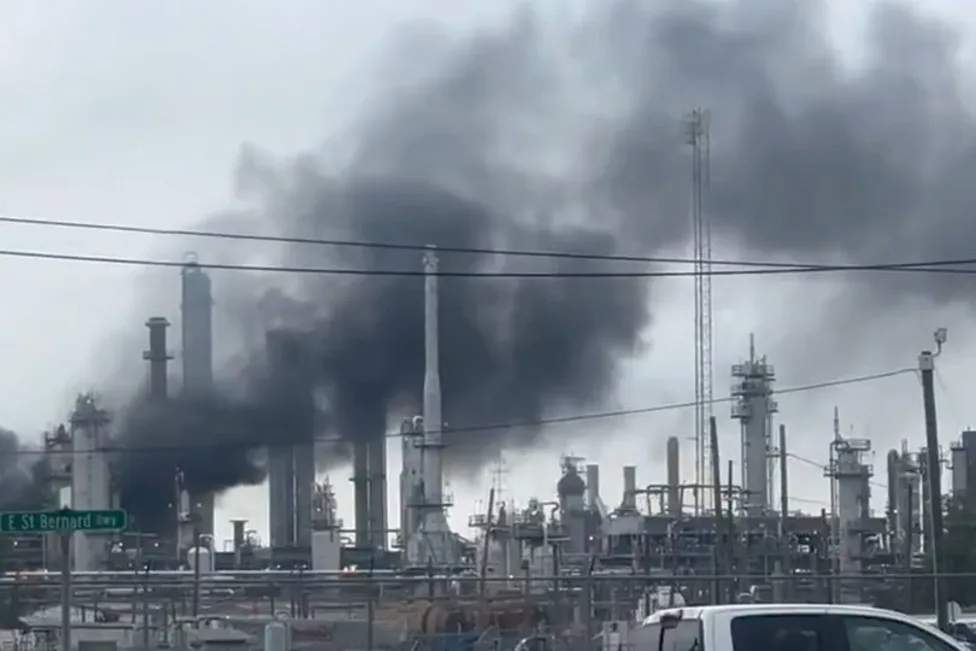
On May 8, 2026, an explosion and fire rocked the Chalmette Refinery in Chalmette, Louisiana, just east of New Orleans. Operated by PBF Energy, the facility processes roughly 185,000–190,000 barrels per day (bpd) of crude into gasoline, diesel, jet fuel, and specialty products. The incident occurred around 12:50–1:00 p.m. CDT in an operating 17,500-bpd reformer unit, where a heater failure triggered the blast. Thick black smoke billowed into the sky, shaking homes miles away in St. Bernard Parish, but the fire was contained within about 10 minutes by refinery responders and local firefighters. No injuries occurred, air monitoring showed no off-site impacts, and the refinery confirmed all personnel were accounted for.
PBF Energy described it as a fire on an operating unit with no immediate production details released. Preliminary reports point to a mechanical issue (heater explosion), and the cause remains under investigation. The affected reformer processes heavy crude into higher-value fuels, so even a partial outage strains local Gulf Coast supply in an already tight market.
This event raises questions: Is the Chalmette fire part of a broader pattern of U.S. refinery incidents? How do recent fires compare in scale, repair timelines, and market effects? Do maintenance pressures play a role—and has sabotage ever been a factor?Chalmette Refinery Background
The Chalmette facility, built in 1915, is one of PBF Energy’s six U.S. refineries and a key Gulf Coast player. It handles light sweet to heavy sour crudes via pipeline and water transport. Past incidents include a 2023 fired-heater tube rupture that caused significant damage (CSB investigation cited creep damage and overheating). The May 2026 event mirrors equipment-focused failures seen elsewhere.
U.S. Refinery Fires: The Last Year (2025–Early 2026)
U.S. refineries recorded approximately nine significant publicly reported fires or explosions in 2025, spanning operators like Chevron, Marathon, Valero, Phillips 66, CITGO, Hunt Refining, PBF Energy, and CVR Energy. Early 2026 has seen additional incidents, including:
PBF Martinez, CA (Feb. 1, 2025): Major fire/explosion during turnaround in a hydrodeoxygenation or related unit. Caused ~$924 million in damage; refinery largely shut down, with partial restarts (e.g., crude unit) by April 2025 and fuller operations delayed into early 2026 in some reports.
Chevron El Segundo, CA (Oct. 2–3, 2025): Fire in jet fuel (Isomax) unit at the 285,000-bpd refinery. Disrupted Southern California fuel supply (20% of motor fuels, 40% jet fuel locally); units down for weeks.
HF Sinclair Navajo, NM (Oct. 31, 2025): Explosion and fire; some injuries reported.
Marathon Galveston Bay, TX (2025): Fire prompted shelter-in-place; controlled without major injuries.
Valero Port Arthur, TX (March 23, 2026): Explosion and fire in a 47,000-bpd diesel hydrotreater (Unit 243) at the 380,000-bpd refinery. Full initial shutdown; partial restart by mid-April 2026 (one crude unit online), with the damaged hydrotreater and another crude line still under repair into spring/summer 2026. Significant short-term distillate impact.
Repair timelines vary widely. Minor unit fires can return online in days to weeks with quick containment and inspections. Major events—like PBF Martinez or Valero Port Arthur—often require months: equipment replacement, regulatory reviews, insurance assessments, and phased restarts. As of mid-May 2026, some 2025–early 2026 damage (e.g., certain Valero units) remains offline or partially operational. Cumulative outages, even if small individually, compound in a system already running near limits.
Impact on Supply and Refining Capacity
U.S. operable refining capacity stands around 18–19 million bpd nationally, with Gulf Coast facilities critical for exports and domestic supply. Utilization has hovered near or above 90% in recent periods amid strong demand and limited new builds (offset by some closures, e.g., Phillips 66 Wilmington, CA). The EIA forecasts U.S. inventories of gasoline, distillate, and jet fuel declining to multi-decade lows in 2026 due to refinery closures, rising consumption, and these disruptions.
Individual incidents like Chalmette’s 17,500-bpd reformer outage represent <1% of national capacity but hit regional gasoline/diesel markets, especially with falling stocks and high crack spreads. Broader 2025–2026 events (e.g., Valero’s distillate hit) have contributed to tighter supply, price volatility, and elevated margins. No single fire has caused a national crisis, but the pattern adds strain amid geopolitical factors (e.g., global outages elsewhere).
Do Refineries Catch Fire More Often Without Maintenance Time?
Yes—evidence strongly links many incidents to mechanical integrity issues, deferred preventive maintenance, and high utilization. Refineries operate complex, high-pressure, high-temperature systems where corrosion, tube creep, heater failures, and leaks accumulate without regular turnarounds. CSB and OSHA investigations repeatedly cite poor preventive maintenance programs, skipped procedures during turnarounds, and production pressures as root causes in major events (e.g., equipment failures during or after deferred work).
High demand and tight margins often delay or compress maintenance windows, increasing risk. Analyses note rising U.S. refinery incidents since ~2018–2020, partly tied to aging infrastructure and operational stress. The Chalmette heater failure and similar cases fit this pattern of equipment pushed hard without full upkeep.
Have Any Been Attributed to Sabotage?
No U.S. refinery fires in the reviewed period (including Chalmette) have been officially attributed to sabotage. Investigations point to industrial accidents, mechanical failures, or process upsets. Officials and operators consistently describe them as non-criminal. While social media and some global commentary speculate amid geopolitical tensions (e.g., Russian refinery drone attacks or U.S.-Iran strains), U.S. incidents show no evidence of foul play. Clusters appear driven by systemic factors: aging plants, high run rates, and deferred maintenance.
Conclusion
The Chalmette fire is the latest in a series of U.S. refinery incidents, but the data points to mechanical and operational risks rather than a coordinated pattern or external threat. Refineries remain resilient—quick responses prevented injuries and spread—but repeated outages underscore the need for robust maintenance amid tight capacity.
That being said, we need more security for our refineries as drones have done a number on global refinery capacity in Europe and the Gulf Countries in the Middle East.
As the industry navigates closures and demand growth, prioritizing mechanical integrity will be key to avoiding bigger disruptions.
Appendix: Sources, Links, and Data Notes
- Incident Details & Statements: PBF Energy/Chalmette Refining social media updates; AP News, Reuters, WWLTV, NOLA.com (May 8–10, 2026 coverage).
- Valero Port Arthur: Reuters (partial restart April 2026); regulatory filings.
- 2025 Incidents Overview: Reuters factbox (Oct. 2025); AOC Corp safety analysis (9 events in 2025).
- PBF Martinez 2025: CSB-related reporting.
- EIA Data: U.S. Energy Information Administration Short-Term Energy Outlook and Refinery Capacity Reports (inventories, utilization forecasts for 2026). Links: eia.gov/todayinenergy; eia.gov/petroleum/refinerycapacity.
- Maintenance & Safety: CSB investigations (csb.gov); OSHA reports on deferred maintenance.
- Charts for Reference (public sources):
- EIA U.S. Refinery Utilization & Capacity Utilization chart: Search EIA.gov for weekly “Refinery Utilization” or STEO reports (typically shows 85–96% range with inventory overlays).
- Gasoline/Distillate Inventory Trends: EIA Weekly Petroleum Status Report charts (historically low levels projected 2026).
- Incident timelines often compiled in industry summaries (e.g., Reuters or safety blogs).
All data drawn from public news, regulatory, and government sources as of May 10, 2026. Ongoing investigations may update details. Energy News Beat will monitor developments.