In a significant disruption to energy flows in the Eastern Mediterranean, Chevron has declared force majeure at Israel’s Leviathan natural gas field following a government-ordered temporary shutdown. The halt, prompted by heightened security risks amid joint U.S.-Israeli strikes on Iran and subsequent regional retaliations, marks the second such interruption in less than a year. This development not only underscores the geopolitical vulnerabilities of the region’s energy infrastructure but also raises questions about supply stability, revenue implications, and broader market dynamics.
The Shutdown and Its Immediate Causes
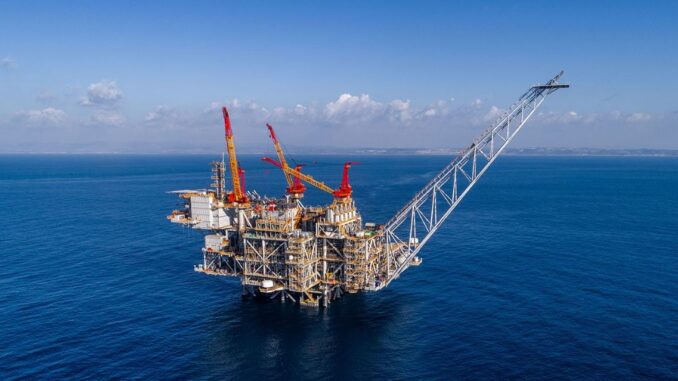
The Israeli Energy Ministry directed Chevron, the field’s operator, to suspend operations at Leviathan on security grounds. The decision came as retaliatory strikes escalated across the Middle East, affecting multiple energy assets—including Qatar’s LNG facilities and Saudi Arabia’s Ras Tanura refinery. Leviathan, located offshore Haifa, is Israel’s largest gas field with recoverable reserves estimated at 22.9 trillion cubic feet (about 648 billion cubic meters). Production began in 2019, and the field plays a critical role in supplying gas to Israel, Egypt, and Jordan.Chevron’s declaration of force majeure—a legal clause allowing parties to suspend contract obligations due to unforeseen events beyond their control—shields the company from liabilities for non-delivery. However, it does not mitigate the loss of production or revenue during the downtime. The suspension is described as temporary, but no specific timeline for resumption has been provided, leaving markets in uncertainty.
Volume of Gas Shut Down and Potential DelaysLeviathan’s current production capacity stands at approximately 12 billion cubic meters (BCM) per year, equivalent to about 1.16 billion cubic feet per day (bcf/d).
This represents roughly half of Israel’s total natural gas output, which hit a record 2.587 bcf/d in 2024 before dipping slightly in 2025 due to prior disruptions.
With the full field offline, daily gas production losses could reach 1.16 bcf/d, impacting domestic Israeli power generation and exports.
Combined with shutdowns at other fields like Tamar (also operated by Chevron) and Energean’s Karish, total halted exports to Egypt alone amount to around 1.1 bcf/d.
This equates to about 11-12 BCM annually if prolonged, straining Egypt’s energy system and forcing it to ramp up LNG imports or fuel oil use for power.
On the development front, Chevron and partners (NewMed Energy with 45.34% and Ratio Energies with 15%) recently approved a $2.36 billion expansion in January 2026, aiming to boost capacity to 21 BCM/year by the end of the decade.
The project involves drilling three additional wells and upgrading infrastructure. The current shutdown could delay these activities, particularly offshore drilling and subsea work, potentially pushing back the 2029-2030 timeline. While no official delays have been announced, similar security halts in 2025 already curtailed output, highlighting the risk of extended timelines.
Expected Revenue Hit to ChevronLeviathan generated approximately $2.23 billion in sales from 10.9 BCM in 2025, implying an average price of around $5.65 per million British thermal units (MMBtu) based on regional contracts.
At full capacity (12 BCM/year), annual field revenue could approach $2.45 billion. Chevron’s 39.66% stake translates to roughly $970-980 million in yearly attributable revenue.
Assuming a complete shutdown, daily revenue losses for the field could total about $6.7 million ($2.45B / 365 days). Chevron’s share: approximately $2.7 million per day. If the halt lasts a week, Chevron’s hit could exceed $18 million; a month-long disruption might cost over $80 million. These figures are gross estimates and do not account for variable costs like operations, which may be partially offset during downtime.
Long-term delays in the expansion could defer billions in future revenue, especially under the $35 billion, 15-year export deal with Egypt for 130 BCM starting in 2026.
That agreement prices gas at around $7.43/MMBtu, boosting potential earnings but amplifying risks from interruptions.
Implications for the Natural Gas Market: Investor Perspectives
Investors should view this event through the lens of regional volatility rather than a global seismic shift. The Eastern Mediterranean gas market is tightly interconnected, with Israel emerging as a key exporter amid Egypt’s declining domestic production. The shutdown exacerbates Egypt’s energy crunch, potentially driving up regional spot prices and forcing Cairo to seek more expensive LNG cargoes—QatarEnergy is already lined up for summer 2026 supplies.
Globally, the impact on natural gas prices may be muted if the halt is short-lived, as Middle East disruptions (including Qatar’s LNG pause) add pressure but represent a fraction of worldwide supply. However, prolonged issues could tighten European LNG markets, where Egypt re-exports some Israeli gas. Investors in Chevron (CVX) or peers like NewMed should monitor geopolitical resolutions; force majeure protects against penalties but erodes earnings. Diversified portfolios may benefit from hedging via futures, while opportunities arise in alternative suppliers like U.S. LNG exporters. Long-term, Israel’s expansion plans reinforce its strategic value, but recurring risks could demand higher risk premiums.
Consumer Impacts: Higher Costs and Energy Security Concerns
For consumers in Israel, Egypt, and Jordan, the shutdown means immediate supply squeezes. Israel may face power rationing or higher electricity bills if alternatives like coal or imports fill the gap. Egypt, already rescheduling LNG and boosting fuel oil, could see elevated energy costs passed to households and industries, risking unrest amid economic strains.
Jordan and Lebanon, smaller importers, might experience similar pressures.
Broader consumer advice: In volatile regions, energy efficiency and diversification (e.g., renewables) mitigate risks. While prices may spike short-term, the temporary nature suggests limited lasting impact—unless escalations persist. For global consumers, any ripple to LNG could nudge heating or electricity costs higher, emphasizing the interconnectedness of energy geopolitics.
This disruption highlights the fragile balance in Eastern Mediterranean energy. As Chevron navigates force majeure, stakeholders from investors to policymakers must prioritize resilience in an increasingly tense region. Stay tuned to Energy News Beat for updates on resumption and market reactions.
Get your CEO on the #1 Energy Podcast in the United States: https://sandstoneassetmgmt.com/media/
Is oil and gas right for your portfolio? https://energynewsbeat.co/invest/