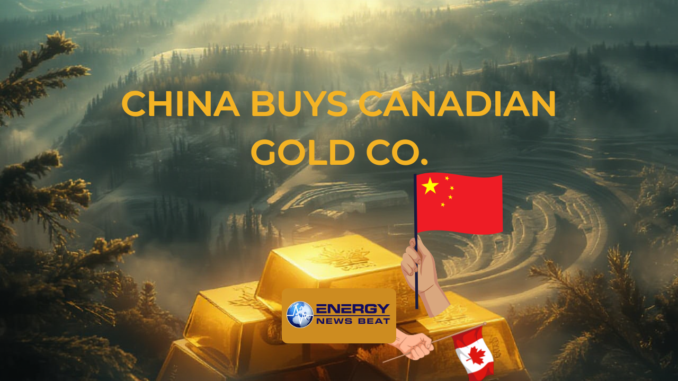
In a bold move that underscores the shifting dynamics of global resource competition, China’s Zijin Gold International has agreed to acquire Toronto-listed Allied Gold Corp. in an all-cash deal valued at C$5.5 billion (approximately US$4 billion). The announcement, made on January 26, 2026, comes just days after Canadian Prime Minister Mark Carney’s high-profile visit to Beijing, where he sought to reset bilateral ties and expand economic cooperation amid rising U.S. trade pressures. This acquisition not only bolsters China’s gold production capabilities but also highlights growing concerns over Beijing’s expanding influence in Canada’s mining sector and broader geopolitical landscape.
Details of the Deal
Zijin Gold, a subsidiary of the state-backed Zijin Mining Group—one of China’s largest mining companies—will pay C$44 per share for Allied Gold, representing a 5.4% premium over the stock’s last closing price before the announcement. Allied Gold, while headquartered in Canada, operates primarily in Africa, with key assets including the Agbaou and Bonikro mines in Côte d’Ivoire, the Sadiola mine in Mali, and the Kurmuk development project in Ethiopia. These operations produced around 141,859 ounces of gold in 2025, contributing to Zijin’s strategy to ramp up global output amid record-high gold prices.
The transaction is structured as a friendly arrangement and requires several approvals, including from Allied Gold shareholders, Canadian courts, and crucially, under the Investment Canada Act, which scrutinizes foreign investments for national security implications. Additional regulatory nods are needed from jurisdictions in China and Africa. If completed, this would mark one of the largest Chinese acquisitions of a Canadian-registered mining firm in recent years, giving Zijin control over significant African gold reserves and enhancing its position as a top global producer.
Allied Gold’s leadership has endorsed the deal, citing the all-cash offer as providing immediate value to shareholders amid a gold price rally that has seen the metal surpass US$5,000 per ounce. However, critics argue it exemplifies China’s pattern of targeting resource-rich companies to secure supply chains, potentially at the expense of Western influence in the sector.
Canada’s Gold Mining Output
Canada remains a major player in global gold production, ranking fourth worldwide. In 2023, the country’s mines yielded nearly 200 tonnes of gold, a figure that has held relatively steady into recent years despite fluctuations in individual operations. For 2025, aggregate production from key Canadian miners, including contributions from companies like Equinox Gold (which reported 922,827 ounces or about 28.7 tonnes) and others such as Lundin Mining and New Gold, suggests total output remained in the 180-200 tonne range, supported by strong demand and high prices.
This production level underscores Canada’s importance in the precious metals market, with exports contributing significantly to the economy. However, foreign takeovers like the Zijin-Allied deal raise questions about how much of this output benefits domestic interests versus feeding into global supply chains dominated by state-influenced entities.
China’s Growing Influence on Canada: A Geopolitical Flashpoint
The timing of the Zijin acquisition—shortly after Prime Minister Carney’s January 16, 2026, visit to China—has fueled speculation about Beijing’s leverage in Canadian affairs. During the trip, Carney met with top Chinese leaders, including President Xi Jinping, to forge a “strategic partnership” focused on energy, agri-food, and trade. Key outcomes included Canada reducing its 100% tariff on Chinese electric vehicles (EVs) to 6.1% for an initial cap of 49,000 units annually, in exchange for China lowering barriers on Canadian canola, lobsters, and other products. Carney emphasized this was not a full free trade agreement but targeted cooperation to diversify Canada’s economy away from over-reliance on the U.S.
Yet, this engagement comes amid well-documented concerns over China’s influence operations in Canada. Intelligence reports from the Canadian Security Intelligence Service (CSIS) and parliamentary inquiries have highlighted extensive foreign interference, including espionage, election meddling in 2019 and 2021, transnational repression of diaspora communities, and the use of proxies linked to the Chinese Communist Party’s United Front Work Department. Beijing has also employed economic coercion, such as trade restrictions on Canadian canola, following the 2018 arrest of Huawei executive Meng Wanzhou.
Geopolitically, these moves position Canada in a precarious spot. With bilateral trade at $118.7 billion in 2024, China is a vital partner, but investments in critical sectors like mining amplify risks to sovereignty and supply chain security. As Canada hedges against U.S. protectionism, deeper ties with China could invite retaliation from Washington, exacerbating North American tensions and potentially destabilizing global resource markets.
Trump’s Tariff Threats and the Volatile Gold Market
Adding fuel to the fire, U.S. President Donald Trump has threatened 100% tariffs on all Canadian products if Ottawa signs a trade deal with China—a direct response to Carney’s recent overtures. This escalation, posted on social media over the weekend, has rattled markets and heightened fears of a renewed trade war, especially as the U.S.-Mexico-Canada Agreement (USMCA) faces review.
Such tariffs would devastate cross-border supply chains, potentially throwing Canada into recession and impacting U.S. growth through higher costs and job losses in integrated industries like autos and metals. Analysts warn of “enormous pressure” for Canadian retaliation, further eroding investor confidence and spiking market volatility.
The gold market, already volatile due to inflation, debt burdens, and geopolitical strife, has reacted sharply. Prices surged past US$5,000 per ounce for the first time on January 26, 2026, driven by safe-haven demand amid tariff uncertainties. Gold rallied 2.1% to US$5,082.50, with forecasts now eyeing US$5,600 by year-end. Silver jumped 14%, reflecting broader precious metals strength. These threats amplify systemic risks, translating bilateral disputes into global commodity price swings and underscoring gold’s role as a hedge against policy-induced chaos.
As Canada navigates this high-stakes triangle of influence, the Zijin-Allied deal serves as a stark reminder of the intertwined fates of resources, trade, and power in an increasingly multipolar world.
Sources: theenergynewsbeat.substack.com,
Get your CEO on the podcast: https://sandstoneassetmgmt.com/media/
Is oil and gas right for your portfolio? https://sandstoneassetmgmt.com/invest-in-oil-and-gas/