


At 12:53 a.m. Central Time on Thursday, FT Energy posted, “EU delays methane emission rules on fossil fuel imports,” with a link to a Financial Times article of the same headline. The post’s standfirst, drawn from the FT, said the new rules “will not be implemented for at least two years after sustained lobbying by the US, Qatar and the wider oil and gas sector.” The Council of the EU and the European Parliament confirmed the same morning that they had reached a provisional agreement on targeted amendments to Regulation (EU) 2024/1787, the Methane Regulation adopted in 2024.
That agreement is a political deal, not a statute in the Official Journal. The Commission’s notice said the text “now requires a formal adoption by both the European Parliament and the Council” and would enter into force after publication in the Official Journal. The Council said the amendment should be adopted and “enter into force before the end of the year.” Until that happens, the original application dates remain on the books.
What the Council published is a two-year postponement of specified dates, not a repeal. Monitoring, reporting and verification obligations for importers of natural gas, crude oil and coal “will apply from 1 January 2029 (instead of 1 January 2027).” Methane-intensity reporting for both importers and Union producers “will apply from 5 August 2030 (instead of 5 August 2028).” The Commission’s review, already due by Jan. 1, 2028, under Article 36(1), is to cover the MRV rules, third-party verifiers and security of supply. The Council release does not state a new date for the future methane-intensity limits in Article 29(2) of the 2024 regulation, and it does not say that penalties have been waived. No consumer bill impact was published.
How a one-year proposal became a two-year deal
The path started on Oct. 14, when the Commission tabled COM(2026) 569, a targeted amendment proposing a one-year postponement of importer monitoring and of methane-intensity provisions for importers and EU producers. In a press release, Energy Commissioner Dan Jørgensen said, “The priority now is to shield European citizens from the price volatility we are facing, and avoid any potential additional risk to energy supplies at a time of global constraints.” On Oct. 22, Parliament voted 341 to 225, with 6 abstentions, for a three-year delay. Thursday’s provisional deal sits in the middle: two years.
Ireland’s Minister for Climate, Energy and the Environment, Darragh O’Brien, speaking for the Council presidency, said, “Tonight, we achieved a pragmatic balance on the methane regulation, addressing the pressures in the energy market while maintaining the EU’s leadership in reducing methane emissions.” Dimitris Tsiodras, Parliament’s environment-committee negotiator, said in an EPP Group statement, “We are not suspending the Methane Regulation but ensuring its effective implementation and that all compliance requirements can be met in practice.” The Commission said the agreement “preserves the overall ambition, integrity and scope of the regulation.”
Why U.S. LNG sits at the center of the import rule
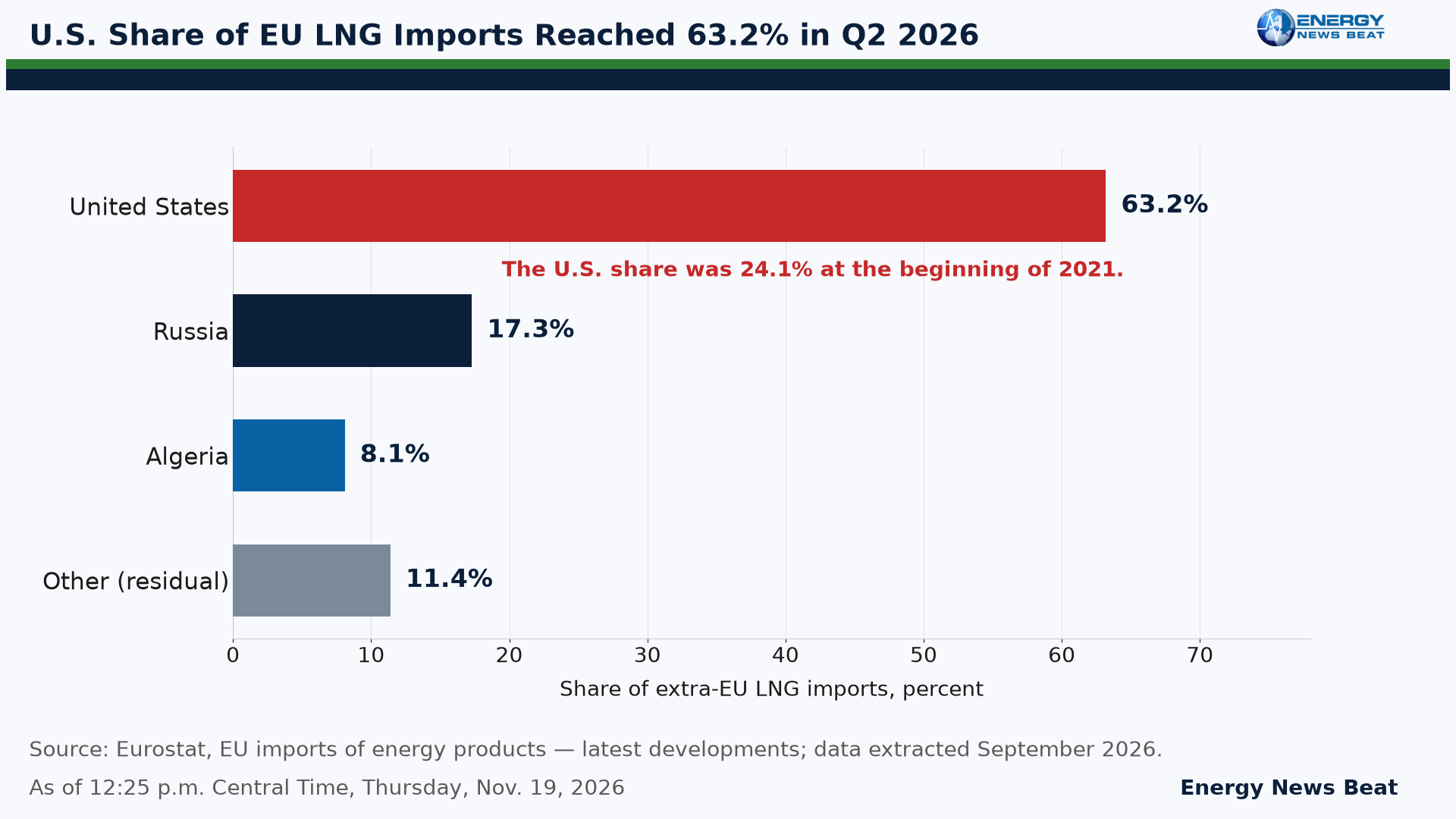
Eurostat, in its energy-import review with data extracted in September 2026, says the United States supplied 63.2 percent of the EU’s liquefied natural gas in the second quarter of 2026, ahead of Russia at 17.3 percent and Algeria at 8.1 percent. The U.S. share was 24.1 percent at the beginning of 2021. In a June 26 article on the first quarter, Eurostat had put the U.S. share at 57.4 percent. Those are extra-EU trade shares, not a forecast.
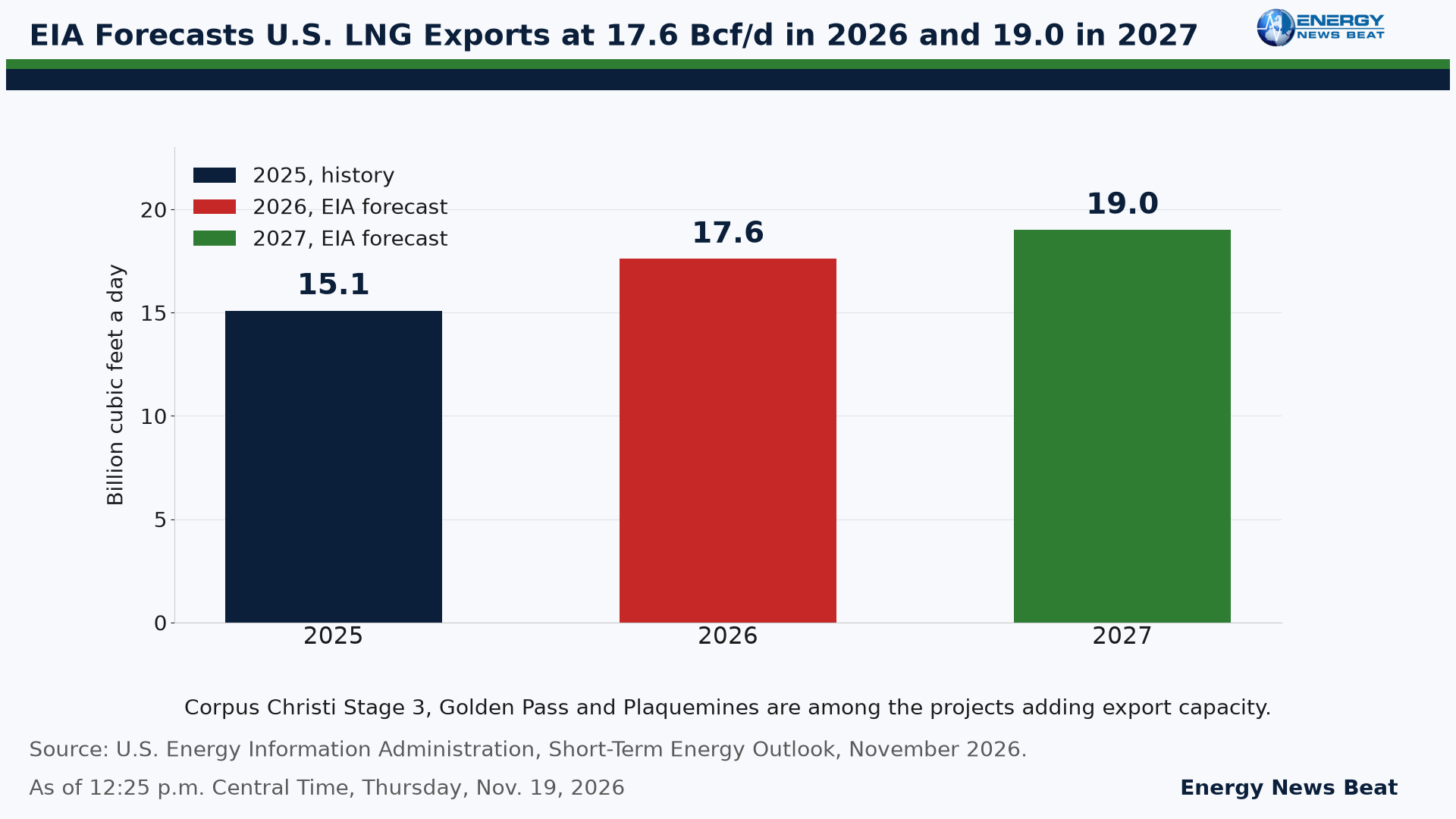
U.S. export capacity is still rising. EIA’s November 2026 Short-Term Energy Outlook forecasts U.S. LNG exports at 17.6 billion cubic feet a day in 2026 and 19.0 billion in 2027, up from 15.1 billion in 2025. The seventh and final train of Corpus Christi Stage 3, with 1.5 billion cubic feet a day of nominal capacity, reached substantial completion in late August, EIA said. Golden Pass, the ninth U.S. export terminal, shipped its first cargo from Train 1 on April 22, 2026. Plaquemines LNG, a Venture Global project, shipped its first cargo on Dec. 26, 2024; EIA put the two-phase plant at 2.6 billion cubic feet a day of nominal capacity and, in a Sept. 1 note, said it was exporting at full capacity. First-half 2026 U.S. LNG exports averaged 17.4 billion cubic feet a day, 23 percent higher than a year earlier.
The compliance problem the dates were written to address
The 2024 regulation’s importer hook is producer-level monitoring that is equivalent to the EU’s own rules. The 2024 regulation provides that, as of Jan. 1, 2027, importers were to demonstrate that contracts concluded or renewed on or after Aug. 4, 2024, cover only oil, gas or coal subject to those equivalent measures, with methane-intensity reporting due by Aug. 5, 2028, and a later demonstration against maximum intensity values. Thursday’s Council release moves the first two of those timetables by two years. It is silent on a new date for the intensity limits themselves.
That equivalence test is what Washington and industry have been fighting. In a June 24 open letter, Energy Secretary Chris Wright and the energy ministers of Qatar, Nigeria and Algeria told EU leaders that “the majority” of exporters “cannot meet the EUMR methane emissions measuring, reporting, and verification (MRV) requirements on the prescribed timeline,” and that, according to an industry analysis they cited, “nearly all of EU oil imports and a significant quantity of EU natural gas imports will be noncompliant … beginning in January 2027.” They wrote that “as of now there is no viable path to compliance with the regulation,” and asked for a stop-the-clock mechanism, grandfathering of new contracts, and the removal of penalties during a transition. Energy News Beat covered that letter the next day.
What Washington, industry and critics said
On Oct. 23, after Parliament’s three-year vote, the Energy Department said Kazakhstan and Guyana had joined Algeria, Nigeria, Qatar and the United States in the same request. Assistant Secretary for International Affairs Kaveh Farzad said, “The growing coalition on this initiative underscores the importance of a pragmatic approach that provides regulatory certainty and ensures reliable energy continues to reach our European allies.” A December 15, 2025, joint statement by the American Petroleum Institute, LNG Allies, Eurogas and other trade groups said the regulation “could make a number of natural gas and crude oil importers de facto non-compliant as of 2027 and expose them to penalties of up to 20% of previous year’s annual turnover,” and pointed to “the equivalency requirement from January 2027.” Article 33(2) of the regulation caps those administrative fines for companies at 20 percent of annual turnover in the preceding business year.
Environmental advocates called the extra time unnecessary. Léa Pilsner of Environmental Defense Fund Europe told EUobserver that, “Despite the delay, the integrity of the regulation is preserved in the final deal,” but that governments had “bought themselves two years the regulation never needed.” She also said 24 billion cubic metres of methane would leak during the extra two years, her figure. The agreement still has to clear formal votes. The rules are postponed, not cancelled.
Consumer and Investor Views
For households, the political case for the deal is price and supply, not a calculated bill cut. Minister O’Brien spoke of “shielding our citizens from high energy prices,” and Commissioner Jørgensen, in October, of shielding citizens from price volatility. Neither the Council nor the Commission published a euro or dollar estimate of what two more years will do to winter bills. That absence should be read as an absence, not as zero.
This is a framework, not buy-or-sell advice, and no analyst note on Thursday’s agreement is cited. Cheniere (NYSE: LNG), Venture Global (NYSE: VG), NextDecade (NASDAQ: NEXT), Sempra (NYSE: SRE) and Kinder Morgan (NYSE: KMI) are the listed U.S. names most directly tied to liquefaction, pipelines and export projects serving Europe. EQT (NYSE: EQT), Expand Energy (NASDAQ: EXE), Antero (NYSE: AR) and CNX (NYSE: CNX) are Appalachian or Lower 48 gas producers that can feed those trains. Devon Energy (NYSE: DVN), which absorbed Coterra Energy in a May 7 merger, also has Marcellus Shale assets. As of about 11:45 a.m. Central Time on Nov. 19, Yahoo’s last prints were LNG $294.06, VG $12.23, NEXT $5.99, SRE $76.73, KMI $31.43, EQT $49.90, EXE $83.02, AR $36.31 and CNX $35.58, and DVN was $41.97 as of about 12:21 p.m., versus Nov. 18 regular-session closes of $296.49, $12.04, $6.09, $77.52, $31.36, $50.69, $84.47, $36.64, $36.64 and $41.96. Those are prices, not proof the market had finished repricing the deal. The practical question is legal certainty on 2027–2028 cargoes, not a new subsidy. The obligation was postponed, not written off, and a Commission review, already due by Jan. 1, 2028, under Article 36(1), is directed to the MRV rules, verifiers and security of supply.
Timeline
Key dates, from the 2024 Methane Regulation through Thursday’s provisional agreement.
May 2024. The EU Methane Regulation, Regulation (EU) 2024/1787, is adopted. The Council says it has been in force since August 2024. The Commission’s October 2026 proposal recites an entry into force of Aug. 4, 2024.
Dec. 26, 2024. Plaquemines LNG, a Venture Global project and the eighth U.S. export terminal, ships its first cargo, EIA later reports. Nominal capacity for both phases is 2.6 billion cubic feet a day.
Dec. 15, 2025. Eurogas, the American Petroleum Institute, LNG Allies and other trade groups issue a joint statement warning that the equivalency requirement from January 2027 could leave importers de facto non-compliant and exposed to penalties they describe as up to 20 percent of the prior year’s turnover.
April 22, 2026. Golden Pass ships its first cargo from Train 1, becoming the ninth U.S. LNG export terminal, EIA says.
June 24, 2026. Energy Secretary Chris Wright and the energy ministers of Qatar, Nigeria and Algeria send an open letter asking for a stop-the-clock mechanism, grandfathering, and the removal of transitional penalties, writing that “as of now there is no viable path to compliance.”
June 26, 2026. Eurostat, in an article on first-quarter energy imports, puts the U.S. share of EU LNG at 57.4 percent.
Late August 2026. The seventh and final train of Corpus Christi Stage 3 reaches substantial completion, EIA’s November Short-Term Energy Outlook says.
September 2026. Eurostat extracts the data later used in its energy-import review: the U.S. share of EU LNG is 63.2 percent in the second quarter, up from 24.1 percent at the beginning of 2021.
Oct. 14, 2026. The Commission tables COM(2026) 569, proposing a one-year postponement of specified importer and intensity-reporting dates.
Oct. 22, 2026. The European Parliament adopts its negotiating position by 341 votes to 225, with 6 abstentions, backing a three-year delay.
Oct. 23, 2026. The U.S. Energy Department says Kazakhstan and Guyana have joined the supplier coalition calling for a delay.
Nov. 19, 2026, 12:53 a.m. Central Time. FT Energy posts that the EU is delaying methane emission rules on fossil-fuel imports.
Nov. 19, 2026. The Council and the European Parliament reach a provisional agreement on a two-year postponement of specified dates. Formal adoption and Official Journal publication are still required.
Caveats and criticism
Thursday’s text is a provisional interinstitutional agreement, not an adopted amendment in the Official Journal. The Council release is silent on a new date for the later methane-intensity limits in Article 29(2), and it does not say penalties have been waived. The Financial Times body was not available; the headline and standfirst are taken from the official FT Energy post. Léa Pilsner’s 24 billion cubic metres figure is her estimate. No sell-side note on the agreement is cited.
Stu’s Take
Call this what it is: a provisional two-year postponement of specified dates, not a repeal and not yet a law in the Official Journal. Importer methane checks would slip to Jan. 1, 2029, and intensity reporting to Aug. 5, 2030, if the Council and Parliament formally adopt the text. The United States already supplies most of the EU’s LNG, and American export capacity is still being built. The June letter Wright co-signed said there was “no viable path to compliance” on the old timetable; this deal buys time, which is what Washington and the industry asked for. It does not cancel the equivalence test, and the Council did not publish a new date for the later intensity limits or a waiver of penalties. No one published a household bill number. For investors, treat the extra years as a reduction in near-term contract risk, not as a verdict on any single stock.What is not talked about is the fact that the EU and UK are flaky enough that they could try to impose fees and controls in the future. This will not workout very well for them.
Sources
Titles are as published. Access date for all entries is Nov. 19, 2026, unless a publication date is the point of the citation. A source that was not available in full is listed as such and is not quoted as if the full text had been read.
- EU delays methane emission rules on fossil fuel imports, FT Energy (@ftenergy), X post 2123308763243221317, 06:53 UTC Nov. 19, 2026 (12:53 a.m. Central Time). The post’s card carries the Financial Times headline and this standfirst: “New rules will not be implemented for at least two years after sustained lobbying by the US, Qatar and the wider oil and gas sector.” Accessed Nov. 19, 2026.
- EU delays methane emission rules on fossil fuel imports, Financial Times, article linked from the FT Energy post (www.ft.com/content/e871493f-920c-4ece-94d4-9d14317047fe). The full body was not available; only the headline and standfirst displayed on the official post are used. Accessed Nov. 19, 2026.
- Methane regulation: EU agrees targeted amendment to safeguard security of supply, Council of the EU, press release, Nov. 19, 2026. Provisional agreement; formal adoption still required. Accessed Nov. 19, 2026.
- Co-legislators agree on a targeted amendment to Methane Regulation to ensure supply security amid energy crisis, European Commission, Energy news, Nov. 19, 2026. Accessed Nov. 19, 2026.
- Proposal for a Regulation of the European Parliament and of the Council amending Regulation (EU) 2024/1787 on the reduction of methane emissions in the energy sector as regards the postponement of certain obligations, European Commission, COM(2026) 569 final, 2026/0325 (COD), Brussels, Oct. 14, 2026. Accessed Nov. 19, 2026.
- Regulation (EU) 2024/1787, Official Journal, via the ELI address. The Official Journal page was not available in full for this report; original application dates are those recited in COM(2026) 569 and restated by the Council. Article 33(2) and Article 36(1) wording is taken from a published reproduction of the Official Journal text. Accessed Nov. 19, 2026.
- Commission proposes flexibility to methane importers to help save costs, European Commission press release IP/26/2119, Brussels, Oct. 14, 2026. Accessed Nov. 19, 2026.
- Methane rules: Parliament backs longer delay for energy importers and producers, European Parliament press release, Oct. 22, 2026, 12:36. Records the vote as 341 in favour, 225 against and 6 abstentions. Accessed Nov. 19, 2026.
- Methane deal to shield EU energy prices, EPP Group in the European Parliament, Nov. 19, 2026. Includes the quoted remarks of Dimitris Tsiodras MEP. Accessed Nov. 19, 2026.
- EU imports of energy products – latest developments, Eurostat Statistics Explained. “Data extracted in September 2026. Planned article update: December 2026.” Q2 2026 LNG partner shares. Accessed Nov. 19, 2026.
- Decrease in the value of gas imports in Q1 2026, Eurostat news article, June 26, 2026. U.S. share of EU LNG in Q1 2026: 57.4 percent. Accessed Nov. 19, 2026.
- Short-Term Energy Outlook, November 2026, U.S. Energy Information Administration, PDF archive. LNG-export forecast and Corpus Christi Stage 3 substantial-completion note. Landing page: https://www.eia.gov/outlooks/steo/. Accessed Nov. 19, 2026.
- The eighth U.S. liquefied natural gas export terminal, Plaquemines LNG, ships first cargo, EIA Today in Energy, first cargo Dec. 26, 2024; article dated Jan. 13, 2025. Nominal capacity 2.6 Bcf/d for both phases (3.2 Bcf/d peak). Accessed Nov. 19, 2026.
- The 9th U.S. liquefied natural gas export terminal, Golden Pass, ships first cargo, EIA Today in Energy, first cargo April 22, 2026; article dated April 23, 2026. Accessed Nov. 19, 2026.
- U.S. LNG exports rose 23% in the first half of 2026 because of higher capacity, EIA Today in Energy, Sept. 1, 2026. First-half exports averaged 17.4 Bcf/d. Accessed Nov. 19, 2026.
- U.S., Qatar, Nigeria, and Algeria Warn Proposed E.U. Methane Regulations Could Disrupt Europe’s Oil and Gas Supply, U.S. Department of Energy, June 24, 2026. Accessed Nov. 19, 2026.
- An Open Letter to Leaders of the European Commission, European Council, and European Union (EU) Member States on the EU Methane Regulation, U.S. Department of Energy document, signed June 24, 2026, by Energy Secretary Chris Wright and the energy ministers of Qatar, Nigeria and Algeria. Accessed Nov. 19, 2026.
- Kazakhstan and Guyana Join International Coalition Calling for Delay of EU Methane Regulation, U.S. Department of Energy, Oct. 23, 2026. Includes the quoted remarks of Assistant Secretary Kaveh Farzad. Accessed Nov. 19, 2026.
- Joint Statement: Calling for Reducing Methane Emissions while Ensuring EU Energy Security, Eurogas, with API, LNG Allies and other associations, Dec. 15, 2025. Accessed Nov. 19, 2026.
- EU gives oil and gas importers until 2029 on methane checks, rules out more delay, EUobserver, Nov. 19, 2026. Source for the attributed remarks of Léa Pilsner of Environmental Defense Fund Europe. Accessed Nov. 19, 2026.
- U.S., Qatar, Nigeria, and Algeria Warn Proposed E.U. Methane Regulations Could Disrupt Europe’s Oil and Gas Supply, Energy News Beat, Clark Savage, June 25, 2026. Accessed Nov. 19, 2026.
- Cheniere Energy, Inc. (LNG) Stock Historical Prices & Data – Yahoo Finance, Yahoo Finance. Last prints as of about 11:45 a.m. Central Time, Nov. 19, 2026, for LNG, VG, NEXT, SRE, KMI, EQT, EXE, AR and CNX, and a DVN print as of about 12:21 p.m. Central Time, Nov. 19, 2026, with regular-session closes for Nov. 18, 2026. These are market prints, not official exchange closes for Nov. 19. Accessed Nov. 19, 2026.
- Devon Energy and Coterra Energy Complete Merger, Devon Energy, May 7, 2026. “Coterra common stock will no longer be listed for trading on the NYSE.” The release describes a portfolio touching the Marcellus Shale. Accessed Nov. 19, 2026.
Key Excerpts
Council of the EU press release, Nov. 19, 2026. “Tonight, the Council of the European Union and the European Parliament reached a provisional agreement on targeted amendments to the EU methane regulation. This agreement secures a two-year postponement for the application of specific methane-related rules on the import of crude oil, natural gas and coal.”
Council of the EU, dates. “monitoring, reporting and verification obligations for natural gas, crude oil and coal importers will apply from 1 January 2029 (instead of 1 January 2027)”; “methane-intensity reporting for both importers and Union producers will apply from 5 August 2030 (instead of 5 August 2028).” The Commission “will review the effective implementation of the methane regulation by 1 January 2028.” “The provisional agreement will now have to be endorsed by the Council and the Parliament. The targeted amendment to the methane regulation will then be formally adopted by both institutions and enter into force before the end of the year.”
Darragh O’Brien, Ireland, Council presidency, Nov. 19, 2026. “Tonight, we achieved a pragmatic balance on the methane regulation, addressing the pressures in the energy market while maintaining the EU’s leadership in reducing methane emissions. This provisional agreement demonstrates the EU’s commitment to an effective approach to cutting harmful methane emissions while shielding our citizens from high energy prices.”
European Commission Energy news, Nov. 19, 2026. “Crucially, the interinstitutional agreement preserves the overall ambition, integrity and scope of the regulation, reaffirming the EU’s commitment to reduce methane emissions from the energy sector.” “Today’s provisional agreement now requires a formal adoption by both the European Parliament and the Council. Once this process is completed, the new legislation will be published in the Official Journal of the European Union and enter into force.”
Dan Jørgensen, Commissioner for Energy and Housing, Oct. 14, 2026, IP/26/2119. “Europe’s ambition in the fight against climate change remains unflinching. But as we approach a difficult winter in terms of energy prices, we need to be flexible and pragmatic in the implementation of our rules. The priority now is to shield European citizens from the price volatility we are facing, and avoid any potential additional risk to energy supplies at a time of global constraints.”
European Parliament press release, Oct. 22, 2026. “MEPs voted on Thursday to delay methane monitoring and reporting rules for oil, gas and coal importers by three years – two more than proposed by the Commission. Parliament adopted its position on the Commission’s proposal to postpone certain obligations under the EU Methane Regulation by 341 votes in favour, 225 against and 6 abstentions.”
Dimitris Tsiodras MEP, EPP Group, Nov. 19, 2026. “We are not suspending the Methane Regulation but ensuring its effective implementation and that all compliance requirements can be met in practice.”
COM(2026) 569 final, explanatory memorandum, Oct. 14, 2026. “Regulation (EU) 2024/1787 … entered into force on 4 August 2024. The scope of the Regulation covers crude oil, natural gas and coal.” The proposal recites the original importer monitoring date of 1 January 2027, methane-intensity reporting by 5 August 2028, and a later demonstration against maximum intensity values.
Eurostat, energy-import review, data extracted September 2026. “In Q2 2026, the United States (63.2%) was the largest supplier of liquefied natural gas (LNG) to the EU. It was followed by Russia (17.3%) and Algeria (8.1%).” “The United States, which accounted for 24.1% of EU LNG imports at the beginning of 2021, increased its share to 63.2% by Q2 2026.”
EIA, Short-Term Energy Outlook, November 2026. “We forecast LNG exports to average 17.6 billion cubic feet per day (Bcf/d) in 2026 and 19.0 Bcf/d in 2027, up from 15.1 Bcf/d in 2025, as new export capacity ramps up. The seventh and final train of the Corpus Christi Stage 3 export facility (1.5 Bcf/d nominal capacity) reached substantial completion in late August.”
Open letter signed by Energy Secretary Chris Wright and the energy ministers of Qatar, Nigeria and Algeria, June 24, 2026. “As a large and diverse importing region, the EU purchases oil and natural gas from a wide variety of exporters, the majority of which cannot meet the EUMR methane emissions measuring, reporting, and verification (MRV) requirements on the prescribed timeline. According to an independent, comprehensive industry analysis, nearly all of EU oil imports and a significant quantity of EU natural gas imports will be noncompliant with the EUMR beginning in January 2027.” “as of now there is no viable path to compliance with the regulation.”
Kaveh Farzad, Assistant Secretary for International Affairs, Oct. 23, 2026. “The growing coalition on this initiative underscores the importance of a pragmatic approach that provides regulatory certainty and ensures reliable energy continues to reach our European allies.”
Eurogas / API / LNG Allies joint statement, Dec. 15, 2025. The regulation “could make a number of natural gas and crude oil importers de facto non-compliant as of 2027 and expose them to penalties of up to 20% of previous year’s annual turnover.” The statement also cites “the equivalency requirement from January 2027.”
Léa Pilsner, Environmental Defense Fund Europe, as quoted by EUobserver, Nov. 19, 2026. “Despite the delay, the integrity of the regulation is preserved in the final deal,” adding that governments had “bought themselves two years the regulation never needed.” EUobserver also reports her statement that 24 billion cubic metres of methane will leak during the extra two-year delay. That figure is hers; it is not rebuilt here.
FT Energy X post standfirst, Nov. 19, 2026. “New rules will not be implemented for at least two years after sustained lobbying by the US, Qatar and the wider oil and gas sector.”
EUobserver, Nov. 19, 2026, on further delay. The article reported that “gone was the option, pushed by member states, to extend the delay again,” and that “any further delay would need a whole new methane law.” It also said “Parliament is due to vote on the deal next week.” The EPP Group statement said a plenary vote would come “in the coming weeks.”
