
David Turver, an Energy Analyst from the UK, stops by the Energy News Beat Podcast.
With the spotlight on the world stage around the price of oil, the world is bifurcating into two camps. Those going after Energy Security Starts at home, and the other camp is tripling down on Green Energy and Deindustrialization.
I do not know how the Iran conflict will turn out, but I feel that if the Venezuelan-style controls are put in place and the Iranians can set up a government, there is hope. That would cut out billions of dollars annually to the proxy fighters in the Middle East, funded by China’s insatiable demand for oil.
David’s Substack is a great resource for information on the UK grid system. In the article Levelised Cost of Energy Models are Junk, he really outlines how Fake LCOE model results are being used to poison the debate about the cost of renewables.
For our Substack subscribers fighting local wind or solar farms, this may help, as we all need to ask the right questions. The thing that struck me most in the article was how the numbers are made up and changed to fit the narrative. It is the same thing that has been done to the United States grid system, as we need to redefine the Levelized Cost of Energy to have wind, solar, and even hydrogen have storage tied to their projects. With recycling and end-of-life projects funded and bonded.
1. Levelized Cost of Energy (LCOE) Models & Their Flaws
- Use unrealistically low capital expenditure estimates
- Assume artificially high load factors (capacity utilization rates)
- Ignore grid integration, storage, and decommissioning costs
- Apply lower costs of capital to renewables than to fossil fuels
Real-world example: IRENA estimates onshore wind at £25/MWh, but actual 2024 UK auction prices were £72/MWh—nearly three times higher.
2. Renewable Energy Economics & Hidden Costs
- Decommissioning costs are not properly funded; companies reduce asset values rather than setting aside cash reserves
- Nameplate upgrades in the US use subsidy money to replace turbine components, artificially extending project lifespans
- Land reclamation liability for wind farms in the US totals ~$89 billion and isn’t factored into LCOE calculations
- Wind farms become uneconomical after ~15 years when subsidies end and maintenance costs rise
3. Grid Reliability & Intermittency Issues
- Gas plants must constantly “spin up and spin down” to compensate for wind/solar variability, causing extra wear and maintenance costs
- Grid balancing and curtailment payments (paying generators not to produce) are not included in renewable cost models
- Texas ERCOT has 85 GW peak demand but 180 GW nameplate capacity due to wind/solar overbuilding—requiring expensive grid infrastructure upgrades
- AI data centers demand dedicated, reliable power, which renewables cannot provide without nuclear backup
4. Energy Security & Geopolitical Implications
- UK/EU deindustrialization: Closing refineries, petrochemical plants, and steel mills due to high energy costs
- Dependency on imports: The UK now imports 50-60% of jet fuel and diesel; refineries in California dropped from 38 to 7, with 6 more slated to close
- China’s energy dominance: Building 150 GW of nuclear capacity by 2035 while increasing domestic drilling
- Living standards decline: UK GDP per capita has fallen below that of Louisiana (the poorest US state)
5. Government Policy Failures
- Renewable Obligations scheme: Provides indexed subsidies that exceed initial capital costs, making projects profitable only through subsidies
- Contract for Difference scheme: Early projects are nearly as expensive as older renewable obligations
- Carbon pricing: Artificially inflates gas costs through target-consistent pricing, making renewables appear cheaper than they are
- Political resistance to change: Energy Secretary Ed Miliband is criticized for ignoring evidence and pursuing ideological policies that harm the economy
6. Alternative Energy Solutions Being Ignored
- China & Japan: Restarting coal plants and building nuclear capacity
- Germany: Ironically flooding coal mines after closing nuclear plants
- US shale gas: Provides cheap, abundant energy that the UK refuses to develop
- Nuclear power: Presented as the only reliable, carbon-free solution that can support AI data centers and grid stability
7. Economic & Political Consequences
- Energy costs driving industrial collapse and job losses
- Reduced competitiveness in manufacturing, steel, fertilizers, and defense
- Growing political awareness of the problem, but only among opposition parties
- Risk of energy crisis as aging gas infrastructure cannot be economically replaced while still being essential for grid stability
The overarching theme that David has brought to light is that renewable energy policies, driven by flawed cost models and ideological commitment, are economically damaging and strategically dangerous without addressing grid reliability, storage, and the role of nuclear power.

On David’s Substack today, he released this cool article:
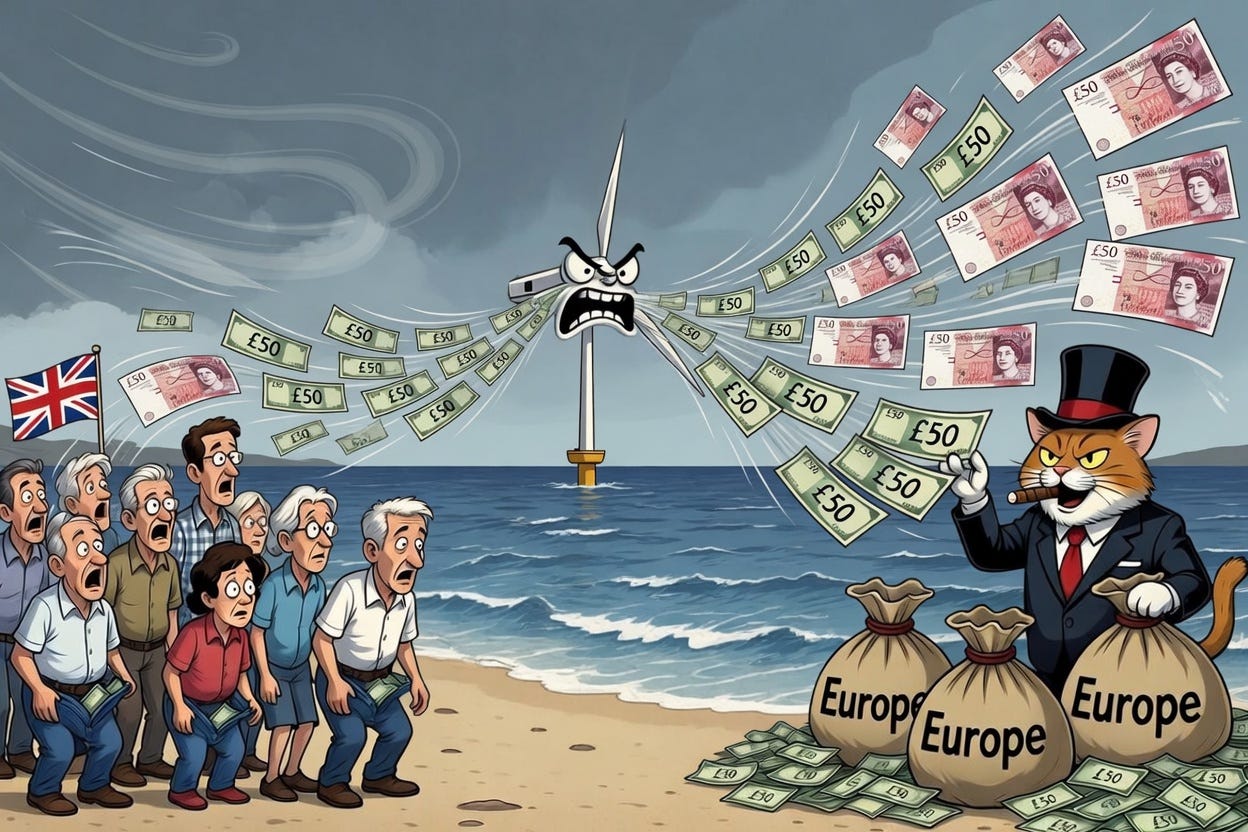
Offshore Wind Farms Being Overcompensated
Many offshore wind farms have received more in subsidies than the initial build cost, surely that is more than enough.
He really goes into how the newest mess in the UK is paying more in subsidies than the original offshore wind project cost to build. What a racket.
And just think, this is the model that the Blue States have been migrating to. So let’s all look at the Levelized Cost of Energy in a different light.
If we cannot have wind, solar, and hydrogen projects tied to storage, land reclamation, and recycling, and maintenance costs aligned, we should not allow them on the grid.
The “Math ain’t Mathing Up” is now a real thing.
In the UK, the decommissioning is about to hit a scandalous level of costs for consumers. And the US is right behind them. Note in the video below that David points out that if the subsidies run out, operating costs exceed revenue around year 15. So they claim to last 20 to 30 years, but they are unprofitable when the subsidies run out, and let’s look at the US. Subsidies and nameplate upgrades that previously covered maintenance are drying up fast.
The Department of Energy, in its own policies, prefers to use a 30-year life cycle for calculations, and we really need to have a deeper dive into the actual life cycles of wind and solar. Both wind and solar can get away with printing incorrect numbers, and neither is sustainable or good for the environment, given their current technology, which uses steel, carbon fiber, coal, oil, natural gas, and rare-earth minerals to build them.
With less than 5 percent of the wind or solar fleet being recycled, there is absolutely no way they are anything but toxic. Let’s change the technology and have discussions about upfront cost projects that include land reclamation and recycling, and inform consumers about the real impact of “Green Energy.”
We still have the Greatest Department of Energy, Interior, and EPA that we ever had working for the American People, and we need to help them get to the next level of great things for the United States.
Thanks again to all of our great subscribers, patrons, and Sponsors!

A shout-out to Steve Reese and the Reese Energy Consulting group for sponsoring the Podcast
https://reeseenergyconsulting.com/.

Data2 if you have any business systems, can you trust A? Well, they have the patent on validation. . https://data2.zoholandingpage.com/energy

And we have WellDatabase rolling in as a new sponsor.