ENB Pub note: This article first appeared on the Energy News Beat Substack, and we reached out to Peter Clack about appearing on the Energy Realities or Energy News Beat Podcast. If you want to leave a comment, subscribe to the Energy News Beat Substack.
The world is running out of easily accessible high-grade ores, and energy policy still pretends the calendar and geology are negotiable.
Peter Clack put the constraint in one sentence: average copper grades have fallen sharply since the early 1990s, so miners move vastly more rock for the same metal, while a new copper or lithium mine takes 12 to 17 years and political net-zero clocks run on five to ten. That mismatch is why the United States, the United Kingdom, and the European Union cannot afford two grids—one built for political scorekeeping, one left to carry factories, data centers, and winter peaks. I am reaching out to Peter to get him on the podcast, as I love his work on X. The link to the original article is in the Appendix.
For our great Substack subscribers who are fighting for consumer rights, opposing useless power lines, and trying to keep your local farms from being overrun, there are some great stats below.
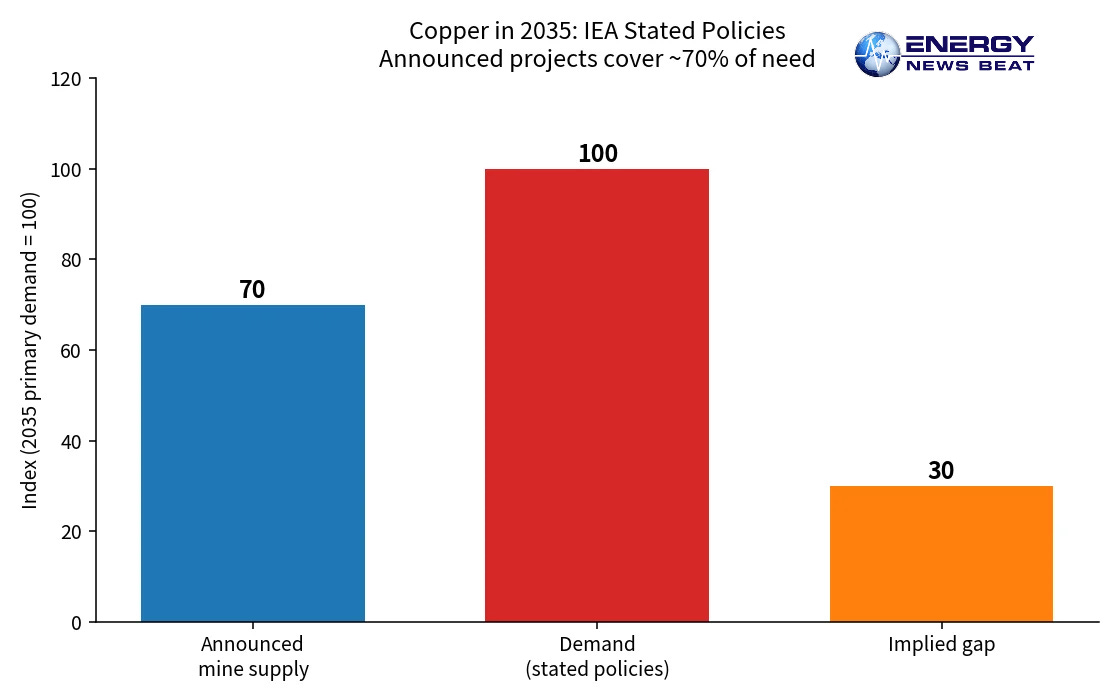
The International Energy Agency’s 2025 critical-minerals outlook says announced copper projects imply a roughly 30 percent supply shortfall by 2035 under today’s policies. Declining grades, fewer discoveries, higher capital costs, and long permits do the damage. Lithium looks supplied for a few years, then slips into deficit in the 2030s as investment follows the price down. Rare-earth processing, especially neodymium and dysprosium for permanent magnets, stays concentrated. Strip out the dominant supplier and, for several battery and magnet metals, the rest of the world covers only about half of remaining demand.
Copper smelting fees have already signaled that mine output is lagging processing capacity. AI campuses, EV mandates, and grid rebuilds are bidding for the same metal and the same water.
Grades Of Ore Tell The Story
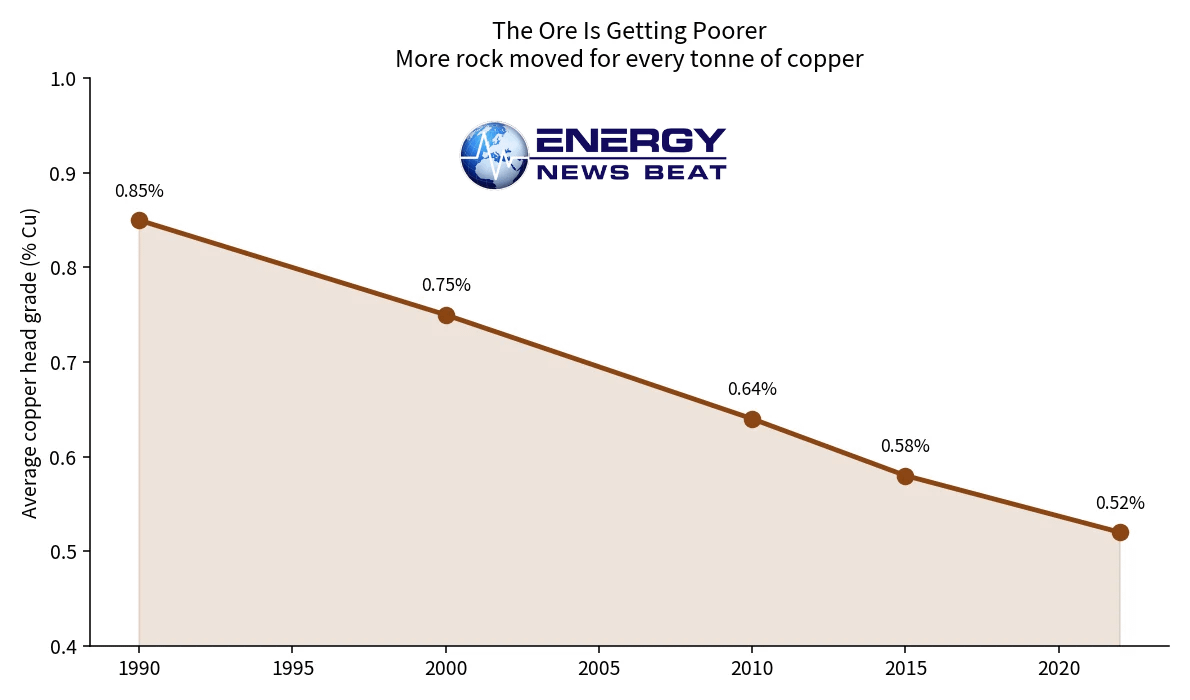
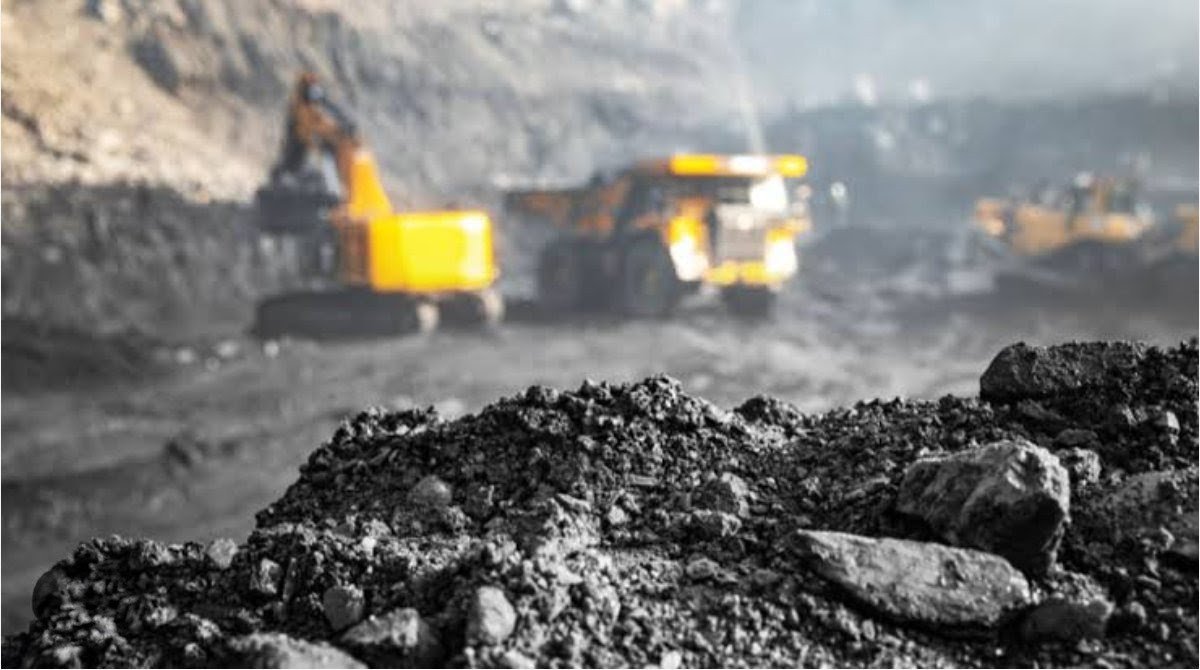
Grades tell the story in rock, not rhetoric. Industry series show copper head grades sliding from around 0.7 percent a decade and a half ago to roughly 0.5 percent. Clack’s longer view, a drop on the order of 40 percent since the early 1990s, matches the direction every miner already prices in: more tonnes moved, more energy in the mill, more water, more waste, for every tonne of cathode. Crushing and grinding already consume a non-trivial share of world energy.
A transition that multiplies copper demand per useful kilowatt-hour tightens that loop.
Copper in 2035 IEA
The second constraint is the machine that moves electricity. Energy News Beat’s grid-hardware review, drawing on IEA Electricity 2026 and U.S. Department of Energy transformer assessments, finds demand growing faster than the wires can carry it. Global electricity use is projected to grow above 3.5 percent a year through 2030, more than double the prior decade. U.S. growth of 2 to 3.2 percent through the mid-2030s is dominated by data centers. More than 2,500 gigawatts sit in interconnection queues. Annual grid investment must rise about half from today’s roughly $400 billion.
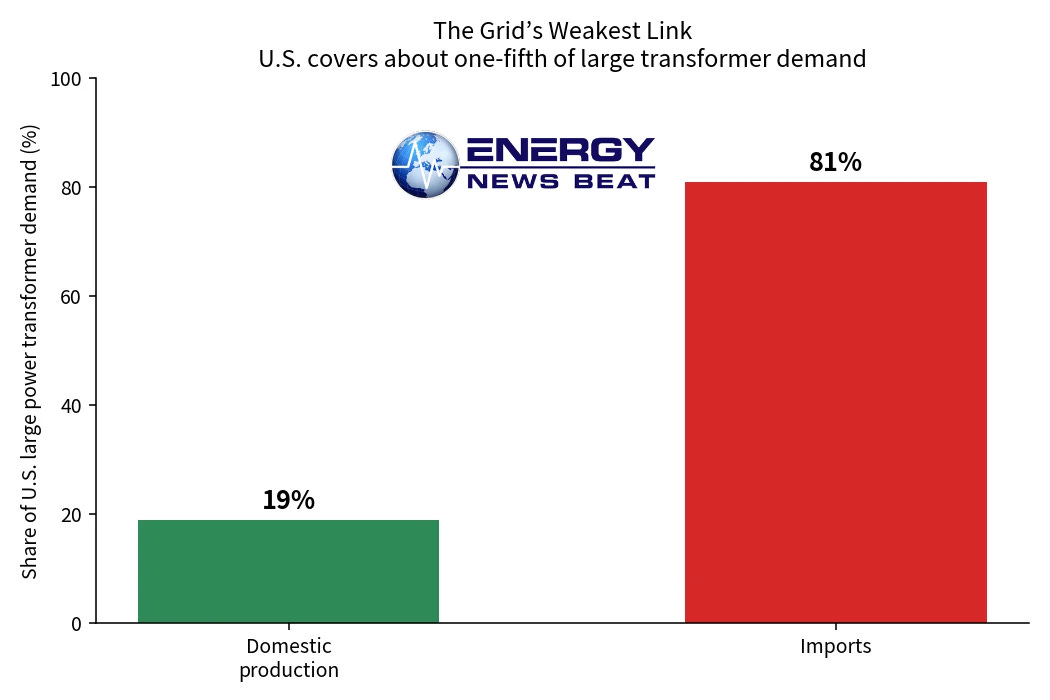
The United States makes only about a fifth of the large power transformers it needs. Seventy percent of the big units are over 25 years old; the average is near 40. Distribution transformers are mostly past their design life, and analysts say 60 to 80 percent may need replacement by 2050, with required capacity 160 to 260 percent above 2021. Lead times that were once months now run two to five years. Prices are up 77 to 95 percent or more since 2019. Grain-oriented electrical steel has one domestic producer.
Britain’s supergrid transformers and much of its switchgear date to the 1960s and 1970s. European high-voltage substations are 30 to 50 years old and fight the same global factory slots. A bad storm season plus a cyber hit does not produce a spare 300-ton transformer.
On yesterday’s podcast, Meredith Angwin ’s frame, aired on Energy News Beat, names the political error: two grids operating at once. Check yesterday’s post for her great video.
The physical grid obeys inertia, weather, and the need for 110 to 120 percent cover when a plant trips. The policy grid pays for certificates, portfolio standards, and net-zero optics, then acts surprised when solar drops in unison at sunset. Roughly $10.3 trillion spent worldwide on wind and solar could have bought about 170 new U.S. reactors. It bought a more fragile system and, in many blue states, bills about 38 percent higher than in states that kept firm capacity.
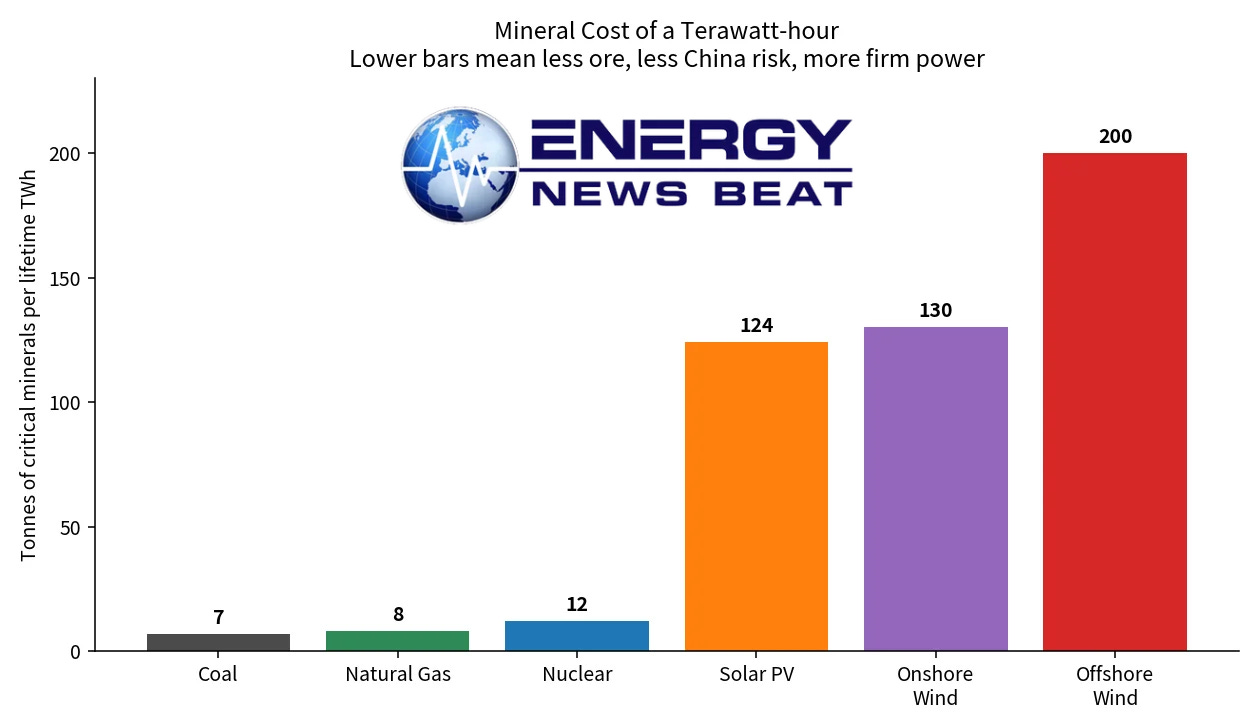
Mineral arithmetic says which projects deserve a spot in the queue. IEA and World Nuclear Association figures, adjusted for capacity factor and life, put critical-mineral use near 7 to 8 tonnes per lifetime terawatt-hour for coal and gas, about 12 for nuclear, and 124 to 200 for solar and wind. An offshore wind plant can require about 13 times the minerals of a similar gas plant. Nuclear’s list is mostly copper, chromium, and nickel, not magnet rare earths. Wind and many EV motors are the rare-earth sink.
Cost Follows the Physics
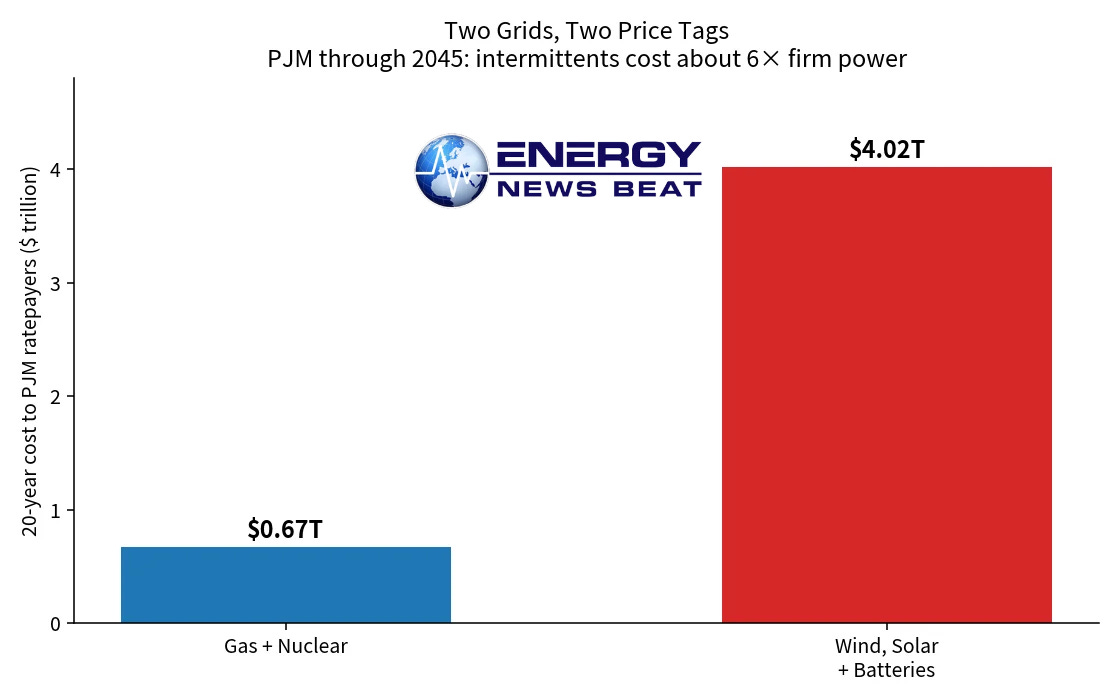
Cost follows the physics. A 2026 National Center for Energy Analytics study of PJM, using the operator’s own demand path through 2045, found a wind-solar-battery build costing ratepayers more than $4 trillion over 20 years—about six times a gas-and-nuclear path—and needing roughly ten times the nameplate capacity to ride through multi-day renewable droughts. Every grid-scale battery in the United States at the start of 2026 could cover about 15 minutes of average national demand. That is not a second grid. It is an expensive shadow of the first.
Two Grids, Two Price Tags
So the priority test for the Trump Administration, grid operators, manufacturers, and miners should be blunt: firm megawatt-hours per tonne of copper, nickel, and rare earths, and per dollar of full system cost, with the supply chain inside allied control inside a decade.
Restart sound nuclear units.
- License new large reactors and small modular designs against the Department of Energy’s path from about 100 gigawatts toward 400 by 2050.
- Build gas plants for the years reactors cannot yet fill; they are the lowest-mineral dispatchable option and the fastest.
- Treat transformers, electrical steel, and high-voltage gear as defense production, and standardize designs so a failed unit is replaceable.
- Let data centers connect when they bring firm power and hardware, not merely a queue position.
- Mine and refine copper, uranium, and processable rare earths on U.S. and allied ground—USGS counts 1,271 known domestic critical-mineral deposits, nearly a third never produced—and stop pretending a five-year mandate can outrun a 15-year mine. Recycling helps. It does not close a 30 percent copper gap.
Drop the second grid. Intermittent megawatts that demand duplicate capacity, extra transmission copper, and storage that does not yet exist should not outrank a factory or a reactor.
Geology has already voted. Policy can count the ballots, or it can keep funding a political grid until the high-grade ore and the transformers run out together.
As I have said on the Energy News Beat Podcast for years, “The Grid does not care about politics; it just demands the laws of physics and fiscal responsibility be obeyed.” Anything less than that will result in rolling blackouts.
This Week On ENB
Working on permitting reform and how it will hit your pocketbook, and lots of other key issues.
We have some great podcasts dropping, and tomorrow on the Energy Realities with David Blackmon’s Energy Additions and The Nemeth Report we have a great line discussion around the energy hypocrisy of Canada now wanting to build pipelines, the Gov of Massachusetts flops and is now asking for a Nat Gas pipeline approval in record time. It seems that governors are under pressure to deliver lower-cost energy, even if it means flopping on your anti-oil and gas stance.

Join us live at 9:00 Central on David Blackmon’s LinkedIn, Dr. Nemeth’s YouTube, and The Energy News Beat’s YouTube Channel. I will also try my X account, and if it allows a stable connection, we may start going live to X again.
Energy News Beat YouTube: https://youtube.com/live/yGIxjzdyGMQ

On Thursday the 8th, we have Doomberg and Charlie Garcia live at 9:00 Central on YouTube https://youtube.com/live/36mgu-wFkS8.
If the Energy Realities works, we will also be live on X
Thank you again to all of our great subscribers, paid patrons, and sponsors. We could not do this without you. We finished another banger month setting records, and we are so humbled. Thank you.
Making Appendices Great Again
Check out the World’s Greatest Podcast Show Notes at EnergyNewsBeat.co or EnergyNewsBeat.com.
Appendix: Sources

Energy News Beat two-grids discussion, https://energynewsbeat.com/conversations-in-energy-with-stu-turley/the-two-grids-why-policy-is-breaking-physics/;
Energy News Beat grid-demand piece, https://energynewsbeat.com/ai/global-demand-for-power-is-growing-faster-than-grids-can-support/;
IEA Global Critical Minerals Outlook 2025, https://www.iea.org/reports/global-critical-minerals-outlook-2025/executive-summary;
IEA mineral-intensity analysis, https://www.iea.org/reports/the-role-of-critical-minerals-in-clean-energy-transitions/mineral-requirements-for-clean-energy-transitions;
World Nuclear Association mineral requirements, https://world-nuclear.org/information-library/energy-and-the-environment/mineral-requirements-for-electricity-generation;
NCEA PJM study, https://energyanalytics.org/press-releases/new-study-a-wind-solar-battery-grid-would-cost-pjm-ratepayers-more-than-4-trillion-six-times-the-cost-of-natural-gas-and-nuclear; USGS deposit update, https://www.usgs.gov/news/national-news-release/usgs-updates-us-critical-mineral-deposits.
The grade chart illustrates the documented multi-decade decline, not a single official series.