California’s energy debate often rests on a convenient narrative: gasoline and diesel demand is falling, so aging refineries can—and should—simply close. A recent CalMatters commentary by Ranjit Deshmukh, an environmental studies associate professor at UC Santa Barbara, advances exactly this view. Titled in essence “Aging oil refineries don’t need more public dollars. California should let them retire,” the piece argues that the state’s remaining major refineries (now roughly half a dozen primary gasoline-producing facilities after recent exits) are outdated, polluting, and facing inevitable retirement driven by declining demand and electric-vehicle adoption. Deshmukh contends the state should facilitate more imports and storage, support workers and communities, hold refiners accountable for cleanup, and avoid intervening to keep the plants open or easing environmental rules.
Hat Tip to David Backmon for the LinkedIn Post. We recommend following him at his Substack, Daily Caller, and Forbes Articles.
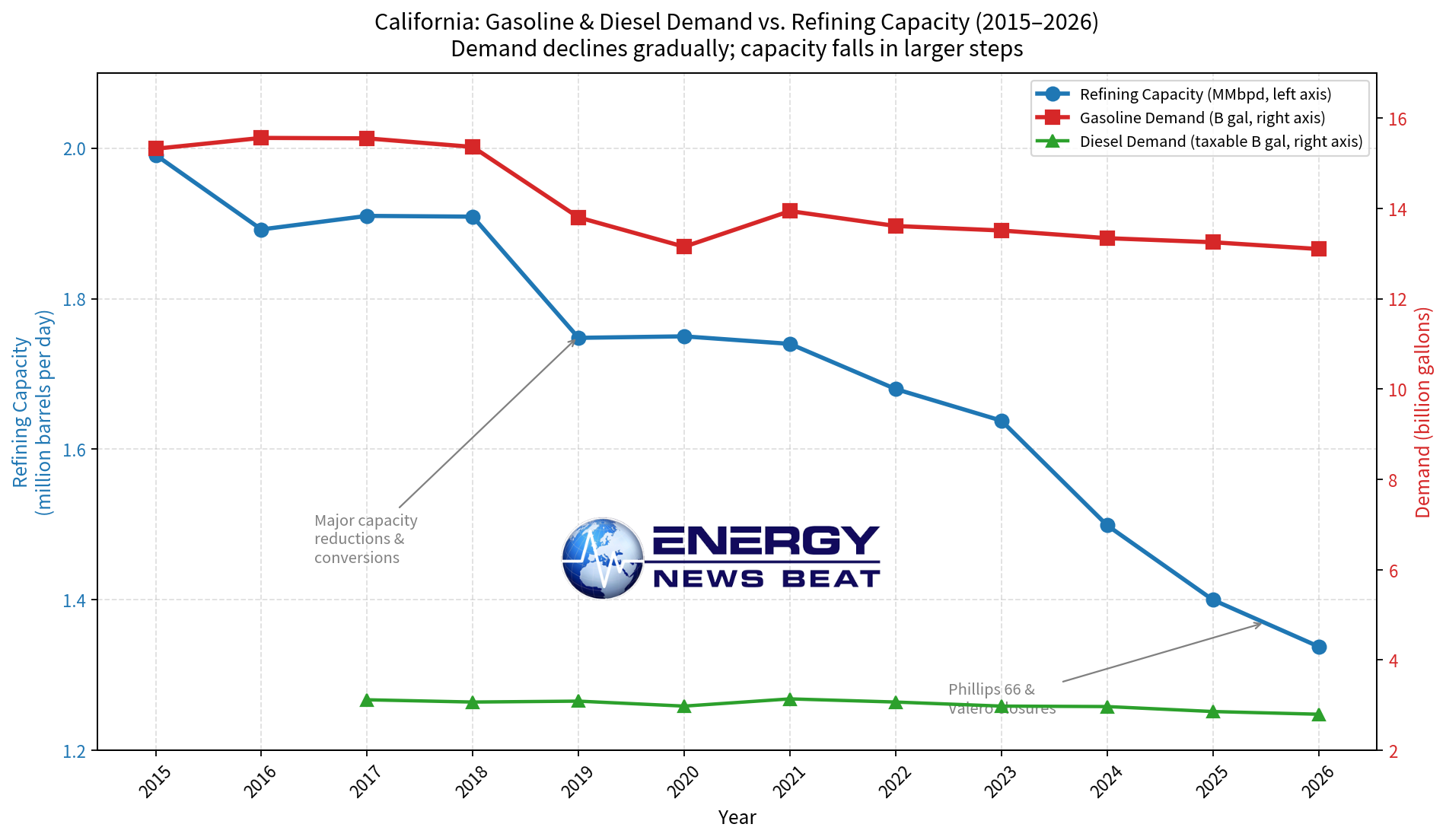
The data tell a more complicated story. Demand is declining modestly, but refining capacity has contracted faster and in large, discrete steps. That mismatch tightens local supply, raises costs for consumers, strains already constrained import infrastructure, and creates an environment hostile to investment. For everyday Californians and for investors, the consequences are not abstract.
Gradual Demand Decline Meets Stepwise Capacity Losses
California gasoline taxable distributions peaked near 15.5 billion gallons in the mid-2010s. By recent fiscal years, they have fallen to roughly 13.3–13.4 billion gallons—about a 14% drop from the peak, with continued soft post-COVID declines on the order of tens to around 100 million gallons per year in non-pandemic periods. Diesel taxable volumes have been flatter (around 3 billion gallons on-road, with total including off-road near 3.5 billion gallons in 2024) but also show mild recent softening. These trends reflect better vehicle efficiency, high prices, and rising zero-emission vehicle sales.
Refining capacity, however, has not declined smoothly in parallel. Earlier conversions (such as Marathon’s Martinez facility and Phillips 66’s Rodeo plant to renewables) were followed by the permanent cessation of petroleum operations at Phillips 66’s Los Angeles-area (Wilmington) refinery (approximately 139,000 barrels per day) in late 2025 and the idling of Valero’s Benicia refinery (approximately 145,000 bpd) by April 2026. Those two exits alone removed roughly 17% of the state’s then-existing refining capacity. Broader multi-year losses, including conversions, approach 30% in some assessments over about five years. As of early July 2026, California Energy Commission data, remaining crude oil refining capacity stands at approximately 1.34 million barrels per day across the listed facilities, with the larger CARB-gasoline and diesel producers including Marathon Los Angeles, the two Chevron plants (El Segundo and Richmond), the two PBF plants (Torrance and Martinez), a smaller Valero Wilmington facility, and a few others.
Demand has eased gradually; capacity has dropped in lumps. The result is a thinner supply cushion, reduced redundancy for maintenance or outages, and greater reliance on imports in a market that already operates as a “fuel island.”
Higher Prices for Consumers Are Not a Side Effect—They Are the Predictable Outcome
California already posts the nation’s highest retail gasoline prices, driven by unique CARB formulations, high state taxes and fees, Low Carbon Fuel Standard and cap-and-trade costs, and limited connectivity to other U.S. refining centers. When local capacity contracts faster than demand, the state must import more product by marine tanker. Imports can fill gaps, but they arrive at higher cost, with longer lead times (often weeks), and under tighter logistical constraints.
Import infrastructure is not infinitely elastic. California has no inbound refined-product pipelines from the rest of the United States; product moves primarily by ship through ports with fixed dock, handling, and storage limits. Analyses show rising import shares (from roughly 10% of gasoline in 2024 toward 20% or higher after the recent closures), record or near-record volumes in periods of tightness, and the need for dock upgrades and additional storage to sustain higher flows. Theoretical maximums exist on paper, yet practical constraints, local permitting hurdles, and the unique CARB specifications mean the system faces real limits and elevated costs when stressed. Claims that ports are simply “maxxed out” capture the near-term pressure; the deeper point is that scaling imports further requires time, capital, and political will that have not kept pace with capacity losses.
For consumers, this translates into higher and more volatile pump prices, greater exposure to global events, and costs that fall hardest on working households, trucking, agriculture, aviation, and emergency services. Deshmukh’s call to let the remaining plants retire without intervention understates these near-term burdens while emphasizing long-term clean-energy goals.
Investors See a Hostile Environment
Would investors willingly commit capital to California’s oil and gas sector under current policy signals? The evidence suggests caution. Successive layers of regulation, carbon pricing, unique fuel mandates, permitting delays, and explicit political pressure to accelerate the exit of petroleum refining raise costs and uncertainty. Refiners have cited precisely these factors in closure decisions. When capacity leaves, and the state leans harder on imports while still requiring CARB-spec fuel, the investment case for new or expanded conventional refining weakens further. Capital flows instead toward jurisdictions with clearer rules, lower policy risk, and growing demand. The result is a self-reinforcing cycle: less local investment, tighter supply, higher prices, and continued political pressure for faster transition—regardless of whether infrastructure and consumer alternatives are ready.
This dynamic harms consumers today while signaling to investors that California prioritizes rapid phase-out over reliable, affordable supply during the transition. Supporting affected workers and communities is necessary and just; pretending that modest demand declines fully offset stepwise capacity losses, or that marine import capacity can seamlessly absorb the difference without cost or risk, is not.
A Clearer View of Trade-offs
The CalMatters commentary correctly notes that many refineries are old, that demand is declining, and that a managed transition requires planning for imports, storage, worker support, and site remediation. It underweights the speed of capacity losses relative to demand, the physical and logistical limits on rapid import scaling, and the direct price consequences for Californians who still rely on liquid fuels for the large majority of transportation. Electric-vehicle adoption is real and growing, yet the vehicle fleet turns over slowly. In the interim, supply reliability and cost matter.
California’s experience illustrates a broader principle: energy transitions succeed when supply and demand move in rough balance, infrastructure is built ahead of need, and policy does not prematurely strand assets that households and businesses still depend upon. Treating modest demand declines as a license for accelerated capacity exits, while downplaying consumer costs and import constraints, risks higher prices, greater volatility, and reduced investment—outcomes that ultimately undermine both economic well-being and public support for the transition itself.
Appendix: Sources and Links
- California Energy Commission, California’s Oil Refineries (data current as of July 8, 2026): https://www.energy.ca.gov/data-reports/energy-almanac/californias-petroleum-market/californias-oil-refineries
- California Energy Commission, California Oil Refinery History: https://www.energy.ca.gov/data-reports/energy-almanac/californias-petroleum-market/californias-oil-refineries/california-oil
- California Department of Tax and Fee Administration (CDTFA) gasoline taxable distributions and diesel reports (via energy.ca.gov and cdtfa.ca.gov fuel tax statistics): https://www.energy.ca.gov/data-reports/energy-almanac/transportation-energy/california-gasoline-data-facts-and-statistics and https://cdtfa.ca.gov/taxes-and-fees/spftrpts.htm
- Ranjit Deshmukh, “Aging oil refineries don’t need more public dollars. California should let them retire,” CalMatters, July 24, 2026 (originally posted July 23): https://calmatters.org/commentary/2026/07/oil-gas-refineries-close-california/
- EIA, “Refinery closures present risk for higher gasoline prices on the West Coast,” July 9, 2025: https://www.eia.gov/todayinenergy/detail.php?id=65704
- Stillwater Associates analyses on California gasoline demand trends and diesel displacement.
- Giannini Foundation / UC analysis on California gasoline import capacity and maritime limits: https://giannini.ucop.edu/filer/file/1772210286/21581/
- California Assembly and CEC hearing materials on petroleum supply and import infrastructure (2026): e.g., https://autl.assembly.ca.gov/system/files/2026-05/2026.05.05-panel-1-cec-assembly-oversight-hearing.pdf
- Additional reporting on rising import reliance, port/storage constraints, and proposed Western Gateway Pipeline (Phillips 66 / Kinder Morgan): various 2025–2026 industry and news sources including OPIS, IER, and company announcements.
Data and assessments drawn from official state and federal sources (CEC, CDTFA, EIA) and contemporaneous analyses through July 2026.