
Global electricity demand is growing faster than the grids that have to carry it. The constraint is no longer just generation. It is the hardware that steps voltage up and down—large power transformers and the related substation gear—and the industrial base that used to build them.
The International Energy Agency’s Electricity 2026 report puts global power demand growth above 3.5 percent a year on average through the end of the decade, more than twice the pace of the prior ten years. Meeting that load, the IEA says, requires annual grid investment to rise about 50 percent by 2030 from roughly $400 billion today. More than 2,500 gigawatts of generation, storage, and large-load projects are already stuck in connection queues worldwide. Planning and building new transmission still takes 5 to 15 years. Data centers take 1 to 3.
That mismatch is now the binding constraint on what OilPrice and others have called the end of a long flat period in rich-country power demand.
Demand is no longer flat
In the United States, electricity use set a record and is still climbing after two decades of near-stagnation. The Energy Information Administration has data-center load as the dominant driver of long-term U.S. growth; OilPrice’s summary of the EIA outlook puts U.S. sales growth near 3.2 percent a year through 2035, with data centers about two-thirds of that. The IEA’s own U.S. figure is a bit lower—close to 2 percent a year through 2030, still more than double the prior decade—and attributes roughly half of advanced-economy demand growth to data centers. Either way, the direction is the same: load that shows up in one to three years, equipment that does not.
Asia-Pacific is expected to account for nearly three-quarters of global demand growth through 2035, led by industrialization and urbanization in China, India, and Southeast Asia. Europe’s rebound is smaller and policy-driven—electrification, heat pumps, and a push to cut gas exposure—landing on networks that were maintained, not expanded, for thirty years.
Gas turbines are a parallel bottleneck for new firm power. Transformers are the one that hits every pathway: gas, nuclear, wind, solar, and the data hall itself.
An old fleet, built one unit at a time
The age figures that circulate in the trade are real, and they are specific.
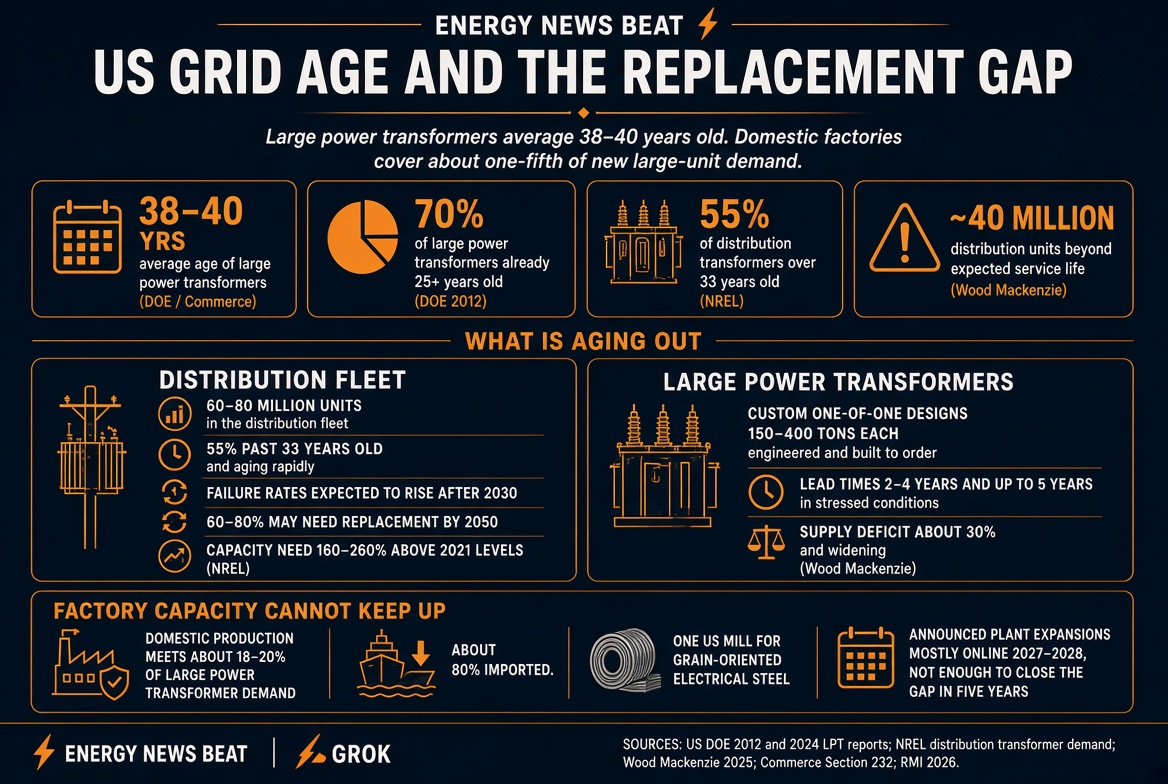
The Department of Energy’s 2012 Large Power Transformers and the U.S. Electric Grid report put the average age of installed large power transformers (generally 100 MVA and above) at about 40 years, with 70 percent already 25 or older. A later Commerce Department Section 232 review, cited by the National Infrastructure Advisory Council, put the in-service average near 38 years. Many of those units were designed around a 25- to 40-year technical life. They have been run past it.
Distribution is a different population. NREL estimates 60 to 80 million distribution transformers in service, with about 55 percent more than 33 years old and approaching end of life. Wood Mackenzie has put more than half of the distribution fleet—about 40 million units—beyond its expected service life. Failure rates are expected to rise sharply after 2030. By 2050, NREL estimates that 60 to 80 percent of in-service distribution units will need replacement, and required distribution-transformer capacity could be 160 to 260 percent above 2021 levels.
They are not interchangeable. DOE and industry counts put the number of distribution configurations above 80,000. Large power transformers are closer to one-of-one: about 1.3 units per design, matched to a specific impedance, voltage ratio, and substation footprint. A single large unit weighs 150 to 400 tons (some citations run higher), moves on specialized rail cars, and cannot be swapped from a warehouse shelf. When one fails, the replacement is engineered, not picked.
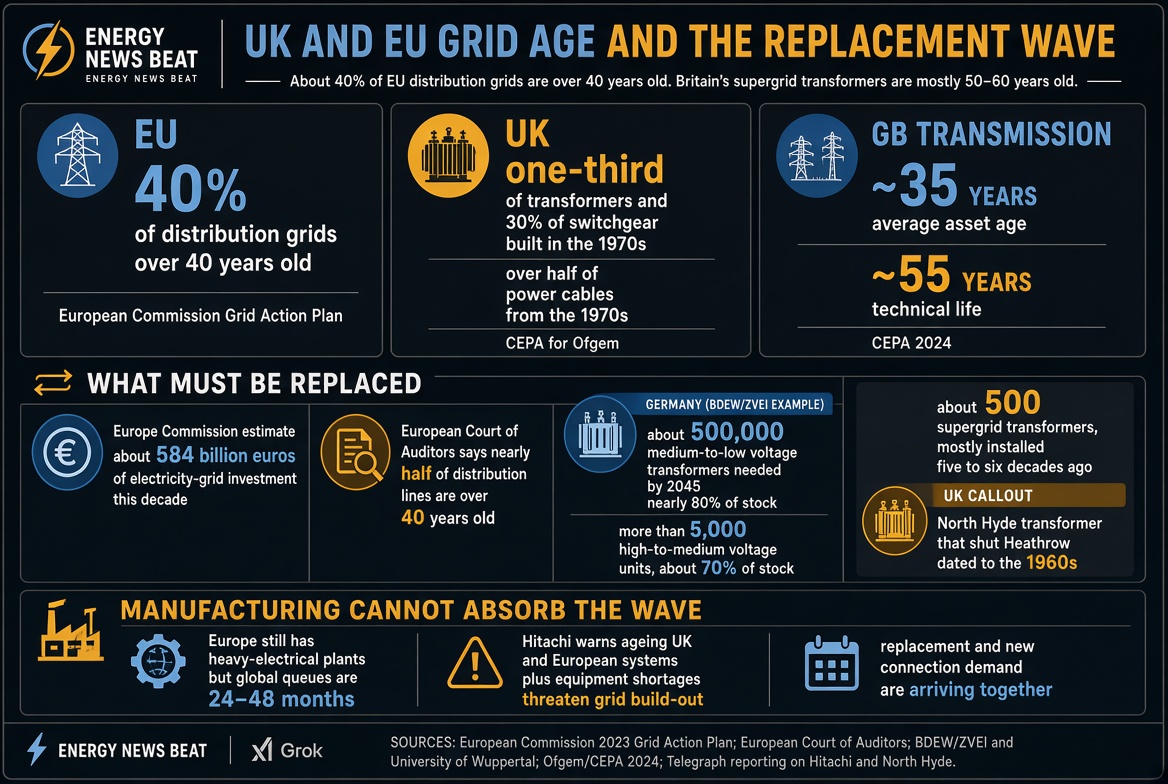
Britain is further along the same curve. Hitachi Energy’s U.K. managing director has described 30 to 40 years of “as-needed” growth and “very aging systems with aging equipment.” The roughly 500 supergrid transformers on the British high-voltage backbone were mostly installed five or six decades ago. The March 2025 North Hyde substation fire that shut Heathrow was traced to a transformer from the 1960s. An Ofgem-commissioned CEPA review found about a third of transformers and 30 percent of switchgear dating to the 1970s, and just over half of power cables from that era. Some control systems were built for a market that no longer exists.
Continental Europe’s high-voltage substations follow the same pattern: a large share of the fleet is 30 to 50 years old, replacement and renewable connection are arriving together, and factory slots are global.
The industrial base was allowed to shrink
This is the deindustrialization problem in physical form.
In 2019, the Commerce Department’s unit count showed 137 large power transformers produced in the United States and 617 imported—an import share of about 82 percent, so domestic production was near 18 percent. Capacity utilization was only about 40 percent, implying a theoretical domestic ceiling near 340 units a year if every line had been full. By the mid-2020s, domestic production was meeting roughly 20 percent of U.S. large-power-transformer demand, according to RMI’s 2026 supply-chain review, and about half of distribution-transformer demand. Some secondary accounts still round the large-unit import share to 80 percent or higher. The “only 10 percent” figure sometimes used in commentary is lower than the best unit data, which cluster around one-fifth for large power transformers. The practical point is unchanged: the United States does not make most of what it installs, and it makes none of the HVDC converter transformers.
Grain-oriented electrical steel, the core material, has a single domestic producer—Cleveland-Cliffs’ Butler Works. High-permeability grades are thinner still. Copper windings, bushings, and on-load tap changers are heavily imported. Building a new high-voltage transformer plant in the United States is estimated at $450–500 million per gigavolt-ampere, well above comparable Asian plants. Lead times that were four to six weeks for many distribution units, and 12 to 18 months for large ones, are now two to four years. Generator step-up units are quoting around 144 weeks. Some high-capacity orders are out to five years. Prices are up roughly 77 percent for power transformers and as much as 80 to 95 percent for distribution units since 2019. DOE has noted cases of four- to ninefold increases on certain transformers.
The United Kingdom’s manufacturing employment has fallen while the EU27’s has grown, and foreign-controlled firms account for a majority of U.K. manufacturing turnover. Europe still has heavy-electrical plants—Hitachi, Siemens Energy, GE Vernova in Stafford—but they are booked globally. The United States spent a generation treating flat load as a reason not to replace either the machines or the factories. Both are now due at once.
Wood Mackenzie’s 2025 balance sheet put the U.S. supply deficit near 30 percent for power transformers and about 10 percent for distribution units. Demand for generator step-up transformers rose 274 percent from 2019 to 2025; substation power transformers rose 116 percent. Manufacturers have announced on the order of $1.8 to $2 billion in North American expansions since 2023, including Hitachi Energy’s billion-dollar program (a large-transformer plant in Virginia aimed at 2028, a components plant in Tennessee) and Siemens Energy capacity targeted for 2027. Burns & McDonnell’s assessment is that those additions are unlikely to close the U.S. gap inside five years. Workforce is the slower constraint: design and build skills for large units are scarce, and training them takes longer than pouring a foundation.
What a bad week actually looks like
A critical storm or a coordinated attack does not fail the grid in the abstract. It fails a finite number of transformers that cannot be replaced on a utility timeline.
The 2013 Metcalf attack in California disabled 17 transformers with rifle fire. With the rest of the system still energized, restoration took 27 days. The August 2026 New York Times account of that attack notes the new arithmetic: average waits for a large power transformer have moved from under a year to about 128 weeks, with some quotes at five years. A multi-substation event now competes for the same factory slots as data centers and end-of-life replacements. Units of that size move by Schnabel rail car; North America has only a handful. Ports, if they are dark, do not unload 400-ton imports.
Moore County, North Carolina, in December 2022 lost power to about 45,000 people for nearly a week after a substation attack. That was a local outage with spares and crews available. A regional storm that takes out multiple 230 kV and 500 kV banks—or a physical campaign against several at once—runs into the customization problem. Sharing programs exist (STEP, SpareConnect, Grid Assurance, regional utility pools). They cover a fraction of designs. DOE’s 2024 Large Power Transformer Resilience Report to Congress documented those programs and stuck with an industry-led sparing model rather than a federal stockpile. Lead times of 36 months, and up to 60, were already the planning assumption.
Cyber risk sits beside the hardware risk, not instead of it. Volt Typhoon, the Chinese state-linked campaign disclosed in 2023, pre-positioned on U.S. electric, water, port, and telecom networks, including small municipal utilities. In July 2026, suspected Iranian-linked actors hit drinking- and wastewater systems in at least a dozen states, including more than 30 systems in Minnesota and a brief operational disruption and boil notice in Clayton County, Georgia. Water plants and port terminals are the loads that make a blackout into a public-health and logistics failure. Data-center cooling and hospital HVAC follow. A grid event and a water-system event in the same week are no longer separate scenarios.
What the Department of Energy has in place
DOE’s Office of Electricity is the lead civilian office on component supply. Its current program, funded at up to $375 million, targets distribution and power transformers, materials, and other grid components. The stated levers are refurbishment and reuse, U.S.-sourced substitute materials, standardization around fewer configurations, and next-generation gear such as solid-state transformers. The published outcome targets are modest: cut imports and lead times by up to 10 percent, and utility spending on essential equipment by as much as 25 percent.
In April 2026, the White House issued a Presidential Determination under Section 303 of the Defense Production Act finding that grid infrastructure—transformers, conductors, substations, breakers, power electronics, core steel, and the tools to make them—is essential to national defense, and that domestic capacity is “dangerously limited.” DPA authorities can include purchase commitments and production support. Execution still depends on appropriations beyond the $375 million already identified.
Older tools remain. The Infrastructure Investment and Jobs Act funded a small, now-expired rebate for efficient distribution-transformer replacement. DOE’s Transformer Resilience and Advanced Components work, including ARPA-E materials projects, targets cores that do not depend on constrained electrical steel. The 2024 resilience report catalogs spare-sharing and transport limits. None of these is a build program scaled to a 30 percent power-transformer deficit plus a 40-year-old fleet.
What still has to be done
The $375 million program and the announced OEM plants are a start. They are not a replacement plan, and they are not a growth plan.
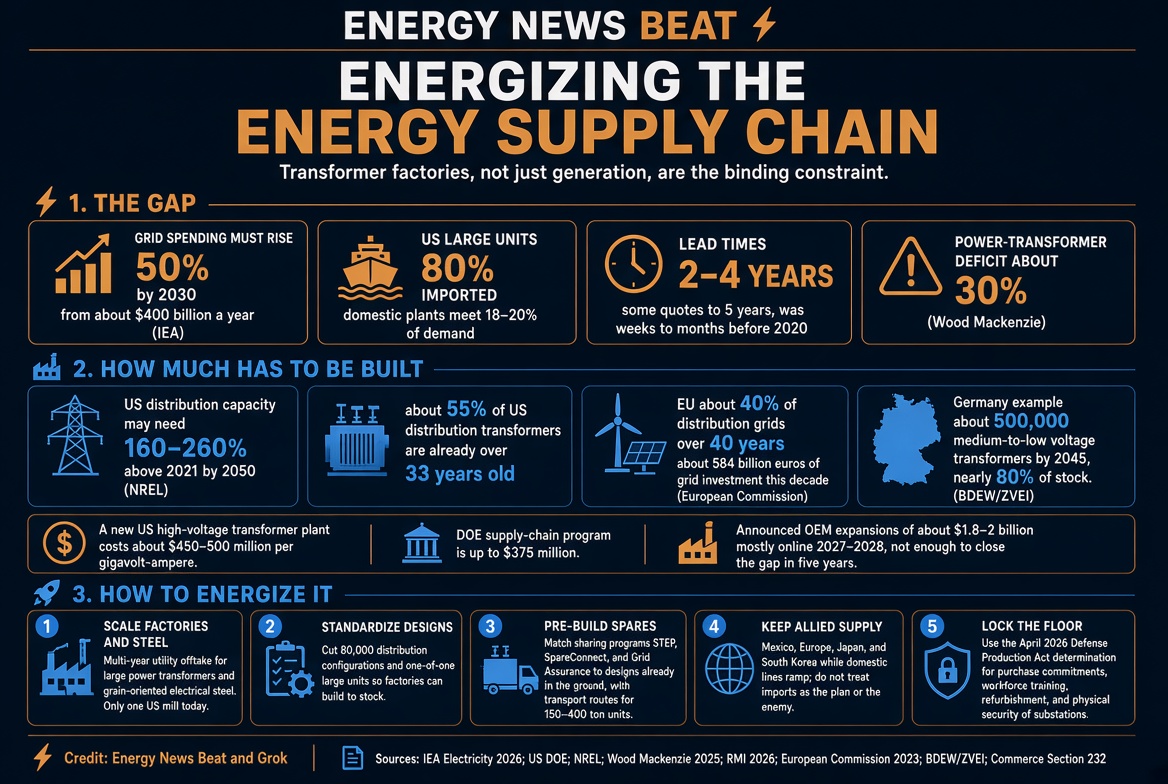
A credible rebuild has to do five things at once.
- First, domestic capacity for large power transformers and grain-oriented electrical steel has to be sized to replacement plus growth, not to a 10 percent trim in imports. A plant measured in hundreds of millions of dollars per GVA, with a workforce that takes years to qualify, will not appear because a grant exists. Multi-year offtake from utilities and federal power marketers is what makes the steel mill and the winding floor financeable.
- Second, specifications have to converge. Eighty thousand distribution configurations and near-bespoke large units are a factory killer. Fewer standard impedance and voltage designs, plus documented interchangeability for emergency spares, cut lead time faster than any single new building.
- Third, the spare fleet has to match the designs actually in the ground. Sharing programs are real. They are not sized for a regional storm and a data-center queue in the same year. Utilities that have not pre-engineered transport routes for 200-ton units will discover that the spare, if it exists, cannot reach the pad.
- Fourth, physical and cyber baselines have to cover the substations and the water and port systems that fail with them. Metcalf was thirteen years ago. The lead time is now worse, not better.
- Fifth, allied capacity in Mexico, Europe, Japan, and South Korea remains necessary while U.S. lines ramp. Treating imports as the enemy and treating them as the plan are both errors. The error that matters is having no domestic floor under the units that take four years and cannot be airlifted.
Improvements have happened, but we are not anywhere out of the woods.

Demand is not waiting on the factories. The IEA’s arithmetic is blunt: grid spending has to rise by half before 2030, or the connection queues—and the outage risk on an already old fleet—keep growing. The United States can still build these machines. It is not building enough today to replace what is wearing out and serve what is being added.
We have several podcasts with CEOs to cover this huge story. Stay Tuned to the Energy News Beat Channel.
Making Appendices Great Again
Check out the World’s Greatest Podcast Show Notes at EnergyNewsBeat.co or EnergyNewsBeat.com.
Appendix: Sources
- Tsvetana Paraskova, “Power Demand Is Surging Faster Than Grids Can Keep Up,” OilPrice, Oct. 1, 2026. https://oilprice.com/Energy/Energy-General/Power-Demand-Is-Surging-Faster-Than-Grids-Can-Keep-Up.html
- International Energy Agency, “Global electricity demand is set to grow strongly to 2030, underscoring need for investments in grids and flexibility,” Feb. 6, 2026. https://www.iea.org/news/global-electricity-demand-is-set-to-grow-strongly-to-2030-underscoring-need-for-investments-in-grids-and-flexibility
- IEA, Electricity 2026, Grids. https://www.iea.org/reports/electricity-2026/grids
- IEA, Electricity 2026, Demand. https://www.iea.org/reports/electricity-2026/demand
- U.S. Department of Energy, Office of Electricity, “Strengthening America’s Grid Supply Chain,” Aug. 4, 2026. https://www.energy.gov/oe/articles/strengthening-americas-grid-supply-chain
- Presidential Determination Pursuant to Section 303 of the Defense Production Act on Grid Infrastructure, Equipment, and Supply Chain Capacity, White House, April 20, 2026. https://www.whitehouse.gov/presidential-actions/2026/04/presidential-determination-pursuant-to-section-303-of-the-defense-production-act-of-1950-as-amended-on-grid-infrastructure-equipment-and-supply-chain-capacity/
- DOE, Large Power Transformer Resilience Report to Congress (signed July 10, 2024). https://www.energy.gov/sites/default/files/2024-10/EXEC-2022-001242%20-%20Large%20Power%20Transformer%20Resilience%20Report%20signed%20by%20Secretary%20Granholm%20on%207-10-24.pdf
- DOE, Large Power Transformers and the U.S. Electric Grid (2012; age statistics discussed in secondary review). Background: https://reliamag.com/guides/aging-transformer-fleet-statistics/
- RMI, “Solving the Gridlock: America’s Electric Supply Chain Opportunity,” May 2026. https://rmi.org/solving-the-gridlock-americas-electric-supply-chain-opportunity/
- Reuters, “US power transformer buyers scramble for imports, factory slots,” May 11, 2026. https://www.reuters.com/business/energy/us-power-transformer-buyers-scramble-imports-factory-slots–reeii-2026-05-11/
- Utility Dive, “Transformer supply bottleneck threatens power system stability as load grows,” Sept. 21, 2026. https://www.utilitydive.com/news/electric-transformer-shortage-nrel-niac/738947/
- POWER Magazine, “Transformers in 2026: Shortage, Scramble, or Self-Inflicted Crisis?,” Jan. 2, 2026. https://www.powermag.com/transformers-in-2026-shortage-scramble-or-self-inflicted-crisis/
- POWER Magazine, “Beating the Transformer Bottleneck,” June 1, 2026. https://www.powermag.com/partner-content/beating-the-transformer-bottleneck-remanufacturing-build-to-stock-and-smart-procurement/
- Congressional Research Service, “Electricity Distribution Transformers: Supply, Tariffs, and Policy Options” (R48933), April 22, 2026. https://www.congress.gov/crs-product/R48933
- National Laboratory of the Rockies / NREL distribution-transformer demand work (NREL/FS-6A40-92076 and related). Cited via Utility Dive and POWER above; lab summary context: https://www.nlr.gov/docs/fy26osti/98874.pdf
- Telegraph, “Electrical equipment shortage threatens net zero, Hitachi warns Miliband,” Jan. 4, 2026. https://www.telegraph.co.uk/business/2026/01/04/electrical-equipment-shortage-threatens-net-zero-hitachi/
- Kathryn Porter, “Britain’s electricity grid is dangerously outdated,” Telegraph, June 12, 2025. https://www.telegraph.co.uk/business/2025/06/12/britains-electricity-grid-is-dangerously-outdated/
- New York Times, “The Blackout That Could Devastate America,” Aug. 18, 2026 (Metcalf and current lead times). https://www.nytimes.com/2026/08/18/magazine/national-blackout-power-electricity-outage.html
- Breaking Defense, “Securing America’s grid through transformers and workforce resilience,” Nov. 25, 2025 (Moore County and related attacks). https://breakingdefense.com/2025/11/securing-americas-grid-through-transformers-and-workforce-resilience/
- Cybersecurity Dive, “What we know so far about the hacking campaign against US water systems,” Aug. 20, 2026. https://www.cybersecuritydive.com/news/what-we-know-so-far-about-the-hacking-campaign-against-us-water-systems/828374/
- WIRED, “What Happens if China Hacks the US Water Supply?” (Volt Typhoon context), July 8, 2026. https://www.wired.com/story/what-happens-if-china-hacks-the-us-water-supply-war-game-volt-typhoon/
- Commerce / BIS Section 232 and related import shares (82 percent LPT imports in 2019; single domestic GOES producer), as cited in DOE-linked and industry reviews including https://parallax.industries/articles/us-transformer-manufacturing-us-transformer-234