

EIA’s weekly diesel average is down 83.4 cents from its September record, while AAA sits at $5.765 today. U.S. refiners ran at 95.7% capacity in mid-November and pushed 2026 turnarounds into 2027, leaving tight inventories exposed if lower margins invite earlier maintenance.
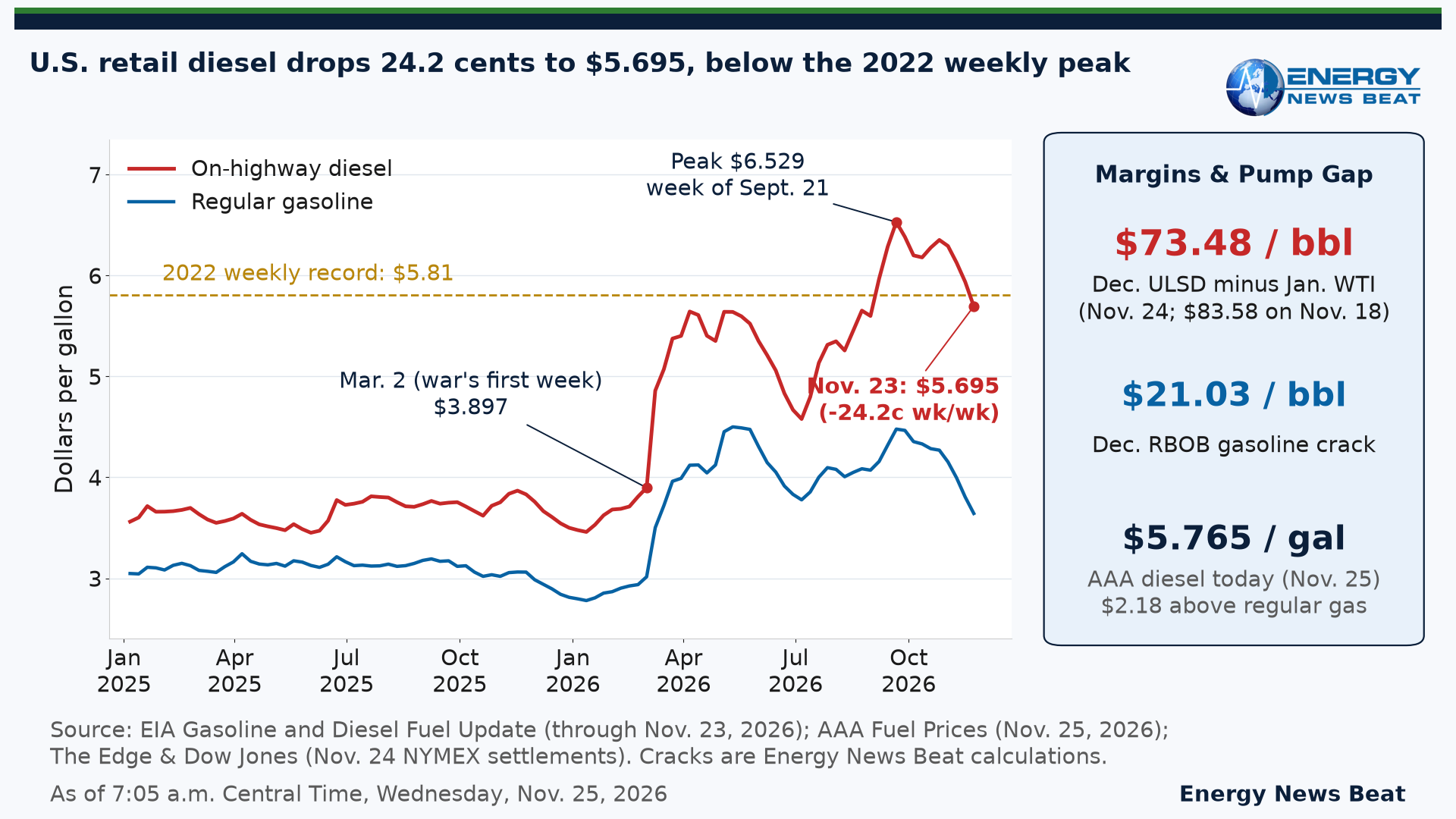
Truckers, farmers, and freight haulers heading into Thanksgiving are finally getting meaningful relief at the diesel pump. The Energy Information Administration reported Tuesday that the U.S. retail on-highway diesel average fell 24.2 cents to $5.695 a gallon for the week of Nov. 23, the largest single-week drop since the Iran war began and the fourth straight weekly decline.
Over those four weeks, the EIA surcharge benchmark has dropped 65.7 cents from $6.352 on Oct. 26, according to EIA’s historical diesel series and FreightWaves. It sits 83.4 cents below the all-time weekly record of $6.529 for the week of Sept. 21 (published Sept. 22), and is the first weekly reading under the June 2022 record of $5.81 since late August. Even so, diesel remains $1.798 a gallon above $3.897 on March 2, the last weekly price before the war’s impact, and $1.864 higher than a year ago.
The slide continues into the holiday travel window, when AAA projects nearly 73 million people will hit the road. AAA’s national average today, Nov. 25, puts diesel at $5.7645 a gallon ($5.765 rounded), down from $5.9594 a week ago and $6.5276 at its Sept. 22 peak, compared with $3.5866 for regular gasoline. As wholesale margins cool from autumn extremes, a key supply question emerges: could falling prices prompt refiners to start scheduling maintenance turnarounds they put off earlier this year?
What the pump and futures curve are showing
Pump relief varies sharply by region, though every major corridor fell in EIA’s Nov. 23 survey. Gulf Coast diesel dropped 25.3 cents to $5.294 a gallon, and the Midwest fell 29.6 cents to $5.671. On the East Coast, where highway diesel competes directly with home heating oil, averages eased 16.3 cents to $5.619, with New England at $6.064 and the Central Atlantic at $6.146. California remains the outlier at $7.436, even after a 29.7-cent weekly decline.
Retail averages lag wholesale and futures markets, which have reset more sharply this month. According to FreightWaves, CME ultra-low sulfur diesel (ULSD) settled at $4.4216 a gallon on Nov. 2 and $4.5306 on Nov. 3 after averaging $4.79 in October, then slid to a November low of $3.6975 on Monday, Nov. 23. On Tuesday, Nov. 24, front-month December ULSD edged up 0.55 cents to settle at $3.7030 a gallon, snapping a seven-session losing streak while remaining 29.63% below the front-month settlement record of $5.262 set Sept. 15.
Crack spreads are compressing alongside futures. Using Tuesday’s settlements in The Edge’s wrap ($3.7030 December ULSD and $82.05 January WTI), Energy News Beat’s front-month ULSD-minus-WTI gross crack stands at $73.48 a barrel, down from $83.58 on Nov. 18. On a separate measure compiled by Reuters columnist Ron Bousso, U.S. diesel margins are about $80 a barrel, down from a record $118 in September, according to OilPrice. FreightWaves notes the spread between Brent and second-month ULSD narrowed to 63.7 cents a gallon ($26.75 a barrel) on Monday from 77.3 cents at the start of November and 90 cents to $1.00 through August, while December-January ULSD backwardation fell to 5.29 cents a gallon, its lowest since July.
Flat-out runs, small builds, and deferred maintenance
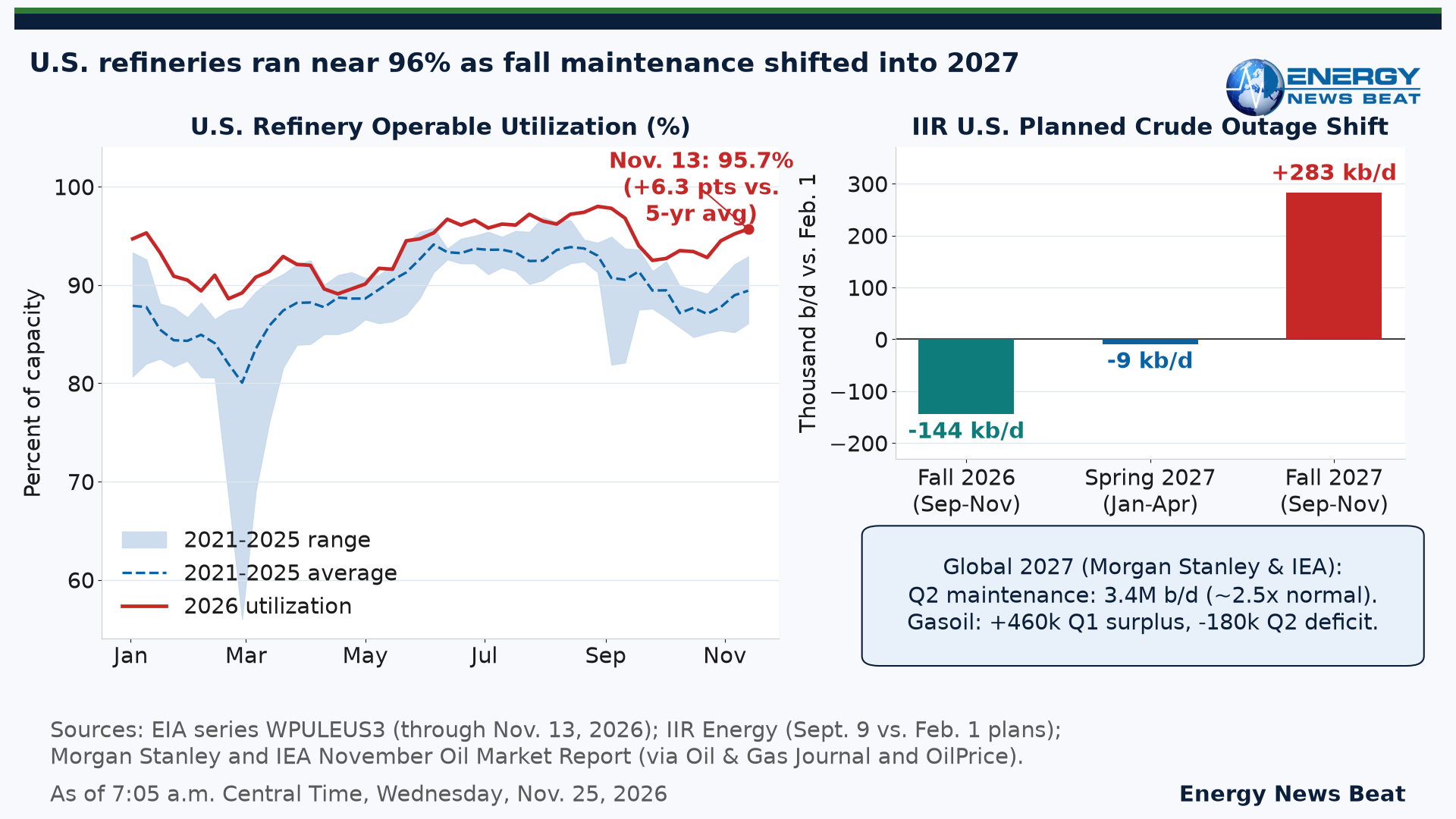
Those wider margins kept U.S. refineries running near physical limits through autumn. In the week ended Nov. 13, EIA’s Weekly Petroleum Status Report showed operable refinery utilization at 95.7%, 6.3 percentage points above the 2021 to 2025 mid-November average of 89.4% and the highest mid-November rate since 1998 (95.9%). Crude inputs averaged 16.918 million barrels a day. Distillate inventories ticked up 1.6 million barrels to 104.9 million barrels on Nov. 13, still 6.8% below the five-year average of 112.6 million. API estimated another 1.647-million-barrel distillate build for the week ended Nov. 20, ahead of EIA’s official release at 10:30 a.m. ET today.
Comparing Feb. 1 plans with Sept. 9 schedules, Industrial Info Resources (IIR Energy) found planned U.S. crude-unit outages for fall 2026 dropped by 144,000 b/d, while fall 2027 rose by 283,000 b/d on average. IIR also tracked planned work at 10 crude units at seven refineries moving from fall 2026 to fall 2027. As reported by Argus Media on Nov. 16, Valero COO Gary Simmons called Q4 a “light maintenance quarter” and said consultants estimate about 1.5 million b/d of global turnarounds have been delayed, pointing to a heavier 2027 season.
PBF and CITGO have confirmed deferrals into 2027, and Motiva has reportedly pushed its Port Arthur VPS-5 turnaround to fall 2027 (Bloomberg, via MNI). In its third-quarter release, PBF Energy moved planned fourth-quarter turnarounds at Chalmette (190,000 b/d) and Toledo (173,000 b/d) into 2027, with Hydrocarbon Processing reporting the company expects 2027 to be a heavier-than-normal turnaround year. According to Argus and ExecGraph’s 2027 calendar, CITGO deferred a coker turnaround at its 471,000 b/d Lake Charles refinery into 2027; Motiva has not published dates. Separately, Reuters has reported that ExxonMobil plans to shut the 120,000 b/d FCC unit at its Beaumont refinery on Nov. 30 until about Feb. 28, 2027; ExxonMobil has not confirmed the details.
Could falling prices accelerate turnarounds?
With diesel cracks narrowing, refiners face a lower opportunity cost for taking units offline. When U.S. diesel margins sat near $118 a barrel in September, on the Reuters measure compiled by Ron Bousso, every day in maintenance meant steep forgone profits. As cracks cool, delaying maintenance becomes less lucrative, making it possible that operators lock in winter or spring 2027 windows or pull forward lighter catalyst and hydrotreater jobs.
Two limits still argue against an immediate wave of unscheduled shutdowns. Major turnarounds require months of parts and labor staging, so a November price drop cannot conjure December outages overnight. Moreover, diesel remains far more profitable than gasoline: Tuesday’s $73.48-a-barrel ULSD crack is roughly 3.5 times the $21.03 December RBOB gasoline crack, and Argus puts November U.S. Gulf Coast 3:2:1 cracks at $43 to $45 a barrel, still about $22 above five-year seasonal norms.
Turnaround timing still matters for 2027 diesel prices. The IEA’s November Oil Market Report, covered by Oil & Gas Journal, projects a Q1 2027 global gasoil surplus of 460,000 b/d and a Q2 2027 deficit of 180,000 b/d, after cutting 2027 throughput estimates because refiners that skipped 2026 work must catch up. Morgan Stanley forecasts global planned maintenance peaking at 3.4 million b/d in Q2 2027, roughly 2.5 times a normal spring. EIA’s November Short-Term Energy Outlook expects 94% U.S. utilization and $5.03 average diesel in 2027, and warns that deferred 2026 maintenance poses downside risk to output. With roughly 2 million b/d of Middle East and Russian diesel exports still disrupted, OilPrice reports that analysts at Sparta Commodities still see a “strong bull case” for early 2027, saying they “still don’t believe that diesel builds are enough for Q1; a colder winter predicted only adds to this.”
Consumer and Investor Views
Not investment advice. For truckers, farmers, and regional haulers, EIA’s 24.2-cent weekly drop saves $24.20 on a 100-gallon fill compared with last week and $83.40 compared with the September peak. Fuel surcharges, which track the EIA weekly price, typically follow futures with a lag, though diesel remains about $1.80 above early-March levels and East Coast distillate stocks sit 26.7% below two years ago heading into winter heating season. This is an observed fuel-market summary, not a forecast of household bills or freight rates.
For energy and refining investors, distillate cracks remain wide even after September’s extremes. Marathon Petroleum ran 100% utilization in Q3 and plans 95% in Q4, while Phillips 66 guided to the mid-90s, with gasoline cracks near $21 a barrel. At the same time, PBF and CITGO have confirmed deferrals into 2027, and Motiva has reportedly pushed its Port Arthur VPS-5 turnaround to fall 2027 (Bloomberg, via MNI), creating uneven quarterly outage exposure next year if cracks compress further or inspection clocks run out. None of this is investment advice.
Timeline
Key milestones connecting pre-war diesel prices, the September spike, autumn maintenance deferrals, and this week’s pump drop.
March 2, 2026. EIA weekly retail diesel stands at $3.897/gal, the last weekly price before the war’s impact showed up (the war began Feb. 28).
Sept. 15-22, 2026. Front-month NYMEX ULSD hits a record settlement of $5.262/gal (Sept. 15); EIA weekly diesel peaks at $6.529 (Sept. 21) and AAA hits $6.5276 (Sept. 22).
Sept. 17, 2026. IIR Energy reports fall 2026 U.S. planned crude-unit outages fell 144,000 b/d vs. Feb. 1 plans while fall 2027 rose 283,000 b/d.
Oct. 21 & Oct. 29, 2026. Morgan Stanley flags a 3.4 million b/d global maintenance peak for Q2 2027; PBF Energy confirms moving Chalmette and Toledo turnarounds from Q4 2026 into 2027.
Oct. 30, 2026. U.S. distillate stocks fall to 99.3 million barrels, the lowest level since May 2003.
Nov. 10 & Nov. 13, 2026. EIA’s STEO flags deferred 2026 maintenance as a 2027 risk; IEA projects a 460,000 b/d Q1 2027 gasoil surplus flipping to a 180,000 b/d Q2 deficit.
Nov. 13-18, 2026. U.S. refinery utilization hits 95.7% (highest mid-November rate since 1998) as distillate stocks rebuild to 104.9 million barrels.
Nov. 23-25, 2026. EIA retail diesel falls 24.2 cents to $5.695; API estimates a 1.647 million-barrel distillate build; Dec. ULSD settles at $3.7030; AAA prints $5.7645 today.
Caveats
The idea that falling diesel prices will prompt refiners to schedule additional turnarounds is presented here as a possibility, not a certainty. PBF and CITGO have confirmed deferrals into 2027, and Motiva has reportedly pushed its Port Arthur VPS-5 turnaround to fall 2027 (Bloomberg, via MNI). Reuters has reported a Beaumont FCC overhaul from Nov. 30 to Feb. 28, 2027. Major turnarounds require months of advance planning and parts staging. Because diesel cracks remain roughly double pre-war levels, refiners still have reason to run units hard until planned 2027 windows open.
EIA’s weekly survey ($5.695) captures Monday pump prices; AAA ($5.7645) updates daily from a separate station panel. API’s 1.647-million-barrel distillate build for the week ended Nov. 20 is a preliminary estimate; EIA’s official report for that week is due at 10:30 a.m. ET today. EIA’s November STEO modeled inputs only through Nov. 5.
Finally, the $73.48/bbl ULSD crack and $21.03/bbl gasoline crack calculated from Tuesday’s settlements compare December 2026 product contracts against January 2027 WTI crude (because December WTI has expired) and represent gross refining margins before operating, energy, RIN compliance, and turnaround costs, not net refiner profit. This article is not investment advice.
Stu’s Take
EIA’s weekly diesel average dropped 24.2 cents to $5.695 a gallon on Nov. 23, its fourth straight weekly decline and largest drop since the Iran war began, while AAA’s national average stands at $5.7645 today. That is real relief for truckers and farmers, though diesel remains nearly $1.80 above March 2 levels. With U.S. refineries running at 95.7% utilization, PBF and CITGO have confirmed deferrals into 2027, and Motiva has reportedly pushed its Port Arthur VPS-5 turnaround to fall 2027 (Bloomberg, via MNI), narrowing crack spreads could reduce the penalty for taking units offline. Yet EIA, IEA, Morgan Stanley, and IIR data show that tight starting distillate stocks and heavy deferred 2027 maintenance mean supply risks have not disappeared.
Sources
Primary government releases, trade press, and refiner filings used in this article. No em-dashes are used in reader text. All URLs accessed Wednesday, Nov. 25, 2026, between 6:25 a.m. and 7:05 a.m. Central Time.
- U.S. Energy Information Administration (EIA), Gasoline and Diesel Fuel Update, released Nov. 24, 2026 (next release Dec. 1). Weekly U.S. on-highway diesel $5.695/gal and regular gasoline $3.642/gal for Nov. 23, plus PADD and state averages. https://www.eia.gov/petroleum/gasdiesel/
- EIA, Weekly U.S. No. 2 Diesel Retail Prices historical workbook (psw18vwall.xls, series EMD_EPD2D_PTE_NUS_DPG), confirming March 2 ($3.897), Sept. 21 ($6.529), Oct. 26 ($6.352), and Nov. 23 ($5.695). https://www.eia.gov/petroleum/gasdiesel/xls/psw18vwall.xls
- AAA Fuel Prices, national averages as of Nov. 25, 2026: diesel $5.7645/gal (week ago $5.9594, month ago $6.3474, year ago $3.7854, Sept. 22 record $6.5276); regular gasoline $3.5866/gal. https://gasprices.aaa.com/
- AAA Newsroom, “Gas Prices Keep Dropping as Thanksgiving Approaches,” Nov. 19, 2026, projecting nearly 73 million Thanksgiving road travelers. https://newsroom.aaa.com/2026/11/gas-prices-keep-dropping-as-thanksgiving-approaches/
- FreightWaves, John Kingston, “Diesel price declines picking up pace,” Nov. 24, 2026. Confirms the 24.2-cent drop, 65.7-cent four-week decline, CME ULSD November trajectory ($4.4216 Nov. 2, $4.5306 Nov. 3, $4.79 Oct. average, $3.6975 Nov. 23 low), Brent-second-month ULSD spread (63.7c/gal vs. 77.3c Nov. 2 and 90c-$1.00 Aug.), and Dec-Jan ULSD backwardation (5.29c/gal). https://www.freightwaves.com/news/diesel-price-declines-picking-up-pace
- Dow Jones Market Data (via Morningstar), “Front Month Nymex ULSD Rose 0.15% to Settle at $3.7030,” Nov. 24, 2026. Confirms Dec. ULSD settlement ($3.7030/gal), the front-month settlement record of $5.262/gal on Sept. 15 (then the October contract), and the 29.63% decline from that peak. https://www.morningstar.com/news/dow-jones/202611246666/front-month-nymex-ulsd-rose-015-to-settle-at-37030-data-talk
- The Edge, “Commodities Wrap 24 November,” updated 23:15 GMT Nov. 24, 2026 (Jan. 2027 WTI $82.05/bbl, Jan. 2027 Brent $91.40/bbl, Dec. 2026 RBOB $2.4543/gal, Dec. 2026 ULSD $3.7030/gal) and “Commodities Wrap 18 November” (Dec. 2026 ULSD $3.9723/gal, Dec. 2026 WTI $83.26/bbl). https://edgeconsultancykw.com/commodities-wrap-24-november-2026/
- The Edge, “Commodities Wrap 18 November: Natural Gas Settles 5.11% Higher, the Only Contract to Rise,” updated 22:12 GMT Nov. 18, 2026. Confirms Nov. 18 settlements behind the $83.58/bbl ULSD crack. https://edgeconsultancykw.com/commodities-wrap-18-november-2026/
- OilPrice.com, Julianne Geiger, “US Crude Oil Inventories Inches Up as Gasoline Holds Steady,” Nov. 24, 2026. Reports API weekly estimate for week ended Nov. 20: distillate build of 1.647 million barrels (after +400,000 prior week). https://oilprice.com/Latest-Energy-News/World-News/US-Crude-Oil-Inventories-Inches-Up-as-Gasoline-Holds-Steady.html
- EIA, Weekly Petroleum Status Report (week ended Nov. 13, 2026, released Nov. 18; next release scheduled Nov. 25) and series WDISTUS1 (distillate stocks: 104.901M bbl on Nov. 13; 99.259M bbl low on Oct. 30). East Coast (PADD 1) stocks of 24.419M bbl, down 7.8% yr/yr and 26.7% vs. two years earlier, are from EIA WPSR Table 6, week ending Nov. 13, 2026 (released Nov. 18). https://www.eia.gov/petroleum/supply/weekly/
- EIA, Weekly U.S. Ending Stocks of Distillate Fuel Oil (series WDISTUS1), historical table used to compute the 2021 to 2025 mid-November average (112.606 million barrels). https://www.eia.gov/dnav/pet/hist/LeafHandler.ashx?n=PET&s=WDISTUS1&f=W
- EIA, Weekly U.S. Percent Utilization of Refinery Operable Capacity (series WPULEUS3), confirming 95.7% in week ended Nov. 13, 2026 (highest mid-November rate since 1998’s 95.9%) vs. 89.42% five-year average. https://www.eia.gov/dnav/pet/hist/LeafHandler.ashx?n=PET&s=WPULEUS3&f=W
- EIA, Short-Term Energy Outlook (November 2026, released Nov. 10; inputs finalized Nov. 5), Petroleum Products chapter and Table 4b. Forecasts ~94% U.S. utilization and $5.03/gal retail diesel in 2027; cites deferred 2026 maintenance as downside refining risk. https://www.eia.gov/outlooks/steo/report/petro_prod.php
- International Energy Agency (IEA), Oil Market Report, November 2026 (published Nov. 13, 2026), and Oil & Gas Journal summary (Nov. 17, 2026). Projects Q1 2027 global gasoil/diesel surplus of 460,000 b/d, Q2 2027 deficit of 180,000 b/d, and relief unlikely before H2 2027. https://www.ogj.com/general-interest/economics-markets/news/55419515/iea-high-diesel-prices-ease-demand-supply-constraints-persist
- OilPrice.com, Tsvetana Paraskova, “The Diesel Crunch Isn’t Over Yet,” Nov. 24, 2026. Estimates ~2 million b/d lost Middle East and Russian diesel exports. Cites a separate Reuters (Ron Bousso) U.S. diesel-margin measure of about $80/bbl, down from a $118 Sept. record, which is not directly comparable with Energy News Beat’s $73.48 NYMEX calc. Also quotes Sparta Commodities: “a strong bull case” and “still don’t believe that diesel builds are enough for Q1; a colder winter predicted only adds to this.” https://oilprice.com/Energy/Energy-General/The-Diesel-Crunch-Isnt-Over-Yet.html
- OilPrice.com, Tsvetana Paraskova, “Morgan Stanley: Global Fuel Market Will Stay Tight Through Mid-2027,” Oct. 21, 2026. Reports Morgan Stanley’s forecast of 3.4 million b/d global planned maintenance peak in Q2 2027 (~2.5 times normal spring). https://oilprice.com/Latest-Energy-News/World-News/Morgan-Stanley-Global-Fuel-Market-Will-Stay-Tight-Through-Mid-2027.html
- Argus Media, Eunice Bridges and Craig Ross, “US refiners keep rates high, defer some work,” Nov. 16, 2026. Quotes Valero COO Gary Simmons (~1.5 million b/d global delays, light Q4), Marathon CCO Rick Hessling (100% Q3, 95% Q4 plan), and Phillips 66 EVP Brian Mandell (98% Q3, mid-90s Q4); puts USGC cracks at $43 to $45/bbl vs. >$69/bbl Sept. average. https://www.argusmedia.com/pages/NewsBody.aspx?id=2904988&menu=yes
- Industrial Info Resources (IIR Energy), “Some U.S. Refiners Deferring Maintenance from 2026 to 2027,” Sept. 17, 2026. Compares Sept. 9 vs. Feb. 1 planned U.S. crude-unit outages: fall 2026 -144,000 b/d, spring 2027 -9,000 b/d, fall 2027 +283,000 b/d on average. Separately, IIR tracked planned work at 10 crude units at 7 refineries moving from fall 2026 to fall 2027. https://www.industrialinfo.com/news/article/some-us-refiners-deferring-maintenance-from-2026-to-2027–362613
- PBF Energy Inc., Third Quarter 2026 Results (Oct. 29, 2026) and Hydrocarbon Processing coverage (Oct. 2026). Confirms deferring Q4 2026 turnarounds at Chalmette and Toledo into 2027 and budgeting advance material purchases in 2026 capex; expects heavier-than-normal 2027 turnaround year. https://investors.pbfenergy.com/news/news-details/2026/PBF-Energy-Announces-Third-Quarter-2026-Results-Declares-Dividend-of-0-325-per-Share/default.aspx
- ExecGraph, “2027 Gulf Coast Turnaround Calendar,” sources reviewed Nov. 6, 2026. Summarizes the confirmed CITGO Lake Charles coker deferral into 2027 and reports, via MNI citing Bloomberg, that Motiva deferred its Port Arthur VPS-5 turnaround to fall 2027 (not operator-confirmed). https://execgraphenergy.com/turnarounds/2027
- MNI Market News, “AMERICAS OIL: Motiva Port Arthur Delays Fall Work on Largest CDU By a Year,” May 22, 2026. Reports, citing Bloomberg and people familiar with operations, that Motiva delayed a planned turnaround including the 345k b/d VPS-5 crude unit at Port Arthur to fall 2027 from autumn 2026. Motiva has not published dates. https://www.mnimarkets.com/articles/motiva-port-arthur-delays-fall-work-on-largest-cdu-by-a-year-1779468325976
- Reuters, Erwin Seba, “Exxon to shut Beaumont, Texas refinery FCCU for work on November 30, sources say,” Nov. 2, 2026, via Longbridge. Sources said the 120,000 b/d FCCU at the 612,000 b/d Beaumont refinery is scheduled to begin shutting down on Nov. 30 and restart on Feb. 28, 2027. This is planned work, not a confirmed deferral of a 2026 turnaround; ExxonMobil has not confirmed the details. https://longbridge.com/en/news/304004150.md
Key Excerpts
FreightWaves, Nov. 24, 2026. “The Department of Energy/Energy Information Administration average retail diesel price declined 24.2 cents/gallon to $5.695/g, effective Monday but published Tuesday. That is the largest one-week decline since the Iran war began.”
EIA November 2026 Short-Term Energy Outlook, Petroleum Products. “Potential unplanned outages because of weather or other events, as well as the need to undertake maintenance that was deferred in 2026, present a source of uncertainty and downside risk to our refining forecast.”
PBF Energy Q3 2026 Release, Oct. 29, 2026. “Additionally, after further diligent review, we elected to move the planned fourth quarter turnarounds at both Chalmette and Toledo to 2027.” And: “included in our 2026 capital spending guidance is funding for advance purchases of materials for the 2026 turnarounds rescheduled in 2027.”
Argus Media, Nov. 16, 2026. “Valero plans to run its assets ‘hard’ in the fourth quarter, chief operating officer Gary Simmons says. It is ‘a light maintenance quarter’ for Valero, which has continued its regular turnaround schedule this year, he says.” And: “About 1.5mn b/d of refinery turnarounds globally have been delayed, Valero’s Simmons says, citing consultants.”
Morgan Stanley via OilPrice.com, Oct. 21, 2026. “Refinery maintenance ‘cannot be delayed indefinitely,’ the Wall Street bank’s strategists noted.”
Oil & Gas Journal on IEA November Oil Market Report, Nov. 17, 2026. “IEA now forecasts a global gasoil and diesel surplus of 460,000 b/d in first-quarter 2027, almost 200,000 b/d higher than in its October forecast. The projected second-quarter deficit has narrowed to 180,000 b/d, while the expected surplus in the second half of 2027 is broadly unchanged.”
Data Tables
Published figures and Energy News Beat arithmetic from primary EIA, AAA, NYMEX, IIR Energy, and IEA data. As-of dates are stated in each table.
Table A. U.S. retail diesel and regular gasoline snapshot (Nov. 23 to Nov. 25, 2026)
| Series / benchmark | Diesel ($/gal) | Regular gas ($/gal) | Notes |
| EIA weekly U.S. average (Nov. 23, 2026) | $5.695 | $3.642 | Diesel -24.2c wk/wk; -83.4c vs. Sept. 21 peak |
| EIA weekly U.S. (March 2, 2026) | $3.897 | $3.015 | Last weekly price before the war’s impact (war began Feb. 28); diesel still +$1.798 |
| EIA weekly U.S. peak (Sept. 21, 2026) | $6.529 | $4.500 (May 11) | Prior 2022 diesel record was $5.81 (June 20, 2022) |
| AAA national average (Nov. 25, 2026) | $5.7645 | $3.5866 | Diesel $2.1779 above regular gas |
| AAA week ago / month ago | $5.9594 / $6.3474 | $3.7502 / $4.2892 | AAA diesel record: $6.5276 (Sept. 22, 2026) |
| AAA year ago | $3.7854 | $3.0549 | Diesel +$1.9791 yr/yr |
Sources: EIA Gasoline and Diesel Fuel Update (Nov. 24 release, psw18vwall.xls & pswrgvwall.xls Data 3); AAA Fuel Prices (Nov. 25, 2026).
Table B. EIA regional on-highway diesel prices (Nov. 23, 2026)
| Region (PADD) | Nov. 23, 2026 ($/gal) | 1-week change | 1-year change |
| U.S. average | $5.695 | -$0.242 | +$1.864 |
| East Coast (PADD 1) | $5.619 | -$0.163 | +$1.757 |
| New England (PADD 1A) | $6.064 | -$0.161 | +$2.007 |
| Central Atlantic (PADD 1B) | $6.146 | -$0.163 | +$2.136 |
| Gulf Coast (PADD 3) | $5.294 | -$0.253 | +$1.835 |
| Midwest (PADD 2) | $5.671 | -$0.296 | +$1.821 |
| West Coast (PADD 5) / California | $6.709 / $7.436 | -$0.239 / -$0.297 | +$2.195 / +$2.453 |
Source: EIA Gasoline and Diesel Fuel Update, Nov. 24, 2026 release. Prices include all taxes.
Table C. Refining utilization, distillate stocks, and NYMEX cracks
| Metric | Latest reading | Prior / comparison | Source & date |
| U.S. refinery utilization | 95.7% | 89.42% (2021-2025 avg); 95.9% (1998) | EIA WPULEUS3 (Nov. 13, 2026) |
| U.S. crude inputs to refineries | 16.918M b/d | 17.047M b/d prior week | EIA WCRRIUS2 (Nov. 13, 2026) |
| EIA distillate fuel oil stocks | 104.901M bbl | -6.8% vs. 112.606M 5-yr avg | EIA WDISTUS1 (Nov. 13, 2026) |
| API weekly distillate stock change | +1.647M bbl | +0.400M bbl prior week | API via OilPrice (week ended Nov. 20) |
| Dec. ULSD minus Jan. WTI gross crack | $73.48 / bbl | $83.58 (Nov. 18) | ENB calc. from The Edge / Dow Jones (Nov. 24) |
| Dec. RBOB minus Jan. WTI gross crack | $21.03 / bbl | $20.98 (Nov. 18) | ENB calc. from The Edge (Nov. 24) |
| Reuters diesel margin (Ron Bousso) | ~$80 / bbl now | $118 Sept. record | OilPrice citing Reuters (Nov. 24); separate from ENB calc |
| USGC 3:2:1 crack spreads (Nov.) | $43 to $45 / bbl | >$69/bbl Sept. avg; +$22 vs. 5-yr avg | Argus Media (Nov. 16, 2026) |
Note: Nov. 24 crack calculations pair Dec. 2026 ULSD ($3.7030/gal) and RBOB ($2.4543/gal) against Jan. 2027 WTI ($82.05/bbl) after Dec. WTI expiry. Nov. 18 figures use then-front-month Dec. WTI. The Reuters (Ron Bousso) $80 / $118 figures are a separate measure and are not directly comparable with the ENB NYMEX calc. Not investment advice.
Table D. Turnaround shifts, planned work, and 2027 maintenance and supply outlooks
| Source / operator | Facility or scope | Documented status or forecast |
| PBF Energy (Q3 release) | Chalmette (190k b/d) & Toledo (173k b/d) | Q4 2026 turnarounds moved to 2027; expects heavier-than-normal 2027 year |
| CITGO (via Argus / ExecGraph) | Lake Charles (471k b/d refinery): coker turnaround | Coker turnaround and depentanizer project delayed into 2027; quarter undisclosed |
| Motiva (Bloomberg, via MNI) | Port Arthur VPS-5 crude unit | Reportedly pushed to fall 2027; not operator-confirmed; exact dates undisclosed |
| ExxonMobil (Reuters, Nov. 2) | Beaumont 120k b/d FCCU | Reuters has reported a shutdown Nov. 30 to Feb. 28, 2027; planned work, not a confirmed deferral; unconfirmed by ExxonMobil |
| IIR Energy (Sept. 17, 2026) | U.S. planned crude-unit outages | Fall 2026 -144k b/d, Spring 2027 -9k b/d, Fall 2027 +283k b/d (vs. Feb. 1 plans) |
| Morgan Stanley (Oct. 21, 2026) | Global planned refinery maintenance | Peaks at 3.4M b/d in Q2 2027 (~2.5x normal spring) |
| IEA Nov. OMR (via OGJ) | Global gasoil/diesel balance | Q1 2027 +460k b/d surplus, Q2 2027 -180k b/d deficit; relief unlikely before H2 2027 |
| EIA Nov. STEO (Nov. 10, 2026) | U.S. utilization & retail diesel | 2027 utilization ~94%, crude inputs 16.5M b/d, diesel $5.03/gal; deferred work is downside risk |
Sources as cited in Sources list. Not investment advice.
Background
A refinery turnaround is a scheduled multi-week shutdown of major processing units (such as crude distillation units, fluid catalytic crackers, cokers, or hydrotreaters) for legally mandated inspections, catalyst replacement, and heavy repairs. Because major turnarounds require months of parts procurement and specialized contractor crews, operators adjust timing based on both mechanical inspection limits and refining margins. A crack spread measures the gross margin between crude oil input and refined fuel output (42 gallons per barrel of product minus crude cost), before operating, energy, compliance, and turnaround expenses.