
Houston-based energy technology leader Baker Hughes (NYSE: BKR) delivered a strong start to 2026, posting first-quarter revenue of $6.59 billion — beating Wall Street estimates by approximately $260 million — driven by a record surge in Industrial & Energy Technology (IET) orders fueled by liquefied natural gas (LNG), power generation, and energy infrastructure demand.
The company reported adjusted diluted EPS of $0.58 (beating consensus by $0.09) and adjusted EBITDA of $1.16 billion, up 12% year-over-year, despite headwinds from Middle East disruptions that weighed on its Oilfield Services & Equipment (OFSE) segment. Attributable net income reached $930 million, while total orders climbed 26% year-over-year to $8.16 billion, with IET alone posting a record $4.89 billion in bookings — its third consecutive quarter above $4 billion — and a 1.5x book-to-bill ratio.
IET Powers Growth Amid OFSE Softness
IET revenue rose 14% year-over-year to $3.35 billion, with standout gains in gas technology services (+34% YoY) and strong execution across power systems, LNG equipment, gas infrastructure, and carbon capture & storage (CCS). EBITDA in the segment jumped 35% to $678 million, expanding margins to 20.2%. Key highlights included major LNG awards from QatarEnergy for the North Field West project (equipment for two mega-trains totaling 16 MTPA capacity, including Frame 9 turbines and compressors) and an agreement with ST LNG for an 8.4 MTPA export terminal offshore Texas. Additional momentum came from a significant QatarEnergy CCS compression contract and over $1.4 billion in power systems orders tied to data centers and grid stability.
In contrast, OFSE revenue declined 7% year-over-year to $3.24 billion, reflecting Middle East disruptions and the impact of portfolio transactions. The segment still showed resilience in subsea and surface pressure systems, but overall activity was pressured regionally — a trend echoed by peers SLB and Halliburton.
Record Backlog and Portfolio Optimization
Baker Hughes exited the quarter with a record remaining performance obligation (RPO) of $36.1 billion, including $33.1 billion in IET — up 10% year-over-year. The company also advanced its portfolio reshaping, closing transactions expected to generate ~$3 billion in gross proceeds in 2026 (including the sale of Precision Sensors & Instrumentation, a surface pressure control joint venture, HMH IPO proceeds, and the announced divestiture of Waygate Technologies). These moves are expected to further strengthen the balance sheet.
CEO Lorenzo Simonelli highlighted the quarter’s execution: “In IET, we delivered another outstanding quarter, with record orders of $4.9 billion… This performance reflects the diversity and versatility of the IET portfolio and the growing strength across energy infrastructure.” He noted that energy security priorities are reinforcing long-term demand for upstream activity and infrastructure spending, even as near-term Middle East challenges persist.
What Analysts Are Saying
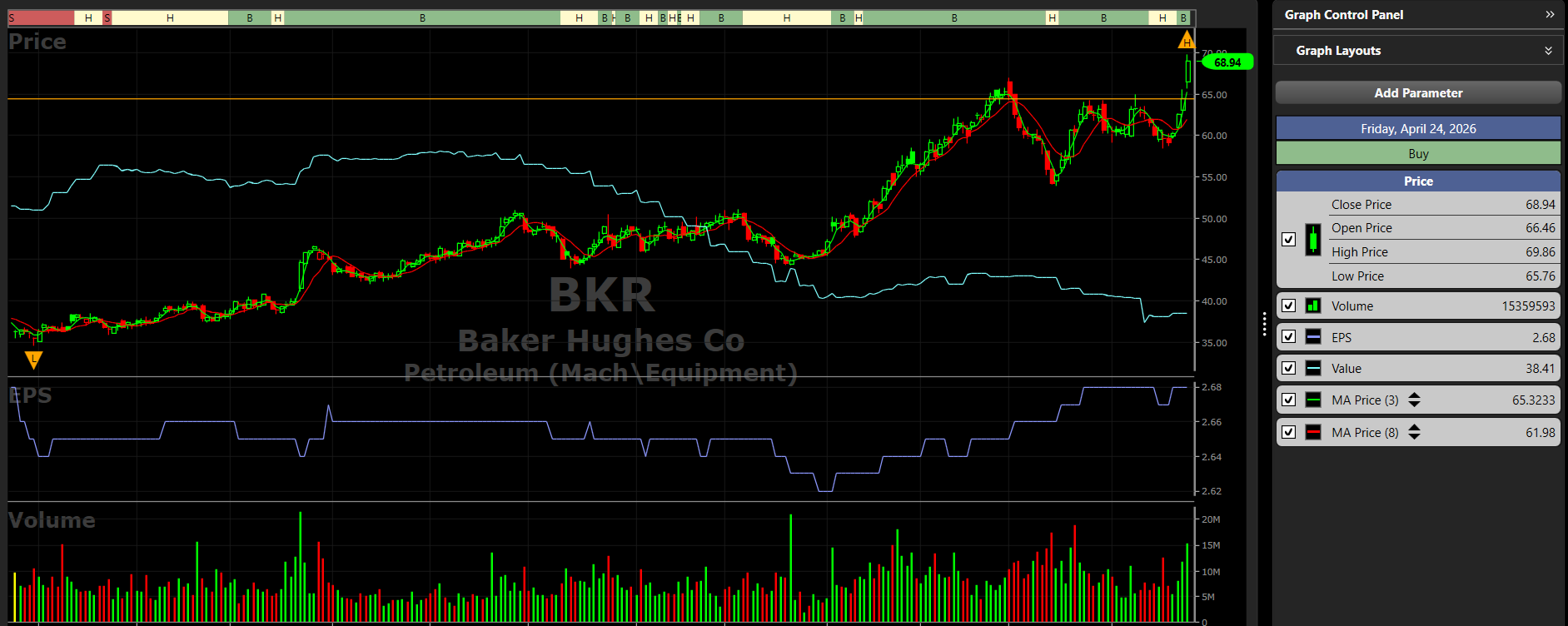
Wall Street reacted positively to the results, with the stock hitting a new 52-week high post-earnings. Stifel reiterated its Buy rating, citing adjusted EBITDA that exceeded forecasts. Multiple firms, including UBS and Citigroup, had recently raised price targets to the $69 range (Neutral/Buy), while consensus remains a Moderate Buy with targets clustering around $62–$65 (some as high as $70). Analysts emphasize the IET segment’s durable growth trajectory in LNG, power/data centers, and new energy technologies as a key differentiator from traditional oilfield services peers.
What Investors Should Watch:
Backlog Conversion & LNG Momentum: With record IET RPO and accelerating project FIDs, watch for how quickly orders translate into revenue. Management sees potential for further North American LNG acceleration and remains confident in full-year IET order targets ($13.5B–$15.5B).
OFSE Recovery: Middle East activity is expected to hold steady into Q2 before a measured second-half rebound; any escalation or resolution in regional tensions could materially impact the segment.
Cash Flow Trajectory: Q1 free cash flow was $210 million (seasonally lower); investors will look for improvement as divestiture proceeds bolster the balance sheet and support capital returns.
Guidance Delivery: Q2 revenue is guided at $6.25B–$6.75B with adjusted EBITDA of $1.04B–$1.22B; full-year ranges ($26.2B–$28.3B revenue; $4.55B–$5.15B EBITDA) remain intact, with results expected slightly below midpoints due to ongoing disruptions.
Energy Transition Tailwinds: Continued wins in data center power, CCS, hydrogen-ready equipment, and digital solutions (e.g., Cordant platform) position Baker Hughes as a diversified energy infrastructure play.
Outlook
Baker Hughes is successfully pivoting toward higher-margin, infrastructure-driven growth while maintaining resilience in core oilfield services. The LNG and power surge underscores the company’s strategic positioning in the global energy transition and security-driven spending cycle. With a strengthened balance sheet and record backlog, the company appears well-placed for sustained momentum through Horizon 2 (2026–2028).
Appendix: Sources and Links
- Baker Hughes Official Q1 2026 Earnings Press Release: https://investors.bakerhughes.com/news/press-releases/news-details/2026/Baker-Hughes-Announces-First-Quarter-2026-Results/default.aspx
- Baker Hughes Q1 2026 Earnings Conference Call Slides (PDF): https://s21.q4cdn.com/548121662/files/doc_earnings/2026/q1/presentation/First-Quarter-2026_Earnings-Conference-Call-Presentation.pdf
- OilPrice.com Coverage: https://oilprice.com/Latest-Energy-News/World-News/Baker-Hughes-Q1-Revenue-Beats-Estimates-by-260-Million-as-LNG-Orders-Surge.html
- Reuters: https://www.reuters.com/business/energy/baker-hughes-beats-first-quarter-profit-estimates-2026-04-23/
- Yahoo Finance / Earnings Call Details: https://finance.yahoo.com/quote/BKR/earnings/BKR-Q1-2026-earnings_call-546601.html
- TipRanks / Analyst Consensus: https://www.tipranks.com/stocks/bkr/forecast
- MarketBeat Analyst Ratings & Stock Reaction: https://www.marketbeat.com/instant-alerts/baker-hughes-nasdaqbkr-reaches-new-1-year-high-after-strong-earnings-2026-04-24/
- Stifel Note (via Investing.com): https://www.investing.com/news/analyst-ratings/stifel-reiterates-baker-hughes-stock-rating-on-strong-q1-results-93CH-4635647
All data as of April 23–25, 2026 earnings release and market reaction. For full financials and SEC filings, visit Baker Hughes Investor Relations at investors.bakerhughes.com.