

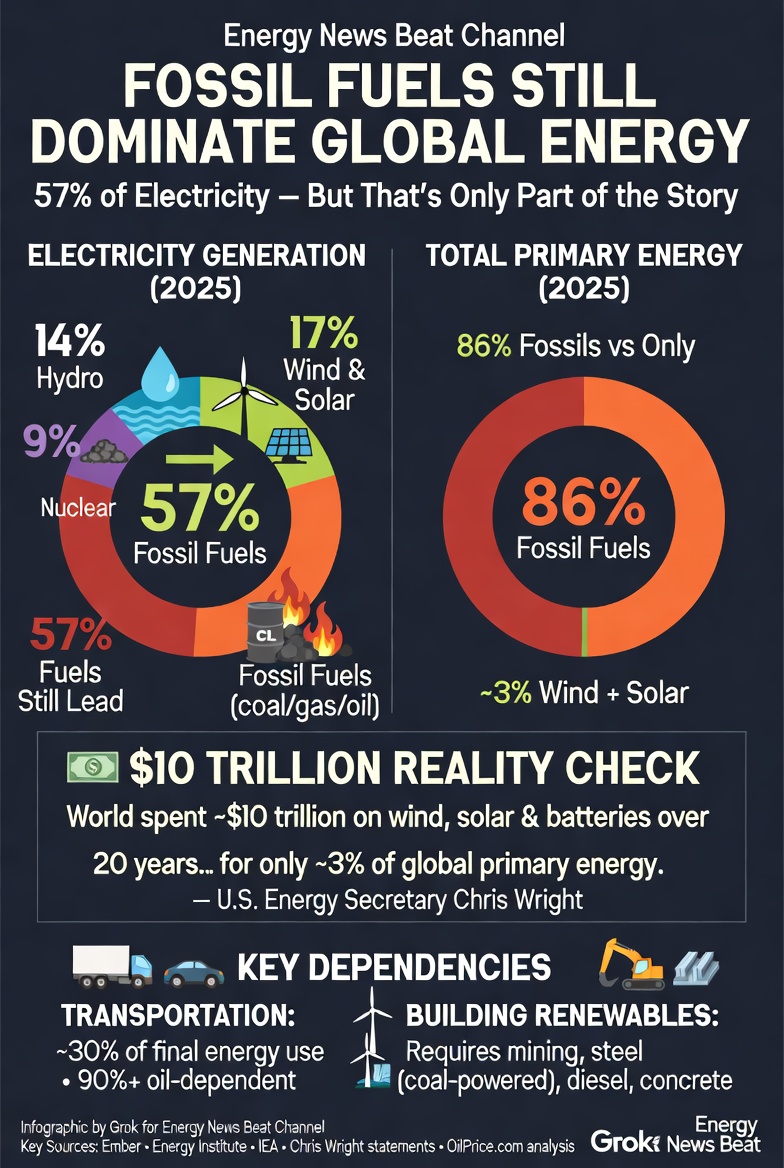
Recent data confirms that fossil fuels (coal, natural gas, and oil) still supply 57% of global electricity generation. Wind and solar together reached about 17% of electricity in 2025, according to Ember’s Global Electricity Review.
This marks progress from a decade ago, yet it tells only part of the story. Electricity represents a minority slice of total global energy use. When we examine total primary energy — which includes transportation, industry, heating, and manufacturing — the picture shifts dramatically. Fossil fuels still dominate at roughly 86%, while wind and solar combined contribute only about 3%.
Electricity vs. Total Primary Energy
Global electricity generation reached record levels in 2025, with low-carbon sources (renewables + nuclear) hitting 43% and renewables alone at 34% (including hydro at ~14%). Coal remained the single largest source at ~33-34%, with natural gas around 21%.
However, electricity accounts for only about 20% of total final energy consumption worldwide. The majority of energy demand comes from direct uses of fuels in transport, industry, and buildings.
According to the Energy Institute’s Statistical Review of World Energy 2026 (covering 2025 data), global primary energy supply exceeded 600 exajoules (EJ). Fossil fuels provided ~518 EJ or 86% (oil ~33%, coal and gas making up the rest). All renewables together supplied around 6%, with wind and solar specifically closer to 3% (roughly 17 EJ combined).
This distinction matters because headlines often focus on electricity shares, where wind and solar growth looks more impressive. In the broader energy system — the fuels that power planes, ships, trucks, factories, and the production of materials — fossil fuels remain overwhelmingly dominant.
Transportation: Still Almost Entirely Fossil-Fueled
Transportation accounts for roughly 30% of global final energy consumption. Road transport dominates (nearly 90% of transport energy), followed by aviation and shipping.
Oil products (gasoline, diesel, jet fuel) supply over 90% of transport energy globally and in major markets like the United States (where petroleum was ~89% of transport energy in recent data). Biofuels and natural gas play small roles; electricity (mostly from EVs) remains a tiny fraction outside specific segments.
Electrifying transport faces hurdles: battery technology, charging infrastructure, heavy-duty applications (trucks, ships, planes), and the energy density advantages of liquid fuels. Even optimistic scenarios show oil continuing to dominate transport for decades.
Manufacturing, Industry, and Building Renewables Themselves Depend on Fossils
Industry and manufacturing consume massive amounts of energy for high-temperature heat, chemical processes, and materials production. Steel, cement, chemicals, fertilizers, and plastics rely heavily on coal, natural gas, and oil.
Wind turbines and solar panels are no exception. Their construction requires:
- Steel (produced using coal or coke in blast furnaces, or energy-intensive electric arc furnaces).
- Concrete (cement production is highly energy- and emissions-intensive).
- Mining for copper, rare earths, lithium, and other materials — often powered by diesel equipment.
- Manufacturing processes that are energy-intensive, frequently located in regions with coal-heavy grids (e.g., China for many solar components).
- Transportation and installation using diesel-powered vehicles and machinery.
U.S. Energy Secretary Chris Wright has highlighted this reality: “We can’t make a wind turbine, or a solar panel, or a nuclear power plant without massive amounts of oil, gas, and coal.”
Lifecycle analyses confirm that while wind and solar have low operational emissions, their upfront embodied energy and materials come largely from fossil sources. The infrastructure build-out itself depends on the very fuels it aims to displace.
The $10 Trillion Question: Secretary Chris Wright’s Assessment
Secretary Wright has repeatedly pointed to the scale of investment versus results. In multiple public statements, he noted that over the past 20 years, the world spent approximately $10 trillion on wind, solar, and batteries. This delivered wind and solar reaching only about 2.6–3% of global primary energy.
He described aspects of the energy transition push as potentially “the greatest malinvestment in human history,” noting that in regions with high renewable penetration, electricity prices have often risen rather than fallen, and industrial activity has sometimes shifted elsewhere.
These comments align with primary energy data: despite rapid growth in wind and solar capacity and electricity generation, their contribution to the overall energy mix that powers the global economy remains small.
On the Energy News Beat program, we have found that the more wind and solar are added to the grid, the more fossil fuels are used.
The Bottom Line
Fossil fuels generated 57% of the world’s electricity in 2025 and still supply the vast majority of total primary energy (~86%). Transportation remains ~90%+ oil-dependent. Manufacturing and the very production of wind turbines and solar panels require mining, steelmaking, diesel, and other fossil inputs.
Wind and solar have grown impressively in the electricity sector and will continue to play a role in an “all-of-the-above” energy future alongside nuclear, hydro, and other sources. However, claims of a rapid, comprehensive transition overlook fundamental realities of energy density, infrastructure needs, material requirements, and the scale of non-electricity energy demand.
Reliable, affordable, and abundant energy — from all practical sources — remains essential for prosperity, poverty reduction, and technological progress. Data from Ember, the Energy Institute, IEA, and statements from energy leaders like Secretary Wright underscore that fossil fuels are not being phased out quickly; they continue to underpin the global energy system.
- OilPrice.com article (Jul 21, 2026): https://oilprice.com/Energy/Energy-General/Fossil-Fuels-Still-Generate-57-of-the-Worlds-Electricity.html (cites Ember/Pew data).
- Ember Global Electricity Review / World data (2025/2026): https://ember-energy.org/countries-and-regions/world/ — 57% fossil, 17% wind+solar in electricity.
- Energy Institute Statistical Review of World Energy 2026 (2025 data): Primary energy shares (~86% fossil, wind+solar ~3%). Summarized in analyses such as Friends of Science and Carbon Brief reports.
- IEA data on transport: ~30% of final energy consumption; overwhelmingly oil-based.
- Secretary Chris Wright statements (various 2025–2026 speeches/interviews, e.g., via RealClearPolitics, Fox News, PolitiFact fact-check): $10 trillion spent for ~2.6–3% wind/solar in global energy; dependence on fossils for manufacturing renewables.
- Additional supporting data: Our World in Data, Statista, IEA Global Energy Review 2026.
All figures are drawn from the most recent available public datasets (primarily 2024–2025). Energy statistics are subject to minor revisions as final data is compiled.