


CenterPoint just raised its 10-year spending plan to $70.7 billion to wire up data centers and other big loads. Here is how that money finds its way onto the delivery charges in Houston power bills.
By Energy News Beat. Data as of Oct. 27, 2026.
If you live in the Houston area, part of every power bill goes to CenterPoint Energy for the poles, wires and substations, no matter which retail provider you pick. On Tuesday, CenterPoint told investors it now plans to spend $70.7 billion over the next 10 years, up $4.0 billion from the $66.7 billion plan it set out in the summer. Most of that is for the electric system, and customers pay for that system through delivery charges.
What changed Tuesday
With its third-quarter results, CenterPoint lifted its 10-year plan by $4.0 billion and moved $1.5 billion of work up into 2026-2030. Its investor slides put the five-year plan at about $38.7 billion, up from $34.2 billion, and show about $51.5 billion of the 10-year total going to electric and $19.0 billion to gas. The company also said it sees at least $10 billion more in possible projects through 2035.
Why: the load is coming
The reason is big new customers, mostly data centers. Houston Electric’s peak today is about 21 GW. Under ERCOT’s new Batch Zero process for loads of 75 MW or more, CenterPoint has about 12 GW of Batch Zero load in its 2030 forecast, and about 14 GW of load growth in all. The company calls that more than a 55% increase in peak demand. Across Texas, ERCOT says it is tracking more than 438,000 MW of large-load requests, nearly 89% of them data centers.
How it reaches your bill
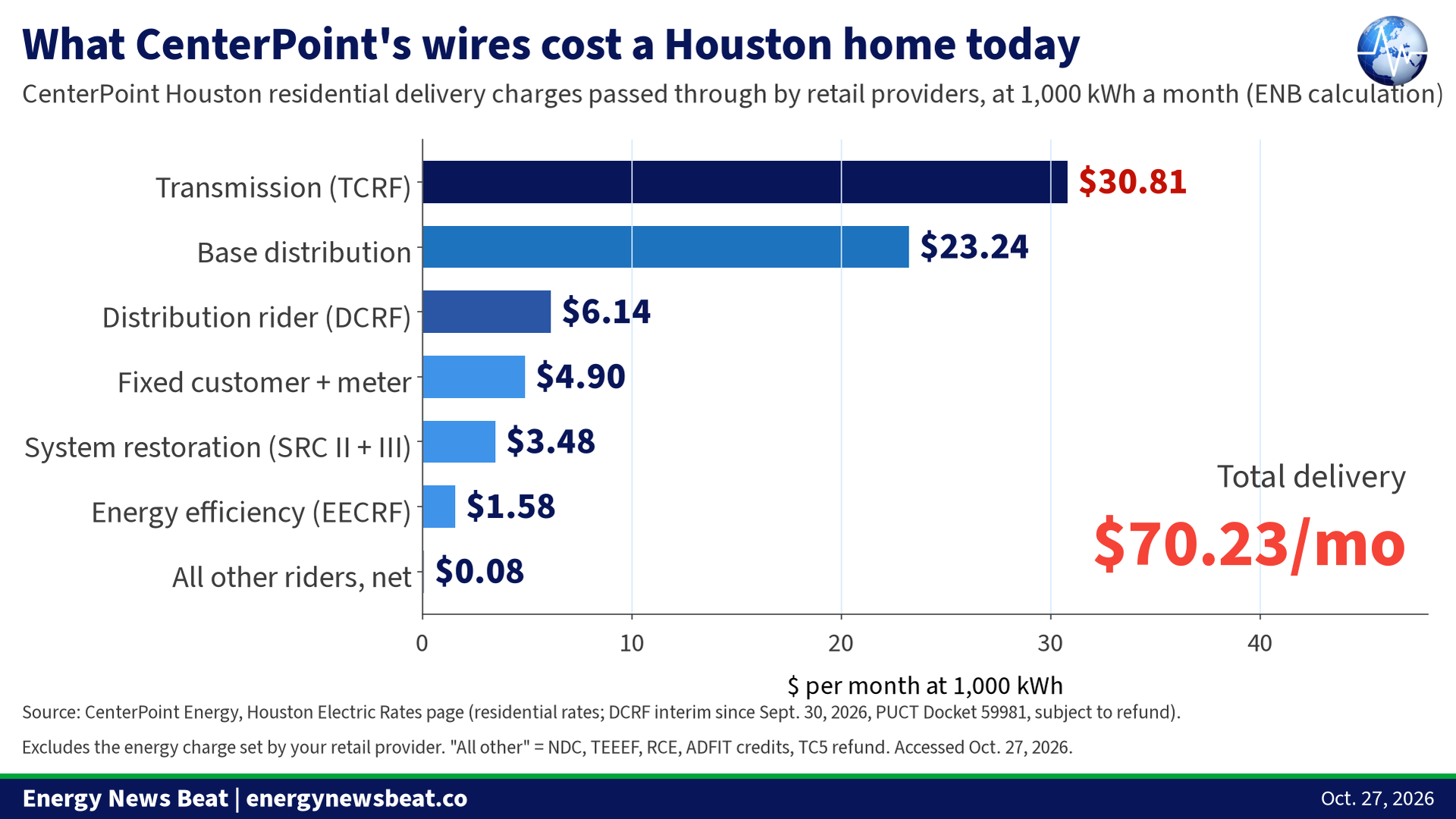
CEO Jason Wells told analysts CenterPoint plans to recover the new transmission and distribution spending through its existing capital trackers. Those are the riders on your bill. At today’s residential rates, CenterPoint’s delivery charges come to about $70.23 a month for a home using 1,000 kWh, by our math. The largest piece is the transmission charge, about $30.81, or 44%. The distribution rider (DCRF) was set at $0.006137 per kWh on Sept. 30 on an interim basis, about $6.14 a month at 1,000 kWh. CenterPoint’s DCRF request at the Texas PUC seeks about $72.9 million a year in added revenue, and the interim rate is subject to refund. CenterPoint filed a settlement in the case on Oct. 1, and a final PUC order was still pending as of Oct. 27. Its last base rate case, Docket 56211, ended in a March 2025 settlement that cut revenue by about $50 million, and no new case is pending.
What it means for you
For households, the wires debate is about who carries the cost. CenterPoint says growth will spread fixed costs over more kWh. Its CEO said “the path to affordable rates is through growth”, and the company expects about $5 billion in savings for Texas customers over the next decade. Those are company projections, not a PUC finding. Watch the DCRF and transmission riders on your provider’s bill.
For investors, CenterPoint kept rate base growth at more than 14% a year through 2030 and raised its 2027 earnings guidance to $2.07-$2.09 a share. It also raised its equity needs by $1.6 billion, which means more new shares.
Caveats
- Load forecasts can slip. ERCOT’s final transmission plan for Batch Zero is due in fall 2027, and about 2 GW of studied load has already withdrawn.
- The $70.23 figure is an illustration at 1,000 kWh. Retail providers package these charges in different ways, and the energy charge comes on top.
- Utility Dive reported CenterPoint submitted 17 GW of projects to ERCOT’s large-load process, with about 12 GW expected to be eligible. On the call, CenterPoint cited about 14 GW submitted as eligible load (10 GW baseload) and at least 14 GW energized by 2030, including smaller customers. We use the company’s figures.
| Stu’s Take
CenterPoint wants to spend $70.7 billion to serve load it says will be 55% bigger. I am all for building the grid that Texas needs. But Houston families already pay about $30.81 a month just for transmission at 1,000 kWh, and CenterPoint says it will recover the new spending through existing trackers, which show up as rider changes on the bill rather than in a full rate case. If the $5 billion in savings is real, the PUC should hold CenterPoint to it, and the data centers driving the build-out should carry their share. |
Check out the World’s Greatest Podcast Show Notes at EnergyNewsBeat.co or EnergyNewsBeat.com. And subscribe to: The Energy News Beat Substack.
Appendix A. Sources
- CenterPoint Energy, Q3 2026 results news release, Oct. 27, 2026. Accessed Oct. 27, 2026.
- CenterPoint Energy, Q3 2026 news release, SEC EDGAR copy (8-K Exhibit 99.1). Accessed Oct. 27, 2026.
- CenterPoint Energy, SEC Form 8-K filed Oct. 27, 2026 (index). Accessed Oct. 27, 2026.
- CenterPoint Energy, Q3 2026 investor update slides, 8-K Exhibit 99.2. Accessed Oct. 27, 2026.
- CenterPoint Energy investor site copy of Q3 2026 slides. Accessed Oct. 27, 2026.
- CenterPoint Energy Q3 2026 earnings call transcript (The Motley Fool), Oct. 27, 2026. Accessed Oct. 27, 2026.
- CenterPoint Energy, Houston Electric rates and tariffs page. Accessed Oct. 27, 2026.
- CenterPoint Energy, notice of interim DCRF rates effective Sept. 30, 2026. Accessed Oct. 27, 2026.
- PUCT Docket 59981, CenterPoint DCRF application, filed July 17, 2026. Accessed Oct. 27, 2026.
- PUCT Docket 59981, motion for interim rates. Accessed Oct. 27, 2026.
- PUCT Interchange, Docket 59981 filings list. Accessed Oct. 27, 2026.
- ERCOT news release, PUCT approves ERCOT Batch Zero, June 18, 2026. Accessed Oct. 27, 2026.
- ERCOT, Large Load Integration page. Accessed Oct. 27, 2026.
- Utility Dive, CenterPoint expands 10-year capital plan by $4B, Oct. 27, 2026. Accessed Oct. 27, 2026.
- PUCT Docket 56211, CenterPoint Houston Electric base rate case. Accessed Oct. 27, 2026.
- City of Houston Administration and Regulatory Affairs, Mar. 13, 2025 notice on CenterPoint rate case. Accessed Oct. 27, 2026.
- Energy News Beat, Who Pays for the Wires? Data centers. Accessed Oct. 27, 2026.
Appendix B. Data table
| Item | Value | As of | Source |
| 10-year capital plan | $70.7B (was $66.7B) | Oct. 27, 2026 | Release |
| 5-year plan 2026-2030 | ~$38.7B (was $34.2B) | Oct. 27, 2026 | Slides |
| 10-year electric / gas | ~$51.5B / ~$19.0B | Oct. 27, 2026 | Slides |
| Houston Electric peak | ~21 GW | Oct. 27, 2026 | Slides |
| Batch Zero energized by 2030 | ~12 GW (14 GW total growth) | Oct. 27, 2026 | Slides |
| ERCOT large-load requests | >438,000 MW, ~89% data centers | June 18, 2026 | ERCOT |
| Residential TCRF | $0.030812/kWh | Oct. 27, 2026 | Rates page |
| Residential DCRF (interim) | $0.006137/kWh | Sept. 30, 2026 | Notice |
| DCRF added revenue requested | $72,852,538/yr | July 17, 2026 | PUCT 59981 |
| Delivery at 1,000 kWh | ~$70.23/mo (ENB calc) | Oct. 27, 2026 | Rates page |
| Rate base growth | >14%/yr through 2030 | Oct. 27, 2026 | Release |
| 2027 EPS guidance | $2.07-$2.09 | Oct. 27, 2026 | Release |
| DCRF settlement filed | Oct. 1, 2026; final order pending | Oct. 27, 2026 | PUCT 59981 |
| Last base rate case (56211) | Settled; ~$50M revenue cut | Mar. 13, 2025 | PUCT 56211; Houston |
| Equity guidance increase | +$1.6B, to $4.5B | Oct. 27, 2026 | Call |
Appendix C. Methodology
- Delivery at 1,000 kWh: customer charge $2.11 + meter charge $2.79 + 1,000 x the sum of all per-kWh residential charges on CenterPoint’s rates page (base distribution, TCRF, DCRF, EECRF, NDC, TEEEF, RCE, SRC II and III, ADFIT II and III credits, TC5 refund) = $70.23. TCRF share = $30.81 / $70.23 = 44%. Excludes the retail energy charge and taxes.
- 5-year increase: $38.7B – $34.2B = $4.5B (company slides), which includes the $1.5B pulled forward.
- Savings, flat-rates and growth claims are CenterPoint statements and have not been reviewed by the PUCT. Call quotes are from The Motley Fool transcript, not an official company transcript.
- The DCRF interim rate is subject to surcharge or refund pending a final PUCT order in Docket 59981.