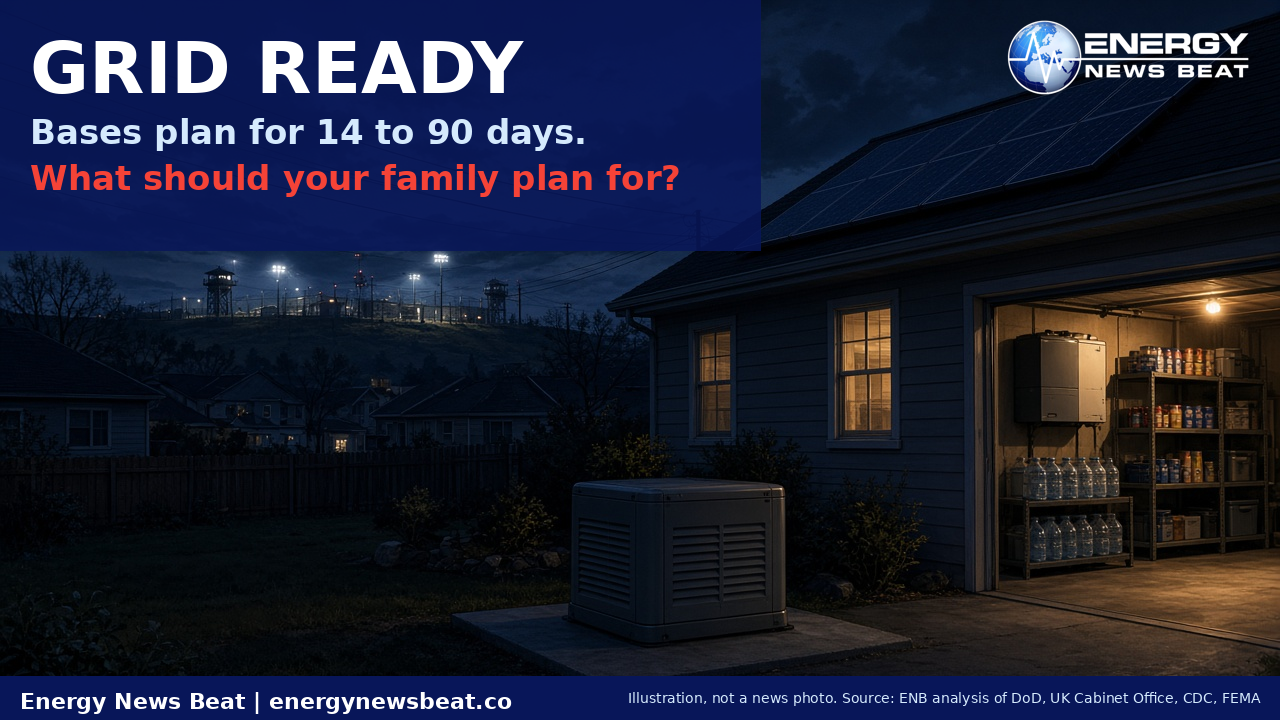
A viral post says every base must run 90 days without the civilian grid. The real policy is newer, vaguer and still being priced. Your household plan should not wait for it.
By Energy News Beat | Oct. 27, 2026
On Oct. 26, Glenn Beck posted on X that “the Pentagon just launched a program requiring every military base in the continental U.S. to be able to run independently for 90 days without the civilian grid,” while the U.K. prime minister is telling citizens to prepare for upcoming “emergencies.” It is a good hook. It is also a mix of confirmed policy, reported detail and missing context. Let us sort it out, then talk about what you can actually do at home, and what it costs.
What the Pentagon actually announced
The program is real. On Sept. 30, Defense Secretary (Secretary of War) Pete Hegseth announced FORTRESS, short for Federal Operations for Resilience, Troop Resources, Energy, Supply, and Survivability, as one of six initiatives in his “State of the Force” address. The memo released that day says it “ensures that every major U.S. military installation generates its own independent power so bases remain lit, aircraft fly, and command centers stay online even if the civilian grid is taken down by cyberattack or sabotage.”
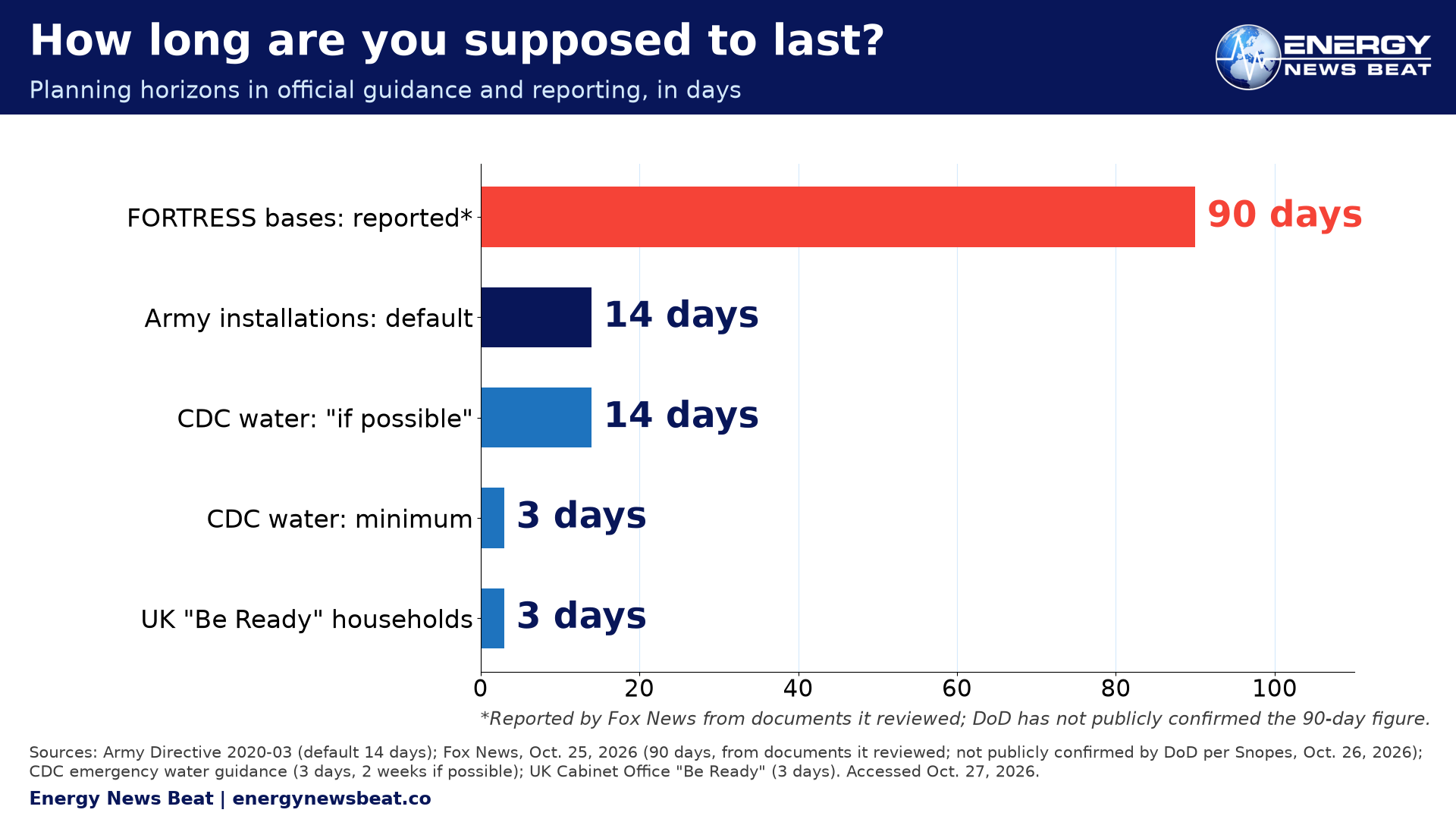
The 90-day number is not in those public statements. It comes from a Fox News report on Oct. 25 based on “documents reviewed by Fox News Digital,” which says every major installation in the continental U.S. “would be expected” to sustain essential operations independently for at least 90 days, covering electricity, water, fuel and communications. Snopes rated the viral claim “mostly true” but noted the department had not confirmed the 90-day requirement. And a senior defense official told Air & Space Forces Magazine on Oct. 20 that details are still being worked out for roughly 500 continental U.S. bases, that the department is still assessing cost, and the magazine reported that fully achieving the goal could take decades.
For context, the Army already had a standard. Army Directive 2020-03 says that when a mission duration has not been set, “the Army will plan to sustain energy and water for a minimum of 14 days.” So 90 days, if confirmed, would be a big step up from that default.
What the U.K. actually said
On Oct. 22 the Cabinet Office launched updated advice as the first stage of a three-year campaign, citing storms and wildfires, and explicitly bringing the U.K. “into line with European peers” such as France, Ireland and the Netherlands. The Be Ready checklist asks households to be ready for 3 days, including 3 litres of drinking water per person per day, non-perishable food, a torch, a battery or wind-up FM radio, cash and a power bank. The BBC reported Prime Minister Andy Burnham saying, “It’s not about panicking… It’s about just taking sensible measures.” That is a three-day kit campaign, not a warning of a specific coming emergency.
Why this matters on our side of the pond
Outages are already getting longer. The EIA reports the average U.S. customer went about 11 hours without power in 2024 including major events, the most in a decade, driven by hurricanes; without major events it was about 2 hours. Texas learned the hard way in February 2021: the FERC-NERC final report found freezing (44.2%) and fuel problems (31.4%) caused 75.6% of unplanned generating outages across ERCOT, SPP and MISO South during Winter Storm Uri, ERCOT ordered 20,000 MW of load shed, and Texas DSHS counted 246 storm-related deaths.
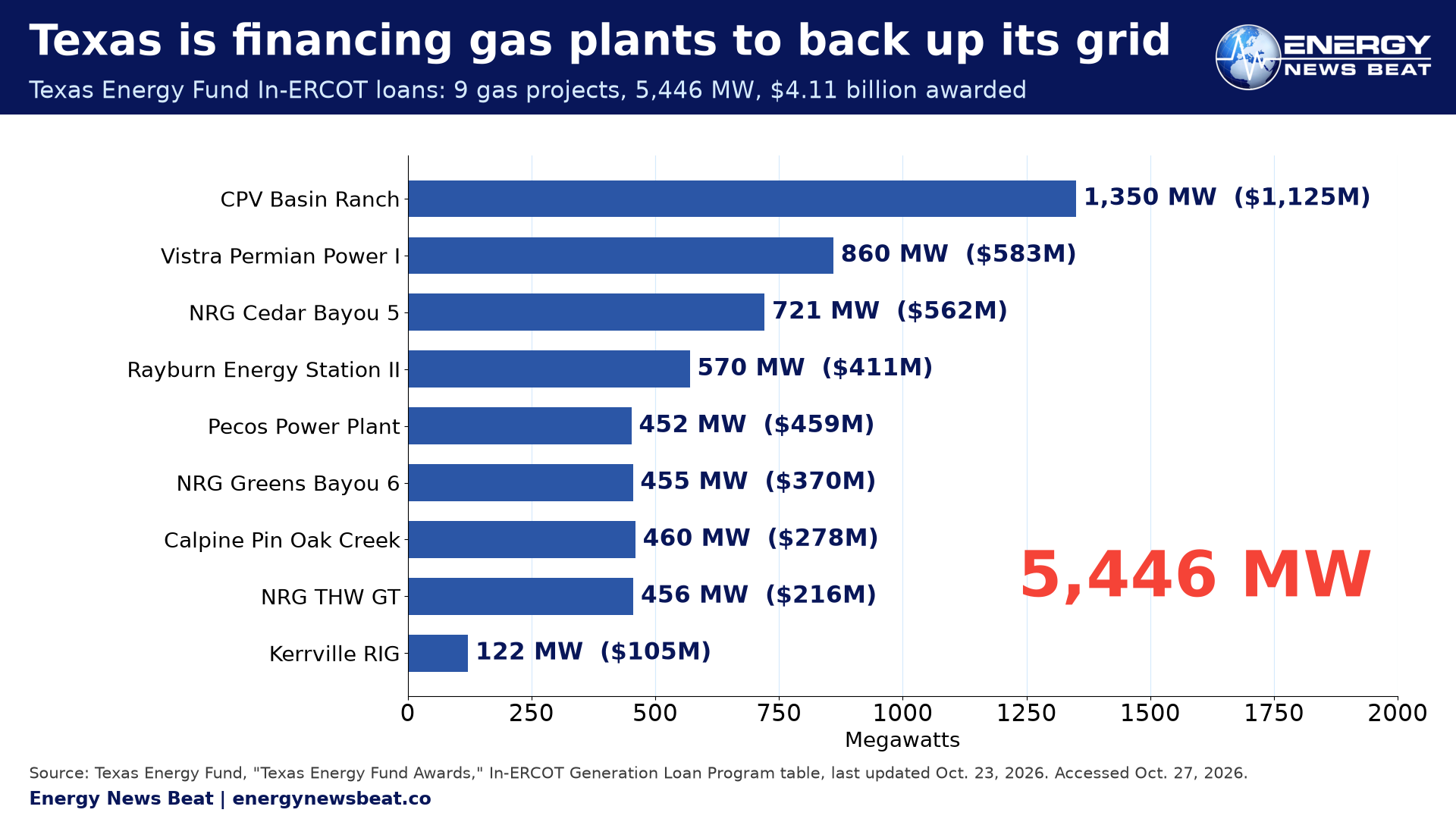
Texas responded with mandatory weatherization (ERCOT has completed 4,588 weatherization inspections over five winters and three summers, starting with 324 in winter 2021-22) and with dispatchable power. The Texas Energy Fund shows nine In-ERCOT loans for natural gas plants totaling 5,446 MW and about $4.11 billion awarded as of Oct. 23. Elsewhere, NERC’s 2025 Long-Term Reliability Assessment, a 10-year outlook, lists PJM, the grid serving Virginia, as elevated risk through 2028 and high risk from 2029, and New York as elevated risk (it also rates ERCOT elevated to high risk), as demand grows and older plants retire. Data centers are a big part of that strain, and we covered who pays for it in Who Pays for the Wires? For more on grid fragility and the transformer supply chain, Stu talked with Doomberg and Steven Wang of Jackery Americas on the Energy News Beat podcast in National Emergency Securing U.S. Bulk Power Sources and Supply Chains.
What a household can do, and what it costs
Start where the official guidance starts: CDC says store at least 1 gallon of water per person per day for 3 days, and “try to store a 2-week supply if possible.” Then size up only as far as your risk and budget justify.
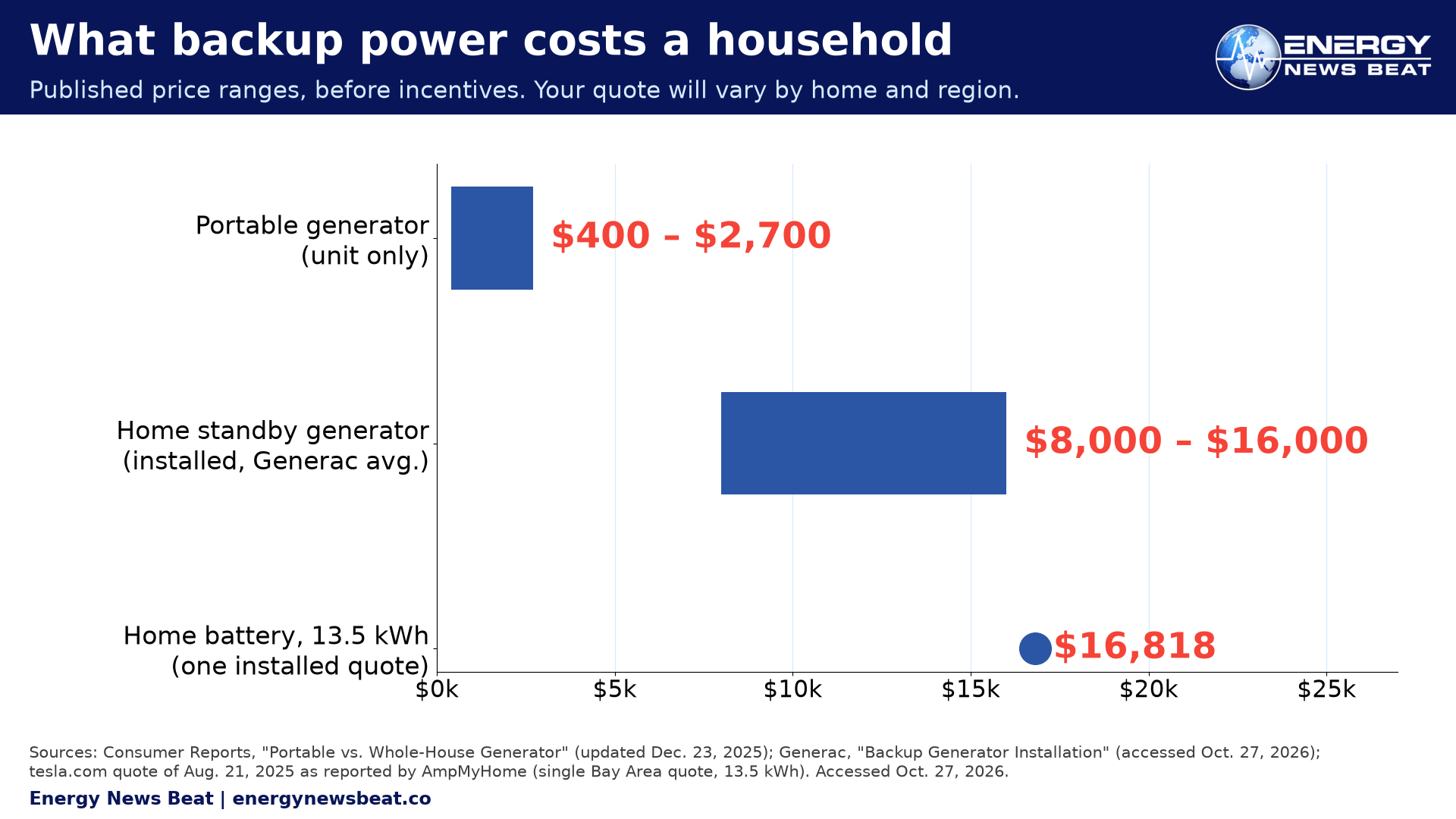
- Portable generator: Consumer Reports lists $400 to $2,700, burning 12 to 20 gallons of gasoline per day. Connecting it to your panel requires a transfer switch installed by an electrician; never backfeed through an outlet.
- Home standby generator: Generac puts the average installed cost at $8,000 to $16,000. Natural gas units run as long as the gas supply holds; propane runtime depends on tank size.
- Solar plus battery: one Tesla Powerwall 3 quote (online cash quote from tesla.com; 13.5 kWh, SF Bay Area, installed, before incentives, August 2025) came to $16,818. NREL benchmarks a typical home battery at 12.5 kWh, enough for essentials, not a whole house for days. Lawrence Berkeley Lab puts the median 2025 rooftop solar price at about $3.60 per watt for host-owned systems before incentives; cash purchases were about $3.00 per watt. If you want a smaller, portable starting point, Stu talked with Steven Wang, CEO of Jackery Americas, about home battery systems on the Energy News Beat podcast: The Energy Crisis is Coming.
- Water and food beyond 3 days: gov says to replace self-filled water every six months and use food-grade containers. Store food you already eat and rotate it; Ready.gov notes refrigerated food is safe for about four hours in an outage.
Generator safety is not optional
Carbon monoxide kills people after every major storm. The CDC is blunt: never run a generator inside your home, basement or garage, even with doors open, and keep it more than 20 feet from windows, doors and vents. Install battery-powered or battery-backup CO alarms. Consumer Reports adds: refuel only when the unit is off, and store gasoline with stabilizer.
Consumer and investor views
For families, the cheapest resilience is water, food, medicine, a radio and a plan. Backup power is a step up in cost; match it to how often and how long your power actually goes out. For investors, FORTRESS could mean federal demand for microgrids, batteries, gas generation and small reactors, but the department says costs are still being assessed, so timing and budgets are open questions. In Texas, the Energy Fund pipeline points to gas as the backbone of new dispatchable capacity.
Caveats
The 90-day requirement has not been publicly confirmed by the Department of Defense. Beck’s “every military base” overstates the public language, which says “every major” installation. Cost figures are published averages or single quotes, not bids for your home, and federal and state incentives change. The U.K. campaign is a 3-day preparedness drive, not a forecast of a specific crisis.
| STU’S TAKE
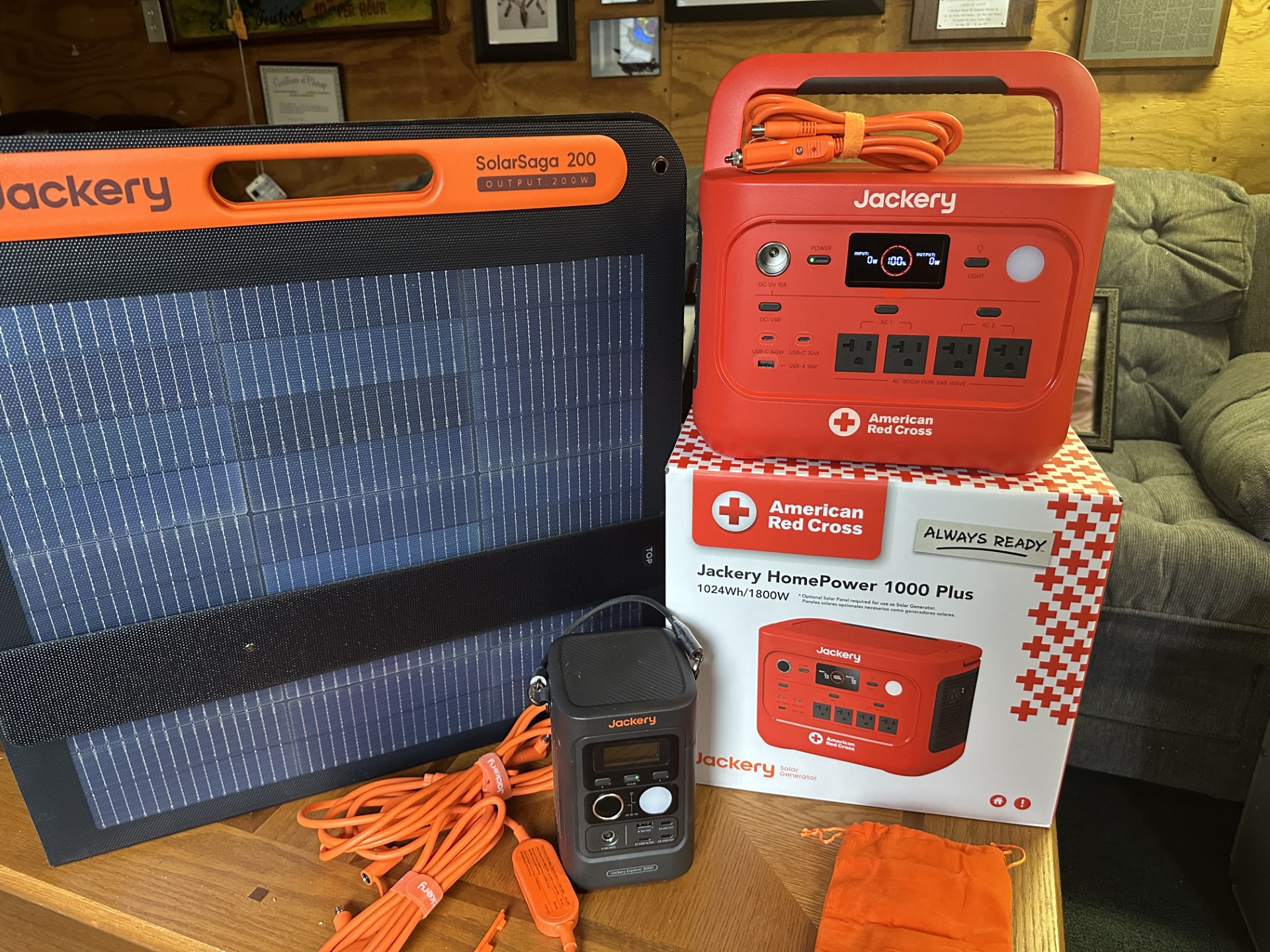
Here is my take. When the Department of War tells its own bases to stop trusting the civilian grid, that is the loudest reliability alarm I have heard. The public memo says every major installation will generate its own power, and Fox reports a 90-day target. The Army’s own default was 14 days. That gap tells you what planners think about grid risk, and I read FORTRESS as a sign of sustained federal demand for microgrids, batteries and gas generation. Texas got serious after Uri, with 246 deaths per Texas DSHS, and is now backing 5,446 MW of gas plants through the Texas Energy Fund. Dispatchable power is what keeps the lights on when the weather turns. States that keep retiring it, while NERC flags them as elevated or high risk, are asking families to carry the risk. My advice: do the cheap stuff first. Water at 1 gallon per person per day per the CDC, food you actually eat, and a CO alarm. Then decide if a $400 to $2,700 portable generator or an $8,000 to $16,000 standby unit fits your budget. Never in the garage. We are working on several configurations. I have purchased about 12 Jackery units for family members or my houses. The one below is one we are running through it’s paces for Jackery. You can get a Jackery Home Power Unit for $17oo to $2500 with solar panels, and get a Harbor Fright gasoline generator for $500 to $900 and be very well prepared for energy. Stay tuned for our parts lists on what works and what does not. The reason I like Jackery units is because they have never had a product recall. I have been using them for years and never had a failure. I only have one complaint, and it is more of observation and that is the change in the older models to the newer plugs. You need to have a plan to keep older panels to charge older units, but not an issue when you buy new gear. |
Here is the episode with Jackery CEO Steven Wang and Doomberg.