
London, July 9, 2026 — The UK’s National Energy System Operator (NESO) issued a rare summer Electricity Margin Notice on July 8, forecasting a shortfall of around 1.2 gigawatts (GW) in electricity margins during Thursday evening’s peak demand period. The warning, one of several issued during the ongoing heat wave affecting the UK and much of Europe, highlights ongoing vulnerabilities in Britain’s power system.
NESO requested additional capacity from generators and flexibility providers to bolster supplies. While no immediate blackout risk exists, the tight margins underscore how extreme weather and the country’s evolving energy mix are testing grid reliability.
Heat Wave Drives Demand Surge
Record or near-record temperatures in June and early July 2026 have pushed electricity demand higher as households and businesses turn to fans and air conditioning. Peak demand often occurs in the evening (7–10 pm), when solar output drops sharply. High temperatures also reduce the efficiency of thermal plants and can cause transmission lines to sag, limiting capacity.
Similar warnings appeared in June 2026 during earlier heat spells, with NESO seeking hundreds of megawatts of extra power and, in some cases, paying premiums to secure supplies. These summer notices are historically uncommon, traditionally reserved for winter peaks.UK Energy Mix: Renewables Rising,
Gas as Flexible Backbone
Great Britain’s electricity generation has shifted dramatically toward low-carbon sources under decarbonization efforts:
- Renewables (wind, solar, hydro, biomass): Often 45–55%+ in recent quarters. In Q1 2026, renewables reached a record 53.1% share, driven largely by wind (35.6% of total generation=
- Gas: Typically 25–40%, serving as the primary flexible backup.
- Nuclear: Around 8–12%, providing a reliable low-carbon baseload (though the aging fleet faces maintenance outages).
- Imports (interconnectors): 10–20%, varying with European conditions.
- Coal: Effectively 0% since its phase-out in 2024.
Live dashboards show wind and solar varying significantly with the weather. In summer heat waves, high-pressure systems often bring low wind speeds, reducing output from Britain’s large offshore and onshore wind fleet precisely when demand rises. Solar helps during daylight but offers little for evening peaks.
Biomass and storage play supporting roles, but the system still relies heavily on gas-fired plants and imports for rapid response.
Supply Issues Exposed by Extreme Weather
The July 2026 warning stems from a combination of factors:
- Elevated cooling demand.
- Low wind generation during the anticyclonic heat wave.
- Reduced imports from a strained European grid.
- Thermal constraints on infrastructure and plants.
These issues are not isolated. The rapid build-out of intermittent renewables, while lowering carbon intensity, has increased the frequency of tight margin periods. Demand is also rising structurally due to electrification (EVs, heat pumps), adding to peak loads. Grid infrastructure upgrades lag behind renewable deployment in some areas, and new firm low-carbon capacity (new nuclear, long-duration storage) has been slow to materialize.Net Zero Policies: Ambition Meets Practical ComplicationsThe UK’s legally binding Net Zero target by 2050 has driven aggressive renewable deployment, subsidy schemes (Contracts for Difference), and the closure of coal plants. Achievements include record renewable generation shares and falling carbon intensity in the power sector.However, the transition has created complications:Intermittency and reliability: Wind and solar output depends on weather. Heat waves frequently coincide with low wind, creating mismatches between supply and peak demand.
Backup and flexibility gaps: Gas remains essential as a bridge fuel, but policy signals around its long-term role create investment uncertainty. Battery storage and demand response help but are not yet at scale for multi-day shortfalls.
Grid and infrastructure strain: High renewable penetration requires massive transmission reinforcements and smarter grids. Electrification increases overall demand, amplifying pressure during extremes.
Cost and security trade-offs: Subsidies, balancing costs, and network charges flow through to consumers. Reliance on weather-dependent sources and interconnectors raises energy security questions during continent-wide stress events.
Critics argue the pace of decarbonization has outstripped the development of adequate firm capacity and storage, leaving the system more exposed to weather extremes than a more diversified baseload-heavy mix would be. Proponents note that renewables have delivered cheap marginal generation when available and that further investment in flexibility will resolve teething issues.UK Power Prices Among the Highest in the West
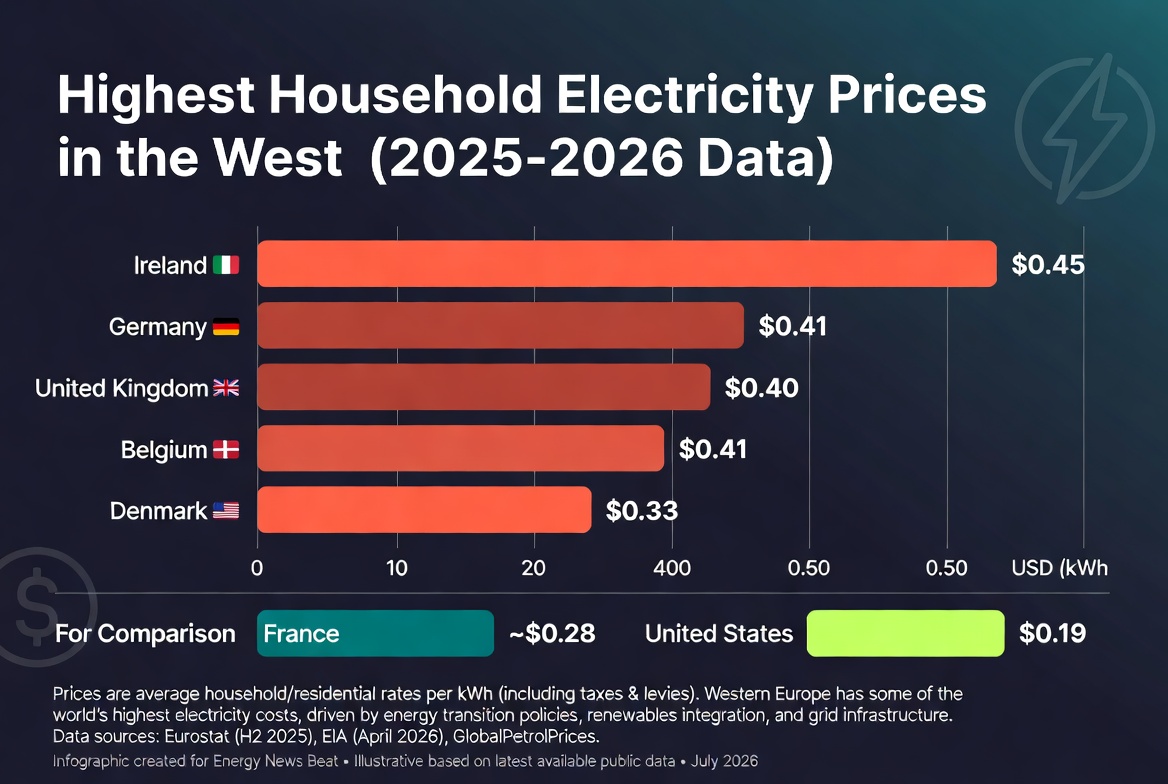
UK household electricity prices rank among the highest in Western Europe and significantly exceed those in the United States:
- UK: Often around €0.40/kWh (or equivalent ~£0.30–0.40/kWh including taxes and levies) in recent data periods. In H1 2025, UK prices were approximately 23% above the EU average.
- Germany: Similarly high (~€0.39/kWh), reflecting its own renewables-heavy transition and nuclear phase-out challenges.
- France: Notably lower (~€0.19–0.28/kWh), benefiting from a large, stable nuclear fleet providing affordable baseload power.
- EU average (H2 2025): ~€0.29/kWh.
- United States: Much lower on average (~$0.15–0.19/kWh or ~£0.12–0.15/kWh), supported by diverse sources including abundant natural gas, nuclear, and hydro in many regions.
UK prices include substantial policy-driven components (renewable levies, carbon costs, network charges). Industrial users also face relatively high costs compared to many European peers. While wholesale prices fluctuate, end-consumer bills remain elevated relative to countries with stronger firm low-carbon capacity.
Outlook
The July 2026 heat wave warning serves as a timely reminder that decarbonization and energy security must advance in tandem. While the UK has made impressive progress on renewables, maintaining a reliable and affordable supply during weather extremes will require accelerated investment in flexible generation, storage, grid modernization, and demand-side solutions.
Policymakers face difficult choices: balancing rapid emissions reductions with the need for resilient, cost-effective power. As electrification and climate-driven demand growth continue, the system’s ability to handle coincident high-demand, low-renewable-output periods will be a critical test of the Net Zero pathway.
- Bloomberg: “UK Issues Electricity Supply Warning as Heat Wave Strains Grid” (July 8, 2026) — https://www.bloomberg.com/news/articles/2026-07-08/uk-issues-electricity-supply-warning-as-heat-wave-strains-grid
- NESO / National Energy System Operator reports and margin notices (various June–July 2026 references via news coverage).
- UK Government Energy Trends June 2026 (Q1 data) — https://assets.publishing.service.gov.uk/media/6a423e678cbc951a27d80dac/Energy_Trends_June_2026.pdf
- Eurostat Electricity Price Statistics (H2 2025 data) — https://ec.europa.eu/eurostat/statistics-explained/index.php?title=Electricity_price_statistics
- DESNZ / UK Government international domestic energy prices comparisons.
- Ember, Guardian, Independent, and other reporting on June/July 2026 heat wave margin notices.
- Live generation data: energydashboard.co.uk and similar real-time trackers.
- Wikipedia and official summaries for historical mix context (2024–2026 trends).
All information drawn from publicly available reports as of July 2026. Prices and mixes are subject to ongoing updates.