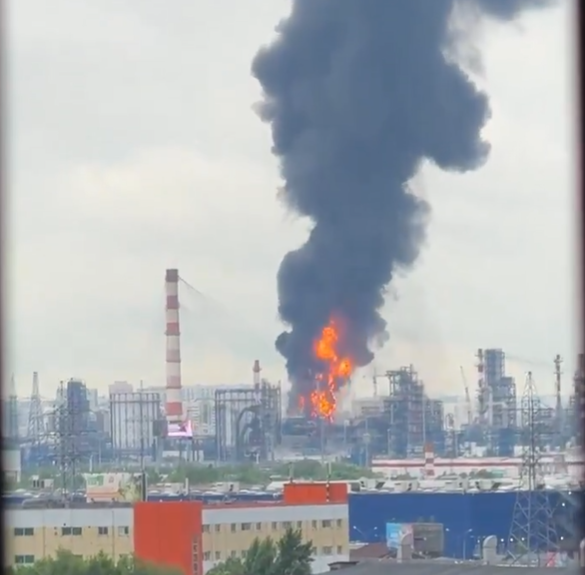
Ukrainian forces struck the Gazprom Neft-owned Moscow Oil Refinery (MNPZ) in the Kapotnya district early on June 16, 2026, igniting a fire at a facility just 15 kilometers (about 10 miles) from the Kremlin. The attack targeted Russia’s capital-region refining hub, which processes roughly 245,000–250,000 barrels per day (11–12 million tons annually) and supplies approximately 35–40% of the Moscow region’s fuel needs, including aviation fuel.
Moscow Mayor Sergei Sobyanin confirmed that air defenses intercepted dozens of drones over the capital, but one struck the refinery, causing damage with no reported casualties. Emergency services responded to the scene. Ukrainian sources, including the General Staff, reported damage to the ELOU AVT-6 primary oil processing (distillation) unit and a resulting fire. President Volodymyr Zelenskyy later confirmed the strike, describing it as a response to ongoing Russian attacks.
This incident follows a pattern of Ukrainian long-range drone strikes on Russian energy infrastructure, with anti-drone nets at the site proving ineffective against the incoming threat.
Ukraine’s Evolving Refinery Tactic
Ukraine has intensified its campaign against Russian refining capacity in 2025–2026, shifting focus from primary crude distillation units to harder-to-repair secondary processing facilities such as hydrocrackers. These units require specialized components with long lead times, exacerbated by Western sanctions.
Key recent examples include multiple strikes on the Tuapse refinery and export complex on the Black Sea (hit three times in April 2026 and twice in May 2026, following earlier attacks), and a major campaign against the Ust-Luga oil export terminal on the Baltic coast in late March 2026, which temporarily disrupted up to 40% of Russia’s oil exporting capacity.
Russia’s offline secondary processing capacity reached 1.2–1.3 million barrels per day in May 2026, with hydrocracker outages alone at 250,000 bpd—significantly higher than a year earlier. Diesel production fell 10% in both April and May 2026.
Domestic Fuel Crisis and Export Restrictions
The strikes have contributed to fuel shortages and panic buying in several Russian regions, including occupied Crimea. At least 14 regions introduced restrictions on fuel sales. In response, Russia banned gasoline exports starting April 1, 2026, and aviation fuel exports from June 1, 2026.
Refinery throughput has been depressed, with April 2026 runs hitting a 16-year low around 4.7 million bpd in some reports. Russia has shifted more crude to direct exports rather than refining it domestically, helping maintain overall crude export volumes but reducing higher-value refined product exports.
Impact on Russia’s Downstream Sector and Oil Market Revenues
Ukraine’s attacks have inflicted measurable pain on Russia’s downstream (refining and product) sector while having a more nuanced effect on overall oil revenues:2025 Losses: Russian oil companies suffered more than $13 billion in combined direct and indirect losses from Ukrainian drone strikes, according to insurance broker Mains. Direct infrastructure damage exceeded 100 billion rubles (~$1.1 billion), with lost production and secondary effects pushing the total above 1 trillion rubles (~$11.5–12.9 billion).
2026 Port and Refinery Campaigns: Strikes on Baltic terminals (Ust-Luga and others) in late March–early April 2026 alone cost Russia an estimated $1–2.2 billion in lost export revenue. Broader attacks since the start of 2026 have been estimated in the multi-billion-dollar range.
Refining and Product Exports: Persistent outages have reduced refined product output and exports. Russia has responded by prioritizing domestic supply through export bans, reversing a previous strategy of maximizing foreign sales of gasoline and diesel. While crude exports have remained relatively resilient (supported by high global prices and a “shadow fleet”), refined product exports have declined more noticeably.
Broader Context: The International Energy Agency revised Russian supply estimates downward due to refinery and port attacks. However, analysts note that Russia’s oil revenues benefit from elevated global prices (partly linked to other geopolitical tensions), and government taxes are primarily on extraction rather than sales. This cushions the fiscal impact compared to direct losses borne by oil companies. No systemic collapse of Russia’s oil sector has occurred, but repeated strikes on bottleneck units are increasing repair costs, extending outages, and straining logistics.
Experts highlight that targeting secondary units and repeatedly hitting the same facilities amplifies economic effects because repairs are slower and more expensive under sanctions.
Outlook
The June 16 strike on the symbolically important Moscow refinery underscores Ukraine’s ability to project power deep into Russian territory and disrupt critical fuel supplies near the political center. While Russia’s overall oil export revenues have proven resilient thanks to price strength and operational adaptations, the cumulative pressure on the downstream sector—through lost product exports, domestic shortages, and billions in damages—continues to mount.
Russia has acknowledged complications in fuel supplies and called for improved air defenses. The long-term effectiveness of Ukraine’s strategy will depend on the sustainability of its drone campaign and Russia’s ability to repair and protect its refining infrastructure.
- Mario Nawfal X Post (June 16, 2026): https://x.com/MarioNawfal/status/2066792897920278630
- OilPrice.com: “Ukraine’s New Refinery Tactic Is Fueling Russia’s Gasoline Crisis” – https://oilprice.com/Geopolitics/Europe/Ukraines-New-Refinery-Tactic-Is-Fueling-Russias-Gasoline-Crisis.html
- Stratfor: Assessing the Impact of Ukrainian Strikes on Russia’s Oil Sector (May 19, 2026)
- Carnegie Endowment: Analysis of Russian oil export revenues and strike impacts (April 2026)
- United24 Media: Ukraine Has Attacked 24 of Russia’s 33 Major Oil Refineries (May 22, 2026) – details on $13B losses
- Reuters and other reporting on specific incidents and throughput data (various 2026 dates)
- IEA Oil Market Report references (April 2026)
All information is based on open-source reporting as of June 16, 2026. Developments are fluid.