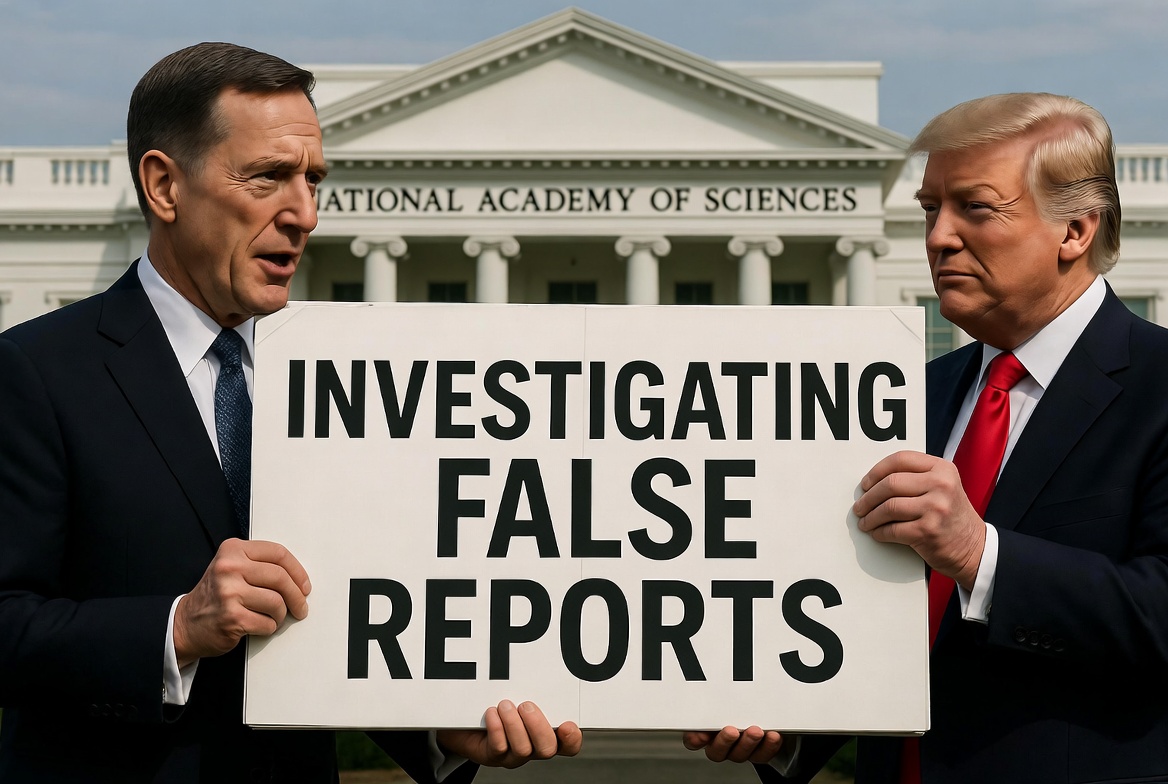
In a forceful move against what he describes as entrenched waste, bias, and politicized science in the energy sector, President Donald Trump has ordered a comprehensive review, suspension, and potential debarment of officials tied to fraudulent climate research and manuals used to justify massive regulatory and litigation costs against American energy producers and taxpayers.
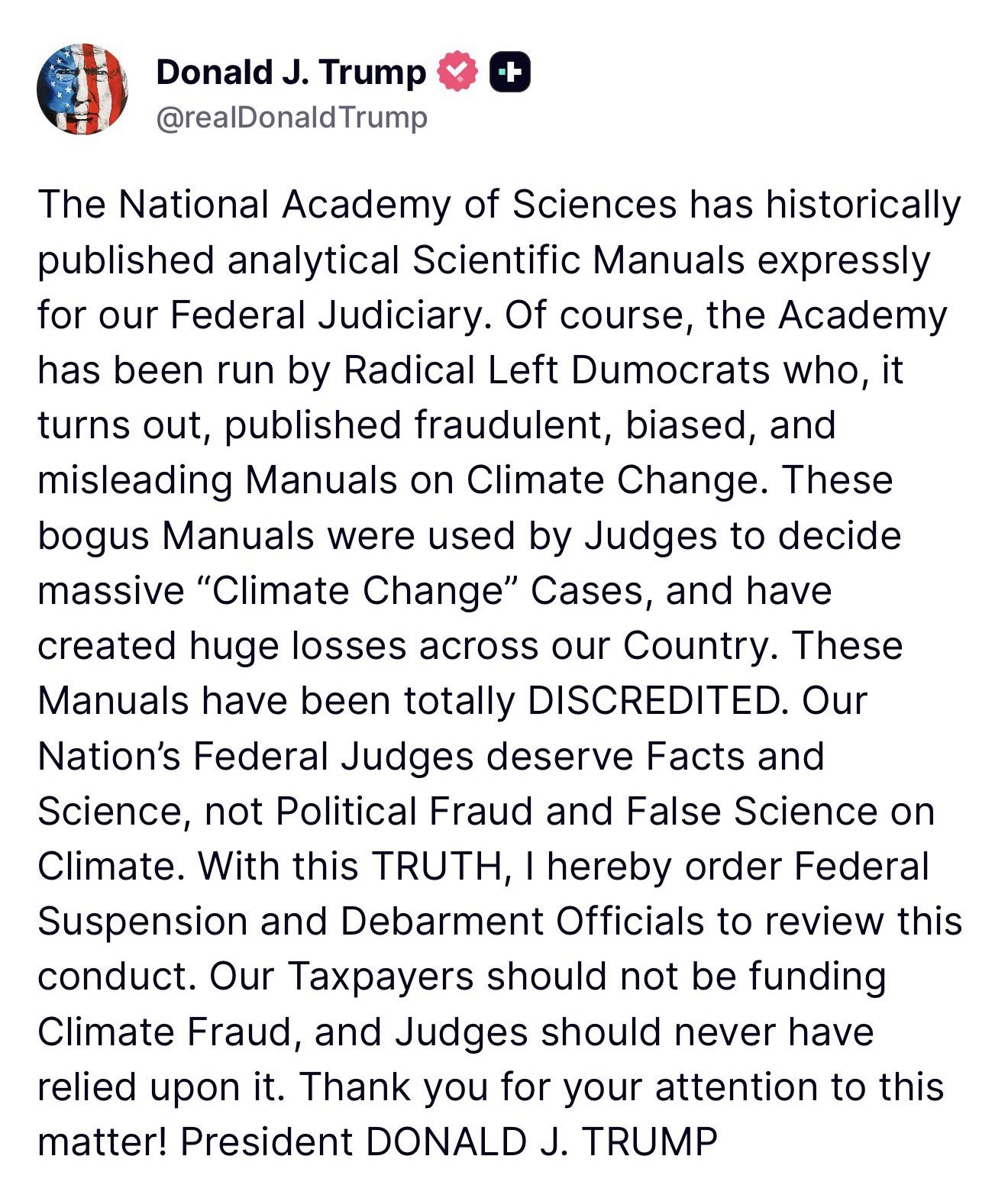
The directive, highlighted in a July 20, 2026, post amplifying the President’s statement, targets the National Academy of Sciences (NAS) and related processes that produced biased “climate manuals” for federal judges. These materials have been criticized as one-sided advocacy tools that fueled lawsuits and regulations imposing “massive losses” on the country.
The False Research: Biased Climate Chapter in Judicial Reference Manual
The controversy centers on the Reference Manual on Scientific Evidence, Fourth Edition (published late 2025), a joint project of the Federal Judicial Center (FJC) and the National Academies of Sciences, Engineering, and Medicine (NASEM). For the first time, it included a dedicated “Reference Guide on Climate Science” chapter.
Critics, including Republican state attorneys general and outlets like the Wall Street Journal, argued the chapter was biased, written by authors affiliated with climate litigation groups (such as the Sabin Center for Climate Change Law at Columbia University), and designed to influence judges in cases involving fossil fuel companies, attribution of weather events to climate change, and regulatory challenges.
Under pressure, the FJC removed the climate chapter from its version of the manual. However, NASEM kept it available on its website, prompting further backlash. Trump’s statement calls these materials “fraudulent, biased climate manuals” that are “now TOTALLY DISCREDITED,” insisting federal judges deserve “FACTS, not political fraud and fake science.” He ordered a full review, suspension, and debarment of involved officials, declaring taxpayers will no longer fund the “Climate Scam” and judges should never rely on it again.
This fits into broader Trump administration efforts, including the May 2025 Executive Order on Restoring Gold Standard Science, which emphasizes transparency, reproducibility, rigorous peer review, and acknowledgment of uncertainties in federally funded or used research.
Green Graft: Billions (and Trillions) in Questionable Spending on Wind, Solar, Battery Storage, and Carbon Capture
Trump’s review of false research ties directly into scrutiny of the enormous taxpayer-funded push for renewables and related technologies under prior policies, particularly the Inflation Reduction Act (IRA) of 2022 and the Infrastructure Investment and Jobs Act (IIJA).
Key spending figures include:In fiscal year 2025 alone, federal energy subsidies and tax expenditures totaled approximately $64.1 billion, with renewables, electric vehicles, and energy efficiency capturing roughly 90% (~$57.9–$58 billion). Fossil fuels received only about $2.6 billion. This single-year renewable support exceeded the cumulative fossil fuel tax expenditures from 1994 through 2025.
Broader estimates for IRA clean energy subsidies (wind, solar, batteries, carbon capture, EVs, etc.) have ballooned far beyond initial projections. Independent analyses put the 10-year cost in the range of $936 billion to nearly $2 trillion, with long-term projections reaching several trillion dollars by 2050.
One analysis estimated the U.S. poured about $1.5 trillion into wind and solar since April 2020 (encompassing subsidies, tax credits, private investment spurred by policy, and related support). Despite this, wind and solar together accounted for only around 17% of U.S. electricity generation in 2025.
Specific programs: IIJA and IRA funneled billions into battery storage manufacturing and deployment, carbon capture and storage (CCS) hubs, direct air capture (DAC), and related demonstration projects. DOE has since terminated multiple awards (e.g., over $3.7 billion in CCS/decarbonization projects and hundreds of millions in battery/manufacturing grants) after reviews found them economically unviable or not advancing national energy needs.
Additional examples of questionable spending include attempts to manage or terminate portions of the $14–20 billion “green bank” grants and various clean energy demonstration awards, some canceled due to inadequate documentation, missed milestones, or political considerations in project locations.
The Trump administration has highlighted these as examples of “Green New Scam” funding rushed through without proper oversight, often benefiting projects that increased system costs, relied on intermittent sources, or depended on foreign supply chains. Policies like the One Big Beautiful Bill Act (OBBBA) phased out or restricted many wind and solar tax credits (effective around mid-2026 for new projects), aiming to end market-distorting subsidies for unreliable energy sources.
Moving Forward: Review, Accountability, and Energy Dominance
President Trump’s order signals a broader reset: prioritizing rigorous, unbiased science in policy and judicial decisions while scrutinizing wasteful spending that propped up intermittent renewables and experimental carbon technologies at enormous taxpayer expense. By ending or reviewing subsidies, terminating non-viable projects, and challenging politicized research, the administration argues it will lower energy costs for Americans, enhance grid reliability, reduce dependence on foreign-controlled supply chains, and restore integrity to federal decision-making.
Supporters view this as long-overdue accountability for policies that delivered limited, reliable energy gains relative to the trillions committed or at risk. Critics, including environmental groups and some courts, have challenged certain cancellations and policy shifts, leading to ongoing litigation.
Appendix: Sources and Links
- X post by
@GuntherEagleman
(July 20, 2026) quoting/amplifying President Trump’s statement: https://x.com/GuntherEagleman/status/2079000269908500781
- National Center for Energy Analytics (NCEA) analysis on 2025 energy subsidies (via Oklahoma Energy Today and related reporting, Dec 2025): Details on ~$58B renewables share.
okenergytoday.com
- Cato Institute: Budgetary Cost of the Inflation Reduction Act’s Energy Subsidies (estimates $936B–$1.97T over 10 years).
cato.org
- Microgrid Media: “U.S. Spent $1.5 Trillion on Wind and Solar Since 2020” (April 2026 update).
microgridmedia.com
- DOE announcements on project terminations (e.g., May 2025: $3.7B+ in CCS/decarbonization savings; other clean energy cuts).
energy.gov
- Coverage of Reference Manual on Scientific Evidence climate chapter controversy (FJC removal, NASEM retention, AG letters, WSJ editorials, ProPublica, Ars Technica, NYT — Feb–March 2026).
arstechnica.com
- Executive Order: Restoring Gold Standard Science (May 23, 2025).
ballotpedia.org
- Additional context on OBBBA/IRA subsidy changes, clean energy investment/cancellations (Third Way, Utility Dive, Clean Air Task Force, E2 reports — 2025–2026).
All information is drawn from publicly available government statements, independent analyses, and reputable reporting as of July 2026. Readers are encouraged to review primary documents for full context.