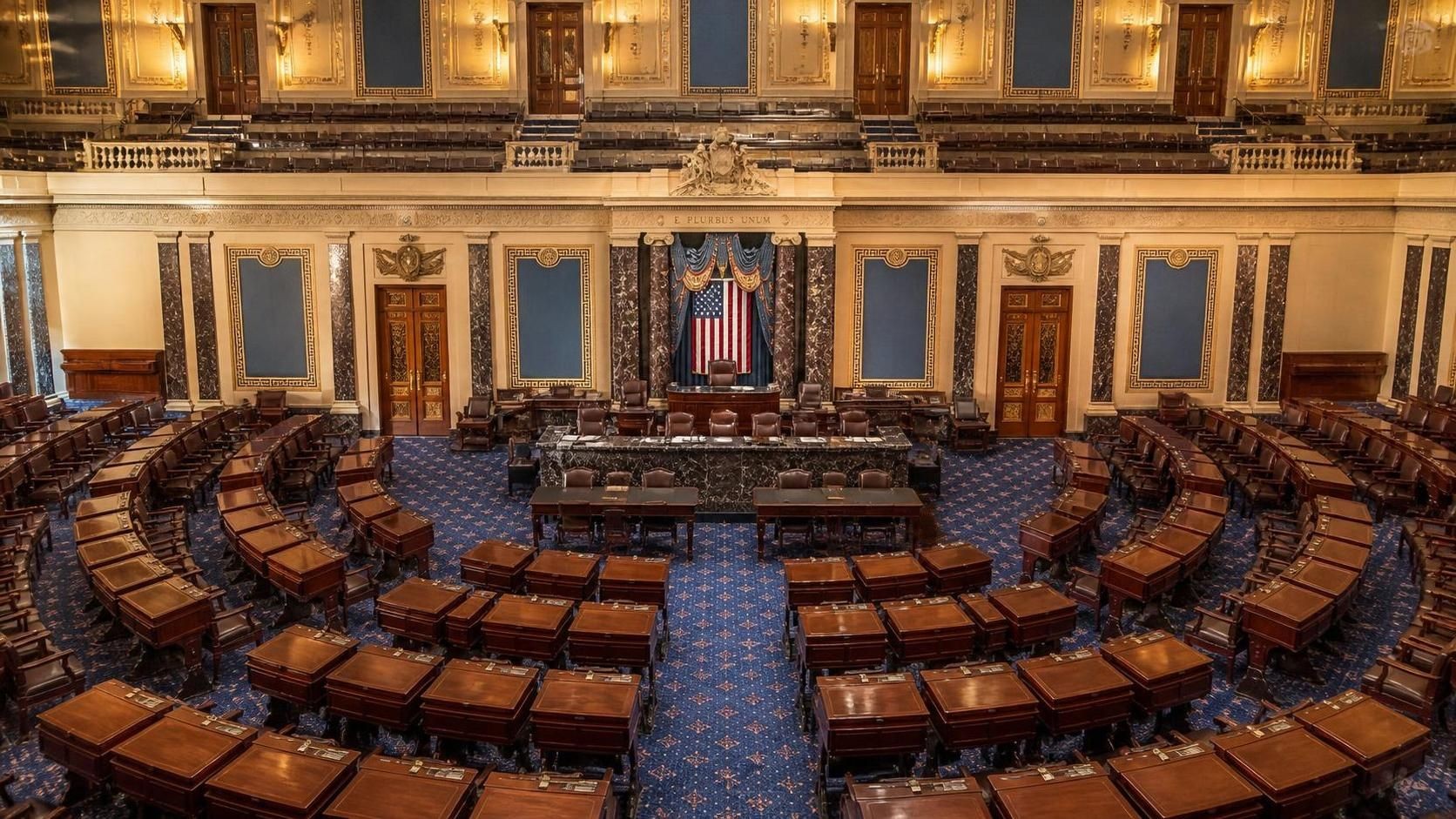
The Senate on Thursday night passed a bill meant to make it easier to build pipelines, power lines and other major energy infrastructure, and sent it to the House, where the calendar is short and the next majority is already spoken for.
On a recorded vote of 62–33, with five senators not voting, the Senate passed H.R. 2347 as amended with the Bipartisan American Affordability and Jobs Act of 2026, authored by Sens. Shelley Moore Capito (R-W.Va.), Mike Lee (R-Utah), Sheldon Whitehouse (D-R.I.) and Martin Heinrich (D-N.M.). The Senate Daily Press Gallery recorded that the roll call began at 9:30 p.m. Eastern and that the bill passed at 10:02 p.m., or 9:02 p.m. Central.
Bloomberg’s @business account posted the news at 11:45 p.m. Central: “The US Senate passed a landmark bill to make it easier to build pipelines, power lines and other major energy infrastructure, sending the measure to the House, where its future remains uncertain.” The next stop is a House that changes hands on Jan. 3, 2027, after Democrats won the majority in this month’s midterms.
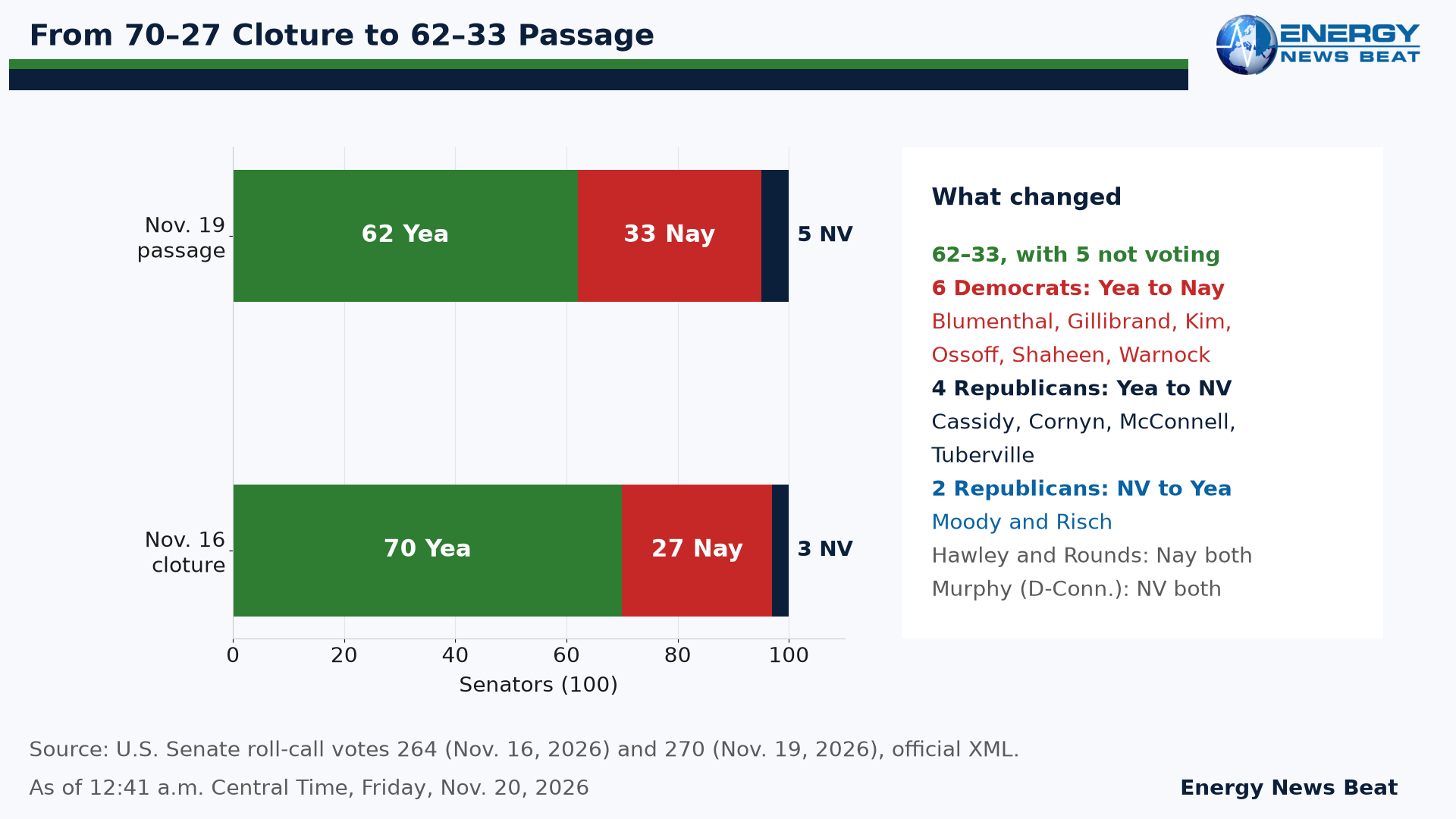
Six Democrats Flipped. Two Republicans Said No. Four Didn’t Vote.
Thursday’s roll call was not the same vote as Nov. 16, when the Senate invoked cloture on Capito Amendment No. 6883, the substitute, 70–27. Final passage ran eight votes weaker on the yes side and six votes heavier on the no side.
Six Democrats who had voted yes on that cloture vote voted no on passage: Richard Blumenthal (Conn.), Kirsten Gillibrand (N.Y.), Andy Kim (N.J.), Jon Ossoff (Ga.), Jeanne Shaheen (N.H.) and Raphael Warnock (Ga.). Four Republicans who had voted yes on cloture — Bill Cassidy (La.), John Cornyn (Texas), Mitch McConnell (Ky.) and Tommy Tuberville (Ala.) — did not vote Thursday night. Two Republicans who missed the Nov. 16 cloture vote, Ashley Moody (Fla.) and James Risch (Idaho), voted yes on passage. Sen. Christopher Murphy (D-Conn.) did not vote on either roll call.
The yes coalition was 47 Republicans, 14 Democrats and Independent Angus King of Maine. The no votes were 30 Democrats, Independent Bernie Sanders of Vermont, and two Republicans, Josh Hawley of Missouri and Mike Rounds of South Dakota, who also voted no on Nov. 16. Minority Leader Chuck Schumer voted yes, as did the four authors.
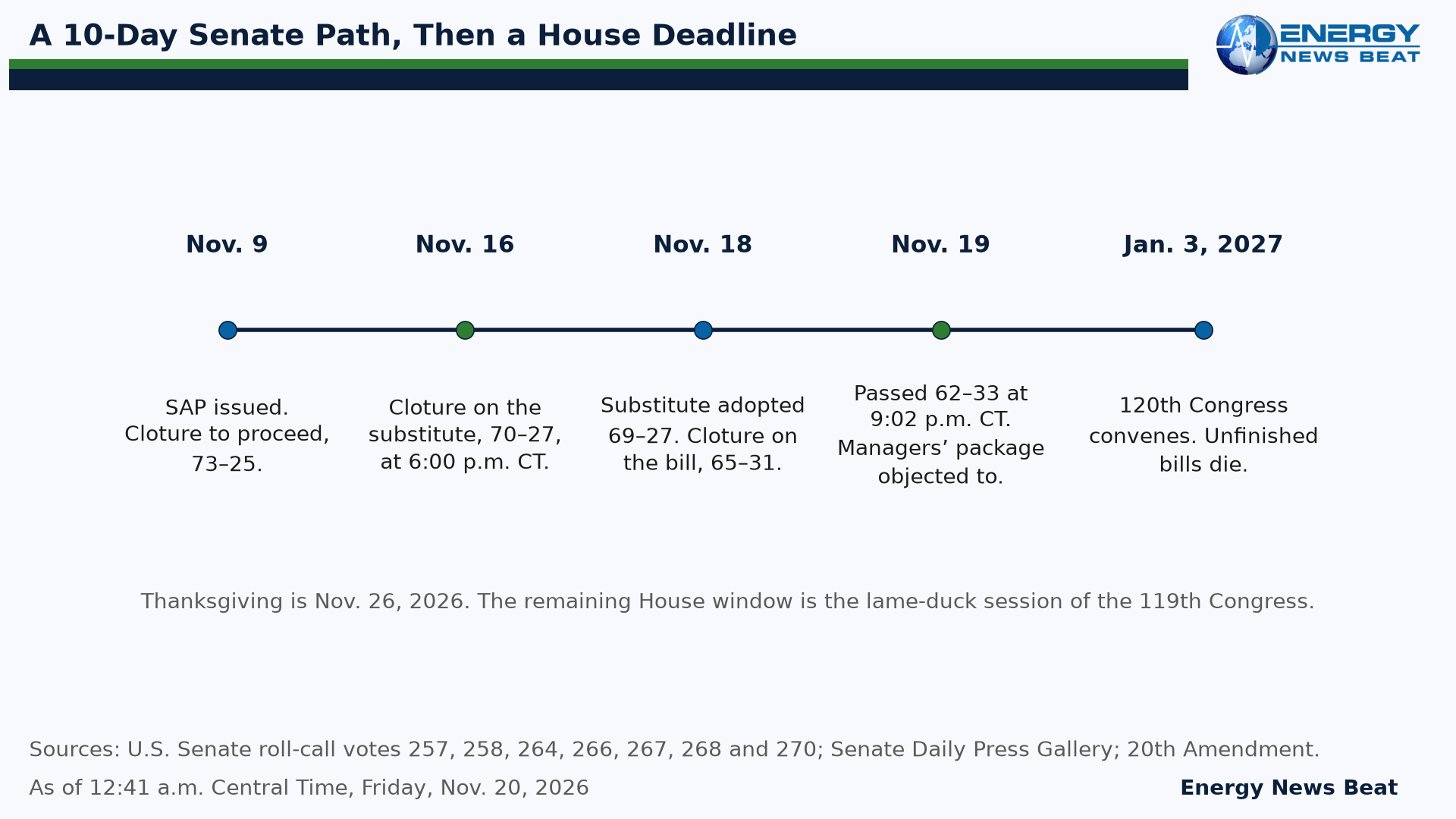
On Nov. 18 the Senate waived a budget point of order, 70–26, adopted the substitute, 69–27, and invoked cloture on the amended bill, 65–31. Thursday evening, Capito asked consent to consider a managers’ package, Amendment No. 7030, and other amendments; Sen. Jeff Merkley (D-Ore.) objected. After passage, Sen. Brian Schatz (D-Hawaii) asked consent to enroll a Lee-Heinrich-Capito correction; Merkley objected again. The House will receive the adopted substitute, not the later package that sponsors said would have tightened historic-preservation exemptions, addressed eminent-domain concerns raised by Hawley and Rounds, and closed a data-center loophole.
What the Bill Does to Pipelines, Power Lines and Court Clocks
The vehicle is still formally H.R. 2347, a House-passed tax bill. The substitute short-titles it the Bipartisan American Affordability and Jobs Act of 2026. What follows is the substitute posted by Senate Environment and Public Works and adopted 69–27.
The bill does not add a standalone pipeline-siting title. Section 1202 would narrow state Clean Water Act Section 401 certifications to water-quality requirements, a change the White House said would “prevent States from abusing the Clean Water Act Section 401 certification system to block pipelines, transmission, or other infrastructure.” Sections 1106 and 1110 would put harder clocks and shorter courthouse windows on federal environmental reviews.
On transmission, Section 2101 would rewrite Federal Power Act Section 216 cost allocation for certain interstate lines and expand federal permitting. The White House, in its Nov. 9 Statement of Administration Policy, said the bill “establishes a benefits-based cost allocation framework for interstate transmission, with explicit protection for ratepayers who receive no benefit from a given project.” Section 2107 states that computational-load customers — data centers — should “bear the full cost of any electric service that they require and the full cost of any infrastructure built to serve them,” so those costs “are not borne by other customers, including residential customers.”
Judicial review is shortened. Section 1110 generally requires National Environmental Policy Act claims to be filed not later than 150 days after the relevant notice, and courts would have to afford “substantial deference” to agencies on environmental documents. On remand, the covered activity “may, notwithstanding that remand, be carried out.” Section 1134 would cut the FAST-41 claims window from two years to 150 days. Section 1106 keeps a one-year clock for environmental assessments and a two-year clock for impact statements, with a record of decision due 45 days after an impact statement is published.
Section 1402 lets developers of any listed project type, from wind and solar to coal, gas and pipelines, sue over a “pattern of disparate treatment” in permitting, the provision supporters say makes it harder to sit on or yank permits for disfavored technologies. Section 2213 would set deadlines on Interior and Agriculture rights-of-way for renewable projects. Sections 2251 and 2252 address offshore energy and offshore transmission. Those are statutory changes, not a White House decision to unstick a stalled wind farm.
The Consumer Question, and a House Clock That Runs Out on Jan. 3
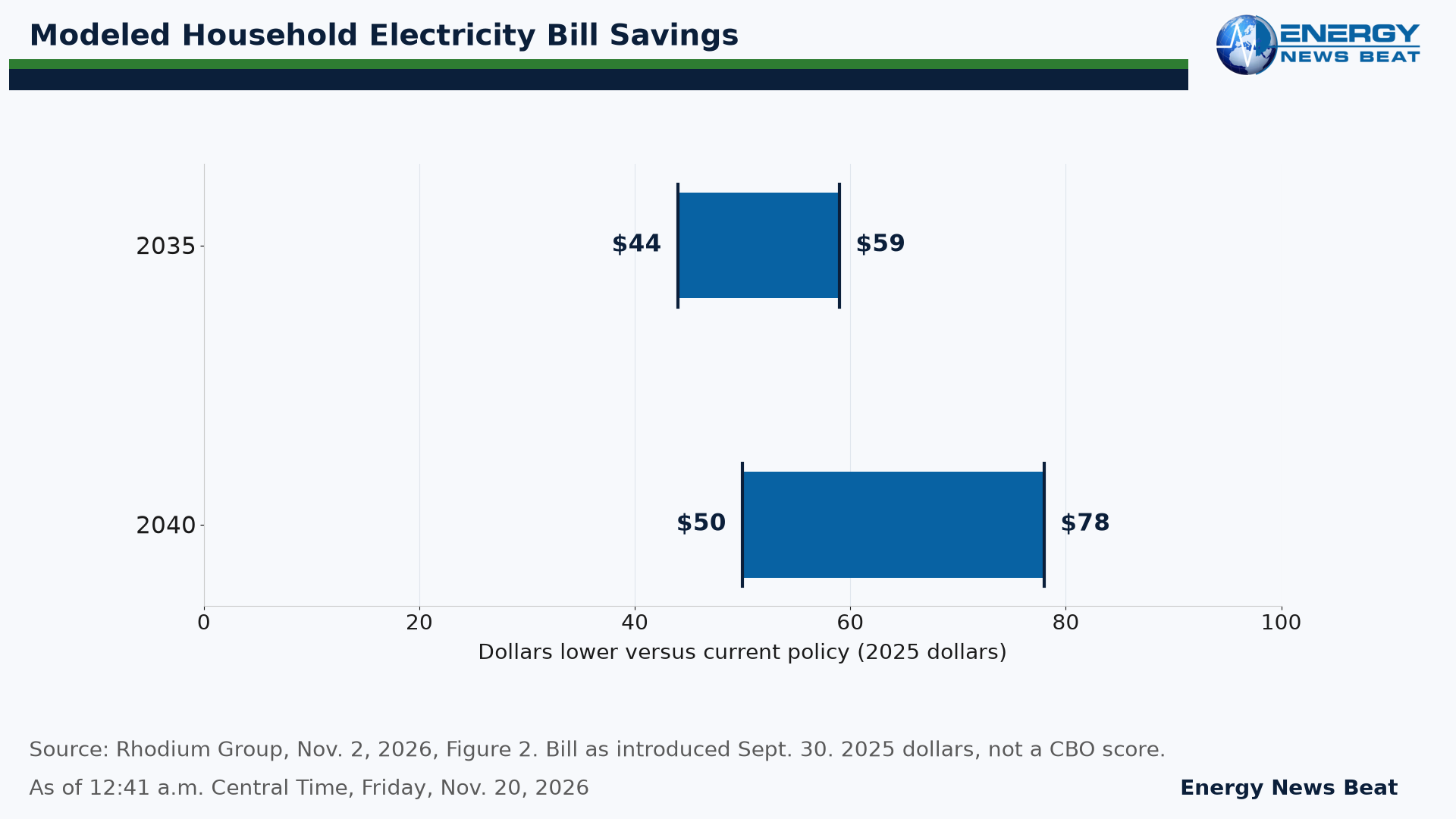
The household question is whether faster pipes and wires, and a rule that data centers pay their own way, show up on the bill. There is no official Congressional Budget Office estimate of the effect on residential gas or electricity bills. Rhodium Group, modeling the bill as introduced Sept. 30, estimated that average household electricity bills would be $50 to $78 lower in 2040, in 2025 dollars, than without the bill. Those are model results, not a guarantee, and the larger savings are more than a decade out. Rhodium did not publish a comparable simple estimate of household natural-gas bills; it found mixed outcomes for gas pipelines and 8% to 15% more LNG exports.
Heinrich’s office, citing Grid Strategies, said data centers would contribute about $55 billion toward transmission costs over the next decade, about $35 billion more than under current policy — a sponsor citation, not a government score. “Tonight, the passage of permitting reform in the Senate finally became reality and we took a major step towards addressing the affordability concerns of the American people,” Capito said after the vote.
The bill now goes to the House. Speaker Mike Johnson told Bloomberg on Nov. 11, “We’ve got the Republicans together to pass anything in the House right now. It’s really up to the Senate.” The White House SAP said that if the measure reached the president, “his advisors would recommend that he sign it into law.” A competing earlier House bill, the SPEED Act, H.R. 4776, sponsored by Rep. Bruce Westerman (R-Ark.), already passed the House 221–196 on Dec. 18, 2025; it is not the Senate text now coming back. Rep. Scott Peters (D-Calif.) said, “We should pass it before the end of this Congress.” “Don’t believe the lie that this terrible bill, exactly as drafted, is the last, best and only chance to ever do permitting reform,” Rep. Jared Huffman (D-Calif.), the likely incoming Natural Resources chairman, said. “We can produce a better deal.”
Consumer and Investor Views
Clean energy and fossil energy groups cheered the Senate vote. The American Petroleum Institute called it a “major breakthrough on historic permitting reforms that would deliver more affordable energy for consumers, cut costly delays, and build much-needed critical infrastructure.” The American Clean Power Association called it “a clean energy bill that will modernize America’s energy systems and lower consumer prices.” Both comments were reported by CNBC. Rob Gramlich, founder of Grid Strategies, told CNBC that Democrats want the grid capacity for clean energy, while Republicans “care about economic growth and serving new large loads.”
Critics were just as clear. The Natural Resources Defense Council said, “The House should not pass a bill that gives President Trump a blank check to reward oil and gas companies and data center developers.” The National Congress of American Indians, with other Native organizations, called on both chambers on Nov. 17 to “reject BAAJA in its entirety,” saying even the latest managers’ amendment, which never became part of the bill, does not resolve concerns “regarding the protection of Native sovereignty, sacred places, cultural heritage, and historic preservation.” Sen. Ron Wyden (D-Ore.) told reporters, “I’m not going to sit around and let these data centers scar our treasures.”
Timeline
Key dates for the Senate permitting bill, from the White House statement of administration policy through Senate passage and the House deadline. Times are Central.
Dec. 18, 2025, 1:39 p.m. CT. The House passed the SPEED Act, H.R. 4776, 221–196 (Clerk roll call 356). The bill was received in the Senate and referred to the Environment and Public Works Committee.
Sept. 30, 2026. Sens. Capito, Lee, Whitehouse and Heinrich introduced the Bipartisan American Affordability and Jobs Act (S. 5653) and later offered it as a substitute to H.R. 2347.
Nov. 9, 2026. The White House Office of Management and Budget issued a Statement of Administration Policy strongly supporting S. 5653 and saying the president’s advisors would recommend that he sign it. The Senate invoked cloture on the motion to proceed, 73–25.
Nov. 10, 2026. The Senate agreed to the motion to proceed to H.R. 2347, 62–21.
Nov. 11, 2026, 3:15 p.m. CT. Speaker Mike Johnson told Bloomberg, “We’ve got the Republicans together to pass anything in the House right now. It’s really up to the Senate.”
Nov. 16, 2026, 6:00 p.m. CT. The Senate invoked cloture on Capito Amendment No. 6883, 70–27, with three not voting (Daily Press, 7:00 p.m. Eastern).
Nov. 18, 2026, 11:41 a.m. CT. The Senate waived budgetary discipline, 70–26 (Daily Press, 12:41 p.m. Eastern).
Nov. 18, 2026, 12:23 p.m. CT. The Senate adopted Capito Amendment No. 6883, the substitute, 69–27 (Daily Press, 1:23 p.m. Eastern).
Nov. 18, 2026, 1:30 p.m. CT. The Senate invoked cloture on H.R. 2347, as amended, 65–31 (Daily Press, 2:30 p.m. Eastern).
Nov. 19, 2026, 8:20 p.m. CT. Capito called up managers’ Amendment No. 7030. Merkley objected (Daily Press, 9:20 p.m. Eastern).
Nov. 19, 2026, 8:30 p.m. CT. The Senate began the roll call on passage (Daily Press, 9:30 p.m. Eastern).
Nov. 19, 2026, 9:02 p.m. CT. The Senate passed H.R. 2347, as amended, 62–33 (Daily Press, 10:02 p.m. Eastern). Official result: Bill Passed (62–33), vote 270.
Nov. 19, 2026, 11:45 p.m. CT. Bloomberg’s @business account posted that the Senate had passed the landmark bill and sent it to the House, “where its future remains uncertain.”
Nov. 26, 2026. Thanksgiving Day. The House lame-duck calendar after the holiday is the remaining window in the 119th Congress.
Jan. 3, 2027. The 120th Congress convenes. Unfinished 119th Congress legislation that has not been sent to the president dies at the end of the Congress.
Caveats and Criticism
This is Senate passage, not a law. The House must still pass the same text, or the chambers must resolve differences, and the president must sign it, all before Jan. 3, 2027. Johnson’s comment that Republicans were together was made on Nov. 11, before the Senate vote, and was not a post-passage whip count.
The consumer savings figures are private model results, not official scores. Rhodium, modeling the bill as introduced Sept. 30 and not the permit-certainty provisions, estimated $50-to-$78 lower household electricity bills in 2040, in 2025 dollars. The official roll-call page stamps vote 270 at “09:30 AM,” the Daily Press start time but labeled a.m. Environmental groups, including the Sierra Club and NRDC, oppose the bill as weakening bedrock review laws.
Stu’s Take
The Senate finally did the hard thing. Passing a permitting bill is not the same as cutting your electric bill next summer, and anyone who tells you the Rhodium $50-to-$78 figure is money in the mailbox in 2027 is selling a model, not a rate case. But this is the first time in years the Senate has actually moved steel-in-the-ground policy — pipelines, interstate lines, and a rule that data centers pay their own way — across the floor. The House is now the whole ballgame. Johnson said before this vote that he had the Republicans. Huffman and other Democrats who just won the next House want a different bill in January, and the managers’ fix that might have blunted the eminent-domain fight never even got a vote. If this dies in the lame duck, we will spend another Congress arguing about process while interconnection queues and gas takeaway stay exactly where they are.
Is the bill perfect, and are there things not so good for consumers in the bill, yes. But we will be tracking policies, implementations, and how all this pans out for consumers by state, and how their representatives voted. I have little faith in Congress that the house will pass it. Just saying.
Appendix A. Sources
Primary and contemporaneous sources used for this article, with access dates. Official Senate roll-call files control the vote count and each senator’s position. The Senate Daily Press Gallery floor log is the source for the evening clock times on passage.
- U.S. Senate, roll-call vote 270, 119th Congress, 2nd session, On Passage of the Bill, H.R. 2347, as Amended, result Bill Passed (62–33), vote date listed as November 19, 2026, 09:30 AM, file modified November 19, 2026, 10:28 PM. Accessed Nov. 20, 2026. https://www.senate.gov/legislative/LIS/roll_call_votes/vote1192/vote_119_2_00270.htm
- U.S. Senate, roll-call vote 270 XML (official member-by-member file). Accessed Nov. 20, 2026. https://www.senate.gov/legislative/LIS/roll_call_votes/vote1192/vote_119_2_00270.xml
- U.S. Senate, roll-call vote 264, cloture on Capito Amendment No. 6883, agreed to 70–27, November 16, 2026, 6:27 p.m. Accessed Nov. 20, 2026. https://www.senate.gov/legislative/LIS/roll_call_votes/vote1192/vote_119_2_00264.htm
- U.S. Senate, roll-call vote 266, motion to waive all applicable budgetary discipline re: H.R. 2347, agreed to 70–26, November 18, 2026, 11:50 a.m. Accessed Nov. 20, 2026. https://www.senate.gov/legislative/LIS/roll_call_votes/vote1192/vote_119_2_00266.htm
- U.S. Senate, roll-call vote 267, Capito Amendment No. 6883 (in the nature of a substitute), agreed to 69–27, November 18, 2026, 12:42 p.m. Accessed Nov. 20, 2026. https://www.senate.gov/legislative/LIS/roll_call_votes/vote1192/vote_119_2_00267.htm
- U.S. Senate, roll-call vote 268, cloture on H.R. 2347, agreed to 65–31, November 18, 2026, 1:23 p.m. Accessed Nov. 20, 2026. https://www.senate.gov/legislative/LIS/roll_call_votes/vote1192/vote_119_2_00268.htm
- U.S. Senate Daily Press Gallery, Thursday, November 19, 2026, floor log (roll call on passage began 9:30 p.m.; bill passed 10:02 p.m., 62–33; managers’ amendment 7030 objected to at 9:20 p.m.). Accessed Nov. 20, 2026. https://www.dailypress.senate.gov/thursday-november-19-2026/
- U.S. Senate Daily Press Gallery, Wednesday, November 18, 2026, floor log. Accessed Nov. 20, 2026. https://www.dailypress.senate.gov/wednesday-november-18-2026/
- Bloomberg (@business), post 2123653856567480496, 11:45 p.m. Central Time, Nov. 19, 2026 (created_at 2026-11-20T05:45:09.000Z). Accessed Nov. 20, 2026. https://x.com/business/status/2123653856567480496
- Executive Office of the President, Office of Management and Budget, Statement of Administration Policy, S. 5653 – Bipartisan American Affordability and Jobs Act of 2026, Nov. 9, 2026. Accessed Nov. 20, 2026. https://www.whitehouse.gov/wp-content/uploads/2026/11/SAP-S5653.pdf
- U.S. Senate Committee on Energy and Natural Resources, “Heinrich: Senate Passage of Landmark Bipartisan Permitting Deal Will Lower Electricity Bills…,” Nov. 19, 2026. Accessed Nov. 20, 2026. https://www.energy.senate.gov/press/dem/heinrich-senate-passage-of-landmark-bipartisan-permitting-deal-will-lower-electricity-bills-hold-data-centers-accountable-create-over-one-hundred-thousand-jobs-reduce-carbon-emissions/
- Sen. Shelley Moore Capito, statement after passage, Nov. 19, 2026, beginning “Tonight, the passage of permitting reform in the Senate finally became reality…,” as reported by Reuters. Accessed Nov. 20, 2026. https://www.investing.com/news/commodities-news/us-senate-passes-bipartisan-bill-to-speed-energy-infrastructure-projects-5040581
- Grid Strategies, “Grid Funding from Data Centers in BAAJA,” on the $55 billion transmission-service-charge estimate cited by Heinrich’s office. Accessed Nov. 20, 2026. https://gridstrategiesllc.com/wp-content/uploads/Grid-Funding-from-Data-Centers-in-BAAJA.pdf
- Congressional Record, Nov. 10, 2026, pages S5471–S5520, text of Capito Amendment No. 6883 (SA 6883) as submitted, used for section citations. Accessed Nov. 20, 2026. https://www.govinfo.gov/content/pkg/CREC-2026-11-10/html/CREC-2026-11-10-pt1-PgS5471-2.htm
- Rhodium Group, “Estimating the US Energy System Impacts of the Bipartisan American Affordability and Jobs Act,” November 2026. Accessed Nov. 20, 2026. https://rhg.com/research/baaja-us-energy-system-impacts/
- Rhodium Group, “Estimating the Energy System and Emissions Impacts of BAAJA” (PDF), November 2026. Accessed Nov. 20, 2026. https://rhg.com/wp-content/uploads/2026/11/Estimating-the-Energy-System-and-Emissions-Impacts-of-BAAJA.pdf
- Rhodium Group, “The Impact of Permitting Reform on State-level Residential Electricity Prices and Bills” (PDF), November 2026. Accessed Nov. 20, 2026. https://rhg.com/wp-content/uploads/2026/11/The-Impact-of-Permitting-Reform-on-State-level-Residential-Electricity-Prices-and-Bills.pdf
- Office of the Clerk, U.S. House of Representatives, roll call 356, H.R. 4776, SPEED Act, 221–196, vote date 2025-12-18T14:39:00. Accessed Nov. 20, 2026. https://clerk.house.gov/Votes/2025356
- Ari Natter, Bloomberg Law, “Johnson Says He Expects House Will Pass Senate Permit Bill,” Nov. 11, 2026, 9:15 p.m. UTC (3:15 p.m. Central). Accessed Nov. 20, 2026. https://news.bloomberglaw.com/environment-and-energy/johnson-says-he-expects-house-will-pass-senate-permitting-bill
- David Jordan, Roll Call, “Sweeping permitting overhaul passes Senate, on to House,” posted Nov. 19, 2026, 10:27 p.m. Accessed Nov. 20, 2026. https://rollcall.com/2026/11/19/sweeping-permitting-overhaul-passes-senate-on-to-house
- Ben Geman, Axios, “Senate passes bill to speed up permits for energy and infrastructure,” Nov. 20, 2026. Accessed Nov. 20, 2026. https://www.axios.com/2026/11/20/senate-passes-energy-permitting-bill
- Garrett Downs, CNBC, “Senate passes BAAJA permitting reform bill backed by AI, energy sectors,” published Nov. 19, 2026, 10:30 p.m. Eastern. Accessed Nov. 20, 2026. https://www.cnbc.com/2026/11/20/baaja-bill-senate-passes-permitting-reform.html
- National Congress of American Indians, “Native Organizations to Congress: Our Position Has Not Changed. Reject BAAJA in its Entirety,” Nov. 17, 2026. Accessed Nov. 20, 2026. https://www.ncai.org/news/reject-baaja-in-its-entirety
- U.S. Constitution, Amendment XX, §1 (terms of Senators and Representatives end at noon on Jan. 3). Accessed Nov. 20, 2026. https://www.archives.gov/founding-docs/amendments-11-27#toc-amendment-xx
- U.S. Senate Committee on Environment and Public Works, “Senate Advances Bipartisan American Affordability and Jobs Act,” Nov. 9, 2026. Accessed Nov. 20, 2026. https://www.epw.senate.gov/press/rep/senate-advances-capito-s-bipartisan-american-affordability-and-jobs-act/
Appendix B. Key excerpts
Senate vote 270, official result. “Bill Passed (62–33).” Question: “On Passage of the Bill.” Title: “H.R. 2347, as Amended.” Majority requirement: 1/2. Count: yeas 62, nays 33, absent 5.
Senate Daily Press Gallery, Nov. 19, 2026. “9:30 p.m. The Senate began a roll call vote on passage of H.R.2347, Bipartisan American Affordability and Jobs Act of 2026, as amended.” “10:02 p.m. By a vote of 62 to 33, the Senate passed H.R.2347, Bipartisan American Affordability and Jobs Act of 2026, as amended.” “9:20 p.m. Senator Capito called up the bipartisan managers amendment #7030. … Senator Merkley objected.”
Bloomberg @business, 11:45 p.m. CT, Nov. 19, 2026. “The US Senate passed a landmark bill to make it easier to build pipelines, power lines and other major energy infrastructure, sending the measure to the House, where its future remains uncertain.”
White House Statement of Administration Policy, Nov. 9, 2026. “The Administration strongly supports passage of S. 5653, the Bipartisan American Affordability and Jobs Act of 2026.” “If S. 5653 were presented to the President, his advisors would recommend that he sign it into law.” The SAP also said the bill “establishes a benefits-based cost allocation framework for interstate transmission, with explicit protection for ratepayers who receive no benefit from a given project,” and would “prevent States from abusing the Clean Water Act Section 401 certification system to block pipelines, transmission, or other infrastructure.”
Speaker Mike Johnson, interview reported by Bloomberg, Nov. 11, 2026. “We’ve got the Republicans together to pass anything in the House right now. It’s really up to the Senate.”
Sen. Shelley Moore Capito, after passage, Nov. 19, 2026. “Tonight, the passage of permitting reform in the Senate finally became reality and we took a major step towards addressing the affordability concerns of the American people.”
Substitute §2107, ratepayer protection (findings). It is the policy of the United States that computational load owners and operators “bear the full cost of any electric service that they require and the full cost of any infrastructure built to serve them … so that such costs are not borne by other customers, including residential customers.”
Substitute §1110, judicial review. A claim generally “is filed not later than 150 days after the date on which” the relevant notice is published. “A court shall afford substantial deference to the agency relating to the scope and contents of an environmental document.” On remand, the activity “may, notwithstanding that remand, be carried out.”
Substitute §1106, NEPA clocks. The lead agency “shall complete and make public the environmental assessment … not later than the date that is 1 year after” the earlier of the specified start dates, and “shall publish an environmental impact statement … not later than the date that is 2 years after” the earlier of the specified start dates. A record of decision is due “not later than 45 days after” the impact statement is published.
Substitute §1134, FAST-41 claims. Section 41007(a) of the FAST Act is amended by striking “2 years” and inserting “150 days.”
Rhodium Group, energy-system analysis, November 2026. “In 2040, BAAJA drives electricity prices down, in inflation-adjusted terms, by 0.5-1.0 cents” and “into average annual household electricity bills that are $50-78 lower in 2040 than without the bill.”
API and American Clean Power, as reported by CNBC, Nov. 19–20, 2026. API: “a major breakthrough on historic permitting reforms that would deliver more affordable energy for consumers, cut costly delays, and build much-needed critical infrastructure.” ACP: “a clean energy bill that will modernize America’s energy systems and lower consumer prices.”
Natural Resources Defense Council, as reported by CNBC. “The House should not pass a bill that gives President Trump a blank check to reward oil and gas companies and data center developers.”
National Congress of American Indians, Nov. 17, 2026. “Our position has not changed. Congress must reject BAAJA in its entirety.” The latest managers’ amendment “does not resolve the serious concerns we have raised regarding the protection of Native sovereignty, sacred places, cultural heritage, and historic preservation.”
Rep. Jared Huffman, as reported by CNBC. “Don’t believe the lie that this terrible bill, exactly as drafted, is the last, best and only chance to ever do permitting reform,” he said. “We can produce a better deal.”
Rep. Scott Peters, as reported by CNBC. “Democrats promised to lower bills, cut pollution, and protect ratepayers. Voters are giving us a chance to show we mean it. BAAJA does all three. We should pass it before the end of this Congress.”
Appendix C. Data tables
Vote tallies and the senator-by-senator scorecard are taken from official U.S. Senate roll-call XML files for votes 257, 258, 264, 266, 267, 268 and 270, retrieved Nov. 20, 2026. Times in Table A are Daily Press result times, shown in Central Time, except as noted for the official vote 270 a.m. stamp. As-of times are Central.
Table A. Recorded Senate votes on H.R. 2347 / BAAJA, November 2026
| Vote | When (Central, with official or Daily Press clock) | Question | Tally | Result |
| 257 | Nov. 9, 2026 | Cloture on motion to proceed | 73–25 | Agreed to (3/5) |
| 258 | Nov. 10, 2026 | Motion to proceed to H.R. 2347 | 62–21 | Agreed to (1/2) |
| 264 | Nov. 16, 6:00 p.m. CT (Daily Press 7:00 p.m. ET) | Cloture on Capito Amdt. No. 6883 | 70–27 (3 NV) | Agreed to (3/5) |
| 266 | Nov. 18, 11:41 a.m. CT (Daily Press 12:41 p.m. ET) | Waive budgetary discipline | 70–26 (4 NV) | Agreed to (3/5) |
| 267 | Nov. 18, 12:23 p.m. CT (Daily Press 1:23 p.m. ET) | Adopt Capito Amdt. No. 6883 (substitute) | 69–27 (4 NV) | Agreed to (1/2) |
| 268 | Nov. 18, 1:30 p.m. CT (Daily Press 2:30 p.m. ET) | Cloture on H.R. 2347 | 65–31 (4 NV) | Agreed to (3/5) |
| 270 | Nov. 19, 9:02 p.m. CT (Daily Press 10:02 p.m. ET; roll call began 8:30 p.m. CT / 9:30 p.m. ET). Official stamp: 09:30 AM | Passage of H.R. 2347, as amended | 62–33 (5 NV) | Bill Passed (1/2) |
Sources: U.S. Senate roll-call votes 257, 258, 264, 266, 267, 268 and 270; Senate Daily Press Gallery, Nov. 19, 2026. Official files retrieved Nov. 20, 2026.
Table B. Party breakdown on final passage (vote 270)
| Party | Yea | Nay | Not voting | Total |
| Republican | 47 | 2 (Hawley, Rounds) | 4 (Cassidy, Cornyn, McConnell, Tuberville) | 53 |
| Democratic | 14 | 30 | 1 (Murphy) | 45 |
| Independent | 1 (King) | 1 (Sanders) | 0 | 2 |
| Total | 62 | 33 | 5 | 100 |
Source: U.S. Senate roll-call vote 270 XML. As of the official file modified 10:28 p.m. Eastern, Nov. 19, 2026.
Table C. Amendments and consent requests on the substitute and passage
| Item | Action | Outcome |
| Capito No. 6883, substitute | Recorded vote 267, Nov. 18 | Adopted 69–27 (4 NV) |
| Motion to waive budgetary discipline (Merkley point of order) | Recorded vote 266, Nov. 18 | Agreed to 70–26 (4 NV) |
| Managers’ package No. 7030 | Unanimous-consent request, Nov. 19, 9:20 p.m. ET | Merkley objected; not adopted |
| Slate including Shaheen 6895, Schiff 6882, Paul 6911, Hawley 6857 and 6858, Kim 6915, Scott (FL) 6973, Merkley 7008 and 6917, King 6951, and others listed in the Daily Press 9:07 p.m. entry | Unanimous-consent request, Nov. 19 | No time agreement; not brought to recorded votes |
| Lee-Heinrich-Capito enrollment correction (Daily Press: “amendment #730”) | Unanimous-consent request after passage, 10:45 p.m. ET, by Schatz | Merkley objected; not adopted |
Sources: Senate votes 266 and 267; Senate Daily Press Gallery, Nov. 19, 2026. Daily Press spelling “Shiff 6882” is treated as Schiff Amendment No. 6882. “Amendment #730” is the Daily Press wording for the post-passage enrollment request and may be a shortened or mistyped reference to a related Lee-Heinrich-Capito amendment; it was not adopted.
Table D. Changes between the Nov. 16 cloture vote (264) and Nov. 19 passage (270)
| Senator | Party-State | Cloture 11/16 | Passage 11/19 | Change |
| Blumenthal, Richard | D-CT | Yea | Nay | Yea → Nay |
| Cassidy, Bill | R-LA | Yea | NV | Yea → Not Voting |
| Cornyn, John | R-TX | Yea | NV | Yea → Not Voting |
| Gillibrand, Kirsten | D-NY | Yea | Nay | Yea → Nay |
| Kim, Andy | D-NJ | Yea | Nay | Yea → Nay |
| McConnell, Mitch | R-KY | Yea | NV | Yea → Not Voting |
| Moody, Ashley | R-FL | NV | Yea | Not Voting → Yea |
| Ossoff, Jon | D-GA | Yea | Nay | Yea → Nay |
| Risch, James | R-ID | NV | Yea | Not Voting → Yea |
| Shaheen, Jeanne | D-NH | Yea | Nay | Yea → Nay |
| Tuberville, Tommy | R-AL | Yea | NV | Yea → Not Voting |
| Warnock, Raphael | D-GA | Yea | Nay | Yea → Nay |
Source: Official Senate XML for votes 264 and 270. “NV” means not voting. Murphy did not vote on either roll call and therefore does not appear as a change.
Table E. Modeled consumer-bill estimates and official-score status
| Item | Figure | Source |
| Average household electricity bill vs. no-BAAJA, 2040 | $50 to $78 lower (2025 dollars) | Rhodium energy-system paper, Nov. 2, 2026, Figure 2. Modeled the Sept. 30 introduced bill, not the permit-certainty provisions. |
| Average household electricity bill vs. no-BAAJA, 2035 (same paper, used in Chart 03) | $44 to $59 lower (2025 dollars) | Rhodium energy-system paper, Nov. 2, 2026, Figure 2. Modeled the Sept. 30 introduced bill. |
| Residential electricity price vs. no-BAAJA, 2040 | 0.5 to 1.0 cents/kWh lower (inflation-adjusted) | Rhodium energy-system paper, Nov. 2, 2026 |
| Average household electricity bill vs. no-BAAJA, 2035 (companion paper) | $41 to $66 lower (2025 dollars) | Rhodium state-bills paper, Nov. 12, 2026. Also modeled the Sept. 30 introduced bill. |
| National residential price change, 2035 | 3 to 4 percent lower | Rhodium state-bills paper, Nov. 12, 2026. Also modeled the Sept. 30 introduced bill. |
| Household natural-gas bills | No comparable simple estimate published; “mixed outcomes for gas pipelines,” and LNG export volumes 8% to 15% higher | Rhodium energy-system paper, Nov. 2, 2026 |
| CBO residential bill estimate | None published as of Nov. 20, 2026 | Congressional Budget Office; none published as of Nov. 20, 2026 |
| Data-center transmission contribution over 10 years | About $55 billion in transmission service charges over ten years ($35 billion embedded + $20 billion incremental), for 40.3 GW of new data centers; excludes ERCOT/Texas. About $35 billion more than current policy. Cited by Heinrich’s office, not a government score. | Grid Strategies, “Grid Funding from Data Centers in BAAJA”; Heinrich release, Nov. 19, 2026 |
Rhodium figures are private model results under multiple scenarios, not Congressional Budget Office scores. Both the Nov. 2 energy-system paper and the Nov. 12 state-bills paper modeled the bill as introduced Sept. 30 and did not include the permit-certainty provisions. Chart 03 uses only the Nov. 2 paper (Figure 2). Retrieved Nov. 20, 2026.
Table F. Full Senate scorecard: Nov. 16 cloture on the substitute vs. Nov. 19 passage
| Senator | Party-State | Cloture 11/16 | Passage 11/19 | Change |
| Alsobrooks, Angela | D-MD | Nay | Nay | — |
| Armstrong, Alan | R-OK | Yea | Yea | — |
| Baldwin, Tammy | D-WI | Nay | Nay | — |
| Banks, Jim | R-IN | Yea | Yea | — |
| Barrasso, John | R-WY | Yea | Yea | — |
| Bennet, Michael | D-CO | Nay | Nay | — |
| Blackburn, Marsha | R-TN | Yea | Yea | — |
| Blumenthal, Richard | D-CT | Yea | Nay | Yea → Nay |
| Blunt Rochester, Lisa | D-DE | Nay | Nay | — |
| Booker, Cory | D-NJ | Nay | Nay | — |
| Boozman, John | R-AR | Yea | Yea | — |
| Britt, Katie | R-AL | Yea | Yea | — |
| Budd, Ted | R-NC | Yea | Yea | — |
| Cantwell, Maria | D-WA | Nay | Nay | — |
| Capito, Shelley | R-WV | Yea | Yea | — |
| Cassidy, Bill | R-LA | Yea | NV | Yea → Not Voting |
| Collins, Susan | R-ME | Yea | Yea | — |
| Coons, Christopher | D-DE | Yea | Yea | — |
| Cornyn, John | R-TX | Yea | NV | Yea → Not Voting |
| Cortez Masto, Catherine | D-NV | Nay | Nay | — |
| Cotton, Tom | R-AR | Yea | Yea | — |
| Cramer, Kevin | R-ND | Yea | Yea | — |
| Crapo, Mike | R-ID | Yea | Yea | — |
| Cruz, Ted | R-TX | Yea | Yea | — |
| Curtis, John | R-UT | Yea | Yea | — |
| Daines, Steve | R-MT | Yea | Yea | — |
| Duckworth, Tammy | D-IL | Nay | Nay | — |
| Durbin, Richard | D-IL | Nay | Nay | — |
| Ernst, Joni | R-IA | Yea | Yea | — |
| Fetterman, John | D-PA | Yea | Yea | — |
| Fischer, Deb | R-NE | Yea | Yea | — |
| Gallego, Ruben | D-AZ | Yea | Yea | — |
| Gillibrand, Kirsten | D-NY | Yea | Nay | Yea → Nay |
| Graham, Darline | R-SC | Yea | Yea | — |
| Grassley, Chuck | R-IA | Yea | Yea | — |
| Hagerty, Bill | R-TN | Yea | Yea | — |
| Hassan, Maggie | D-NH | Nay | Nay | — |
| Hawley, Josh | R-MO | Nay | Nay | — |
| Heinrich, Martin | D-NM | Yea | Yea | — |
| Hickenlooper, John | D-CO | Yea | Yea | — |
| Hirono, Mazie | D-HI | Nay | Nay | — |
| Hoeven, John | R-ND | Yea | Yea | — |
| Husted, Jon | R-OH | Yea | Yea | — |
| Hyde-Smith, Cindy | R-MS | Yea | Yea | — |
| Johnson, Ron | R-WI | Yea | Yea | — |
| Justice, James | R-WV | Yea | Yea | — |
| Kaine, Timothy | D-VA | Nay | Nay | — |
| Kelly, Mark | D-AZ | Nay | Nay | — |
| Kennedy, John | R-LA | Yea | Yea | — |
| Kim, Andy | D-NJ | Yea | Nay | Yea → Nay |
| King, Angus | I-ME | Yea | Yea | — |
| Klobuchar, Amy | D-MN | Yea | Yea | — |
| Lankford, James | R-OK | Yea | Yea | — |
| Lee, Mike | R-UT | Yea | Yea | — |
| Lujan, Ben | D-NM | Nay | Nay | — |
| Lummis, Cynthia | R-WY | Yea | Yea | — |
| Markey, Edward | D-MA | Nay | Nay | — |
| Marshall, Roger | R-KS | Yea | Yea | — |
| McConnell, Mitch | R-KY | Yea | NV | Yea → Not Voting |
| McCormick, David | R-PA | Yea | Yea | — |
| Merkley, Jeff | D-OR | Nay | Nay | — |
| Moody, Ashley | R-FL | NV | Yea | Not Voting → Yea |
| Moran, Jerry | R-KS | Yea | Yea | — |
| Moreno, Bernie | R-OH | Yea | Yea | — |
| Murkowski, Lisa | R-AK | Yea | Yea | — |
| Murphy, Christopher | D-CT | NV | NV | — |
| Murray, Patty | D-WA | Nay | Nay | — |
| Ossoff, Jon | D-GA | Yea | Nay | Yea → Nay |
| Padilla, Alex | D-CA | Nay | Nay | — |
| Paul, Rand | R-KY | Yea | Yea | — |
| Peters, Gary | D-MI | Yea | Yea | — |
| Reed, John | D-RI | Yea | Yea | — |
| Ricketts, Pete | R-NE | Yea | Yea | — |
| Risch, James | R-ID | NV | Yea | Not Voting → Yea |
| Rosen, Jacky | D-NV | Yea | Yea | — |
| Rounds, Mike | R-SD | Nay | Nay | — |
| Sanders, Bernie | I-VT | Nay | Nay | — |
| Schatz, Brian | D-HI | Yea | Yea | — |
| Schiff, Adam | D-CA | Nay | Nay | — |
| Schmitt, Eric | R-MO | Yea | Yea | — |
| Schumer, Charles | D-NY | Yea | Yea | — |
| Scott, Rick | R-FL | Yea | Yea | — |
| Scott, Tim | R-SC | Yea | Yea | — |
| Shaheen, Jeanne | D-NH | Yea | Nay | Yea → Nay |
| Sheehy, Tim | R-MT | Yea | Yea | — |
| Slotkin, Elissa | D-MI | Yea | Yea | — |
| Smith, Tina | D-MN | Nay | Nay | — |
| Sullivan, Dan | R-AK | Yea | Yea | — |
| Thune, John | R-SD | Yea | Yea | — |
| Tillis, Thomas | R-NC | Yea | Yea | — |
| Tuberville, Tommy | R-AL | Yea | NV | Yea → Not Voting |
| Van Hollen, Chris | D-MD | Nay | Nay | — |
| Warner, Mark | D-VA | Yea | Yea | — |
| Warnock, Raphael | D-GA | Yea | Nay | Yea → Nay |
| Warren, Elizabeth | D-MA | Nay | Nay | — |
| Welch, Peter | D-VT | Nay | Nay | — |
| Whitehouse, Sheldon | D-RI | Yea | Yea | — |
| Wicker, Roger | R-MS | Yea | Yea | — |
| Wyden, Ron | D-OR | Nay | Nay | — |
| Young, Todd | R-IN | Yea | Yea | — |
Source: Official U.S. Senate roll-call XML, votes 264 and 270, retrieved Nov. 20, 2026. Yea/Nay/NV as recorded. A dash means the senator’s position did not change.
Appendix D. Background
The Bipartisan American Affordability and Jobs Act of 2026 began as S. 5653, introduced Sept. 30, 2026, by Sens. Capito, Lee, Whitehouse and Heinrich. The Senate used H.R. 2347, originally the Survivor Justice Tax Prevention Act, as the legislative vehicle; the Capito substitute (Amendment No. 6883) struck the House text after the enacting clause and inserted BAAJA, while a short Division C retained the original tax title. Energy News Beat previously covered the Nov. 9 cloture vote on the motion to proceed (73–25), the Nov. 10 motion to proceed (62–21), and the Nov. 16 cloture vote on the substitute (70–27). Those votes were not final passage. A separate, earlier House bill, the SPEED Act (H.R. 4776, Westerman), passed the House 221–196 on Dec. 18, 2025, and was referred to the Senate Environment and Public Works Committee. It is a competing NEPA-reform vehicle, not the Senate-passed text now returning to the House. The 119th Congress ends when the 120th Congress convenes at noon on Jan. 3, 2027, under the Twentieth Amendment. Democrats won a House majority in the November 2026 midterms and have nominated Rep. Hakeem Jeffries as their candidate for Speaker in the new Congress; Speaker Mike Johnson remains Speaker of the current House through the lame-duck session.