Inventories rose 20 billion cubic feet in the week ended Nov. 13, ahead of the five-year pace. EIA’s Winter Fuels Outlook puts the average gas-heated home at about $640 this season, but NERC says extreme, wide-area cold can still leave some regions short of electricity.
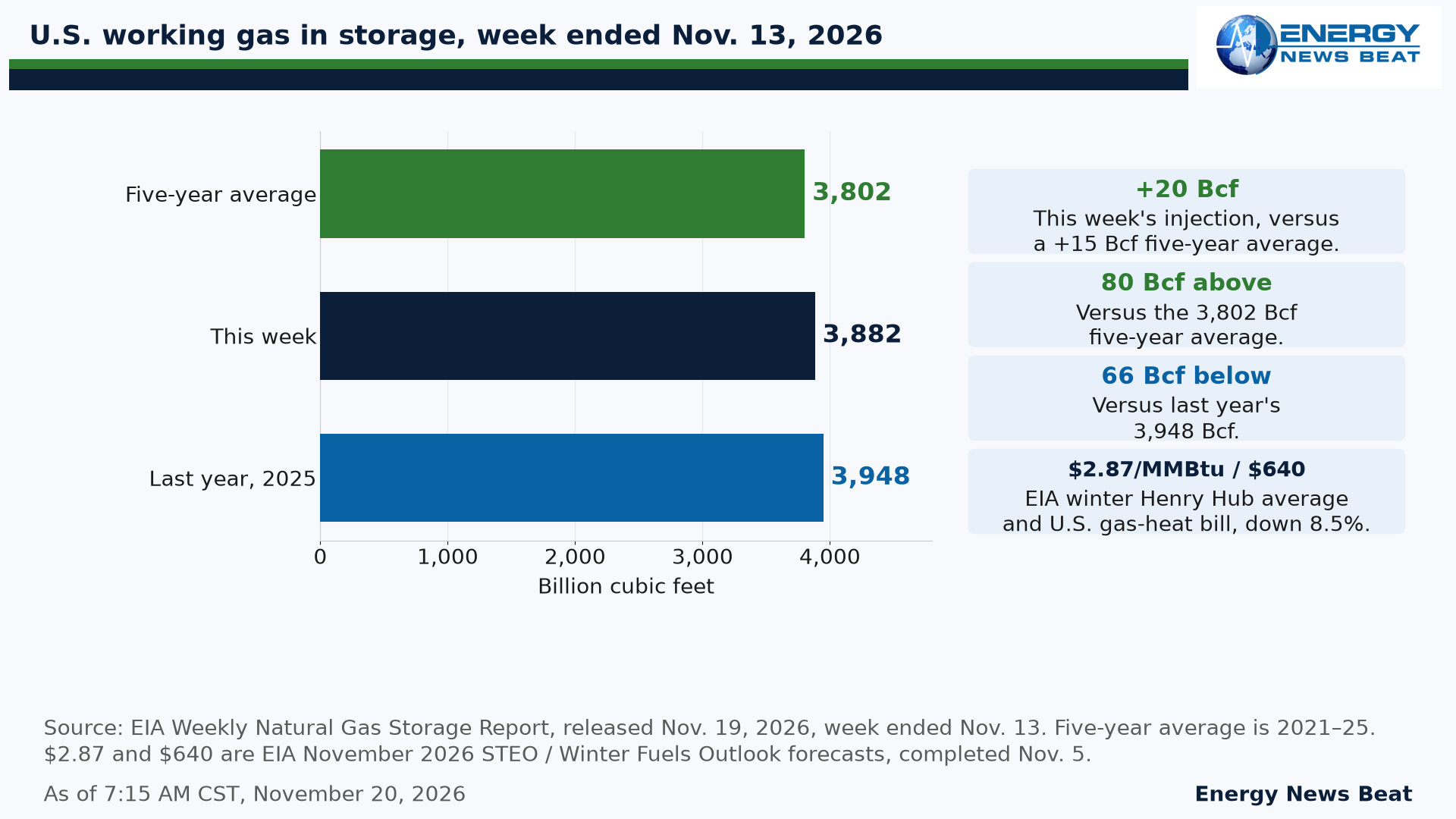
The U.S. Energy Information Administration reported Thursday that working gas in Lower 48 underground storage rose 20 billion cubic feet in the week ended Friday, Nov. 13, to 3,882 Bcf. That build was larger than the five-year average injection of 15 Bcf for the same week, though Barchart said it came in below a 25 Bcf expectation. Stocks now sit 80 Bcf, or 2.1%, above the five-year average of 3,802 Bcf, and 66 Bcf, or 1.7%, below last year’s 3,948 Bcf. The next report is due Nov. 25.
A packed storage cushion is one reason wholesale prices have stayed soft; a warm start to November is another. In its November Short-Term Energy Outlook, released Nov. 10, EIA forecasts the Henry Hub spot price will average $2.87 per million British thermal units from November through March — 16% less than the agency’s October outlook and 36% less than last winter. The forecast assumes 13% fewer November heating degree days than the 10-year average, and 3,840 Bcf in storage at the end of November, 67 Bcf more than last month’s outlook.
For households that heat mainly with natural gas, that backdrop shows up as a lower seasonal bill in EIA’s Winter Fuels Outlook. The November 2026 forecast table puts the U.S. average at about $640 from Nov. 1 through March 31, 8.5% below last winter’s about $700. Those figures include water heating, cooking and other household uses, not space heating alone, and they are national averages, not a utility tariff. The West is the exception: EIA expects spending there of about $587, up about 7%, as a colder winter than last year outweighs lower prices. Homes that heat mainly with electricity are on a different path: about $1,186 this winter, up about 3.4%.
Consumer View
A milder, cheaper gas winter would be welcome at the kitchen table. It is not a guarantee. EIA’s own colder-weather case still puts the average gas-heated home at about $679, only 3% below last winter, and the outlook warns that severe cold in January or February could lift demand and cause temporary price spikes. NOAA’s U.S. Winter Outlook, which EIA cites, reflects a strengthening El Niño and favors above-average temperatures across the northern United States from December through February, but the timing and severity of cold remain uncertain. Your bill will still follow the thermostat and your local rate.
The Risk If the Weather Turns
On Nov. 18, the North American Electric Reliability Corporation said its 2026–2027 Winter Reliability Assessment finds a better resource outlook, with all areas assessed as having adequate resources for a normal winter peak. Extreme, wide-area winter conditions may still result in electricity supply shortfalls, and this year’s El Niño “introduces an additional layer of unpredictability.” NERC President and CEO Jim Robb said, “While the resource outlook has improved, the unpredictable weather of El Niño and rapid load growth present unique challenges this winter. We anticipate operators will need everything in their tool kit—including requests for emergency support—to maintain reliable operations.” Winter peak demand continues to grow, NERC said, primarily because of data-center expansion and electrification, with a higher demand forecast in 21 of 23 assessment areas. Natural gas remains essential for winter power, and several areas are at elevated risk of fuel-supply problems for gas-fired plants in prolonged cold weather. “Regionally constrained natural gas infrastructure limits available fuel for generators during cold snaps, risking outages when generators lack alternate fuels,” said Mark Olson, NERC’s manager of Reliability Assessments, pointing to predominantly single-fuel gas plants in the Pacific Northwest. Successive overlapping arctic air masses in January 2026, NERC said, showed the need to plan for extreme conditions lasting 10 days or more.
Investor View
Traders are already positioned for softness. In the Commodity Futures Trading Commission’s Commitments of Traders report for positions as of Nov. 10, money managers were net short 224,463 Nymex natural gas futures contracts. Non-commercial traders as a group were net short 269,998 contracts. That is a heavy short book, not a forecast. If a cold snap lifts prices, those shorts can be forced to cover, adding fuel to a rally.
A Fair Caveat
The 3,882 Bcf figure is a national total; the South Central region, at 1,248 Bcf, was 3 Bcf below its own five-year average. EIA’s weekly estimates have sampling error; the standard error on this week’s net change is 1.2 Bcf. The $2.87 Henry Hub path and the $640 household figure come from the November STEO, with forecasts completed Nov. 5 and released Nov. 10, before this storage print. They are forecasts, not bills already mailed, and $2.87 is a winter average spot price, not a utility rate. NERC’s assessment is a reliability warning for extreme conditions, not a prediction that the lights will go out. Storage and bill relief can still coexist with grid stress if pipelines cannot get gas to power plants in a freeze.
Stu’s Take
The storage report is the easy headline, and it is real: the country has more gas in the ground than usual, and EIA still sees a cheaper winter for the typical gas-heated home. That is not a promise your January bill will be lower, and it is not a promise the lights stay on in a long freeze. NERC’s warning is about getting fuel to power plants when everyone is heating at once, not about empty storage fields. A cold snap can still raise bills and, in some regions, tighten the grid. Watch the weather, not just the weekly storage print.
Sources
Access dates below are November 20, 2026, Central Time, unless a document date is listed.
- EIA, Weekly Natural Gas Storage Report for the week ended Nov. 13, 2026, released Nov. 19, 2026, 10:30 a.m.: working gas 3,882 Bcf, net increase 20 Bcf, year-ago 3,948 Bcf (−1.7%, 66 Bcf less), five-year average 3,802 Bcf (+2.1%, 80 Bcf above), South Central 1,248 Bcf versus a 1,251 Bcf five-year average, and a 1.2 Bcf standard error on the total net change. The 15 Bcf five-year-average weekly change is the difference between this week’s 3,802 Bcf five-year average and the 3,787 Bcf five-year average for the week ended Nov. 6 in EIA’s five-year-average table (ngsstats.xls). https://ir.eia.gov/ngs/ngsstats.xls https://ir.eia.gov/ngs/ngs.html
- EIA, Short-Term Energy Outlook, November 2026, released Nov. 10, 2026 (forecasts completed Nov. 5): Henry Hub average of $2.87/MMBtu from November through March, 16% below the October outlook and 36% below last winter; end-of-November storage forecast of 3,840 Bcf, 67 Bcf more than last month; November heating degree days 13% below the 10-year average; residential and commercial winter demand 36.4 Bcf/d, down 3.8%; NOAA Winter Outlook citation; warning that severe cold in January or February could raise demand and cause temporary price spikes. https://www.eia.gov/outlooks/steo/report/natgas.php
- EIA, Winter Fuels Outlook 2026–27, November 2026 update, Table WF01 (Excel): U.S. average natural-gas household expenditure of $640.28 for Nov. 1–March 31, 8.5% below last winter’s $699.93; West $587.50, up 6.7%; Northeast $870.49, down 14.8%; colder-weather case $678.98, down 3.0%; electricity-heated U.S. average $1,186.10, up 3.4%. The figures cover households that use that fuel as the primary space-heating fuel and include other household uses of the same fuel. https://www.eia.gov/outlooks/steo/report/perspectives/2026/10-winterfuels/wf01.xlsx
- NERC, “Increasing Demand and El Niño Challenge Winter Grid Reliability,” Nov. 18, 2026: 2026–2027 Winter Reliability Assessment summary, adequate resources for a normal winter peak, extreme wide-area shortfall risk, El Niño wording, Jim Robb and Mark Olson quotations, 21 of 23 assessment areas, natural-gas fuel-supply risk, Pacific Northwest single-fuel example, and the January 2026 arctic events lasting 10 days or more. https://www.nerc.com/newsroom/increasing-demand-and-el-nino-challenge-winter-grid-reliability
- CFTC, Disaggregated Commitments of Traders, futures only, NAT GAS NYME (code 023651), positions as of Nov. 10, 2026: managed money long 188,001, short 412,464, net short 224,463 contracts. Legacy Commitments of Traders, same date and contract: non-commercial long 264,910, short 534,908, net short 269,998 contracts. https://www.cftc.gov/dea/futures/deanymelf.htm https://www.cftc.gov/dea/futures/nat_gas_lf.htm
6. Barchart, Rich Asplund, “Larger-Than-Average Storage Build Knocks Nat-Gas Prices Lower,” Nov. 19, 2026: reported the +20 Bcf build versus a +15 Bcf five-year average, below expectations of +25 Bcf, and a lower Thursday settlement in December Nymex gas. https://www.barchart.com/story/news/8923900/larger-than-average-storage-build-knocks-nat-gas-prices-lower