International revenue climbed to $3.5 billion while North America slipped to $2.2 billion as U.S. fracking slowed. Here is what Halliburton’s Q3 2026 results mean for your fuel bill, oilfield jobs and HAL shareholders.
Energy News Beat | October 23, 2026
If you want to know where the oil patch is heading, follow the companies that drill and frack the wells. Halliburton, one of the biggest of them, reported third-quarter 2026 results on October 20, and the results point to more growth overseas while U.S. shale catches its breath.
The numbers
Halliburton posted revenue of $5.7 billion, flat with the second quarter. Net income was $417 million, or $0.50 per diluted share. Excluding a $107 million net pre-tax charge, driven by $107 million of severance tied to cutting its global headcount, adjusted earnings were $0.60 per share, up from $0.55 in Q2. Adjusted operating margin improved to 12.8% from 12.0%. The release was also furnished to the SEC on a Form 8-K.
The real story is geography. North America revenue fell 5% from Q2 to $2.2 billion. That segment includes Canada and drilling work, and the release says the drop was “primarily driven” by lower pressure pumping (fracking) on U.S. land. International revenue rose 3% from Q2 to $3.5 billion, led by an 8% jump in Middle East/Asia to $1.4 billion on more work in Saudi Arabia and Kuwait. Compared with a year ago, international revenue was up 9.5% ($3,543 million vs. $3,236 million) and North America was down 8.6% ($2,160 million vs. $2,364 million).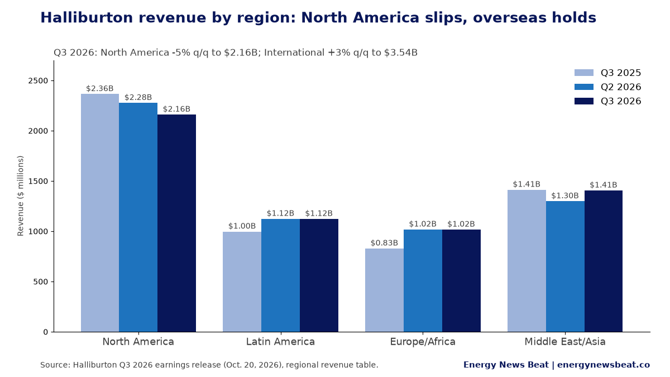
Source: Halliburton Q3 2026 earnings release, Oct. 20, 2026. Chart: Energy News Beat | energynewsbeat.co
What it means for consumers
Oil and gas supply: Fewer frack jobs today usually means fewer new wells feeding U.S. production a few months from now. Rigs are not collapsing, though. Baker Hughes counted 603 active U.S. rigs on October 23, 53 more than a year ago. Drilling is steady; it is the completion work, where Halliburton earns much of its money, that has cooled.
Fuel prices: The EIA’s latest survey put regular gasoline at $4.284 a gallon and diesel at $6.276 for the week of October 19, and AAA’s national average on October 23 was $4.293 for regular and $6.317 for diesel. CEO Jeff Miller said, “We are another three months into one of the largest energy disruptions in history.” Halliburton’s results do not by themselves signal a change in pump prices.
Oilfield jobs: The $107 million charge was largely severance for rationalizing global headcount. The release does not say how many jobs were cut, and we could not verify a figure. If you work in U.S. pressure pumping, the near-term picture is cautious.
What it means for investors
Halliburton is still returning cash: about $250 million in buybacks and a $0.17 dividend this quarter. Free cash flow, though, was only $156 million as working capital absorbed $330 million. For 2027, Miller guided to mid-single-digit revenue growth and margins of about 15%, assuming a flat North America market. On the earnings call, management guided to fourth-quarter earnings per share of about $0.62 to $0.64, according to published transcripts from The Motley Fool and Investing.com.
Fair caveats
Adjusted EPS and margins are non-GAAP figures that exclude charges; GAAP EPS of $0.50 was down from $0.64 in Q2. The 2027 outlook is an early forecast, not a promise, and the company’s own filing lists the conflict in Iran among its risks. Details are also in the Form 10-Q filed October 23.
Stu’s Take
Halliburton just told us something important: the world needs more oil and gas, and the dollars are flowing to the Middle East and offshore, not West Texas. International revenue hit $3.5 billion while North America slid 5%. With diesel at $6.276 a gallon and only 603 U.S. rigs running, American consumers need policy that rewards drilling here at home. In my view, a softer U.S. frack market will not lower prices by itself; more American barrels will. Halliburton expects about 15% margins in 2027 without any U.S. frack recovery. Imagine what happens if we get one.
Sources (accessed Oct. 23, 2026)
- Halliburton, “Halliburton Announces Third Quarter 2026 Results” (Oct. 20, 2026)
- Halliburton Form 8-K, SEC EDGAR (filed Oct. 20, 2026)
- Halliburton Form 10-Q for Q3 2026, SEC EDGAR (filed Oct. 23, 2026)
- Baker Hughes Rig Count overview (week of Oct. 23, 2026)
- S. EIA Gasoline and Diesel Fuel Update (week of Oct. 19, 2026)
- Halliburton Q3 2026 earnings call transcript, The Motley Fool (Oct. 20, 2026)
- Halliburton Q3 2026 earnings call transcript, Investing.com (Oct. 20, 2026)
- AAA Gas Prices national average (Oct. 23, 2026)