ENB Pub Note: This article was originally published on the California Globe and has some outstanding points that Michael Tanner and Stu Turley have been covering on the Energy News Beat Podcast for years. We have been asking whether Gavin has gone too far and how the economy will recover when all the oil companies have been shut down by regulatory overreach. We are watching as the main oil artery in California is losing 2 million dollars a month, and how much longer can they stay afloat? That will be a massive national security risk when that pipeline goes bankrupt. Now Gavin is looking to run the refineries under government control? He can’t run the state; how can he run a refinery?
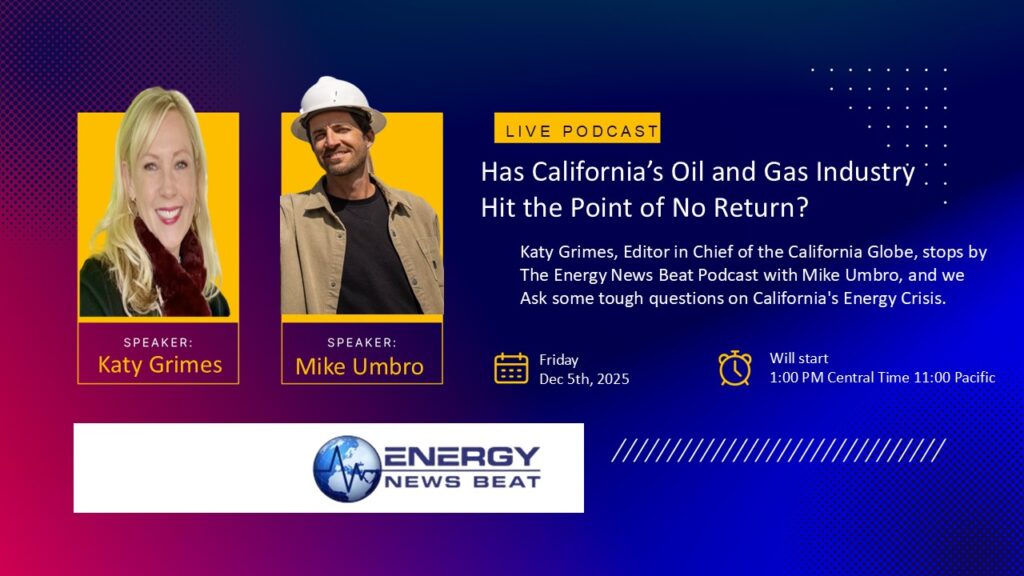
We have an interview with Katy Grimes, Editor-in-Chief of the California Globe, and Mike Umbro live on LinkedIn, YouTube, and X on Friday at 11:00 Pacific and 1:00 Central. YouTube:
Most California residents recognize that California’s highest-in-the-nation gas prices are self-inflected, as is the gasoline crisis in the state. This has subsequently increased dependency on foreign oil suppliers and shippers to supply fuels, and as we reported recently, this poses a direct threat to U.S. military force readiness on the West Coast.
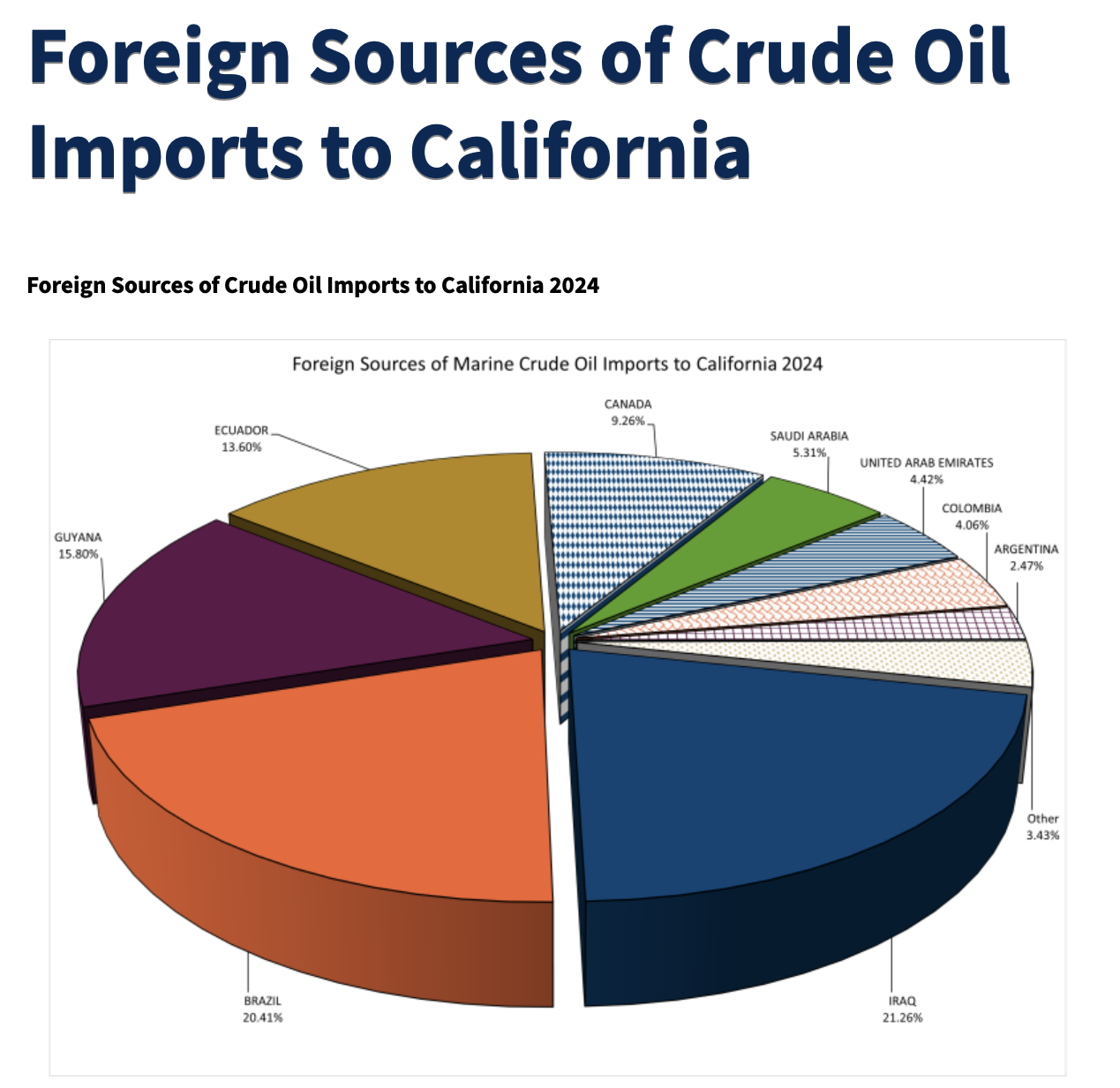
California today produces less than 23% of its own in-state petroleum needs and imports over 65% of its crude oil from foreign sources, yet the oil and gas industry in California account for nearly 8% of the state’s GDP, even in its diminished capacity.
In 1988, the state of California only imported about 4.5% of all the oil that we consumed in our state. By 2020 we were importing over 70%.
As California Assemblyman Stan Ellis, USC Professor Professor Michael Mische, and petroleum expert Michael Ariza warned recently, without oil and gas, the other 92% of the state’s GDP would be impossible to attain.
Arizona gets nearly half of its gas from California. And the vast majority of Nevada’s gas – 88% – comes from California.
Adding to California’s current gas crisis is the recent seizure of an oil tanker by Iran in the Strait of Hormuz, as well as severe weather conditions in Alaska delaying oil tankers, causing fewer tankers to be delivering crude oil to California. “Iranian forces seized a Marshall Islands-flagged tanker in the Strait of Hormuz, the first confirmed capture of a commercial vessel by Tehran since its June clashes with Israel and the United States, according to multiple governments and maritime agencies,” the New York Post reported.
California Governor Gavin Newsom is presiding over perhaps the largest energy policy collapse of the oil industry, refinery operations and gasoline production in U.S. history. A momentous report recently prepared by Ellis, Mische and Ariza warned that California’s self-inflicted gas crisis is also a direct threat to U.S. military force readiness on the West Coast, the Globe reported in October.
Their report exposes how Governor Newsom’s energy policies are sabotaging domestic refining capacity and leaving U.S. military bases in the West vulnerable to foreign adversaries like Russia and China.
Their conclusion is that there must be federal intervention.
Mike Ariza spoke with the Globe again last week with yet another dire warning – that California may have already hit the point of no return.
Ariza told the Globe that Valero, which announced in April 2025 that it would be shutting down its Benicia refinery in April 2026, has bumped the closure date up to January. Ariza explains why:
“The Phillips 66 refinery in Wilmington shut down on October 17th is taking 140,000 barrels per day of crude oil refining offline. Originally Valero in Benicia was slated to shut down in April of 2026. However, given the fact that they cancelled their crude oil contracts over six weeks ago it looks like they will be shutting down no later than January of 2026, four months ahead of schedule.
Now, in 2025, Valero is not even seeking to try and sell the refinery. Even after the state tried to convince Valero to remain open, they elected to shut down. And instead of shutting down in April, they have moved the shutdown ahead to January. All due to the state’s egregious regulations and unprecedented unjustified fines.”
Ariza said when refineries shut down, more Californians will leave the state. California’s oil and gas industry provides 536,770 total jobs in California and 148,140 Californians are directly employed by its individual companies—along with the $338 billion total economic contribution to California’s economy.
He explained in more detail in an updated statement he shared:
“At this point we will be importing nearly half (50%) of our gasoline and 40% of our jet fuel from overseas. This is unprecedented in our country’s history. This leaves both us and our military at extreme risk to multiple events. Many of these have occurred just within the past 8 weeks.
- The Chevron Refinery in El Segundo had a massive fire resulting in a loss of both jet fuel and gasoline production. The loss of jet fuel forced a rerouting of a gulf tanker from the east coast to the west coast AND a rerouting of Northern California produced jet fuel south.
- A fuel oil tanker bound for a refinery in Singapore was hijacked by the Iranian revolutionary guard.
- A cargo ship at the port of Los Angeles had a huge fire resulting in it being towed out and away from the dock to prevent damage.
- A major Olympic gasoline pipeline near Seattle sprang a leak resulting in its shutdown for repair.”
Ariza reiterates that these are all real-world events that have just occurred. “Real events that make us extremely vulnerable along with Phoenix and all of Nevada,” he says. “One additional real-world event that can bring us severe shortages is the weather. When I ran the Valero refinery on the Control Board, we experienced crude oil shortages due to storms in Alaska delaying the tankers bringing Alaskan North Slope crude oil to Benicia. At one point I cut the refinery from 135,000 barrels per day down to 100,000 barrels per day. In another instance we were mere hours away from running out of crude oil which would have resulted in a refinery shutdown. ALL these events are real. They have ALL occurred.”
California’s largest inland oil pipeline will be closing down by the middle of December, Ariza said. “Crimson Midstream LLC’s San Pablo Bay Pipeline that hauls oil from the Bakersfield area to Northern California refiners is losing $2 million a month, creating ‘severe financial distress’ for the company, Robert Waldron, CEO of Crimson’s parent CorEngery Infrastructure Trust, wrote in a letter to Governor Gavin Newsom’s office this week,” Bloomberg reported. The shutdown that would choke off some crude supplies to at least two San Francisco-area refiners, they report.
Economically, Ariza warns that the price of everything goes up when the price of fuel goes up:
“On the base case I see gasoline prices soaring to over $8 per gallon up to as high as$12 per gallon. We will in fact have the highest gasoline prices in the world. Diesel will go up accordingly. And since every truck, piece of farm equipment, and piece of construction equipment runs on diesel, we can expect the prices of everything to skyrocket!”
Ariza said all efforts need to be made to keep the refineries open, because “Once these refineries go down for any significant amount of time they become very difficult to bring back up.”
“The Marathon Refinery in Martinez needs to start back up. The PBF refinery in Martinez needs to come back up on full rates. Phillips 66 in Wilmington needs to be brought back up and Valero needs to remain online. Immediate federal intervention needs to take place. CARB, the CEC, and all other agencies that have caused this problem need to have all their influence on this industry suspended immediately and permanently!!! All efforts to help our refineries come back and remain online need to be made at the federal level.
“This is due to mechanical issues and lack of qualified personnel. For instance, if Valero goes down for a significant amount of time very few people are available on the planet that can help bring it back online due to its unique complexity.”
The report, “CALIFORNIA ENERGY & FUEL POLICIES: A CLEAR AND PRESENT THREAT TO NATIONAL SECURITY AND FORCE READINESS?” was prepared by the three powerhouse experts: Assemblyman Stan Ellis (R-Bakersfield), a quantum physics expert with 50-years of oil and gas experience in drilling engineering and chemical processing, Professor Michael Mische from the University of Southern California, and Michael Ariza, a petroleum professional and U.S. Navy veteran. They explain:
“California has the most severe restrictions regulating the oil, refining, and fuels industries in the world. California’s energy policies and regulations have not only resulted in the highest gasoline prices in the nation, and the highest taxes and fees in the nation, but have led to the closure of two major refineries which now threaten essential pipelines that provide crude oil and fuel supplies to California’s surviving refineries, civilian markets, and military installations, as well as those in Arizona and Nevada.”
Assemblyman Ellis said in an interview with the Globe that California military bases could end up running out of jet and aviation fuels should a military conflict unfold.
Why? Because of Governor Newsom’s political policies resulting in shockingly detrimental and lethal regulations of the oil and gas industry.
“California has no inbound pipelines supplying crude oil, gasoline, or aviation fuels, which amplifies U.S. national security vulnerabilities. Astonishingly, over 95% of California’s inbound crude and gasoline supplies are delivered by maritime tankers, the majority of which are not U.S.-flagged vessels, including tanker ships owned by Russia’s SCF Group and China’s Cosco Shipping Energy Transportation,” Ellis told the Globe.
Remember this. California is doing business with Russia and China.
California is about to suffer a meltdown, courtesy of Governor Gavin Newsom and the state’s elected Democrats.
Could Gavin Newsom be California’s Nicolás Maduro, the Socialist president of Venezuela? Newsom is destroying the middle class, just as Maduro and Hugo Chavez before him did, while threatening takeover of California’s oil and gas industry, as Chavez did and Maduro continued.
Instead of making life more affordable for Californians by producing more of our own energy, and using our own resources to bring down costs and build a more affordable future for everyone, Newsom and California’s lawmakers continue to push for ridiculous “green energy” mandates. They restrict our car choices, and force many people summer and winter to live uncomfortably because of high heating and cooling costs – in the state with the best weather in the country.
While President Donald Trump’s U.S. Energy Secretary Chris Wright has vowed to “get out of the way” of coal, oil and gas, and called the UK’s 2050 net zero target “a sinister goal” that would “impoverish” people, downplayed the threat from extreme weather, and suggested that climate action is part of a plot to “grow government power” and “shrink human freedom,” Newsom is doubling down on green climate rhetoric.
President Trump and Secretary Wright promised to make energy affordable, reliable and secure for all Americans first. Governor Newsom is doing the opposite, meanwhile impoverishing California’s middle class.
In August 2024 I reported that just as Chevron Oil company announced it would move its headquarters to Houston Texas from San Ramon California, California Energy Commission regulators announced proposed government controls of the petroleum industry, ostensibly in order to combat future energy price surges, according to a report released August 1, 2024 by the CEC.
Gov. Newsom threatened to call a special session if lawmakers didn’t pass his Venezuela-Like price controls proposal of the oil and gas industry – unless lawmakers passed his proposal to control California’s petroleum industry.
Even the LA Times acknowledged that California policymakers were considering state ownership of one or more oil refineries, as if this is a good idea. The state can’t even build a high speed rail system – what makes anyone in government think taking over the oil and gas refineries is a reasonable plan?
“State officials have long considered the rules essential to cleaning up California’s severe air pollution and combating climate change,” CalMatters reported, obviously upset about the federal waiver forcing big rigs to go all-electric being dropped.
As the Globe asked, “Where is California’s severe air pollution? Who in California is experiencing climate change?”
It’s probably more important to listen to those in the trucking industry than a reporter paid to write “about the impacts of climate change and air pollution and California’s policies to tackle them.”
While we see many changes courtesy of the Environmental Protection Agency, and the U.S. Department of Energy, will this to trickle down to California so that the state is no longer living under self-imposed energy scarcity and exorbitant costs to heat and cool homes, or put gas in the car?
Not if Gavin Newsom gets his way. California must have federal intervention – or end up like Venezuela: beautiful, with state-owned natural resources enriching the politicians, leaving the people totally poverty-stricken.
Written by Katy Grimes, the Editor in Chief of the California Globe, we will be reaching out to her to hop on an episode of the Energy News Beat podcast.
Got Questions on investing in oil and gas?

If you would like to advertise on Energy News Beat, we offer ad programs starting at $500 per month, and we use a program that gets around ad blockers. When you go to Energynewsbeat.co on your phone, or even on Brave, our ads are still seen. The traffic ranges from 50K to 210K daily visitors, and 5 to 7K or more pull the RSS feeds daily.
https://energynewsbeat.co/request-media-kit/