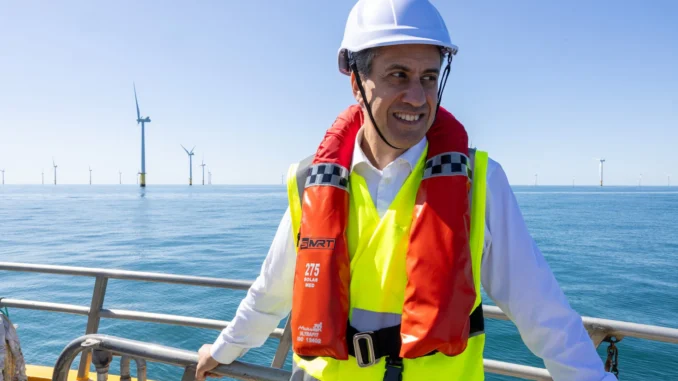
In a bold and bright move for a Wallace and Gromit character, underscoring the UK’s aggressive push toward net zero, Energy Secretary Ed Miliband has greenlit a massive expansion of offshore wind farms, securing contracts for 8.4 gigawatts (GW) of new capacity—enough to power the equivalent of over 12 million homes. Announced in early January 2026, this record-breaking auction represents the largest procurement of offshore wind in British or European history. However, the initiative comes at a steep price: annual subsidies could climb to £1.8 billion by the early 2030s, with the costs ultimately passed on to consumers through green levies on energy bills.
Critics argue this “wind farm blitz” prioritizes ideological goals over practical energy security, potentially exacerbating the financial strain on households already grappling with high electricity prices.
The government’s rationale is clear: transitioning away from volatile fossil fuels to homegrown renewables will deliver long-term energy sovereignty and lower bills. In a Guardian op-ed, Miliband hailed the auction as a triumph over “rightwing doubters,” emphasizing that the billions in private investment will insulate Britain from global energy shocks.
He pointed to immediate relief measures, such as £150 off average annual bills starting in April 2026 and expanded warm home discounts for six million low-income families. Yet, the subsidies—distributed via contracts for difference (CfDs)—will be funded by billpayers over 20 years, with levies potentially reaching £1.8 billion annually once the farms are operational around 2030.
This isn’t just about wind; it’s part of Labour’s broader decarbonization agenda under Prime Minister Keir Starmer. The plan aligns with targets to quadruple offshore wind capacity by 2030, but it has drawn fire from opposition figures and energy experts. Conservative peer Baroness Jacqueline Foster lambasted the deal on GB News, questioning Miliband’s judgment and warning that “we can’t power this nation on wind.”
Reform UK and other voices echo this, highlighting the intermittency of renewables and the risk of over-reliance on weather-dependent sources. As one Telegraph report noted, the subsidies will “gradually increase as the windfarms are constructed, potentially spiralling to £1.8bn a year by 2032-33.”
The timing couldn’t be more contentious. With North Sea oil and gas production declining and 17 GW of gas and nuclear plants set to retire by 2030, the UK faces a precarious energy landscape. Proponents argue that this wind expansion is essential for filling the gap, but detractors point to hidden costs like grid upgrades and curtailment payments—where wind farms are paid to shut down during oversupply. In 2025 alone, the UK shelled out £1.5 billion in such payments, a figure projected to balloon to £8 billion annually by 2030 without interventions.
Miliband’s vision is ambitious, but it raises fundamental questions: Can the grid handle this surge in renewables? And who foots the bill for net zero? As households brace for potential hikes, the debate intensifies over whether this blitz will deliver clean, affordable energy or merely inflate costs in the name of green progress.
Analysis of Kathryn Porter’s Report: The Real Impact on Consumers
Kathryn Porter’s report, “Electrification: Can the Grid Cope?” from Watt-Logic, provides a sobering examination of the UK’s electrification drive, which underpins initiatives like Miliband’s wind farm expansion. Published in early 2026 and featured on the Energy News Beat podcast, the report scrutinizes whether the nation’s grid can support a massive shift to electric vehicles (EVs), heat pumps, and industrial electrification amid heavy reliance on intermittent renewables. Drawing on data from the UK, EU, and U.S. “blue” states, Porter warns of systemic risks that could translate into higher bills, blackouts, and economic fallout for everyday consumers.
Kathryn Porter outlines the problems with the UK grid and pricing issues on the Energy Realities Podcast below.
Grid Strain and Reliability Risks
At the heart of Porter’s analysis is the intermittency of wind and solar power, which forms the backbone of the UK’s renewable strategy. With 32 GW of installed wind capacity, output can plummet below 1 GW during cold, windless winters—exactly when demand spikes for heating. Prolonged “dunkelflaute” periods (low wind and solar for up to 14 days every five years) could create 10 GW deficits in firm capacity, leading to a 65–85% chance of regional power rationing and a 5–10% risk of nationwide blackouts by 2030. This vulnerability is amplified by retiring legacy assets, leaving the grid ill-equipped for electrification demands.
For consumers, this means potential disruptions: Imagine winter evenings without heat or lights, especially in rural or low-income areas. Porter draws parallels to EU nations like Germany, where renewable bottlenecks could push demand beyond 950 TWh by 2035, and Norway, facing a 60% demand surge by 2040 with doubled flexibility needs. In the U.S., California-style blackouts during heatwaves serve as a cautionary tale for states like New York and Massachusetts pursuing similar all-electric mandates.
Escalating Costs and Consumer Burdens
The financial implications are stark. Electrification could add 30–40 TWh annually from EVs alone (8–10% of current UK demand), with heat pumps pushing winter peaks from 57–58 GW to 108–119 GW by 2050. Upfront costs deter adoption: Heat pumps average £12,795 after subsidies (versus £3,818 for gas boilers), while EVs carry £11,000–14,000 premiums. Running expenses favor gas in many cases, with electricity pricier per unit.
Subsidies like the £7,500 Boiler Upgrade Scheme provide relief but shift costs to taxpayers and billpayers. Grid upgrades for EVs and heat pumps are estimated at £37–50 billion through 2050, excluding high-voltage reinforcements. Curtailment payments—£1.5 billion in 2025, including £380 million to idle farms and £1.08 billion to fire up gas backups—represent wasted energy (8.3 TWh in 2024, up 91% year-on-year). Scotland, hit hardest, saw £116 million in costs for 4.6 TWh curtailed in the first half of 2025.
Consumers bear the brunt through inflated bills. UK electricity prices are already among the world’s highest, and the EU’s Carbon Border Adjustment Mechanism (CBAM), effective from 2026, could add further pressure by hiking import costs—potentially £130 million annually for Ireland, or £45 per Northern Irish household. In U.S. blue states, savings vary (e.g., $2,050 yearly in cold New York regions versus propane), but without addressing intermittency, bills could rise amid deindustrialization and job losses.
Policy and Broader ImplicationsPorter critiques the ideological drivers behind these policies, noting a disconnect between ambitious targets and implementation realities. Adoption lags—only 42,645 heat pumps installed in 2024—highlighting barriers like high costs and grid constraints. EU parallels show electricity at just 23% of final energy use, with a 35% target by 2030, reliant on unproven incentives. In the U.S., coalitions in states like California (4.3% EV market share from 2013–2018) mirror this, but blackouts underscore the perils.
Ultimately, the real impact on consumers is multifaceted: Higher energy bills from levies and upgrades, unreliable supply risking outages, and economic strain from deindustrialization. Porter urges pragmatic fixes—bolstering firm capacity (e.g., gas or nuclear backups) and grid reinforcements—to avoid leaving households in the dark. As Miliband’s wind blitz ramps up, her report serves as a critical reminder that net zero ambitions must align with grid realities, or consumers will pay the price.