In a landmark move that underscores Japan’s growing commitment to securing its energy future, Mitsubishi Corporation announced on January 16, 2026, its acquisition of Aethon Energy Management’s Haynesville shale gas assets in a deal valued at approximately $5.2 billion in equity, with the Japanese giant also assuming $2.33 billion in net debt for a total enterprise value of around $7.53 billion.
This transaction marks Mitsubishi’s largest acquisition to date and its first major foray into U.S. shale gas production, positioning the company as a key player in North America’s natural gas landscape. The assets span roughly 380,000 acres across Texas and Louisiana in the prolific Haynesville Shale formation, currently producing about 2.1 billion cubic feet per day (Bcf/d) of natural gas, equivalent to around 15 million metric tons per annum (mtpa) of liquefied natural gas (LNG).
Mitsubishi anticipates peak production reaching 2.6 Bcf/d, or about 18 mtpa of LNG equivalent, which could cover roughly a quarter of Japan’s annual LNG demand.
Aethon Energy, a Dallas-based private firm founded in 1990, will retain operational responsibilities and has the option to repurchase up to 25% of the assets within six months of closing, expected between April and June 2026.
The sellers include Aethon Energy Management alongside major stakeholders like Ontario Teachers’ Pension Plan and RedBird Capital Partners.
This deal aligns with Japan’s broader strategy to bolster energy security amid global uncertainties. As a resource-scarce nation heavily reliant on imports, Japan has ramped up investments in U.S. shale to ensure stable, diversified supplies. Recent examples include JERA’s $1.5 billion Haynesville acquisition in October 2025, part of Tokyo’s $550 billion U.S. investment pledge.
By controlling upstream production, Mitsubishi can better manage supply chains, reducing vulnerability to price swings and geopolitical risks while supporting the energy transition with natural gas as a bridge fuel.
Earnings Insights for the Companies Involved
Mitsubishi Corporation, a diversified trading conglomerate, reported solid financials in its latest Q2 FY2025 results (six months ended September 30, 2025). Underlying operating cash flow stood at ¥446.3 billion, with consolidated net income at ¥355.8 billion, on track for full-year forecasts of ¥900 billion in operating cash flow and ¥700 billion in net income.
The Environmental Energy segment, which encompasses natural gas and LNG, saw its full-year forecast revised upward to ¥93 billion from ¥82 billion, reflecting optimism in restructuring upstream LNG businesses.
Mitsubishi projects the Haynesville assets to contribute significantly post-acquisition, with an estimated FY2027 underlying operating cash flow of ¥270-300 billion and consolidated net income of ¥70-80 billion on a 100% basis.
Aethon Energy, as a privately held entity, discloses limited public financials. Recent estimates peg its annual revenue between $500 million and $1 billion, with a three-year average EBITDA of around ¥200 billion (approximately $1.3 billion USD at current exchange rates).
The company’s hedging strategy for 2025-2026 covers significant portions of production at prices around $2.77-$3.10 per thousand cubic feet, providing revenue stability amid market volatility.
What This Means for Investors
For Mitsubishi investors, the deal enhances portfolio resilience by integrating upstream assets into its global LNG value chain, potentially driving long-term earnings growth. The company emphasizes capturing U.S. demand surges from AI/data centers, manufacturing, and LNG exports, while hedging risks through production optimization and futures markets.
However, shares dipped 2% on the announcement, reflecting concerns over the premium paid and near-term payback horizons in a volatile energy market.
Broader energy investors may see this as a bullish signal for U.S. shale, with Japanese capital inflows (now controlling 32% of operated Haynesville volumes) validating the basin’s role in global LNG supply.
The buy-and-hold strategy could stabilize valuations, but it also highlights risks like regulatory hurdles or price downturns.
Implications for ConsumersConsumers, particularly in Japan and Asia, stand to benefit from enhanced energy security and potentially more stable pricing. By securing competitive U.S. gas, Mitsubishi can mitigate supply disruptions, supporting affordable imports amid rising global demand.
In the U.S., the deal could boost local production and infrastructure, indirectly lowering domestic gas costs while contributing to economic growth in Texas and Louisiana. Globally, it promotes natural gas as a cleaner alternative during the transition to renewables, though environmental groups may scrutinize methane emissions from shale operations.
The Path to Japan: Natural Gas to LNG and Shipping
Haynesville gas will flow via in-house midstream infrastructure and secured pipelines to Gulf Coast LNG terminals, optimizing sales through Mitsubishi’s Houston-based CIMA Energy.
Key among these is Cameron LNG in Louisiana, where Mitsubishi holds a 16.6% stake through a partnership with Japanese shipping firm NYK Line and liquefaction tolling rights.
Gas will be liquefied there for export, with portions earmarked for Asia (including Japan) and Europe.
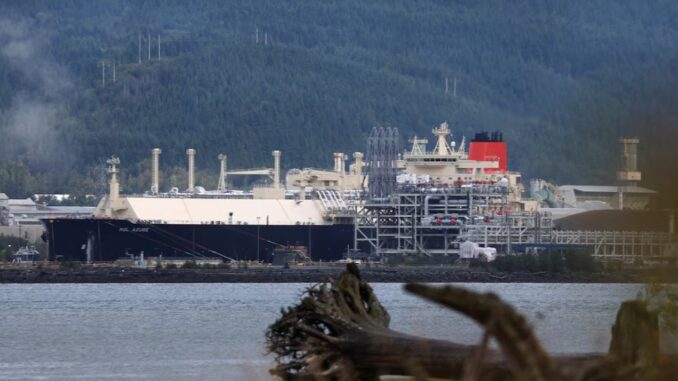
Shipping will likely involve NYK’s LNG fleet, leveraging Mitsubishi’s integrated logistics to ensure efficient delivery.
This acquisition not only fortifies Japan’s energy supply lines but also signals a new era of international collaboration in the global gas market. As Mitsubishi integrates these assets, watch for ripple effects on LNG pricing and U.S. export dynamics in the coming years.
Sources: mitsubishicorp.com, industrialinfo.com, hartenergy.com