
Ukrainian strikes have cut Russian crude processing about 45 percent from late October, U.S. Energy Secretary Chris Wright says Washington is considering more diesel exports to Europe, and East Coast inventories remain tight. Europe’s diesel crack has still fallen to a three-month low.
This winter, especially in the Northeast, the diesel that heats houses and moves groceries is being pulled in two directions at once.
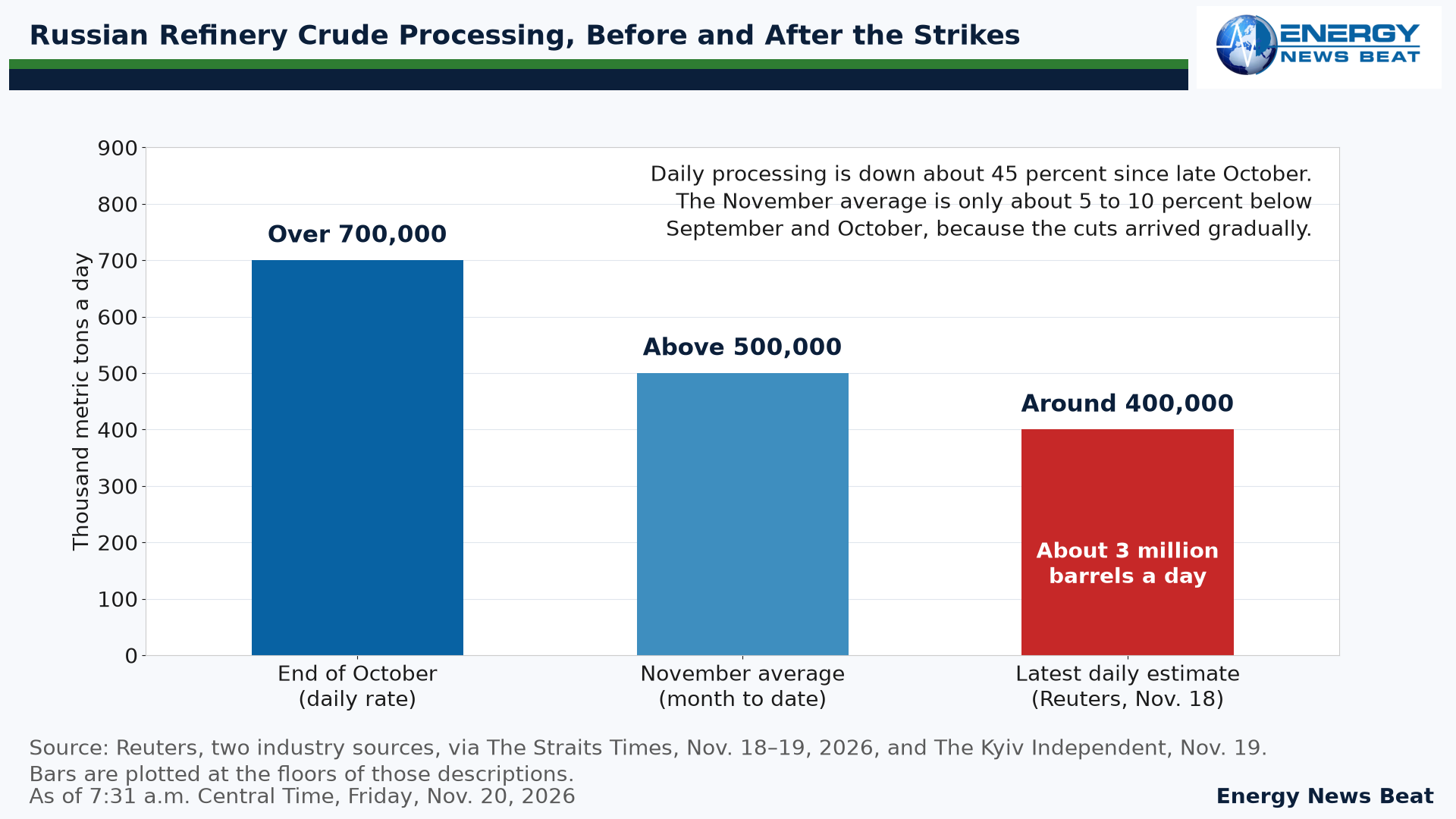
On one side, Ukrainian strikes have slashed crude processing at Russian refineries. Two industry sources told Reuters that combined daily runs have fallen about 45 percent since late October, from more than 700,000 metric tons a day to around 400,000 tons a day, or about 3 million barrels, with operations disrupted or halted at 15 of Russia’s 35 major refineries.
In Warsaw on Thursday, U.S. Energy Secretary Chris Wright told a press conference, “Are we considering ramping up oil and diesel exports to Europe? Absolutely.”
On the other side, the usual tightness signal has loosened. Reuters reported that at 16:54 GMT on Thursday, ICE low-sulfur gasoil futures were at a $59.14-a-barrel premium to Brent, down $1.68 from the previous close and the lowest for Northwest European diesel margins since Aug. 5, as supply fears eased.
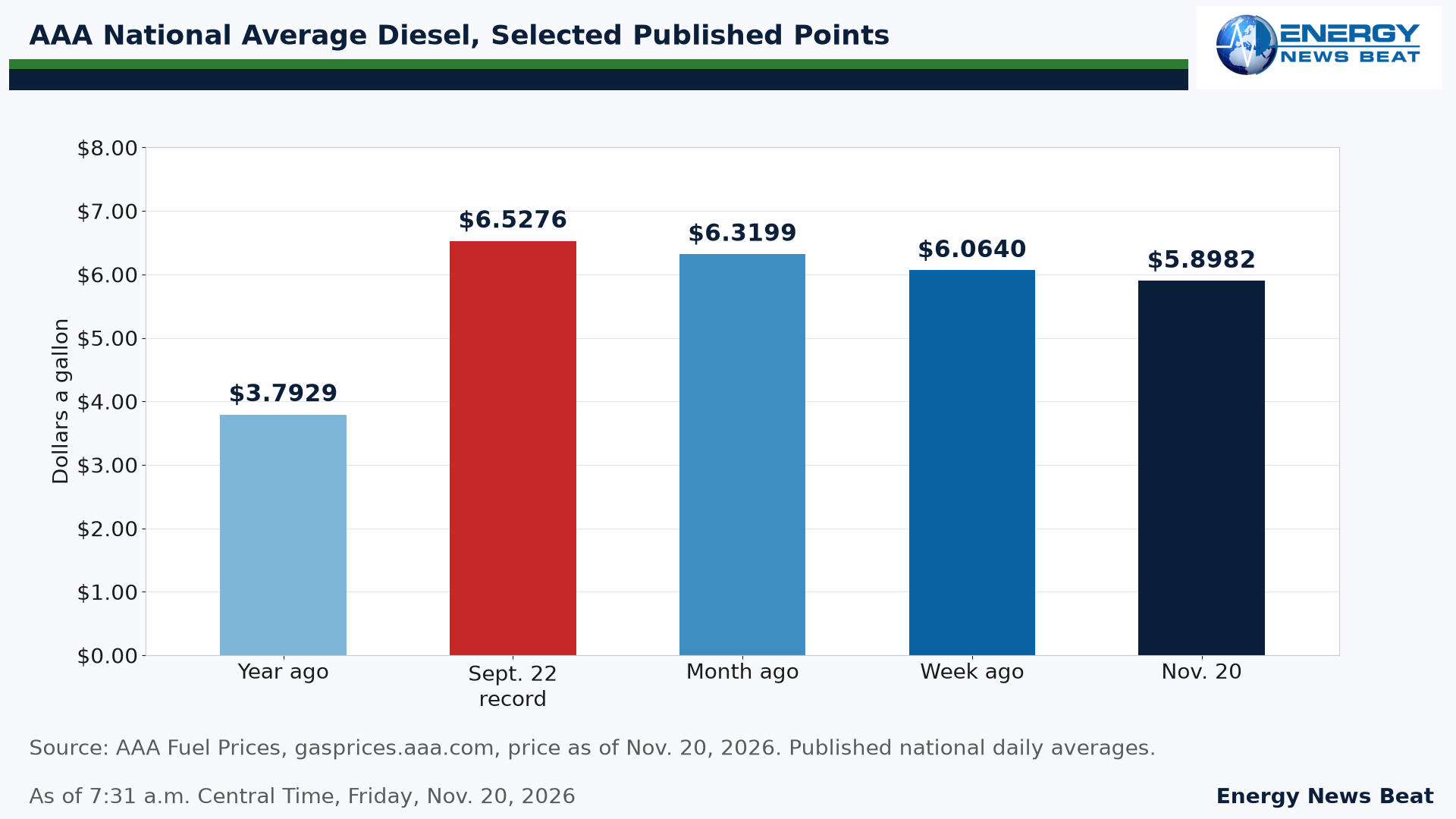
The pump has come off the boil, but it is not cheap. AAA‘s national average diesel price is $5.8982 a gallon as of Friday, Nov. 20, down from $6.3199 a month ago and still $2.11 above the year-ago $3.7929. U.S. distillate stocks rose 1.6 million barrels to 104.9 million in the week ended Nov. 13, about 7 percent below Energy News Beat’s five-year average. On the East Coast, where heating oil and trucking share the same barrel, stocks were 24.4 million barrels, 7.8 percent below a year earlier and 26.7 percent below two years earlier.
The contest this winter is whether lost Russian barrels and more U.S. diesel exports to Europe outweigh a European crack that has already slipped.
What the strikes have taken offline
The 45 percent figure is a daily processing number, not a claim that Russia’s refining system is half shut. Reuters, in a Nov. 18 dispatch carried by The Straits Times and reported the next morning by The Kyiv Independent, said two industry sources put crude processing at around 400,000 metric tons a day, down from more than 700,000 at the end of October. Russia’s Energy Ministry did not respond to a Reuters request for comment.
Because the cuts arrived gradually, the same sources said average crude processing in November remains above 500,000 tons a day, only about 5 to 10 percent below September and October. A 45 percent drop in the latest daily rate can coexist with a much smaller decline in the month-to-date average.
They also separated processing from nameplate capacity. The combined nominal capacity of the plants hit since late October is about 500,000 tons a day, or about 54 percent of Russia’s estimated 930,000-ton-a-day primary refining capacity. That 54 percent is the share of capacity at plants that have been affected, not the share that is dark. President Volodymyr Zelensky said on Nov. 15 that Ukrainian forces had taken more than 55 percent of Russia’s oil refining capacity offline. That is his claim. It is close to the affected-capacity share Reuters later described, but it is not the 45 percent cut in daily processing, and it is not a Reuters finding.
Reuters had reported around a 30 percent cut in refining capacity on Nov. 10. The newer 15-of-35 count, up from nine in the middle of last week, is the escalation underneath this week’s debate. Reduced refining, Reuters noted, could tighten global fuel markets and hamper a deal to export Russian diesel to the United States.
Washington weighs more exports. The East Coast is already tight.
That talk is now on the record. At a transatlantic energy conference in Warsaw on Thursday, Wright told a press conference the United States is considering ramping up oil and diesel exports to Europe. “Absolutely,” he said, in remarks reported by Reuters and published in a syndicated Reuters dispatch the same day. A Reuters French item on Boursorama also recorded the comment. Considering more exports is not a formal program or a guarantee that U.S. pump prices will rise. It is a signal that Washington is willing to let more diesel go east.
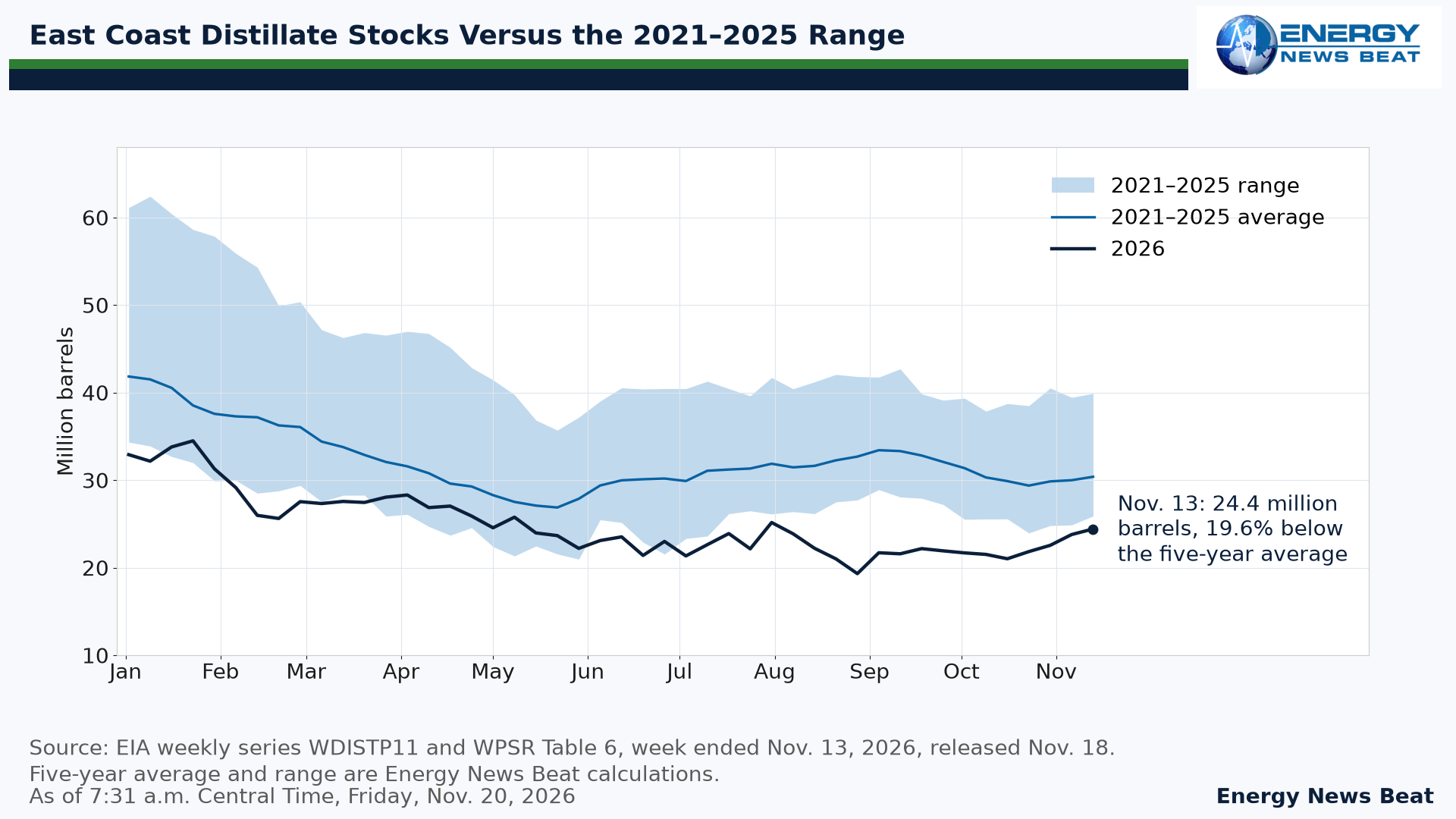
The inventory math is why that signal matters in the Northeast. The Energy Information Administration‘s Weekly Petroleum Status Report for the week ended Nov. 13, released Nov. 18, put U.S. distillate stocks at 104.9 million barrels, up 1.6 million from 103.3 million and 5.6 percent below the year-ago 111.1 million. Energy News Beat’s calculation from EIA’s official weekly series puts that 104.9 million about 6.8 percent, or about 7 percent, below Energy News Beat’s 2021–2025 five-year average for the comparable week, 112.6 million barrels.
The tighter picture is regional. East Coast, or PADD 1, distillate stocks were 24.4 million barrels, up 0.6 million from 23.8 million, but 7.8 percent below a year earlier and 26.7 percent below the 33.3 million barrels on hand two years earlier. The same official weekly series puts PADD 1 about 19.6 percent below its own five-year comparable-week average of 30.4 million barrels. Inside the region, Central Atlantic stocks were 11.7 million barrels, New England 3.2 million and the Lower Atlantic 9.5 million.
A build is welcome, but it is not comfort. If more U.S. diesel is loaded for Europe, the first place a tight system shows up is still the East Coast.
What it means at the pump this winter
Drivers have already seen some relief. AAA’s national average diesel price on Friday is $5.8982 a gallon, down from $6.0640 a week ago and $6.3199 a month ago. It is 63 cents below the Sept. 22 record of $6.5276, and it is still $2.11, or 55 percent, above last year’s $3.7929. AAA is a national daily print, not a Northeast heating-oil ticket, but it is the number most households see.
The official forecast is for that price to come down over the next year, on a path drawn before this week’s headlines. The EIA’s November Short-Term Energy Outlook, released Nov. 10, puts the 2027 U.S. retail on-highway diesel average at $5.03 a gallon, 12 percent above last month’s 2027 forecast of $4.49, after a 2026 average of $5.25. The quarterly path is still high nearby: $6.05 in the fourth quarter of 2026 and $5.37 in the first quarter of 2027, then $5.03, $4.91 and $4.80. Those inputs were finalized on Nov. 5. The outlook does not specifically account for Wright’s Warsaw comments, Thursday’s European crack, or Reuters’ newer Russian processing estimates.
Sparta Commodities is more hawkish about the first quarter. In a Nov. 19 note, head of commodities James Noel-Beswick wrote that some diesel and jet weakness this week had not produced a “strong solution for Q1 tightness,” and that the firm still sees “a strong bull case for Q1 2027.” That is a trading-house view, not a government forecast and not a prediction of the AAA daily average.
The European crack is the other weight on the rope. A $59.14-a-barrel gasoil premium to Brent, the lowest for Northwest European diesel margins since Aug. 5, is the market saying near-term supply fears in Northwest Europe have eased. A falling crack argues against a panic bid for every available U.S. cargo. Tight East Coast stocks and Washington’s openness to exporting more diesel argue the other way.
Consumer and Investor Views
For households, especially in the Northeast, the practical question is the heating-oil tank and the grocery bill. Diesel and heating oil are cousins in the same distillate family, and the East Coast is the region with the least spare inventory. A national average of $5.8982 is better than $6.32 a month ago, but it is still far more expensive than last year’s $3.79. A tight PADD 1 stockpile means a cold snap or a burst of exports can show up at the rack before it shows up in a national forecast.
For truckers, farmers and anyone who moves goods, the same gallon is a cost of doing business. The STEO still sees the annual average moving toward $5.03 in 2027. The first-quarter forecast of $5.37, and Sparta’s tighter Q1 view, are the nearer risk. This is not investment advice.
Timeline
Key dates for the Russian refining cuts, the European diesel crack, U.S. inventories and the pump. Times are Central where a clock time is given.
End of October 2026. Reuters’ industry sources put Russian crude processing at more than 700,000 metric tons a day.
Nov. 5, 2026. The Energy Information Administration finalized inputs to the November Short-Term Energy Outlook, including a 2027 retail on-highway diesel average of $5.03 a gallon. The outlook, released Nov. 10, does not specifically account for market events after Nov. 5.
Nov. 10, 2026. Reuters reported that Ukrainian drone attacks had reduced Russia’s oil refining capacity by around 30 percent.
Nov. 13, 2026. Week ended for the latest Weekly Petroleum Status Report: U.S. distillate stocks 104.9 million barrels, East Coast 24.4 million, released Nov. 18.
Nov. 15, 2026. President Volodymyr Zelensky said Ukrainian forces had taken more than 55 percent of Russia’s oil refining capacity offline.
Nov. 18, 2026. Reuters, citing two industry sources, reported that daily Russian crude processing had fallen about 45 percent since late October, to around 400,000 metric tons a day, with 15 of 35 major refineries disrupted or halted. The same sources said the November average remains above 500,000 tons a day.
Nov. 19, 2026. U.S. Energy Secretary Chris Wright, at the Partnership for Transatlantic Energy Cooperation conference in Warsaw, said, “Are we considering ramping up oil and diesel exports to Europe? Absolutely.” At 16:54 GMT, Reuters put the ICE gasoil crack at $59.14 a barrel, the lowest for Northwest European diesel margins since Aug. 5. Sparta Commodities published its note that diesel builds are still not, in its view, a strong solution for first-quarter tightness.
Nov. 20, 2026. AAA’s national average diesel price is $5.8982 a gallon, with the page marked price as of Nov. 20, 2026.
Caveats and Criticism
The 45 percent cut is an estimate from two unnamed industry sources, published by Reuters, not a figure from Russia’s Energy Ministry, which did not comment. The latest daily rate of around 400,000 tons is not the November average, which those sources still put above 500,000 tons a day. Zelensky’s more than 55 percent claim is his own statement about capacity taken offline. The 54 percent Reuters figure is affected nameplate capacity, a different concept.
The $59.14 crack is a 16:54 GMT timestamp on Thursday, Nov. 19, not a weekly average. The same Reuters table listed a session close of $59.05 against a previous close of $60.84. AAA’s $5.8982 is the national daily average as of Nov. 20, not a Northeast city price. The 6.8 percent and 19.6 percent gaps versus five-year norms are Energy News Beat calculations from EIA’s official weekly series. The November STEO was finalized on Nov. 5 and does not incorporate later events. Wright said the United States is considering more exports; he did not announce a volume or a start date. Sparta’s Q1 tightness view is attributed to Sparta. None of this is investment advice.
Stu’s Take
The numbers can live together, and that is the point. Russian runs are sharply lower on a daily basis, Washington is weighing more diesel exports to Europe, and East Coast inventories are still lean. At the same time, the European diesel crack just printed its lowest level since early August, and the U.S. pump has come down from $6.32 a month ago to $5.90. A falling crack does not erase a 45 percent drop in Russian daily processing, and a tight PADD 1 stockpile does not guarantee that prices go back up tomorrow. It means this winter is a contest, not a one-way bet. Watch the East Coast inventory, the export slate, and whether that European margin stays soft. If it does, the relief at the pump can continue. If it snaps back, the Northeast will feel it first.
Appendix A. Sources
Primary and contemporaneous sources used for this article, with access dates. Official EIA weekly stock figures and the AAA Fuel Prices page control the U.S. inventory and pump numbers. Russian refining estimates and the European gasoil crack follow Reuters, as published by The Straits Times, The Kyiv Independent and Boursorama. Wright’s Warsaw remark follows the Reuters syndicated dispatch published by Devdiscourse and the Reuters French item on Boursorama. Accessed Nov. 20, 2026.
- Reuters, “Ukrainian drone attacks nearly halve Russia’s November oil refining, sources say,” as published by The Straits Times, Nov. 18, 2026, updated Nov. 19, 2026. Two industry sources; daily processing from more than 700,000 metric tons a day at the end of October to around 400,000 (about 3 million barrels a day); 15 of 35 major refineries disrupted or halted, up from nine in the middle of last week; affected nameplate capacity about 500,000 tons a day, or about 54 percent of an estimated 930,000; November average still above 500,000 tons a day, about 5 to 10 percent below September and October; Energy Ministry did not respond. Accessed Nov. 20, 2026. https://www.straitstimes.com/world/europe/drone-attacks-nearly-halve-russias-november-oil-refining-sources-say
- Lachlan Hyatt, The Kyiv Independent, “Ukrainian strikes cut Russian oil refinery processing by 45%, Reuters reports,” Nov. 19, 2026, 2:47 a.m. Reuters figures of about 45 percent, 700,000 to around 400,000 metric tons a day, and 15 of 35 refineries; Zelensky’s Nov. 15 claim that more than 55 percent of capacity had been taken offline, attributed to him; prior Reuters report of around 30 percent on Nov. 10. Accessed Nov. 20, 2026. https://kyivindependent.com/ukrainian-strikes-cut-russian-oil-refinery-processing-by-45-reuters-reports/
- Reuters, “Distillats européens — Les marges du diesel tombent à leur plus bas niveau depuis trois mois,” as published by Boursorama, Nov. 19, 2026, 18:26. ICE low-sulfur gasoil crack $59.14 a barrel versus Brent at 16:54 GMT, down $1.68 and the lowest since Aug. 5; table close $59.05 versus previous close $60.84; Insights Global ARA gasoil/diesel stocks 1.762 million metric tons, down 1.3 percent on the week; kerosene 423,000 tons, down 9.2 percent; Wright’s Warsaw comment on considering more diesel and oil exports to Europe. Accessed Nov. 20, 2026. https://www.boursorama.com/bourse/actualites/distillats-europeens-les-marges-du-diesel-tombent-a-leur-plus-bas-niveau-depuis-trois-mois-c66d2ca572fefcd1ccfd22a0e9dbdbee
- Reuters, “US mulls ramping up diesel and oil exports to Europe, US energy chief Wright says,” syndicated dispatch as published by Devdiscourse, Nov. 19, 2026, 17:14 IST. Quotation: “Are we considering ramping up oil and diesel exports to Europe? Absolutely,” at the Partnership for Transatlantic Energy Cooperation conference in Warsaw. Accessed Nov. 20, 2026. https://www.devdiscourse.com/article/international/4009451-us-mulls-ramping-up-diesel-and-oil-exports-to-europe-us-energy-chief-wright-says
- U.S. Energy Information Administration, Weekly Petroleum Status Report, week ending Nov. 13, 2026, released Nov. 18, 2026; next release Nov. 25, 2026. Table 6: U.S. distillate 104.9 million barrels, East Coast (PADD 1) 24.4 million. Weekly series WDISTUS1 and WDISTP11. Accessed Nov. 20, 2026. https://www.eia.gov/petroleum/supply/weekly/pdf/table6.pdf
- EIA, Weekly U.S. Ending Stocks of Distillate Fuel Oil (thousand barrels), series WDISTUS1, latest data for Nov. 13, 2026, release date Nov. 18, 2026. Accessed Nov. 20, 2026. https://www.eia.gov/dnav/pet/hist/LeafHandler.ashx?n=PET&s=WDISTUS1&f=W
- EIA, Weekly East Coast (PADD 1) Ending Stocks of Distillate Fuel Oil (thousand barrels), series WDISTP11, latest data for Nov. 13, 2026, release date Nov. 18, 2026. Accessed Nov. 20, 2026. https://www.eia.gov/dnav/pet/hist/LeafHandler.ashx?n=PET&s=WDISTP11&f=W
- EIA, Short-Term Energy Outlook, November 2026, released Nov. 10, 2026; forecast completed Nov. 5, 2026; next release Dec. 8, 2026. Retail on-highway diesel $5.25 a gallon in 2026 and $5.03 in 2027; Table 2 quarterly path. Accessed Nov. 20, 2026. https://www.eia.gov/outlooks/STEO/
- EIA, Short-Term Energy Outlook, November 2026, Table 2, Energy Prices. On-highway diesel: 2026 Q1–Q4 $4.05, $5.37, $5.57, $6.05; 2027 Q1–Q4 $5.37, $5.03, $4.91, $4.80; annual 2025 $3.66, 2026 $5.25, 2027 $5.03. Accessed Nov. 20, 2026. https://www.eia.gov/outlooks/steo/tables/pdf/2tab.pdf
- AAA Fuel Prices, national retail averages, price as of Nov. 20, 2026. Diesel current average $5.8982; yesterday $5.9298; week ago $6.0640; month ago $6.3199; year ago $3.7929; record $6.5276 on Sept. 22, 2026. Accessed Nov. 20, 2026. https://gasprices.aaa.com/
- James Noel-Beswick, Sparta Commodities, “Some diesel and jet weakness this week, but we still see no strong solution for Q1 tightness,” published Nov. 19, 2026, 11:15. Q1 tightness view and “strong bull case for Q1 2027” attributed to Sparta. Accessed Nov. 20, 2026. https://www.spartacommodities.com/market-outlook/q1-2027-hogo-long-diesel-tightness/
Appendix B. Key excerpts
Reuters, via The Straits Times, on daily Russian processing. “Following near-daily drone strikes over the last 20 days, crude processing volumes at Russian refineries have fallen to around 400,000 tonnes per day, or around three million barrels per day, from over 700,000 tonnes per day at the end of October, the estimates showed.”
Reuters, via The Straits Times, on the November average. “However, the sources said that given the gradual reduction in operating capacity, average crude processing volumes in November remain above 500,000 tonnes per day, about 5% to 10% below September and October levels.”
Reuters, via The Straits Times, on affected nameplate capacity. “The combined nominal capacity of Russian refineries affected by the attacks since late October stands at around 500,000 tonnes per day, equivalent to approximately 54% of the country’s total primary refining capacity of an estimated 930,000 tonnes per day.”
The Kyiv Independent, attributing Zelensky. “On Nov. 15, President Volodymyr Zelensky said that Ukrainian forces have taken 55% of Russia’s oil refining capacity offline.”
Reuters, via Devdiscourse, quoting Energy Secretary Chris Wright in Warsaw. “Are we considering ramping up oil and diesel exports to Europe? Absolutely,” Wright told a press conference.
Reuters, via Boursorama, on the ICE gasoil crack. “À 16h54 GMT, les contrats à terme sur le gazole à faible teneur en soufre LGOc1 s’échangeaient avec une prime de 59,14 dollars le baril par rapport aux contrats à terme sur le Brent LCOc1, en baisse de 1,68 dollar par rapport à la clôture précédente.” The same item said Northwest European diesel refining margins had reached their lowest level since Aug. 5.
Sparta Commodities, James Noel-Beswick, Nov. 19, 2026. “Some diesel and jet weakness this week, but we still see no strong solution for Q1 tightness.” And: “We still don’t believe that diesel builds are enough for Q1; a colder winter predicted only adds to this.” And: “We still see a strong bull case for Q1 2027!”
EIA, November 2026 Short-Term Energy Outlook, forecast overview. “In our forecast, the U.S. retail diesel price averages $5.03 per gallon (gal) next year, 12% higher than we forecast last month.” And: “We finalized inputs into the model on November 5, 2026. This month’s forecast does not specifically account for market events after that day.”
Appendix C. Data tables
The tables below collect the figures used in the article. Underlying official series and Reuters estimates are listed with their sources.
Table A. Russian refining estimates reported by Reuters
| Item | Figure | Whose figure | Notes |
| End-October daily crude processing | More than 700,000 metric tons a day | Two industry sources, Reuters | Starting point for the 45 percent cut |
| Latest daily crude processing | Around 400,000 metric tons a day, or about 3 million barrels | Two industry sources, Reuters | As of the Nov. 18 report |
| Change in daily processing since late October | About 45 percent | Two industry sources, Reuters | Daily rate, not the November average |
| November average crude processing | Still above 500,000 metric tons a day | Two industry sources, Reuters | About 5 to 10 percent below September and October |
| Refineries disrupted or halted | 15 of 35 major plants, up from 9 in the middle of last week | Two industry sources, Reuters | Named plants include Ryazan, Yaroslavl, Kirishi and the Volga region |
| Affected nameplate capacity | About 500,000 tons a day, or about 54 percent of an estimated 930,000 | Two industry sources, Reuters | Capacity at plants that have been affected, not capacity that is dark |
| Capacity taken offline | More than 55 percent | President Volodymyr Zelensky, Nov. 15 | His claim; not a Reuters finding |
| Earlier Reuters capacity cut | Around 30 percent | Reuters, Nov. 10 | Superseded by the Nov. 18 reporting |
Russia’s Energy Ministry did not respond to a Reuters request for comment.
Table B. U.S. and East Coast distillate stocks, week ended Nov. 13, 2026
| Region | Nov. 13, 2026 | Nov. 6, 2026 | Year ago (Nov. 14, 2025) | Two years ago (Nov. 15, 2024) | Five-year average | Versus five-year average |
| U.S. distillate | 104.9 | 103.3 | 111.1 | 114.3 | 112.6 | About 6.8 percent below, or about 7 percent |
| East Coast (PADD 1) | 24.4 | 23.8 | 26.5 | 33.3 | 30.4 | 19.6 percent below |
| New England (PADD 1A) | 3.2 | 3.3 | 3.5 | 5.3 | — | Not calculated |
| Central Atlantic (PADD 1B) | 11.7 | 11.4 | 12.5 | 17.4 | — | Not calculated |
| Lower Atlantic (PADD 1C) | 9.5 | 9.1 | 10.5 | 10.6 | — | Not calculated |
Underlying weekly totals are 104,901 thousand barrels for the United States and 24,419 thousand barrels for PADD 1. The U.S. five-year average is 112,605.6 thousand barrels; the PADD 1 average is 30,379.6 thousand barrels. Year-ago and two-year-ago percentages in Table 6 are −5.6 and −8.2 percent for the United States, and −7.8 and −26.7 percent for PADD 1.
Table C. AAA national average retail diesel, as of Nov. 20, 2026
| Dollars a gallon | Change versus Nov. 20 | |
| Friday, Nov. 20, 2026 (current) | 5.8982 | — |
| Thursday, Nov. 19, 2026 (yesterday) | 5.9298 | Down 3.16 cents |
| Week ago | 6.0640 | Down 16.58 cents |
| Month ago | 6.3199 | Down 42.17 cents |
| Year ago | 3.7929 | Up $2.1053, or about 55 percent |
| Record, Sept. 22, 2026 | 6.5276 | Down 62.94 cents |
Changes are arithmetic on the published AAA table. AAA is a national daily average, not a Northeast city price or an EIA weekly average.
Table D. EIA Short-Term Energy Outlook, retail on-highway diesel
| Period | Forecast, dollars a gallon | Notes |
| 2026 Q1 | 4.05 | Table 2 |
| 2026 Q2 | 5.37 | Table 2 |
| 2026 Q3 | 5.57 | Table 2 |
| 2026 Q4 | 6.05 | Table 2 |
| 2026 annual | 5.25 | Up 1.2 percent from the October STEO $5.19 |
| 2027 Q1 | 5.37 | Table 2 |
| 2027 Q2 | 5.03 | Table 2 |
| 2027 Q3 | 4.91 | Table 2 |
| 2027 Q4 | 4.80 | Table 2 |
| 2027 annual | 5.03 | 12 percent above the October STEO 2027 forecast of $4.49 |
The outlook does not specifically account for market events after Nov. 5, 2026, including Wright’s Warsaw remarks, Thursday’s European crack, and Reuters’ Nov. 18 Russian processing estimates.
Table E. European diesel crack and ARA stocks, Nov. 19, 2026
| Item | Figure | Notes |
| ICE low-sulfur gasoil crack versus Brent, 16:54 GMT | $59.14 a barrel | Down $1.68 from the previous close; lowest since Aug. 5 |
| Same Reuters table, session close | $59.05 a barrel | Previous close $60.84 |
| ARA gasoil and diesel stocks (Insights Global) | 1.762 million metric tons | Down 1.3 percent on the week |
| ARA kerosene stocks (Insights Global) | 423,000 metric tons | Down 9.2 percent on the week; more than 60 percent below a year earlier |
Reuters gave the $59.14 figure at 16:54 GMT; the session close is listed separately.
Table F. Five-year comparable-week averages used in this article
| Series | 2021 | 2022 | 2023 | 2024 | 2025 | Average | Nov. 13, 2026 | Percent below |
| U.S. distillate, WDISTUS1 (thousand barrels) | 123,685 (Nov. 12) | 107,383 (Nov. 11) | 106,579 (Nov. 10) | 114,301 (Nov. 15) | 111,080 (Nov. 14) | 112,605.6 | 104,901 | 6.84 percent |
| PADD 1 distillate, WDISTP11 (thousand barrels) | 39,907 (Nov. 12) | 25,889 (Nov. 11) | 26,314 (Nov. 10) | 33,303 (Nov. 15) | 26,485 (Nov. 14) | 30,379.6 | 24,419 | 19.62 percent |
Figures in the article are rounded to about 6.8 percent, or about 7 percent, for the United States, and 19.6 percent for PADD 1.